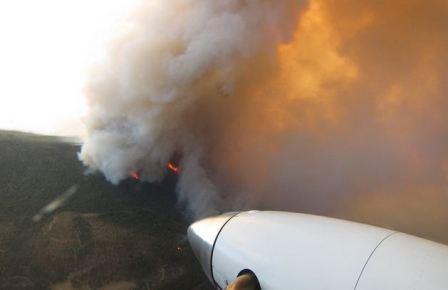
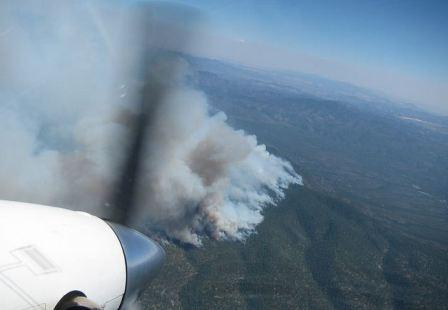
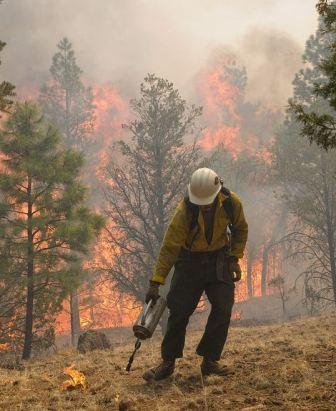
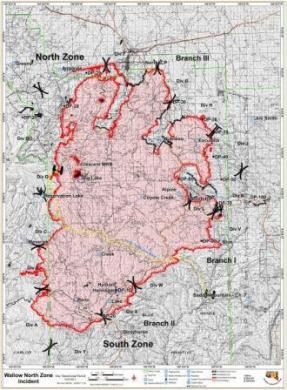
Firefighters are burning vegetation between Wallow fire and the fireline north of road 180 in the Luna Lake fire camp area. This burnout will strengthen and connect containment lines in zones 1 and 2.
As long as the current favorable weather conditions continue, the crews will ignite unburned fuels in the Luna Lake area and bring fire down toward road 180.
Protection plans are in place for Luna Lake firecamp. If needed, for personal safety related to smoke or fire suppression actions, personnel may temporarily leave the fire camp.
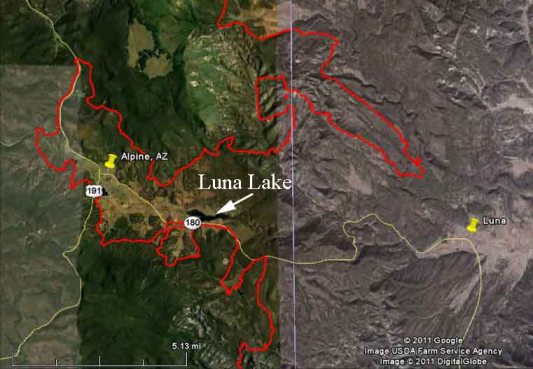
Below is a map we put together showing the location of Luna Lake, which is on the east side of the fire between Alpine, AZ and Luna, NM. The white line is the state line. The red line is the fire perimeter.
=======================
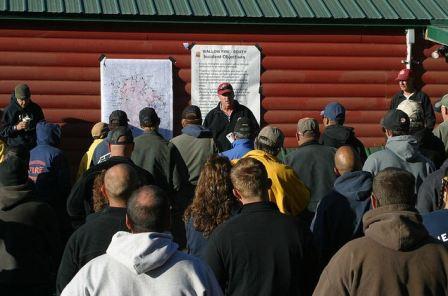
Wallow fire Briefing by Deputy Incident Commander Ed Lewis at Hannagan spike camp 6-13-2011. Photo credit, U. S. Forest Service
The Wallow fire in eastern Arizona and western New Mexico has grown to become the largest in Arizona history, burning 469,407 acres to eclipse the 2002 Rodeo-Chediski fire which burned 468,638 acres. Area Command reported at 7:00 a.m. Tuesday via Twitter that containment has reached 18% and: “Will see continued line construction & line improvement today. Expect containment to increase.”
The only areas of the fire that spread significantly on Monday were on the east side between Alpine, AZ and Luna, NM and on the south side above the Blue River.
Firefighters have been conducting a burnout or backfire northwest of Luna but that is not yet complete. They may be waiting for optimum conditions to finish it and tie it in to highway 180.
On the south side, in very remote and rugged terrain, they have been working on 9-10 miles of indirect fireline near the Blue River. When weather conditions are suitable they will burn out the area between the main fire and the constructed line.
Below is a 3-D map of the south and southeast sides of the Wallow fire. Click on it to see a larger version. Continue reading
The Apache-Sitgreaves National Forest Twitter account just sent out a link to an official Wallow fire update that reduces the acreage from this morning’s 452,155 to 448,620. But now that tweet and the latter document have apparently been deleted. InciWeb still says 454,155 acres. (Update: the June 13, 6:00 p.m. document was deleted and later restored with a modified acreage of 454,155.)
===========================
Update at 11:50 a.m. MT, June 13, 2011:
Today’s 8:00 a.m. update from the incident management team was released at about 10:20 a.m on InciWeb.
===========================
Wallow fire, east fork of the Little River, June 8, 2011. Photo by Jayson Coil. Credit: USFS, Apache-Sitgreaves National Forest
Firefighters on the Wallow fire in eastern Arizona and western New Mexico continued making progress on the fire Sunday. The fire grew by 9,000 acres but the containment percentage also grew, from 6% to 10%. There is conflicting information on the fire’s InciWeb site and there has been no official email update from the incident management team since Saturday morning. However, the Twitter account of the Area Command Team that is supervising four incident management teams (Reinarz, Pendleton, Hughes and Ponci) Tweeted at 9:03 a.m. Monday: “Wallow fire at 452,155 acres with 10% containment”. But at least the wildland fire agencies seem to have InciWeb working again this morning, which is an improvement over the frequent outages over the last few days. The national Situation Report has also been intermittent recently, but is working today.
Sunday night at 11:16 p.m. the backfire or burnout in New Mexico on the east side of the fire was in about the same place as it was Saturday night, having progressed approximately six miles, most of it along Jenkin Creek Road and Forest Road 220, working southeast toward the community of Luna, NM. It was still within about two miles of Luna.
An operational period briefing on the Wallow fire, June 8. Photo by Jayson Coil. Credit US Forest Service, Apache-Sitgreaves National Forest.
A small portion of the main fire south of Highway 180 has crossed into New Mexico where the Blue River intersects the AZ/NM state line.
There was no major movement of the fire on the north, west, or south sides on Sunday. The fire continued to spread slowly on the south side and there were some areas on the east side south of Greer where the fire was very active.
Azcentral.com has a very cool interactive progression map of the Wallow fire. Unfortunately it is only current through June 10.
We did not hear anything about the DC-10 Very Large Air Tanker being used on the Wallow fire yesterday. There was an unconfirmed report on Facebook of it being requested to drop on a 1,600-acre fire in New Mexico near Raton Pass.
Below is a 3-D map of the east side of the Wallow fire. Click on it to see a larger version. Continue reading
Air Tanker 911, a DC-10, drops retardant on the Wallow fire to reinforce the fireline above Greer, AZ, 6-11-2011. Photo by Jayson Coil. Credit: US Forest Service, Apache-Sitgreaves National Forest.
Air Tanker 911, a DC-10 that can carry up to 11,000 gallons of retardant, made two sorties Saturday to the Wallow fire in eastern Arizona.
Air Tanker 911, a DC-10, drops retardant on the Wallow fire to reinforce the fireline above Greer, AZ, 6-11-2011. Photo by Jayson Coil. Credit: US Forest Service, Apache-Sitgreaves National Forest.
And as a bonus, since you scrolled down this far, below are two more photos (non-DC-10) taken by Jason Coil on June 8, 2011. Credit: US Forest Service, Apache-Sitgreaves National Forest.
Apache County Sheriffs Office Lifts Evacuation of Springerville, Eagar and South Fork
On Sunday June 12 at 10 am, the Apache County Sheriffs Office, after consulting with fire officials, has lifted the evacuation for the residents of the Springerville, Eagar and South Fork areas.
It has been determined that fire conditions have diminished enough that they will no longer be a threat to the citizens of the towns.
It should be noted, however, that the smoke still poses serious health hazards as has been outlined by Chris Sexton, Apache County Health Director, and the smoke problems may continue for weeks.
Because of the health problems associated with the smoke from the Wallow Fire, Apache County Public Health Services District and the Emergency Operations Center warns residents of Eagar, Springerville and South Fork that it would be best not to return to their homes until the concentration of smoke diminishes.
Alpine and Nutrioso are still under evacuation orders.
=========================================== Update at 11:33 a.m. MT, June 12, 2011:
The Wallow fire incident management team at 10:51 a.m. released their “8:00 a.m.” update. The size of the fire increased by about 13,000 acres to 443,989 acres, and it is still reported to be 6% contained.
Total personnel: 4,311, including 24 hot shot crews and 84 other hand crews
Residences destroyed: 29 and 5 damaged (4 commercial structures destroyed)
Resources include: 15 Helicopters, 5 Air Tankers available; 334 Engines; 66 Water Tenders; 27 Dozers
Here is an excerpt from their update, which for some crazy reason was sent out as a GoogleDoc, rather than a format that could be more easily utilized:
The fire is 6% contained. Last night firefighters finished burnout between Forest Road (FR) 275 and FR 220 northeast of Alpine; burnout completed near South Fork; and a 3-mile burnout operation was completed in the Turkey Creek drainage along FR 281 toward Blue Creek. Good progress continued along the southwest and west flanks of the fire.
Today:
Burnout operations will continue SE along FR 220 to tie in with State Hwy 180, northwest of Luna, NM. Burnout preparations will continue along FR 74 and Trail 33 through Malay Gap and along FR 116. Structure protection, burnout and mop-up operations to strengthen containment lines and patrol for spot fires will continue.
A Red Flag Warning has been issued for today from 11 am to 8 pm, SW winds 15 to 20 mph, gusts to 40 mph; relative humidity 5-10%.
Public Information:
The public may call the following numbers for area-specific fire information:
InciWeb is still down. The NPS, USFS, USFWS, BLM, and BIA need to make it a priority to fix the infrastructure supporting InciWeb, so that it can be robust enough to work even when fires are burning, which is the only purpose of the site.
================================================
A firefighter on the Diamond Mountain Hotshots uses a drip torch on the Wallow fire, June 8, 2011. Photo by Kari Greer for NIFC. Credit: U.S. Forest Service
On Saturday, firefighters on the Wallow fire, most of which is in eastern Arizona, continued their backfiring operation across the state line in New Mexico. As of Saturday night they had completed over six miles of firing, most of it along Jenkin Creek Road and Forest Road 220, working southeast toward the community of Luna, NM, population 246. As of Saturday night they had progressed to within about two miles of Luna.
The purpose of the backfiring is for the controlled fire they are setting to remove the vegetation, the fuel, ahead of the main fire which is actively spreading towards the fire they are igniting. If everything goes as planned, the two fires will burn together and that eight-mile section of the fire will be contained.
Unfortunately, InciWeb, which has been having problems for the last couple of days, is down again Sunday morning, and the Wallow fire incident management team has not sent out any updates since Saturday afternoon. At that time the size was 430,171 acres and it was 6% contained. A revised acreage will probably show that the fire has grown by 10,000 to 15,000 acres.
On Saturday, on the west side south of Greer, the fire burned intensely in some areas while it continued to move slowly on the south side. The north and northeast sides of the fire were not very active on Saturday.
There were 15 helicopters and six air tankers assigned or available on the fire yesterday. Tanker 911, the DC-10, made two sorties to the fire.
Below are two maps of the Wallow fire. The second one is a 3-D map that shows the area on the east side where the firefighters are conducting the backfire in New Mexico. The vertical white line is the AZ/NM border.
Here are two photos the Apache-Sitgreaves National Forest posted on their Flickr page. It said the photos are by Chris Francis, credit US Forest Service. They were both taken on June 11, 2011.
Show Low Fire Engine 311 stands by as the Wallow Fire burns near Hannagan Meadow.The Wallow Fire burns near the Meadow Lodge as firefighters protect the historic structures.
Wallow fire 6-8-2011; photo by Kari Greer for NIFC
Update at 10:00 p.m. MT, June 11, 2011
Another update from the fire this evening included some information that we had not seen from the incident management team, and that is the number of air tankers used on the fire. Today there were “5 air tankers available, plus a DC-10”. So, there were six air tankers available. The DC-10 made two sorties to the fire on Saturday, dropping on the west side south of Greer. Structural protection and fireline improvements are underway around Sunrise Resort. There is no change in the acreage, but the containment is back up to 6%, a 1% improvement since this morning.
Update at noon MT, June 11, 2011:
Ten minutes ago, at about 11:50 a.m., the incident management team released their “8:00 a.m.” update: the fire has burned 430,171 acres and it is 5% contained, down from 6% yesterday. Also:
Fire Update
The fire is 5% contained, with containment lines established on the fires northeast side. Improved weather conditions allowed for successful burnout operations along the 273 road near Greer, in Water Canyon south of Eager, and northeast of Alpine. Today’s activities include structure protection, continued burnout and mop operations to strengthening containment lines, and patrol for spot fires. Burnout operations will continue into New Mexico east of Luna along Highway 220.
Burnout operations may be limited due to Red Flag warning that has been issued for today from 1 PM to 8 PM for gusty south-southwest winds 15-25 mph, low relative humidity, and unstable air mass over the fire.
One hundred and seventeen law enforcement officers from multiple jurisdictions are working with the incident to ensure public and firefighter safety, as well as protection of property during evacuations.
Public Safety
According to the State of Arizona, air quality in the Springer-Eager area is currently considered extremely hazardous. Residents with respiratory problems in the path of smoke may want to consider relocating temporarily until smoke dissipates. Motorists should exercise caution due to reduced visibility.
The fire is the second largest in Arizona history, and is closing in on the 2002 Rodeo-Chediski fire which burned 468,638 acres.
===========================
Update at 11:19 a.m. MT, June 11, 2011:
We were interviewed over the phone yesterday by a reporter for CNN about the Wallow fire and what it’s like to be a wildland firefighter. Here is a link to the article at CNN.com.
============================
Map of the Wallow fire, showing heat (the red and yellow dots) detected by satellites over the last 24-hours with heat data current as of 11:40 p.m. MT, June 10. A mapped fire perimeter is shown (the red line) current as of 11:01 p.m. on 6-10-2011. MODIS/Google
While the main Wallow fire in eastern Arizona has not crossed into New Mexico, firefighters have started a backfiring operation in New Mexico in order to eventually control the spread of the fire. In the area where the backfiring operation on the east side of the fire began, the fire was about one and a half to two miles from the state line, but the backfire as of Friday night at 11 p.m. MT had progressed approximately one and a half miles into New Mexico. Scroll down to see a more detailed 3-D map showing the east side of the fire.
South of where the backfiring operation began on Friday, south of Highway 180, the fire has come close to the state line in two places, from one-half mile in one area to just a matter of feet in another.
The fire is almost completely surrounding the community of Alpine. Yesterday east of the town the fire burned intensely downhill, moving approximately one-half mile closer. There is only a narrow corridor southeast of the town along highway 180 that has not yet burned.
Some areas on the west side of the fire burned intensely on Friday, but it did not encroach any further into the community of Greer, where 22 houses burned on Wednesday.
The DC-10, Tanker 911, which was used on Friday near Greer, did not make any drops over the fire on Friday.
Yesterday we ranted a little about what we (and some others) have perceived to be a less than adequate performance by the Information function on the fire. Another example: this morning we called two different phone numbers listed as official sources of information on the fire and asked a question that could be easily answered by looking at a copy of the daily Incident Action Plan. Neither location had a copy of today’s IAP.
It’s probably a coincidence, but this morning the Area Command Team 3 Twitter account sent these messages:
Information Team support for ACDR this location 0900 today. Spinning up increase info significant
And then:
Setting up JIC. Contact info to follow.
And later:
Best local information on Wallow Fire Springerville, Greer, Alpine 928-333-3412. Luna, Reserve 575-5336928. S and W of fire 928-205-9884
“ACDR” is the Area Commander, the person in charge of the Area Command Team. “JIC” is Joint Information Center. From these messages, it appears that Area Command will more closely coordinate and supervise the Information function, a welcome improvement.
More information about the Wallow fire, including additional maps, are below.
On Thursday, Air Tanker 911, a DC-10 Very Large Air Tanker, made its first drops on the Wallow fire in Arizona, dropping retardant near the Community of Greer which was overrun by the fire Wednesday evening. The DC-10 can carry up to 11,000 gallons of fire retardant, almost four times the capacity of a conventional large air tanker.
AZfamily.com has a gallery of 20 excellent photos of the DC-10 in action. But I think few if any of the photos were taken in Arizona; I could be wrong.
It is good to see the DC-10 being used, but again, very large air tankers don’t put out fires. They slow them down, like other air tankers, if the wind and terrain conditions are favorable. Firefighters on the ground put fires out.
The Wallow fire in eastern Arizona has spread very close to the New Mexico border. The satellite data we just obtained (see map below) shows that in at least two areas it is one-half to one mile from the Arizona/New Mexico border, and it is spreading to the east and northeast. Well, actually, to be correct, it is spreading in all directions, being only 5% contained.
The thin vertical white line in the map below is the AZ/NM border.
(Click to enlarge) Map of the east side of the Wallow fire, showing heat (the red and yellow dots) detected by satellites over the 24-hour period ending at 2:15 p.m. p.m. MT, June 10. A mapped fire perimeter is shown (the red line) current as of 12:20 p.m. on 6-10-2011. MODIS/Google
The incident management team has distributed more information, this time correct they say, about the number of structures that have burned in the Wallow fire. Earlier today they sent out a correction, and now there is still another report from them with the following information.
“Residences: 29 destroyed and 5 damaged
Structures: 35 destroyed”
I am guessing that they think the word “structures” means “outbuildings”.
Information from the Type 1 Incident Management Teams running the fire, especially concerning structures, has been slow to be provided, inconsistent, confusing, and filled with errors. They can’t decide if they want to use InciWeb or Google Docs. Or if they do use InciWeb, it may be used in a non-standard fashion, for example showing zero acres burned in the “Size” field on the front page and forcing the viewer to search around or open secondary documents on the site to find that important piece of information.
I have been biting my tongue about this issue, thinking it would be resolved, but if anything it’s getting worse. There have been too many failings from the Information wing of these teams. Teams that are supposed to be the best of the best… the Type 1 Incident Management Teams. I am sure the firefighters are doing their usual great job of dealing with this extraordinary fire. The people in the shiny, clean, yellow shirts running the Information function need to get their sh*t together.
Update at 11:32 a.m. MT, June 10, 2011. The Incident Management Team reported at about 11 a.m. that the most current mapping from an infrared flight last night determined that the fire has burned 408,887 acres. They are still calling it 5% contained, and:
Last night’s operational period included burnout operations, structure protection, patrolling for spot fires, and mop up in the Alpine area. The predicted weather today is expected to allow firefighters to continue burnout operations. Today’s operational period also includes, building fireline using handcrews & dozers around Springerville and Eager, structure protection, patrolling for spot fires and mop up. The DC-10 air tanker was used during yesterday’s operations in the area of Greer.
========================
Wallow fire briefing map 6-9-2011
To see a much higher-resolution version of the Wallow fire map above, click here.
A summary of the fire status as of Friday morning, from the incident management team:
This fire (cause under investigation) started 5/29, originated southwest of Alpine, AZ (33 36 7N 109 26 56W). It is being managed under a full suppression (perimeter control) strategy in Fuel Model 8 (Closed timber litter) by an Area Command Team (Loach, IC) with one Type 1 IMT (Reinarz) and one Type 2 IMT (Philbin, IC). Two Type 1 IMT’s moved into management positions this morning at 0600. The fire will be separated into three zones (North, East, and West). Type 2 IMT (Philbin) will transfer out today. As of 6/09 2100, the fire is 5% contained at 386,453 acres (272,490 ac North and 113,963 ac South) with no expected containment date reported.
NORTH: Three-thousand nine-hundred structures reported threatened, one reported damaged (outbuilding), and sixty-three destroyed (29 residence and 34 outbuildings). Difficulty of terrain is high and growth potential is high. Extreme fire behavior with frequent spotting. Rapid rates of spread in all fuel types. Powerlines in the area are threatened. Plan is to focus on securing west perimeter south of Greer and from Escudilla south to Luna, NM, through line construction and burnout. Some resourses will be reassigned to additional zones with incoming IMT’s. Sixteen Type 1 crews, 35 Type 2 crews, 14 helicopters, 192 engines, 15 dozers, 56 water tenders, and other local resources assigned.
SOUTH: One-hundred eighteen structures reported threatened, none reported damaged, and four destroyed (commercial). Difficulty of terrain is high and growth potential is medium. Creeping, smoldering, and active backing fire with short flanking upslope runs. Significant heat generated in canyons on west side of fire. Some spotting continues. Three Type 1 crews, 10 Type 2 crews, 29 engines, 2 dozers, 10 water tenders, and other local resources assigned.
The DC-10 Very Large Air Tanker, Tanker 911, dropped one load of retardant on the Wallow fire on Thursday in support of fire suppression operations near Greer.
A Multi-Agency Coordinating Group (MAC Group) makes decisions about how to prioritize fire suppression resources when multiple fires may be competing for the same resources. Here is an excerpt from the report on the decisions made on Thursday by the Southwest Area MAC Group.
Below, are more maps, including a map showing the location of the three large fires in the state of Arizona and a map showing heat detected by satellites on the Wallow fire early Friday morning.