A southwest Colorado man must pay $200,000 to state and federal agencies after a judge said he was guilty of starting a wildfire in October 2012.
Roger Stratton, 55, of Dolores, Colorado was sentenced last week in connection with the Roatcap Hill Fire, which triggered evacuations almost two years ago, according to The Cortez Journal.
Montezuma County District Judge Todd Plewe took “less than three minutes” to issue the fine, the bulk of which will go to the U.S. Forest Service and the state of Colorado, the newspaper reported.
Stratton pled guilty in the fall to starting the Roatcap Hill Fire, which burned around 400 acres on Oct. 24, 2012. The fire prompted the evacuation of 30 to 40 homes in the area, leading to a disaster declaration from Gov. John Hickenlooper, according to the Colorado Office of Emergency Management.
California fire crews this week battled a series of wildfires, which burned homes in San Diego County and threatened vineyards in the Napa Valley wine country. As of Thursday, 80 percent of the state was considered to be in “exceptional” or “extreme” drought, according to the U.S. Drought Monitor.
The entire state has been in a “severe” drought since April, the first time that has happened in 15 years, The Los Angeles Times reported.
The Monticello Fire was first reported at 9:33 p.m. PDT July 4. The fire started on the southeast shore of Lake Berryessa, northwest of the Napa Valley area. The fire grew from 1,600 acres on Saturday morning to 5,000 acres by the afternoon; it was 15 percent contained as of 4:45 p.m. PDT. One neighborhood and one campground were evacuated. Two-hundred firefighters, one helicopter and four airtankers were assigned to fight the blaze.
As of Saturday morning, all evacuation orders for the Butts Fire have been lifted, according to CALFire. Also called the Pope Valley fire, the blaze started on July 1 on the northwest side of Lake Berryessa and destroyed two homes and seven outbuildings. At 4,300 acres, the fire was 70 percent contained as of 7:45 a.m. PDT July 5. Read more of our coverage of the Butts Fire.
The Banner Fire in San Diego County was declared 90 percent contained as of 7:45 a.m. PDT Saturday. The fire started on July 3 and went on to burn only 217 acres, but destroyed two homes and one outbuilding.
A small grass fire broke out near Sacramento on July 4, prompting the rapid evacuation of people from a water park at the Cal Expo fairgrounds. The fire ignited around 2 p.m. PDT and was extinguished more than two hours later, after it sent a massive smoke plume over Sacramento. Nonetheless, Fourth of July festivities were not to be deterred–officials decided to go ahead with the city’s fireworks’ display at the fairgrounds while smoke still lingered in the air, The Sacramento Bee reported.
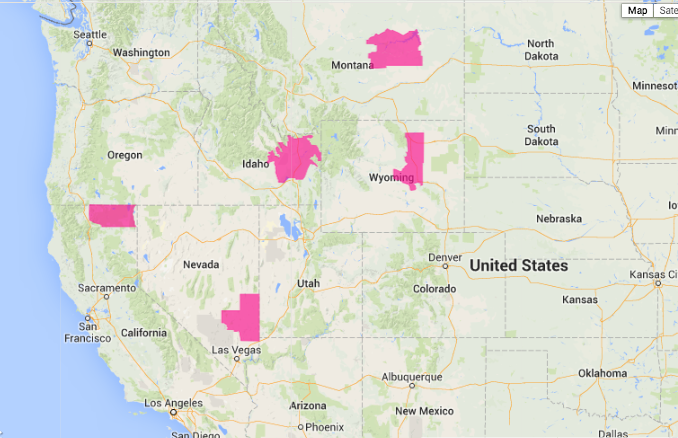
Warnings for elevated wildfire danger were issued Saturday by the National Weather Service for areas in California, Nevada, Idaho and Wyoming.
The Red Flag Warning map was current as of 10:30 a.m. MDT on Saturday. Red Flag Warnings can change throughout the day as the National Weather Service offices around the country update and revise their forecasts. For the most current data, visit this NWS site.
Firefighters help trapped residents evacuate by National Guard helicopter. Photo by Justin Cowger.
Incident management teams that usually respond to wildfires found themselves in a position to help thousands of Colorado residents earlier this month when unprecedented amounts of rain caused massive flooding and damage to infrastructure
Today we have a guest author, someone who worked with one of the two incident management teams during their assignment September 13 through 24. Rae Brooks was an information officer with Shane Del Grosso’s team. Her background is in journalism.
****
By Rae Brooks
They came not to fight a fire, but to perform a rescue mission.
On September 13, Shane Del Grosso’s Rocky Mountain Incident Management Team was deployed to Colorado to help manage the response to the flooding in Larimer County, north of Denver. A second Rocky Mountain Type 2 team, headed by Dan Dallas, managed the rescue response in Boulder County.
When Del Grosso’s team arrived in Fort Collins, hundreds of people remained trapped in mountain towns, cut off by roads that were likely to remain impassable for months. Thousands of homes were without power. Although the tally was not yet in, the county would eventually announce that 45 miles of roads and 65 bridges were either damaged or destroyed.
The flood cut away a section of Highway 36 between Pinewood Springs and Estes Park. Photo by Justin Cowger
The flooded area in Larimer County delegated to the team covered 768 square miles, close to double the size of California’s Rim Fire, the largest in the nation this year. About 1,500 homes had been destroyed in the county, almost three times as many as the Black Forest Fire burned in June, the most destructive wildfire in Colorado history.
Wildland firefighters had to immediately get their minds around a simple fact: You can’t put out a flood. Their job on this mission would be to rescue traumatized people, aiding them however they could.
For most of the team, the flood was their first experience on a non-fire event. Although water-soaked terrain might seem a foreign environment for wildland firefighters, the work required — helicopter rescues in the mountains — was actually right up their alley. Continue reading
Smith Ranch Fire as seen from the Jiggs Highway (SR 228) shortly after igniting from a lightning strike July 19, 2013. InciWeb photo.
A female inmate crew from a Conservation Camp in Las Vegas prepared meals for the firefighters working on the Smith Ranch Fire 10 miles north of Jiggs, Nevada. Rae Brooks, an Information Officer at the fire, wrote the article and took the photos below. In case you’re wondering, it is against the rules to take photos of the inmates’ faces.
****
Female inmate kitchen crew prepares New York steaks for firefighters’ dinner
“ELKO, Nev. — The task: prepare a hot breakfast, hearty bag lunches and a three-course dinner for 250 firefighters in a cow pasture with no running water. The pay: a dollar an hour — and a day knocked off their sentences for every eight hours worked.
A kitchen crew of 14 female inmates from the Jean Conservation Camp in Las Vegas have been providing meals for firefighters this week on the Smith Ranch Fire, about 25 miles southeast of Elko.
Ranging in age from 21 to 48, the women are all minimum-security prisoners who are being rewarded with the privilege of working outside the conservation camp fence after making it through a rigorous screening process, passing a physical-fitness test and undergoing a comprehensive training program.
Another reward: What one crew member called “big old smiles” from the firefighters working on the 2,777-acre blaze. After a long hot day building line — and a few days subsisting on Meals-Ready-to-Eat — the firefighters are not hesitant to let the kitchen crew know how much they appreciate tucking into a real meal.
“A lot of us never had that appreciation before,” said the crew member. “So to have it is great.”
The meal on tap this particular evening: 8-oz. New York steaks, black bean chili, cheesy mashed potatoes and three different types of salad, followed by freshly baked apple pie.
Eighteen apple pies baked in a transportable oven for firefighters’ dinner at Smith Ranch Fire
The Nevada Division of Forestry and the Nevada Department of Corrections jointly run nine minimum-security conservation camps throughout the state where inmates serve sentences, while doing project work and serving on emergency-response crews for wildland fire suppression, flood control, search and rescue, and ice and snow removal.
Although much of the work the inmate crews perform is unpaid, they generate about $1.4 million annually for the state’s general fund.
Only the Jean location houses female inmates. During the past two years, Jean crews have worked more than 12,000 hours on 28 emergency incidents.
When they arrive at a fire, the crew can have their kitchen up and running within an hour. Their normal workday begins at 3 a.m., and except for a few hours’ rest in the mid-day heat, ends an hour short of midnight.
Outdoor dining tables await firefighters at Smith Ranch Fire
Wearing hairnets and disposable gloves, the women prepare and cook meals on a portable outdoor two-sided range, then serve the food in a cafeteria-style line. After each meal, they do clean up. They are also responsible each day for making sandwiches and stuffing multiple lunch items into a legion of paper sacks.
At night, they bed down in tents, watched over by a female correctional officer. She takes roll call, escorts them on any night-time Porta Potty visits, counts them hourly throughout the night, and wakes them up when it’s time to go back to work.
Working on the kitchen crew teaches the women a trade, which they can use to earn a living after their release. Many of the younger women had never learned to cook.
The kitchen crews are “a good local resource” for fires that aren’t big enough to warrant a national caterer, said Jean camp supervisor Jon Shogren. The state also has two male inmate kitchen crews.
Crew boss Bruce Travis said the inmates really appreciate the opportunity to work on the crews, and the experience can bring out the best in them.
“If you get people out of that negative environment, you can see there’s more to them,” said Travis.
Another inmate said she was grateful for all the skills she has learned, including food preparation, cooking, food safety, cleanliness and presentation. Being outdoors was also a bonus.
‘Especially at night-time when it’s dark, and you see all the stars,” she said. “It’s just all-round rewarding.’ ”
Jean Conservation Camp supervisor Jon Shogren removes apple pies from transportable ovens at Smith Ranch Fire.
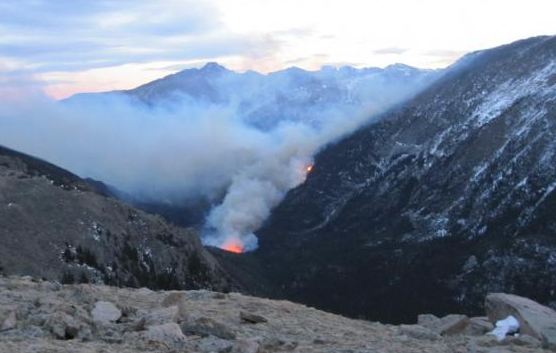
Tanker 48 dropping on the Fern Lake Fire in Colorado, Dec. 4, 2012. Photo by Paul Filmer
The Fern Lake Fire created problems for firefighters in Colorado’s Rocky Mountain National Park from the minute it started on October 9, 2012. At first it was the steep, inaccessible terrain, but very soon the 9,000-foot altitude and especially the low temperatures became another foe to deal with as the fire kept burning into November and December. The order for the Type 1 incident management team that was placed December 1 has to be one of the latest orders for a Type 1 team ever put into the system, although there have been some December orders a few times in southern California during Santa Ana wind conditions.
Today a guest author who was there will tell us what it was like at that winter fire in Colorado. Rae Brooks worked as a public information officer with the Type 1 team in December at the Fern Lake Fire. Her background is in journalism.
****
ESTES PARK, Colo. — Sweltering heat and long summer days are the usual operating theater for wildland firefighters. At the Fern Lake Fire in northern Colorado, firefighters entered a new world of winter firefighting, where pumps freeze, dip lakes ice over, darkness descends early, and fire prediction models say nothing should be burning at that time of year anyway.
Most firefighters had long ago packed away their gear and turned their attention to skiing or Christmas shopping, when the call came in early December for hundreds to come to Estes Park to help battle a persistent blaze in Rocky Mountain National Park.
“This is definitely a first for me, much less at 9,000 feet,” said veteran firefighter Kevin La Bella of Palmer Lake, Colo., a safety officer on the fire. “I’ve lived on the Front Range for 30 years and I’ve never heard of a major fire here in December.”
Early in the Fern Lake fire, Forest Canyon blow up. NPS Photo
The New York Times called the nearly 3,500-acre blaze “perhaps the most unusual sign of the nagging drought” currently plaguing the United States. The Fern Lake Fire, The Times reported, is burning “on peaks that should be covered in snow right now.”
Although winter fires remain atypical, it is clear that fire seasons in the United States are beginning earlier, ending later and burning more acres annually. Six of the most destructive fire seasons have occurred in the past nine years. More than 9.3 million acres burned in 2012, the third highest since record-keeping began more than half a century ago.
The disconnect for many firefighters began while driving to Estes Park, listening to Christmas carols on the radio. Strains of “White Christmas” and other holiday standards also wafted around the incident command post, which, in order to escape the cold, was located in a hotel convention center. More typically, schoolyards, agricultural fairgrounds, or yurts hastily assembled in cow pastures serve as fire headquarters.
After 70 mile-per-hour winds caused the fire to double in size on Dec. 1, forcing the evacuation of more than 600 homes, a national Type 1 incident management team was deployed to handle the fire. Type 1 teams manage the nation’s most complex emergencies. Continue reading
In a case that Wildfire Today has been following since November 17, 2008, David Monington pleaded guilty last week in a Rapid City, SD federal court to mail fraud for sending wildfire training certificates through the mail with forged signatures of fire training instructors.
The original indictment for Mr. Monington alleged he forged about 20 signatures of South Dakota firefighting officials in an attempt to gain certification from the National Wildfire Suppression Association. The documents included training certificates, position task books, and a performance rating. The documents fraudulently attest to his training and experience as a firefighter.
Mr. Monington was trying to become qualified as Air Tactical Group Supervisor, Strike Team Leader, and Helibase Manager.
“A number of the printed names and signatures of certifying officials were misspelled, while others were followed by incorrect listings of the certifying officials’ titles,” the indictment stated.
The charge to which he pleaded guilty carries a maximum penalty of 20 years in prison, but the plea deal specifies that the prosecutors will recommend five years of probation and $5,000 restitution when Mr. Monington is sentenced on February 1, 2010.
It is stunning to think about what could have happened if this douche bag had actually become qualified for the positions of Air Tactical Group Supervisor, Strike Team Leader, and Helibase Manager. They are all positions that require a great deal of experience, skill, and knowledge. They supervise others and manage very technical, specialized fire suppression equipment.
Bad performance or decisions in these positions could put numerous firefighters at risk. The thought of a fraud or imposter directing air tankers, helicopters, and a strike team of engines or hand crews is scary as hell.
I think he should receive some prison time in addition to the plea deal’s probation and $5,000 restitution.
I am very glad that someone caught these forgeries before this asshole got someone killed.
Here is an excerpt from the Semiannual Report to Congress by the U.S. Department of the Interior Office of Inspector General in April, 2009. It has a summary of the case at that time:
Contractor Indicted for Fraud in Connection With Bogus Training Certificates
The OIG initiated a joint investigation in December 2007 with the BLM Office of Law Enforcement and Security regarding fraud allegedly committed by private fire contractor David A. Monington, operating as Midwest Fire Suppression, in Miles City, Montana. Investigators suspected Monington had submitted false documents to BLM fire contractors in connection with his fire suppression training and employment qualifications.
Our investigation revealed 10 forged certificates of training, 9 forged fire position task books, and 1 forged employee performance rating issued in the name of David Monington. Monington used these documents to obtain fire suppression-related employment in supervisory positions for which he was unqualified (e.g., air tactical group supervisor, strike team leader, and helibase manager). If he had been successful, he could have created an unsafe and increasingly hazardous work environment for fellow fire fighters. Several South Dakota and Wyoming state employees, as well as one former U.S. Forest Service employee, stated that their purported signatures recorded on certificates of training and position task books issued in Monington’s name were forgeries.
When interviewed, Monington admitted that 15 of these false documents contained forged signatures, although he denied that he was responsible for the forgeries. Monington asserted that he first learned of the forged documents in December 2006 while employed with the Miles City Fire Department. However, he continued to issue these documents to prospective employers through calendar year 2007. The investigation also revealed that Monington submitted these false documents to the National Wildfire Suppression Association in May 2006 to obtain instructor status, a position he was unqualified to hold and one that he maintained until December 31, 2006.
On November 19, 2008, our findings were presented to the Federal Grand Jury convened in Rapid City, South Dakota. The Grand Jury charged Monington with two counts of mail fraud and one count of wire fraud. He was arrested without incident at his residence on November 24, 2008, and transported to the U. S. District Courthouse in Billings, where he appeared before a U. S. Magistrate and, after processing, was released from federal custody.
The Orange County Fire Authority, in the news recently because of their reality show The Academy: Orange County Fire about training new firefighters in southern California, is making more news for eliminating their hand crew. After having had a crew for 30 years, the department is facing some monetary shortfalls and has already reduced their proposed 2009-2010 budget by $24 million, which is about 10 percent.
They had planned to upgrade their part-time crew which last year cost the OCFA $373,151 to a full-time crew next year, at a cost of $1.7 million, so they could get what OCFA calls “round-the-clock-staffing”. A 24-hour hand crew is an unusual staffing pattern, to say the least.
In spite of the budget problems, they recently bought $24 million worth of specially-equipped helicopters so they could begin fighting fire with them at night, but disputes internally and with their union have kept them grounded after sunset. And oddly, $24 million is identical to the amount they are having to cut from the 2009-2010 budget.
Here is an excerpt from an article in the Orange County Register.
OCFA spent nearly $35,000 to recruit and test potential full-time hand-crew members this year. Job offers were ready to go out in May when the OCFA decided to freeze the positions – part of a department hiring freeze. Qualified candidates remain on a hiring list.
It was an OCFA hand crew’s scraping and cutting away of brush that kept the Freeway Complex fire from racing into Anaheim Hills and Orange Park Acres after it jumped the 91 and ran up the hillsides, said Joe Kerr, president of the Orange County Professional Firefighters.
The fire service world is a world of specific roles. The engineer drives the engine. The paramedic treats patients. The dispatcher answers emergency calls and sends help. The hand crew has its role: cutting fire lines around the fire. It is a complicated unit, dependent on teamwork and experience to be effective. It is a young man’s job, made up of hours of hard labor.
To make do, OCFA is taking paramedics and engineers out of their engines, handing them shovels and rakes, and teaching them how to be a hand crew. Instead of treating car accident victims and heart attacks, engine crews are cutting brush and picking up used hoses.
Firefighters can do the job of clearing brush, but they are hardly the experts, union and management officials agree, and in many cases are not qualified to safely handle some of the equipment.
“I just don’t think it’s the best use of our resources,” Cruz said. But management decided not to staff a hand crew, and the agency is trying to make it work.
“It’s not a tool we use every day,” Kerr said. “Hand crews are specifically dedicated to the mission of brush clearance. And that is just as important as the mission of our firefighters.”
Some engines carry chainsaws, but many of OCFA’s 800-person firefighting force are not certified to use them. Just 45 out of roughly 800 OCFA firefighters are qualified to use chainsaws to cut down burning trees, with 20 more waiting to be certified.
Additional wildland chainsaw training has been offered to firefighters, but is not required, Battalion Chief Kris Concepcion said.
In July, that fact forced OCFA firefighters to wait for two Los Angeles County hand crews to cut down burning eucalyptus trees at a Lake Forest fire. Plans are in the works next year to train an additional 100 firefighters to cut down trees, Cruz said.
Pulling engines from their stations to transform them into makeshift hand crews sets off a complex chain reaction, forcing other engines to cover larger areas. That means potentially longer response times and longer periods of times engines and trucks are unavailable for the next call.
The Communications Family Credit Union in Michigan felt they needed a name change after three decades because they wanted to appeal to a younger demographic and because some people were confused about who was eligible to become a customer. So they hired the Weber Marketing Group in Seattle to suggest prospective names. The company provided a list of 40 possibilities from which the credit union selected “Wildfire Credit Union”.
I went to their web site, halfway expecting to see a logo, photo, or at least colors derived from a wildfire, but no… just photos of a suburban setting and autumn colors on hardwood trees. Very boring, to tell you the truth.
I wonder if the average banking customer, when seeing “Wildfire” in the name, thinks of flames, destruction, blackened landscapes, burned structures, and smoke columns, or do they picture a reputable banking institution?
So, would you be more or less likely to become a customer of a credit union called “Wildfire”?
Fires caused by railroads are much more numerous than people think. Most railroad fires are caused by improperly maintained turbo chargers on the engines. If not maintained, large pieces of red-hot carbon can be blown out of the turbo chargers, starting fires. A smaller percentage of railroad-caused fires originate from brakes that lock up, become super-heated, disintegrate and shower the area with hot metal. I once responded to a series of 11 fires over several miles that started from hot brakes.A cause and origin fire investigator, looking for what started a fire near railroad tracks, can usually find many pieces of carbon along the tracks. To definitively say that a single piece started a particular fire can be difficult to prove beyond a reasonable doubt.In some parts of the country, including northwest Indiana, railroads have gotten a free ride. They save money by reducing the maintenance on their turbo chargers, start fires, then many times get away with it.
Fires caused by railroads are much more numerous than people think. Most railroad fires are caused by improperly maintained turbo chargers on the engines. If not maintained, large pieces of red-hot carbon can be blown out of the turbo chargers, starting fires. A smaller percentage of railroad-caused fires originate from brakes that lock up, become super-heated, disintegrate and shower the area with hot metal. I once responded to a series of 11 fires over several miles that started from hot brakes.
A cause and origin fire investigator, looking for what started a fire near railroad tracks, can usually find many pieces of carbon along the tracks. To definitively say that a single piece started a particular fire can be difficult to prove beyond a reasonable doubt.
In some parts of the country, including northwest Indiana, railroads have gotten a free ride. They save money by reducing the maintenance on their turbo chargers, start fires, then many times get away with it.
Yesterday a Seattle television station, KONG, or KING5.com, aired the first portion of a two-part series about wildfires that are caused by railroads. They found that over the last decade 234 fires in the state were attributed to railroads. Houses burned and one person was killed, but no citations or criminal charges were issued. Here is a 5-minute video from that report.
(VIDEO NO LONGER AVAILABLE)
One of the troubling parts of the video is when Joe Shramek, the Resource Protection Manager for the Washington Department of Natural Resources says they can’t take action against a railroad for starting a fire unless they can prove that:
…the railroad acted deliberately, intentionally, and recklessly.
That is a ridiculously high standard. In most states and on federal land, a deliberately-set fire is one thing, arson, and a fire that is unintentional but results from negligence is treated as a separate violation of the law. If the State of Washington can’t prosecute someone for negligently allowing a fire to start and/or burn public or private land, they need to amend their law.
The State of Washington is negligent for sitting on their hands while they watch the railroads start fires and in some cases kill people and burn houses.
Here is a second video from KONG that provides more details about why they conducted their investigation.




 They had planned to upgrade their part-time crew which last year cost the OCFA $373,151 to a full-time crew next year, at a cost of $1.7 million, so they could get what OCFA calls “round-the-clock-staffing”. A 24-hour hand crew is an unusual staffing pattern, to say the least.