Legal frameworks for firefighters

The laws to protect firefighters are designed to provide a degree of comfort and certainty to those who are out there doing their job in an uncomfortable and uncertain environment. And there is no shortage of law firms circling for new work to ensure firefighters get the support they need. Jackson Ruby, a freelance writer for a Los Angeles law firm, provides an overview of the legal frameworks that protect firefighters in legal actions.

Firefighters protect lives, property, and the environment from fire, medical emergencies, and disasters. Given their work’s high-risk and fast-paced nature, firefighters often make split-second decisions under extreme conditions. To enable them to perform their duties effectively without undue fear of legal repercussions, various legal frameworks have been established to protect them from lawsuits arising from their actions during an emergency response.

Sovereign Immunity and Qualified Immunity
One of the most significant legal doctrines protecting firefighters is sovereign immunity, which protects government entities and their employees from certain types of lawsuits. Sovereign immunity often extends to firefighters who work for municipal or state governments, protecting them from liability for acts performed within the scope of their employment.
In addition, firefighters in the United States may be protected by qualified immunity, which shields government employees from personal liability unless their actions violate “clearly established” statutory or constitutional rights. Qualified immunity ensures that firefighters are not deterred from performing their duties due to fear of litigation, as long as they act in good faith and within the boundaries of the law.

Good Samaritan Laws
Good Samaritan laws provide immunity from lawsuits to individuals, including firefighters, who render emergency aid in good faith and without gross negligence. For example, if a firefighter administers CPR or uses a defibrillator on an unresponsive person, they are typically protected from legal claims even if the outcome is unfavorable. These laws encourage quick action in emergencies by reducing the risk of legal consequences for well-intentioned efforts.

Statutory Protections
Many states have enacted specific statutes that protect firefighters from lawsuits arising from their official duties. These statutes often provide immunity for discretionary acts performed in the line of duty. For instance, decisions about how to suppress a fire, prioritize rescues, or deploy resources are generally considered discretionary and thus protected. However, as mentioned by California wildfire attorneys, these protections usually do not extend to acts of gross negligence, willful misconduct, or actions outside the scope of employment.

Workers’ Compensation Laws
Firefighters who are injured or killed in the line of duty are typically covered under workers’ compensation laws. These laws ensure that injured firefighters or their families receive medical benefits and compensation without the need to prove fault. Workers’ compensation also serves as the exclusive remedy for workplace injuries, preventing lawsuits against employers or coworkers for workplace-related incidents.

Federal Law Protections
Federal laws also play a role in shielding firefighters from legal repercussions. For example, the Volunteer Protection Act (VPA) provides immunity to volunteers, including volunteer firefighters, from liability for harm caused by their actions while performing duties for a nonprofit organization or government entity. The VPA encourages community service by reducing legal risks for volunteers.
Additionally, the Federal Tort Claims Act (FTCA) allows lawsuits against federal employees under certain conditions but provides immunity for discretionary acts performed within the scope of employment. This framework can apply to federal firefighters working for agencies such as the U.S. Forest Service.

Collective Bargaining Agreements and Union Protections
Many firefighters are represented by unions that negotiate collective bargaining agreements (CBAs) on their behalf. These agreements often include provisions related to legal representation, indemnification, and procedural protections in cases of lawsuits or disciplinary actions. For example, a firefighter accused of negligence may receive legal defense funded by their employer or union, as stipulated in the CBA.

Limits and Accountability
While legal frameworks provide robust protections for firefighters, they are not absolute. Protections generally do not cover acts of gross negligence, intentional harm, or criminal misconduct. For instance, a firefighter who intentionally sets a fire or acts recklessly, endangering lives, can face legal and criminal consequences. This balance ensures that accountability is maintained while enabling firefighters to perform their duties without undue hesitation.
The legal frameworks protecting firefighters recognize the unique challenges and risks associated with their work. By providing immunity from lawsuits, these laws enable firefighters to act decisively and effectively in emergencies, knowing they are protected from undue legal repercussions. At the same time, these frameworks uphold accountability by excluding acts of gross negligence or intentional wrongdoing from protection. This balance is essential for maintaining public trust and ensuring that firefighters can focus on their critical mission of safeguarding lives and property.


Moving resources to where they are most needed

Tanker 101 dropping Alisal Fire

The “Wildfire Matters” podcast is produced by the Bureau of Land Management out of Boise, Idaho. Here is an episode from a couple of years back but as reminded by the National Interagency Fire Center, it has retained its relevance in light of the current discussions on aircraft use in the southern California fires.

In this podcast, Sean Peterson, Assistant Center Manager of the National Interagency Coordination Center, or NICC, talks about his career in wildland fire management from firefighter to his current position at the National Interagency Fire Center. He discusses day to day NICC operations – explaining the dispatch system and the role of the air space coordination unit, predicative services, and the intelligence section. Sean talks about working with the National Multi-Agency Coordinating Group, or NMAC, on setting national wildfire resources priorities, preparedness levels, and the importance of working with interagency, state, international, and military partners to support not only wildfires nationally but also assisting FEMA during all-hazard/all-risk incidents.

Listen to the podcast here.

Firefighters from around the US support Southern California

Coulson CH-47 helicopter

When the fires started burning in Los Angeles this month, firefighters from around the country streamed into California to help, including Kelly Martin.

Kelly has been fighting wildfires and advocating for the health of firefighters for years. She co-founded the advocacy group Grassroots Wildland Firefighters, was Chief of Fire and Aviation at Yosemite National Park, has chaired two National Wildfire Coordinating Group programs and has just completed a six-year term as a Board Member of the International Association of Wildland Fire with her final two years as President.

Kelly spoke to Boise State Public Radio – Idaho Matters from the fireground in Los Angeles this week.

She has spent many years fighting fires in California but, she admits, she has never seen anything like this. “It is really beyond anything that I have seen in my career…it looks almost apocalyptic is some areas, I think that is a fair assessment.”


Recognition for leading by example

The National Wildfire Coordinating Group (NWCG) Leadership Committee has announced the recipients of the Paul Gleason “Lead By Example” award.
The award was created by the NWCG to remember Paul Gleason’s contributions to the wildland fire service and as a pioneer in wildfire safety. The intent of this award is to recognize individuals or groups who exhibit this same spirit and who exemplify the wildland fire leadership values and principles.
This year’s recipients are:
• Sam Bowen, Mark Twain Veteran Crew Superintendent, U.S. Forest
Service (Initiative & Innovation)
• Greg Titus, St. Marks National Wildlife Refuge Zone Fire Management
Officer, U.S. Fish and Wildlife Service (Mentoring & Teamwork)
• Renae Crippen, Blue Mountain Interagency Dispatch Center Manager,
U.S. Forest Service (Motivation & Vision)
• Eric Carlson, OMNA International Instructor (Lifetime Achievement)

Congratulations to all!

The National Wildfire Coordinating Group was established in 1976 to provide national leadership in the US to enable interoperable wildland fire operations among federal, state, local, Tribal, and territorial partners.

For more information about the winners and more about the NWCG go to:
Lead by Example Awards

Cal Fire resources on the fire line

Here are the current resources on the Cal Fire: drawing from the largest fire aviation fleet in the world plus support from eight other states, Canada and Mexico.

California statewide fire summary, 13 January 2025. Cal Fire

Cal Fire has been active in promoting what its aircraft can and cannot do in extreme wildfires.

And here is the CAL FIRE Aviation Recognition Guide This provides a comprehensive overview of the resources in wildfire aviation. https://www.paperturn-view.com/cal-fire…/aviation-guide…

Lessons from LA – what do we do now?

Many of the fires in southern California remain active but there is no shortage of views on what went wrong or right, what could or couldn’t be done, who is to blame and what do we all do now?

Wildfire Today is keen to find the most important lessons to be learnt from these fires.

Terms like “unprecedented” and “unpredicted” are not helpful – especially when we have seen it before and knew it could happen again. Those term take away responsibility and action. They excuse the fact that things could have been done, by many.

Dr Marty Alexander, long time Canadian wildland fire researcher, has reminded Wildfire Today of the 1974 publication by Clive M. Countryman, “Can Southern California Wildland Conflagrations be Stopped?”.

Countryman was at the time of writing a wildland fire behavior scientist with the USDA Forest Service in southern California. His paper was a reflection of the 1970 fire season in California where 16 people died and more than 200 000 hectares of land burned, and around 700 homes lost.


His statement on The Fire Problem barely differs from today:

    • Climate, fuels, topography and people create fire problems
  • Relatively few fires become conflagrations
  • Conflagrations are most frequent during Santa Ana winds
  • Suppression of Santa Ana fires is difficult

His other conclusions include:

  • Fire prevention has limited value
  • Firefighting techniques and equipment and not adequate

His solutions then rely on a range of fuel modification measures.

For more nostalgia, watch these 1971 newsreels – on the same topic, same problem:

Deign for Disaster

Countdown to Calamity

Having looked back to see what we already know, Wildfire Today now turns to finding a way through new wildfire challenges.


Here are some tough questions for starters:


Evacuations

To have a large fire in such a heavily populated area with so few deaths or injuries is extraordinary. This suggests the evacuation process was largely successful – people were moved out of harms way. And yet we saw those abandoned vehicles on narrow mountainous roads that funnelled people onto Palisades Drive and Sunset Boulevard , panicked residents fleeing on foot, bulldozers shunting cars off the road to gain access for fire fighting vehicles – that’s not how an orderly evacuation is meant to work, that is last-minute, panicked fleeing. There are many international examples of disorderly evacuations going horribly wrong.

Is there are better way to get thousands of people out of the way of a fast moving wildfire? If evacuations occur well before the flames arrive that would help. But how early do you do early evacuations? When is it too late to leave? Where do 100,000 people evacuate to?


Suppression

As Carpenter noted in 1971 we need to all understand that once a fire gets to this size under these conditions all attempts to simply put it out are futile. The focus is on protecting people and strategic assets. The fire fighters on the ground and in the air understand this. Does the wider community understand this?? Does this explain all the anger that “someone should have done something”, and the thinking that if it wasn’t for a few empty hydrants and grounded aircraft (due to high winds) the fire would have been suppressed?


Fuel management

Many, many others since Carpenter have said you have got to better manage the fuels if you want to have any chance of managing the fire. What does good fuel management look like in southern California and when do we know that we have done enough? Would have it made a difference for these fires when it looks more like an urban conflagration with house to house burning?


Built environment

Are we living in the wrong places? If we know that wildfires are inevitable, why do we build homes in the middle of the highest wildfire risk areas? Any other day, it is clearly a wonderful place to live. But on days like 7 January 2025, this place was hell on earth. Do we place faith in the development of “fireproof” structures, or do we just accept that homes will burn?


Recovery

Once the emergency response phase settles and the debris is cleared, what does long term recovery look like? How do we build back better without just repeating the same mistakes? How does a community put aside the blame and divisions to work together on building long term resilience, and be ready for the next, inevitable, big fire?


There have been many articulate voices in the last few days with this Los Angeles Times article one of the better ones. It draws on wildfire researcher Jack Cohen, who encourages us to abandon our thoughts that this was a wildland fire and see it more as an urban fire that leapt from house to house, and fire historian Stephen Pyne who places today’s fire within a century of fires across a whole continent:

https://www.latimes.com/california/story/2025-01-11/fire-experts-asses-los-angeles-blazes-amid-changing-times

High winds prove a challenge for aircraft on LA fires

The fires today around Los Angeles have escalated quickly into a major situation that is likely to develop overnight as the high winds increase.

The aerial firefighting effort at Pacific Palisades is being hampered by the strong winds that are being felt across southern California.

While air attack was happening early in the day, the increasing wind speeds have pushed crews beyond their limits, as reported in the Los Angeles Times just now:

Palisades fire 7 Jan 2025, LA Times

Palisades fire 7 Jan 2025, LA Times

The National Weather Service has been clear and consistent about the risk, today and in the lead-up to this event:

LA wildfires fanned by high winds as fire, snow and ice compete for headlines around the world

As if we didn’t need more evidence of overlapping wildfire seasons, fire activity is competing for headlines with snow and ice warnings in both northern and southern hemispheres around the globe.

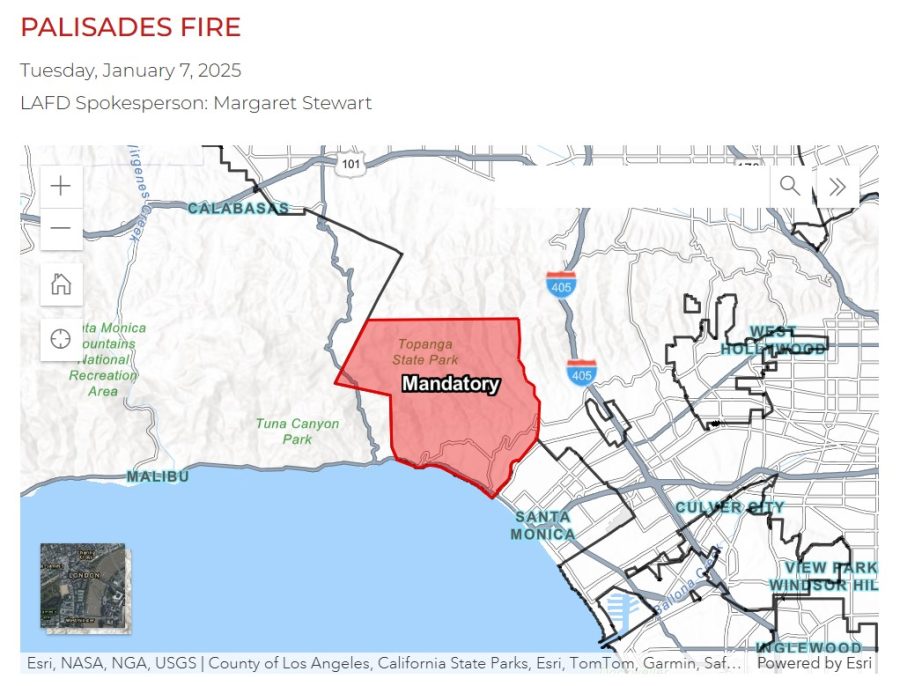
Today a fast-moving fire is threatening residents in the Pacific Palisades area of Los Angeles and has closed parts of the Pacific Coast Highway between Malibu and Santa Monica. The situation is developing fast with the Los Angeles Fire Department issuing mandatory evacuation orders and traffic alerts:

Palisades fire 7 Jan 2025
Palisades fire 7 Jan 2025, Los Angeles Fire Department


Wildfires in January are not unprecedented in southern California and only last month the Franklin Fire burned more than 4000 acres around Malibu.

The National Weather Service warned on 7 January of Extremely Critical Fire Weather in Southern California with high winds around the mountains and foothills:

High winds and low relative humidity will produce critical to extremely critical fire weather in southern California through Thursday.

Critical fire weather conditions and damaging downslope winds expected through Thursday across portions of Southern California with extremely critical fire weather likely for parts of Los Angeles and Ventura counties on Wednesday…


California Governor Gavin Newsom said on Monday that these could be some of the worst fire conditions the region had seen for many years with the wind forecast combined with the extremely dry conditions with low humidity.

Meanwhile after three weeks and a disrupted Christmas, the long-running bushfire in the Grampians (Gariwerd) National Park in Victoria Australia is now contained. The fire began on 17 December after dry lightning started multiple fires in the southern part of the national park.

With a fire footprint circumference of 262 miles (422 kms), more than 188,000 acres (76,000 hectares) of national park and agricultural land was burned with smoke covering most of south-west Victoria and parts of Melbourne.

With most of fire in dense forest property losses were relatively small and there were no serious personal injuries. Early data indicates livestock losses include 775 sheep, one horse, one beef cattle and 1,285 beehives, plus 335 miles (540 kms) of fencing.

New South Wales this week contended with more than 70 fire outbreaks across the state, many started by lightning strikes as summer storms passed over. The firegrounds are now seeing welcome rain. Earlier, the New South Wales Rural Fire Service showed how to get the water to a dry fireground:


How do people actually use a fire map? Researchers are finding out.

How well do you understand public wildfire prediction maps?

And does the average member of the public understand these maps?

A research team in Australia is looking at a range of maps available to the public during fire emergencies to determine if the public understand them enough to take the right action to protect their lives and their communities.

Researchers from four universities are collaborating with all fire agencies in Australia for a national view on bushfire prediction maps. The Black Summer fires of 2019/20 prompted the need to better understand the potential of these maps. At the height of the fires, the New South Wales Rural Fire Service was concerned that many residents and holiday-makers did not fully appreciate the risk. So, they began publishing detailed predictive maps in the hope that more information would lead to better household decisions. But did more detailed maps better help the public? Hence, the need for this research.

Predictive maps display critical information, but knowledge is limited on the best design or how maps are actually used during active fires. As Dr Erica Kuligowski, Principal Research Fellow at RMIT University and Natural Hazards Research Australia explains:

“Maps are an important way to communicate spatial information and they are increasingly being used in natural hazards like bushfires. However, no evidence base exists on how these maps should be designed and communicated as well as how they should be disseminated to the public.”

The researchers surveyed more than 3,000 people across all Australian states and territories in 2022 and 2023 to see if and how the public understood maps differently from the fire agencies.

They were shown mocked-up maps with varied levels of detail and asked the following questions:

  • Do you understand the purpose of this map?
  • What action is it prompting you to take?
  • How risky do you see the situation?
  • What emotions are you feeling?
  • What actions are you going to take?

They were also invited to provide open feedback, which provided a deeper level of insight for the researchers, particularly on whether it was the visuals, the text, or a combination of both that were seen as more important.

Public responses to uses of bushfire prediction maps
Public responses on uses of bushfire prediction maps in Australia.

The survey participants used a range of maps during bushfires, including local fire agency maps, the Bureau of Meteorology, Google Maps, and third-party weather or hazard mapping platforms, like Windy app, Digital Earth Australia (DEA) hotspots map, and bushfire.io.

Maps were checked more often at certain times during the bushfire, especially for early information (when the fire had not yet spread to participants’ immediate areas) or when the fire was moving quickly. Many participants used maps frequently, between 20 to 50 times each day.

A combination of information sources was used by participants to get a broader picture of their bushfire situation, with maps only one tool in their information toolbox. Community meetings were particularly useful in increasing understanding of fire spread prediction maps, as fire agency experts were on hand to explain the maps in more detail and answer questions.

Responses identified a wide range of uses for the maps, with different purposes more important to some than others, including to:

  • identify where they were in relation to the bushfire
  • gather information about the bushfire and what to do next
  • monitor the extent or rate of spread using the burnt areas shown on the map
  • cross-reference map information with other sources
  • confirm or explain the physical cues that they were seeing around them (for example, smoke or emergency response crews and vehicles responding to the fire)
  • make judgments about how the fire might spread and the level of risk
  • inform or warn others who may be at risk
  • monitor the impact of the fire on their or others’ properties, especially after evacuation.

The research is ongoing to provide guidelines on good structure to be translated into agency policies from 2025. In brief, the study found that bushfire maps must be updated promptly, clearly display their time and date of issue, and include relevant information, with an understanding that including too much or complex information may be problematic for comprehension.

For more resources on this study, including two webinars, go to:

Hazardous Webinar – Community perceptions and understanding of predictive maps 

The research is published in the International Journal of Wildland Fire

Understanding the challenges in bushfire map use and effective decision-making amongst the Australian public.

How does this compare with maps used elsewhere around the world? Are the challenges the same? Show Wildfire Today some of the better examples you have seen.

Australian fleet poised and ready, while waiting for late arrivals

Air-Crane Gypsy Lady arriving at Sydney

The Australian aerial firefighting fleet has been upgraded as an anticipated long, hot summer begins across the south, with most states expanding access to more aerial options in their local fleets.

Late season fires in the northern hemisphere have delayed the arrival of some the fleet. In Victoria, the announcement of the summer firefighting fleet of 54 aircraft was tempered by the statement that “2 Aircranes will also join the fleet once their service period ends in North America. Three additional aircraft will be on short-term contracts until the Aircranes arrive.”

Erickson Air-Cranes in Greece
Erickson Air-Cranes on northern hemisphere service, October 2021 in Greece. Photo by Dimitris Klagos.

The National Aerial Firefighting Centre (NAFC) has contracted 177 aircraft on behalf of Australian state and territory governments for the 2024-25 season. This fleet is supplemented by NAFC aircraft contracted as “call when needed”, and additional state owned and state contracted aircraft hired to meet peak demand across the country. In total more than 500 aircraft, provided by over 150 operators, are available as a shared resource for firefighting across Australia for season 2024-2025.

Amid regular calls at the political level for a national sovereign fleet that is less dependent on the variable end to the northern hemisphere fire season, NAFC figures show that 95 percent of the Australian firefighting fleet is already resident year-round in Australia, including 75 percent owned and operated by Australian companies.

The remaining 5 percent are predominantly the larger aircraft, both fixed wing and rotary, that follow the fire seasons around the globe. NAFC contracts these under partnerships between Australian and foreign companies. The aircraft fly on complementary contracts in the northern hemisphere and then are, ideally, packed up and returned in time for the Australian summer.

But that start of Australian summer has its own variable timing that contributes to the annual problem of overlapping seasons across the hemispheres: along the heavily populated east coast of the continent, bushfire season can begin as early as August into September, while New South Wales regularly has a highly active October and November. Further south, Victoria fires appear around December, with Tasmania seeing most activity from January onwards.

With the Australian fire season now well into its southward trajectory from the tropical north – currently in its Wet Season after an active Dry Season of bushfires – to a southern Australia with a year of below average rainfall, fire authorities are relying on their aerial resources for essential support to ground crews. The large grassland regions abutting the forests are particularly vulnerable this year, with several large outbreaks currently being dealt with in Victoria.

The Australian Government has funded NAFC with around $A100 million ($USD 63M) for this season and the next. Two Blackhawks and a Sikorsky S-61N have recently joined the fleet.

At the end of September 2024, the contracted national fleet comprises of:

  • 6 Large fixed wing air tankers
  • 16 Large rotary wing aircraft (Type 1)
  • 68 Medium and small rotary wing aircraft (Type 2 and 3)
  • 54 Fixed wing firebombers
  • 18 Light fixed wing

Coulson Aviation Australia has secured a long-term contract with Australia’s largest state-based fleet. The New South Wales Rural Fire Service announced in July this year that Coulson would manage the NSW fleet for the next 10 years, after managing it for the previous five.

The NSW RFS fleet of 11 aircraft includes a 737 large air tanker (the Marie Bashir, which has seen service in North America including a three-month stint in 2023), two Cessna Citations, six Bell-412 helicopters, a Chinook helicopter, and a Beechcraft Super King Air. Under the new contract, these aircraft will be overseen by primarily Australian crews, in a shift to bolster the local workforce and makes NSW more self-sufficient.

NSW RFS 737 fire tanker at NIFC.
The New South Wales Rural Fire Service 737 at the National Interagency Fire Centre in Boise, Idaho in 2023.

The fleet also supports other emergency services, such as the NSW State Emergency Service for rescues during floods, when they are not being used for firefighting duties.

Even the smaller states are increasing their capacities from the NAFC pool. Tasmania has received 15 dedicated aircraft from the NAFC fleet, to be managed locally by the Tasmania Fire Service. South Australia has retained its record high level of 31 aircraft from last year into this year, managed by the Country Fire Service, including five Blackhawk helicopters. Western Australia, immense in size but small in population, has found an extra $A10 million for its fleet, which includes four Blackhawks and a C130 Hercules.