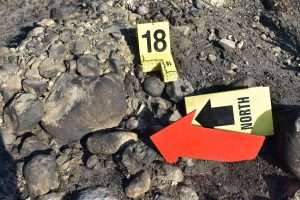
Fire Pattern Indicators research helps reconstruct the past

Fire Pattern Indicators NWCG

Like an archeologist examining artifacts to learn about historical events, a wildfire investigator pieces together fire pattern indicators – FPIs – to interpret directional travel of fires, and the origin and cause of wildfires.

The National Wildfire Coordinating Group (NWCG) in the United States has developed an internationally recognized methodology for wildfire investigations based on the fundamentals of FPIs.

When historical events can’t be physically witnessed or reproduced, evidence is gathered to reconstruct the past.

Fire Pattern Indicators NWCG

Whether an archaeologist or investigator, context is crucial. Without context, artifacts or FPIs are just standalone items of evidence. Context provides background information that influences how a scene is interpreted. Wildfire context includes but is not limited to weather, topography, fuels, and suppression actions. When evaluating a wildfire scene, a comprehensive standard approach is required to understand the relationship between FPIs and its overall context.

FPIs are fire effects created during the passage of a wildfire; they are the physical evidence of fire progression and provide information about the fire’s behavior, weather, spread, and intensity. FPIs develop within the localized fire behavior context and applicable fire behavior principles and dynamics. When properly analyzed each FPI reflects the direction of fire progression at its location; each FPI is a valuable tool to locate the origin and cause of a wildfire.

For the full story on the NWCG work with fire pattern indicators see Wildfire magazine by Shawn Zimmermaker

Fire mapping funds uncertain as northern Australian fire season begins

The Northern Australia Fire Information Service - NAFI.

Funding for a fire mapping service across the top half of Australia is due to end on 30 June, with this week’s Federal election highlighting the uncertainty around continuation of funds beyond that date.

The Northern Australia Fire Information Service (NAFI) provides satellite derived fire mapping data for fire managers and the agricultural sector across the North – in Western Australia, Northern Territory, South Australia and Queensland. The main fire season in the North of Australia typically begins around now and lasts into August or September.

The Australian Government has funded NAFI in recent years through its National Emergency Management Agency but has not committed to continued support. It’s May Federal Budget was silent on its future.

Australia goes to the polls in a Federal Election this Saturday (3 May). The Federal Opposition has pledged $2.5 million over three years if it is elected to govern, which would allow the service to continue.

The site was created by a community of fire researchers and managers in 2002 and is managed by Charles Darwin University. NAFI tracks current fires and publishes them on a map of Australia using a visual representation of ‘hotspots’. Hotspots are produced from thermal sensors on a number of different satellites including NOAA and NASA.

NAFI also produces burnt-area maps that are updated throughout the year. NAFI is the only service that provides critical fire information over the 80% (remote/regional) of Australia where 99.3% of fires occur.

The NAFI website is free for users to access and has relied on sporadic, often short-term, grant funding to survive. In addition to researchers and fire agencies, the site is an essential tool for a wide range of other land holders impacted by wildfire including pastoralists, mining, forestry, defence and other assorted carbon abatement projects.

As the North now enters its fire season, Indigenous ranger groups are working to combine traditional fire practices with live fire mapping data from NAFI.

For more information on the funding see the NAFI web service funding backgrounder.

Save the date for Wildfire Summit in Calgary

17th International Wildland Fire Safety Summit and the 7th Human Dimensions of Wildland Fire Conference in Calgary, Alberta, Canada, from October 20-23, 2025.


The IAWF will host the 17th International Wildland Fire Safety Summit and the 7th Human Dimensions of Wildland Fire Conference in Calgary, Alberta, Canada, from October 20-23, 2025.

Fire Safety Summit Conference – The 17th International Wildland Fire Safety Summit and the 7th Human Dimensions of Wildland Fire Conference

This is a fantastic opportunity for professionals in the wildland fire community to gather, share insights, and discuss advancements in fire safety and human dimensions related to wildland fire management.

The Call for Presentations is open.

The Call for Workshop proposals is open.

Additionally, there is a post-conference field trip to Banff National Park from October 24-25, 2025. This will be a great chance to explore the beauty of the Canadian Rockies while connecting with fellow attendees.

Mark your calendars for this important event and stay tuned for more details regarding registration and program.

California fires and the IAWF

By Trevor Howard, IAWF President

Amid the global wildfire challenges and changing fire regimes across the world, the current fires in California stand out as a tragedy of epic proportions.

The terrible loss of lives, homes and businesses, the broader and ongoing social, economic and environmental impacts, and the effects on firefighters and other responders are being deeply felt around the world.

Over time, there will be many findings, recommendations, improvements and changes generated through insight and hindsight. There will also be lessons to be learned regionally and globally that will require foresight to be adaptable, effective and sustainable.

Many members of the International Association of Wildland Fire, in California and beyond, will be affected by these fires, and many will contribute to learning and change. It’s also a time to reflect on the purpose of the IAWF.

The IAWF is a non-profit corporation built on the belief that an understanding of fire is vital for natural and cultural resource management, for firefighter safety and community preparedness and protection, and for harmonious interaction between people and their environment.

The IAWF has been formed to:

  • create networks across sectors, fields and disciplines to connect the global wildland fire community and to facilitate sharing of latest knowledge and lessons learnt;
  • create a sense of belonging and inclusiveness among our diverse and geographically dispersed wildland fire community through membership and multiple platforms;
  • provide regional and international leadership and impact through partnerships that leverage the considerable expertise throughout IAWF’s networks and membership.
Trevor Howard, IAWF President.

While this is a time for compassion and community, a different future will require courage and change and the IAWF membership is uniquely positioned to contribute.

IAWF welcomes new President for 2025

Trevor Howard, IAWF President.

As we step into 2025, we welcome new members to the IAWF Board of Directors.

We are thrilled to announce Trevor Howard as the new IAWF President, Ciaran Nugent as the new Vice President, and Tamara Wall as the new Treasurer.

Joining them are three new board members: Alistair Smith, Professor and Chair of the Wildland Fire Science Department at the College of Science, University of Idaho; Kerryn Little, Research Fellow and Head of School Research Support at the University of Birmingham; and Megan Dolman, who holds a Ph.D. in Ecology, Evolution, and Behaviour from Boise State University. IAWF Board Members.

As the IAWF bids farewell to board members Sara McAllister, Nuria Prat-Guitart, and Xinyan Huang, we extend our heartfelt gratitude for their dedication and service. We extend our sincere gratitude to Kelly Martin, our outgoing president for her leadership over this past year. Her passion and dedication have been unwavering – thank you!

Trevor Howard, IAWF President.

Howard’s new role is a testament to his dedication, extensive experience, and commitment to the wildland fire community throughout the world. He possesses a wealth of knowledge and expertise that spans various regions of Australia.

His leadership as the National Manager of the Prescribed Burning Strategy at the Australasian Fire and Emergency Service Authorities Council (AFAC) has significantly advanced national capabilities in prescribed burning, showcasing Australia’s ability to drive positive change within communities and with practitioners. He has held previous roles with IAWF, including Vice President and a Board Member since 2022.

Howard is well prepared for this new challenge, providing IAWF invaluable insights into the complexities and nuances of wildland fire management on a global scale.

Outgoing President, Kelly Martin, welcomed Howard into the new role in January. “He will be leading an esteemed organization that plays a crucial role in facilitating communication and providing leadership for the wildland fire community worldwide.

“His vision for inclusivity and innovation will undoubtedly inspire many others to engage in meaningful dialogue and work towards sustainable wildland fire solutions,” she said.

“We are confident that his strategic approach will enhance IAWF’s initiatives and foster a collaborative environment within and between countries where diverse perspectives can flourish. His commitment to supporting land management agencies and rural fire services aligns perfectly with IAWF’s goals of promoting safety, resilience, and effective management practices across all levels of wildland fire operations.”

Global firefighting aircraft market continues to grow

The global firefighting aircraft market is predicted to grow at an annual rate of 6.3 per cent, according to a report by Allied Market Research.

The media release on the report states that the global firefighting aircraft industry size generated US$9.0 billion in 2022 and is anticipated to generate US$16.2 billion by 2032, for a CAGR (Compound Annual Growth Rate) of 6.3% from 2023 to 2032.

The report analyses the firefighting aircraft market by Aircraft Type (fixed-wing and rotorcraft), Tank Capacity (less than 10,000 litres, 10,000 to 30,000 litres, and more than 30,000 litres), Maximum Take off Weight (less than 8000 kg, 8000 to 30,000 kg, and more than 30,000 kg), and Range (less than 1000 km, 1,000 to 3000 km, and more than 3000 km).

The analysis of the firefighting aircraft market encompasses more than 15 countries, with a country-by-country breakdown in terms of value (US$ million) for the forecast period 2022-2032.

Allied Market Research (AMR) is a market research and business consulting wing of Allied Analytics LLP based in Wilmington, Delaware. Their research methodology includes combining data, professional opinions, and independent perspectives plus a comprehensive review of over 3700 product catalogues, annual reports, industry descriptions, and resources from industry leaders.

On the basis of region, North America held the highest market share in terms of revenue in 2022, accounting more than two-fifths of the firefighting aircraft market revenue and is expected to continue to dominate the market with the growing demand for firefighting aircraft due to the rise in the frequency and intensity of wildfires. However, the Asia-Pacific region is expected to witness the fastest CAGR of 7.8% from 2023 to 2032, owing to surge in the initiatives, funding, and support for firefighting agencies.

The firefighting aircraft industry has been adversely affected by the conflict between Russia and Ukraine, mainly because of supply chain disruptions involving essential raw materials. The supply chain of Russia, a significant manufacturer of titanium, a substance that is frequently used in the aerospace industry due to its strength and low weight, especially in widebody aircraft, has been impacted. This has created difficulties for the large aircraft manufacturers, such as Boeing and Airbus SE, to get a steady supply of titanium.

The report lists the following significant developments in the firefighting aircraft sector

  • Lockheed Martin, in August 2021, secured a contract from United Rotorcraft for five S-70 Black Hawk helicopters, for aerial firefighting operations.
  • Kaman Corporation, in October 2022, received a purchase agreement from North American Helicopter for a K-MAX medium-to-heavy lift helicopter.
  • Kaman Corporation announced its intention, in May 2022, to acquire Parker-Hannifin Corporation’s Aircraft Wheel and Brake division for $440 million.
  • Coulson Aviation, in August 2023, was selected for an indefinite delivery/indefinite-quantity contract, involving C-130H Hercules and Boeing 737 Fireliner aircraft, providing maintenance support.
  • Coulson Aviation secured a $16 million firefighting contract in November 2023, extending support for Southern California’s Quick Reaction Force throughout 2024, with potential extension into 2025.
  • In November 2023, Coulson Aviation secured a three-year firefighting contract with Corporación Nacional Forestal (CONAF) of Chile, deploying a C-130H Hercules Large AirTanker and a Citation 550 air attack lead plane.
  • In July 2022, Coulson Aviation introduced its latest aerial firefighting tanker, converted from a Boeing 737.

The full report is available for purchase here.

New PBS doco takes us inside the LA firestorm

Camera operator, Josh Finbow films the aftermath of the Eaton Fire from a fire helicopter, Altadena, CA. Photo: Connor Nelson

On January 8 this year a film crew was on the ground in the LA firestorm capturing footage that is, in the aftermath of the tragedy, helping to explain the fire behavior and sheer destruction of the event.

Their work is now ready for viewing as an hour documentary on PBS. The program has interviews with fire officials who were there on the day, scientists, residents, and a volunteer fire brigade, who discuss the challenges of urban firestorms and the need to better protect communities.

Weathered- Inside the LA Firestorm is out of filmmaker Trip Jennings and Balance Media, who produced Elemental: Reimagine Wildfire two years ago.

Watch the television premiere of Weathered- Inside the LA Firestorm on Wednesday, March 19 and online thereafter:

  • Television broadcast PBS Member Stations – 10PM Pacific and Eastern/9PM Central, online at that link from 5.30pm Pacific.
  • PBS Terra YouTube – Join director Trip Jennings, PBS host Maiya May and crew for a live chat at 5:30 PM Pacific Time
PBS host Maiya May surveys the destruction of a home in the Eaton Fire, Altadena, CA. Photo: Josh Finbow

Produced as a special edition of PBS Weathered, host Maiya May explains a play-by-play of the fires with first-person footage, cinematic fire footage, and animations created in collaboration with NASA.

The show will be available after the premiere at the link above so please share with anyone you believe would be interested in this program.

But please note – for those outside of the United States access to PBS may be denied, but the YouTube links should work everywhere.

Connor Nelson, while filming the Palisades Fire. Photo: Josh Finbow

Remains identified as missing firefighter from 2020 fire

Remains found late last year in the San Bernardino Mountains in California have been positively identified as Carlos Baltazar, a US Forest Service firefighter who went missing during the El Dorado Fire in 2020, county officials have confirmed.

An investigation began in October last year when a hunter discovered a human remains in a remote part of the mountains near Highway 18.

The San Bernardino County Sheriff-Coroner Department confirmed that the identification of Baltazar, a 39-year-old from La Puente, was made using DNA. The cause of death remained undetermined.

As reported by Wildfire Today at the time, Baltazar was a member of the Big Bear Interagency Hotshot Crew in September 2020 that fought the El Dorado Fire, sparked after a gender reveal party gone wrong. Charles Morton, serving as the squad boss for the crew, died in the fire, and Baltazar’s family told local media that Baltazar had seemed depressed in the days after Morton’s death and went missing the week after.

The deadly El Dorado Fire scorched nearly 23,000 acres after erupting in September 2020.

A California couple pleaded guilty after accepting a plea deal to take responsibility for the blaze that was sparked by the gender reveal. The male pleaded guilty to charges of involuntary manslaughter and two counts of recklessly causing a fire to an inhabited structure, while the female pleaded guilty to three misdemeanors. He was sentenced to one year in a county jail, two years felony probation and 200 hours of community service. In addition, the family was ordered to pay victims’ restitution of $1,789,972.

Why fly – survey open on Australian aerial firefighting

An Australian based research project is seeking to better understand how and why aircraft are used on wildfires and how effective that use is.

As part of the project, the Research Team of Matt Plucinski (CSIRO) and Owen Price (University of Wollongong) have developed a survey to help them understand strategic and tactical objectives involved in decision making with respect to the use of aerial firefighting assets.

The survey aims to capture expertise and opinion regarding objective setting, tactical response and resource selection for aerial firefighting. It is focused on aircraft use in firebombing roles (i.e. dropping suppressants and retardants).

If you are an Air Attack Supervisor, pilot, or Incident Management Team member, who has worked on Australian bushfires please consider undertaking this survey.

The survey is open until 18 April.

More information on the Natural Hazards Research Australia funded project is available at Why fly? How do we know that aerial firefighting operations are effective and efficient?

Note that the survey may take up to an hour to complete, as the research team is trying to cover a wide range of topics, so it may be best attempted when respondents have time available. It is possible to start the survey and come back to it. Responses are recorded as you go, so you can return later (within a week of starting) to complete if using the same computer.  It is best undertaken on a computer, as many questions require text responses.

The team is also looking for case studies from recent Australian fires where they are able to match up fire progression data to the ARENA database and talk to air attack supervisors about objectives and tactics.

If you have any suggestions for fires that you think might make good examples, please reach out to Matt Plucinski at matt.plucinski@csiro.au.

Guilty plea to recklessly crashing drone into firefighting aircraft at Palisades

Two Super Scoopers arrive in LA County

Some fine detective work led by the FBI working closely with other agencies has resulted in charges against a 56-year-old Culver City man for flying his drone into a Super Scooper firefighting aircraft on the Palisades fire earlier this month.

According to a media statement from the United States Attorney’s Office Central District of California, Peter Tripp Akemann, 56, faced one count of unsafe operation of an unmanned aircraft. Federal prosecutors filed a criminal information charging Akemann with the misdemeanor offense that carries a prison sentence of up to one year in federal prison.

In a plea agreement, Akemann agreed to plead guilty to the criminal offense and admitted to his reckless and illegal conduct in flying the drone that posed an imminent safety hazard to the Super Scooper crew.

Akemann flew the drone at least 2,500 meters (more than 1.5 miles) toward the fire and lost sight of the drone. As Akemann was flying the drone, it collided with a Government of Quebec Super Scooper carrying two crewmembers attempting to fight the blaze. The impact caused an approximately 3-inch-by-6-inch hole in the left wing. After landing, maintenance personnel identified the damage and took the aircraft out of service for repairs as it was not able to continue its firefighting mission. As part of the plea agreement, Akemann agreed to pay full restitution to the Government of Quebec, which supplied the plane, and an aircraft repair company that repaired the plane. Akemann also agreed to complete 150 hours of community service in support of the 2025 Southern California wildfire relief effort.

In a neat summary, Akil Davis, the Assistant Director in Charge of the FBI’s Los Angeles Field Office, noted:

“Lack of common sense and ignorance of your duty as a drone pilot will not shield you from criminal charges. Please respect the law, respect the FAA’s rules and respect our firefighters and the residents they are protecting by keeping your drone at home during wildfires.”