Hours after firefighters in Idaho broadcast they were being shot at, two of the firefighters are dead and the lone gunman’s body has been recovered, Kootenai County Sheriff Bob Norris said at a press conference Sunday night.
A firefighter from the Coeur D’Alene Fire Department and a firefighter from the Kootenai County Fire & Rescue were those who died. A third firefighter was shot and was in critical condition before being transported to a local hospital. Norris said that the firefighter’s condition is now stable after undergoing surgery.
Firefighters responded to the wildfire near the town of Coeur D’Alene at around 1:21 p.m. on Sunday, according to Norris. Calls for shots fired were sent out at around 2 p.m.
Law enforcement officers who responded to the scene reportedly exchanged gunfire with the suspect between 2 p.m. and 7:40 p.m. During that time, officers used what they called a “cell phone activation” to pinpoint the shooter’s location.
The activation found a phone that had been sitting in the same spot for hours. That’s where law enforcement would eventually recover the suspect’s body, along with a high-powered rifle. Investigators have not shared how they believe the suspect died.
“Keep in mind, we had a fire that was rapidly approaching the body, so we had to scoop up that body and transport it to another location…we believe that is the only shooter that was on that mountain at that time,” Norris said.
Investigators believe the suspect, who has since been identified as Wess Roley, started the fire to lure firefighters to the location for an ambush. Norris said Roley had no criminal history and local law enforcement had five interactions with him, but they were minor.
Norris said investigators would not release the identities of the victims, as the investigation is still in its very early stages.
The wildfire, named the Nettleton Gulch Fire, has burned 26 acres and is 0% contained as of Monday morning, according to the Idaho Department of Lands.
WildfireToday and the International Association of Wildland Fire share our condolences with the families of the victims.
The United States’ wildland firefighting force was called the “very best 1990s firefighters” during a congressional hearing on Thursday morning.
San Bernardino County Fire Protection District Chief Dan Munsey, speaking at a hearing held at the House Committee on Natural Resources, said it’s a misnomer to say the US has the most “technologically advanced” firefighting force, since firefighters on the ground are using paper maps and radios from decades ago, compared with the modern technology available to the general public today. Munsey attributed the failure to use modern technology to federal barriers.
“We are slow to innovate, we are burdened by the regulatory process, we are hampered by lengthy bureaucratic procurement processes, and we lack access to fundamental tools,” Munsey said. “We don’t have a technology problem in the United States to combat wildfire; we have a technology adoption problem.”
Lawmakers invited wildfire technology experts to Capitol Hill to start fixing the problem Munsey spoke on. Thursday’s hearing focused on advancing innovative technology for forest management and wildfire prevention. Although some portions were overshadowed by partisan back-and-forths over whose fault the current wildland fire crisis is, lawmakers shared a common goal of adopting more technological advancements to meet the crisis and prevent future tragedies.
The wildfire technology sector continues to grow, including the launch of the Association of Firetech Innovation, which claims to be the first trade association dedicated to supporting technology focused on wildfire prevention, mitigation, and response. The association plans to act as a “central force for policy engagement, investment, and industry collaboration,” and was meeting with congressional leaders as the hearing went on.
One of the association’s founding member CEOs, Allison Wolff with Vibrant Planet, was also a speaker at the hearing and released research showing how a federal investment of $9 million in wildfire risk mitigation treatments would have slowed January’s Eaton Fire enough to mitigate much of the $40 billion in damages the community of Altadena experienced from the fire.
Data analyzed by Vibrant Planet found 300 communities in eight states have a 98% to 100% wildfire risk, similar to Altadena. Wolff also estimated that investing between $40 billion to $73 billion in risk mitigation in communities similar to Altadena, the nation can avoid up to $435 billion in insured losses.
“The problem is that today, without modern tools like ours, it can take three, five, to even 10 years to get to an implementation plan,” Wolff said. “Often, the data is low-quality, and collaborators are often planning on paper. Plans are often obsolete by the time they hit print because the landscape has already burned.”
Many Democratic lawmakers pointed out that the Trump administration’s recent budget cuts to research and development at the United States Forest Service and the Department of the Interior would further slow getting new technologies into firefighters’ hands. Karen Howard, director of science and technology assessment at the US Government Accountability Office, agreed, saying having new tools does nothing if systems aren’t in place to study and use them.
“You could have a beautiful tool that tells you where hazardous fuel reduction will be most effective, but if the agencies…don’t have the resources to conduct that hazardous fuels reduction, the model doesn’t do us a lot of good,” Howard said.
The job of wildland firefighters is “inherently dangerous,” but an analysis of nearly 500 wildland firefighter injuries over four years in the United States found no single activity on the job is more dangerous than another.
The analysis, recently published in the International Journal of Wildland Fire, used weekly U.S. Forest Service reports from between March 23, 2019, and Dec. 31, 2023, to create an in-depth assessment of wildland firefighter injuries. The researchers broke down the injuries by the activity being performed, the hazard encountered, and the severity of the injury.
The report found that there was no statistically significant difference in injury severity among wildland firefighter activities, outside of aviation. While aviation activities had the majority of fatal injuries, they had very few injuries overall.
“Across activity categories, average injury severity was relatively similar for fireline, ground transportation, camp/staging/project work, and illness categories,” the analysis said. “Our results do not indicate that incident complexity or incident kind affect severity, though previous research has found incident complexity may influence injury frequency.”
The report also found that there wasn’t a statistical difference in the number of injuries between fire types. Fewer injuries during prescribed fires appeared in the data set, which researchers said reflects the fact that Forest Service personnel spend substantially less time on Rx burns compared with the number of hours spent on wildland fire suppression.
No one region had greater proportions of wildland firefighter injuries either, despite higher levels of fire suppression occurring in the west and higher levels of prescribed burning in the east, the two had nearly the same rate of injuries.
“Protecting the safety of wildland firefighters cannot be solely reliant upon individual or realtime risk management, but must also include clearly defined organizational risk tolerances and appetites,” the report said. “We anticipate that future work may leverage this effort that identifies the hazards, their frequencies and consequences to provide additional insight into the tradeoffs between risks to firefighters and the goals associated with the suppression work with which they are assigned.”
Increasingly complex and large wildfires throughout the world have necessitated a growing collaboration between public, semi-public, and private entities that span across regions and interests. The issue has driven some in the United States, including President Donald Trump and sitting senators, to advocate for a single and overarching wildfire agency to handle the nation’s wildland fire threat.
The movement of multiple varying wildfire-prone regions into a single regime, although successful in some circumstances, may risk undermining the effectiveness of managing a wildfire incident, according to newly published research.
The study, recently published in the International Journal of Wildland Fire, studied 15 wildfire disasters from 2017 and 2018 and the 139 jurisdictions involved in fighting them. The researchers wanted to see whether the “pluralism paradox,” or when the threat of conflict increases when multiple and varied interests are needed to collaborate to address complex problems, held up to scrutiny.
Their findings suggest that trying to create a permanent single wildfire management strategy across numerous jurisdictions opens the door to conflict among involved organizations.
“Given the different missions guiding land jurisdictions, it may be structurally impossible to craft a strategy that optimizes values for all interests,” the researchers said. “Thus, zero-sum logic will apply to some strategies for fire management.”
Researchers found that collaboration among resource use and operational strategy, in particular, has the highest risk of generating conflict because the entities involved are likely to view the decisions made as privileging certain jurisdiction interests over others.
Collaboration between organizations and agencies that disagree, however, doesn’t always lead to conflict. Communication and information management collaboration, for example, has the least risk of creating conflict because they’re least likely to be perceived as a win-lose scenario for agencies involved in fighting fires.
Wildland fire stakeholders can also begin addressing potential conflict by addressing values-based mission differences between federal and state/private fire managers and holding pre-fire season workshops, table-top exercises, and meetings.
“These insights provide some nuanced, empirical insight into the dynamics of organizational pluralism in collaborative settings,” the researchers said. “Providing greater understanding of where we can expect to find conflict can lead to not only more realistic expectations, but also more resilient collaborative designs targeted at specific contexts and potentially better managed outcomes for all involved.”
The US Department of the Interior and the USDA Forest Service on Tuesday announced the opening of access to a mental health provider network for the nation’s wildland firefighters.
The “Wildland Fire Therapy Service” was established under the Federal Wildland Firefighter Health and Wellbeing Program, which began under the Biden Administration in 2024 as part of the Infrastructure Investment and Jobs Act. The service is designed to address the unique mental health needs of those in emergency management positions, according to a press release from the DOI.
Any wildland firefighter with the Forest Service, Bureau of Indian Affairs, Bureau of Land Management, National Park Service, and U.S. Fish and Wildlife Service can access the therapy service, regardless of whether they are in a permanent, temporary, seasonal, or year-round position. Eligible individuals can get up to 16 sessions per year at no cost.
Available therapy services include sessions to address acute stress reactions, anxiety, complex grief, depression, post-traumatic stress disorder, or substance use concerns related to traumatic events or cumulative emotional strain from working in wildland fire, according to the therapy service’s website. The services are provided through Magellan Federal, a business management consultancy agency. The sessions reportedly include initial assessments and psychotherapy sessions through in-person or virtual appointments. In-person appointments will be prioritized as they are known to increase the effectiveness of treatment, the website said.
“Firefighters and first responders put their lives on the line to protect us, our resources and our communities. We are so grateful for their service, and we are happy to provide them with more support if they need it,” U.S. Department of Agriculture Secretary Brooke L. Rollins said in the press release. “As we approach peak fire season, access to mental health services for our firefighters and first responders will now be easier and more convenient so we can continue to have the best wildland firefighting force in the world.”
President Donald Trump on Thursday ordered the United States Department of Agriculture and the Department of the Interior to consolidate the nation’s wildland fire programs.
Trump’s executive order, focused on “empowering commonsense wildfire prevention and response,” also instructed the departments and all agencies represented by the National Interagency Fire Center to increase wildland firefighting capabilities at the state and local levels, including through the use of artificial intelligence, data sharing, and mapping capabilities.
“Wildfires threaten every region, yet many local government entities continue to disregard commonsense preventative measures,” Trump’s order said. “Firefighters across the country are forced to rely on outdated technology and face challenges in quickly responding to wildfires because of unnecessary regulation and bureaucracy.”
The “consolidation” mentioned in the order is reminiscent of a push started earlier this year by Republican Senator Tim Sheehy of Montana and Democratic Senator Alex Padilla of California to create a single wildland firefighting agency, dubbed the “National Wildland Fire Service.” A Senate bill directed the two departments to reorganize wildfire response nationwide into the new agency.
Advocacy group Grassroots Wildland Firefights supports the consolidation, saying they’ve advocated for a National Wildland Fire Service since the group was founded in 2019.
“This is a historic day in the modernization of our National Wildland Fire Service,” the group told WildfireToday. “After we digest, interpret, and understand this EO, we will have more to say. We will continue to support public lands and public land management, public land agencies, and all public servants.”
The order also instructs Environmental Protection Agency Administrator Lee Zeldin to modify or rescind “Federal rules or policies that impede the use of appropriate, preventative prescribed fires.” Zeldin previously signaled the EPA was in the process of changing the agency’s decade-old Exceptional Events Rule to expand the legal ability to set prescribed burns.
The rule has long held prescribed burning in a gray area. The policy allows states to be exempt from meeting national air quality standards during “exceptional events,” or times of high pollution readings that states can’t control, like wildfires. However, a study published in February said prescribed fires may not always meet the exemption.
Canadian firefighters are battling 225 active wildfires throughout the nation as of Wednesday, including 101 fires labeled as “out of control,” according to the Canadian Interagency Forest Fire Centre.
Numerous evacuation orders are in place throughout British Columbia, Alberta, Saskatchewan, and Manitoba provinces. Local officials have declared multiple states of emergency as over 8,318,000 acres (3,366,566 hectares) have burned across the country since the beginning of 2025.
The fires’ consequences are not just being felt locally, but internationally. Smoke from the wildfires has drifted across the Atlantic Ocean, turning skies above the United Kingdom orange. The fires’ smoke may also be uniquely toxic due to the country’s heavily mined forests.
“The country’s forests have long been mined, operations that loaded soils and waterways with toxic metals like lead and mercury, especially before clean-air standards kicked in 50 years ago,” Matt Simon with Grist reported. “Now everyone downwind of these wildfires may have to contend with that legacy and those pollutants, in addition to all the other nasties inherent in wildfire smoke, which are known to exacerbate respiratory and cardiac problems.”
“This week, the enormous smoke plumes of wildfires in Canada’s boreal forest were picked up by high-altitude winds, blanketing part of eastern Canada in haze and contributing to poor air quality,” the Canadian Space Agency posted on June 8.
The international problem triggered international help. Multiple firefighters from Australia recently deployed to Canada to assist with wildfire efforts, including personnel with Forest Fire Management Victoria and the New South Wales Rural Fire Service. FFMVic reportedly sent a taskforce of 20 firefighters to assist efforts in Alberta.
“The Canadian terrain may be challenging and the trees and wildlife very different, but FFMVic staff are experienced in fighting fires these conditions,” the management service said in a social media post. “Their skills are sharpened through overseas deployments where they learn from different environments, fire behaviour and international colleagues.”
NSW sent 36 firefighting specialists with the service, along with 16 members from the National Parks and Wildlife Service and two from NSW’s Forestry Corporation.
“Here in NSW, we understand the destructive power of bush and forest fires, and we stand ready to support our Canadian colleagues in their time of need,” Minister for Emergency Services Jihad Dib said in a press release. “I’d like to thank all personnel involved in this deployment and wish them well. We look forward to their safe return.”
A Greek court has sentenced four former fire and civil protection officials to numerous years in prison stemming from charges related to a 2018 wildfire in the coastal town of Mati that left more than 100 people dead.
Fire Brigade Chief Sotiris Terzoudis, Deputy Vassilis Matthaiopoulos, the former head of the National Coordination Center for Operations and Crisis Management (ESKE) Ioannis Fostieris, and former Civil Protection Secretary-General Ioannis Kapakis were each sentenced to serve five years in prison for causing loss of life through negligence, according to the Associated Press and local newspaper Kathimerini.
According to these reports, the court ruled that the officials failed to organize an orderly evacuation during the wildfire that swept through Mati, east of Athens, on July 23, 2018. Residents were forced to find their own ways of escape, with some attempting to drive their vehicles through dense forest or trying to flee into the sea.
“Rescuers reported finding the bodies of more than 20 people huddled together near a beach. Others were found in or near groups of vehicles that became trapped,” according to WildfireToday reporting from the immediate aftermath of the fires. “As 50 mph winds pushed the fires, residents and tourists took refuge on ocean beaches. Boats plucked some out of the water while others were picked up on the shore and taken to safety. The Greek Coast Guard and other vessels picked up more than 700 who were fleeing from the fire.”
The AP reported that the officials were initially found guilty in a trial last year but were only fined, not jailed. A prosecutor then challenged the verdict, which led to the retrial and the new ruling.
Kathimerini reporters present at the ruling said the court’s audience members burst into applause and shouting when the officials were escorted out of the courtroom by guards, saying, “Let’s see those handcuffs for a moment,” and, “At least apologize – still unrepentant, even now.”
A bill that allows old military aircraft to be used for water-dropping firefighting response is headed to President Donald Trump’s desk.
The “Aerial Firefighting Enhancement Act of 2025,” introduced by Sen. Martin Heinrich (D-N.M.) and Rep. Gabe Vasquez (D-N.M.), was passed on Tuesday. The bill extended the Wildfire Suppression Aircraft Transfer Act of 1996, which authorizes the sale of surplus military aircraft and parts for aerial firefighting usage, through October 1, 2035.
The act, if passed, would also allow aircraft to carry and drop water, along with fire retardant, to assist wildfire response. It also specifies that the Department of Defense can only sell aircraft and parts to persons or entities if they are used only for wildfire suppression.
“I urge the president to immediately sign the Aerial Firefighting Enhancement Act, which is urgently needed to expand the operations of Very Large Air Tankers that have proven absolutely essential to firefighters battling large wildfires in New Mexico and across the West,” Heinrich said in a press release. “I will never stop fighting to deliver the resources that our communities need to effectively respond to wildfires.”
Heinrich also announced Tuesday that two wildfire dispatch centers in New Mexico no longer face the risk of lease cancellations. The two offices were previously among the several hundred nationwide lease closures announced by Elon Musk’s Department of Government Efficiency, but have since been removed. According to this report, about 500 offices remain on the closure list, down from 750 earlier.
One of the most striking patterns in the aftermath of many urban fires is how much unburned green vegetation remains amid the wreckage of burned neighborhoods.
In some cases, a row of shrubs may be all that separates a surviving house from one that burned just a few feet away.
As scientists who study how vegetation ignites and burns, we recognize that well-maintained plants and trees can actually help protect homes from wind-blown embers and slow the spread of fire in some cases. So, we are concerned about new wildfire protection regulations being developed by the state of California that would prohibit almost all plants and other combustible material within 5 feet of homes, an area known as “Zone 0.”
Photos before and after the 2025 Palisades Fire show thick green vegetation between two closely spaced homes. The arrow shows the direction of the fire’s spread. Max Moritz; CAL FIRE Damage Inspection photos, CC BY
Wildfire safety guidelines have long encouraged homeowners to avoid having flammable materials next to their homes. But the state’s plan for an “ember-resistant zone,” being expedited under an executive order from Gov. Gavin Newsom, goes further by also prohibiting grass, shrubs and many trees in that area.
If that prohibition remains in the final regulation, it’s likely to be met with public resistance. Getting these rules right also matters beyond California, because regulations that originate in California often ripple outward to other fire-prone regions.
Lessons from the devastation
Research into how vegetation can reduce fire risk is a relatively new area of study. However, the findings from plant flammability studies and examination of patterns of where vegetation and homes survive large urban fires highlight its importance.
When surviving plants do appear scorched after these fires, it is often on the side of the plant facing a nearby structure that burned. That suggests that wind-blown embers ignited houses first: The houses were then the fuel as the fire spread through the neighborhood.
We saw this repeatedly in the Los Angeles area after wildfires destroyed thousands of homes in January 2025. The pattern suggests a need to focus on the many factors that can influence home losses.
Shrubs in Zone 0 of a home did not ignite during the Eaton Fire, despite the home burning. Max Moritz
For example, installing rain gutter covers to keep dead leaves from accumulating, avoiding flammable siding and ensuring that vents have screens to prevent embers from getting into the attic or crawl space can lower the risk of the home catching fire.
However, guidance related to landscaping plants varies greatly and can even be incorrect.
For example, some “fire-safe” plant lists contain species that are drought tolerant but not necessarily fire resistant. What matters more for keeping plants from becoming fuel for fires is how well they’re maintained and whether they’re properly watered.
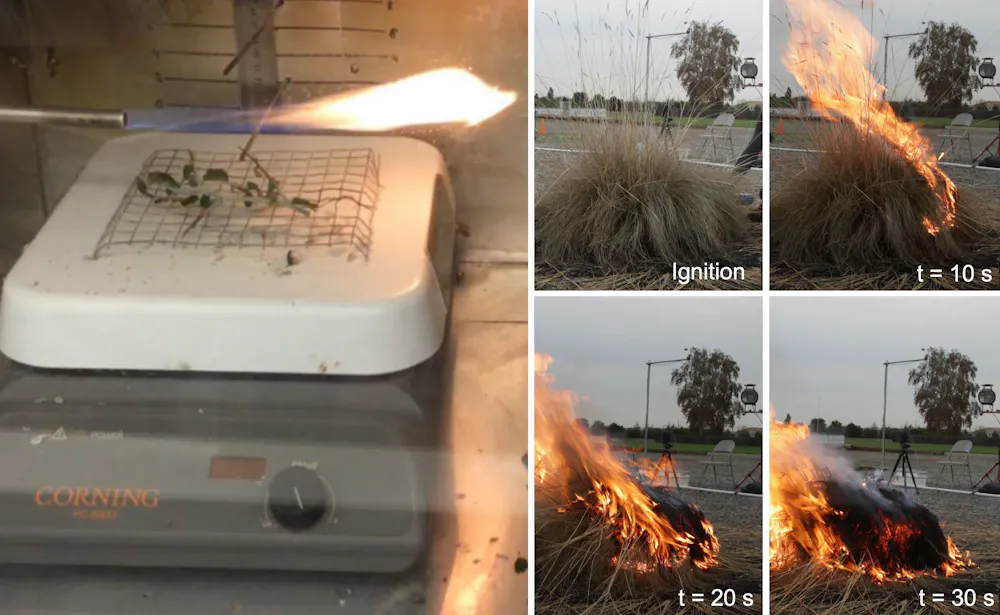
In many cases, high moisture can actually keep a plant from igniting. We’ve seen this in some of our experimental work and in other studies that test the flammability of ornamental landscaping.
With enough heat, dried leaves and stems can break down and volatilize into gases. And, at that point, a nearby spark or flame can ignite these gases and set the plant on fire.
Plant flammability testing shows how quickly twigs, grasses, plants and leaves will burn at different moisture levels. The images on the right are from an experiment at the University of California’s South Coast Research and Extension Center to test flammability of a living but overly dry plant. Max Moritz (left); Luca Carmignani (right)
Even when the plant does burn, however, its moisture content can limit other aspects of flammability, such as how hot it burns.
Up to the point that they actually burn, green, well-maintained plants can slow the spread of a fire by serving as “heat sinks,” absorbing energy and even blocking embers. This apparent protective role has been observed in both Australia and California studies of home losses.
How often vegetation buffers homes from igniting during urban conflagrations is still unclear, but this capability has implications for regulations.
California’s ‘Zone 0’ regulations
The Zone 0 regulations California’s State Board of Forestry is developing are part of broader efforts to reduce fire risk around homes and communities. They would apply in regions considered at high risk of wildfires or defended by CAL FIRE, the state’s firefighting agency.
Many of the latest Zone 0 recommendations, such as prohibiting mulch and attached fences made of materials that can burn, stem from large-scale tests conducted by the National Institute of Standards and Technology and the Insurance Institute for Business and Home Safety. These features can be systematically analyzed.
But vegetation is far harder to model. The state’s proposed Zone 0 regulations oversimplify complex conditions in real neighborhoods and go beyond what is currently known from scientific research regarding plant flammability.
A mature, well-pruned shrub or tree with a high crown may pose little risk of burning and can even reduce exposure to fires by blocking wind and heat and intercepting embers. Aspen trees, for example, have been recommended to reduce fire risk near structures or other high-value assets.
In contrast, dry, unmanaged plants under windows or near fences may ignite rapidly and make it more likely that the house itself will catch fire.
As California and other states develop new wildfire regulations, they need to recognize the protective role that well-managed plants can play, along with many other benefits of urban vegetation.
We believe the California proposal’s current emphasis on highly prescriptive vegetation removal, instead of on maintenance, is overly simplistic. Without complementary requirements for hardening the homes themselves, widespread clearing of landscaping immediately around homes could do little to reduce risk and have unintended consequences.