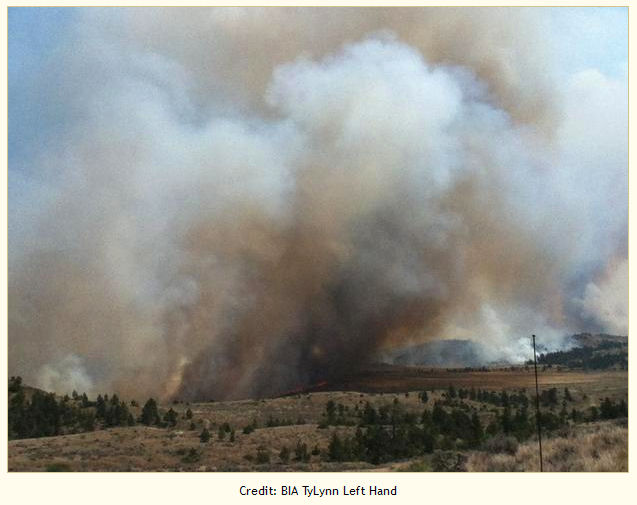
Goblin Gulch Fire too steep for safety

The Goblin Gulch Fire is southwest of Monarch, Montana, on the Belt Creek Ranger District of the Lewis and Clark National Forest. Reported on July 30 by a military aircraft, the fire was probably caused by lightning. Firefighters worked yesterday on scouting adequate safety zones and helicopter landing zones. Crews cleared a spot for helicopters to land closer to the fire, and air resources checked on numerous spot fires on the west side of the fire.

This fire is expected to be active for a long time because of the extreme terrain and concerns for firefighter safety. The fire’s inciweb page says “Firefighter safety will not be compromised in order to suppress this wildfire.”
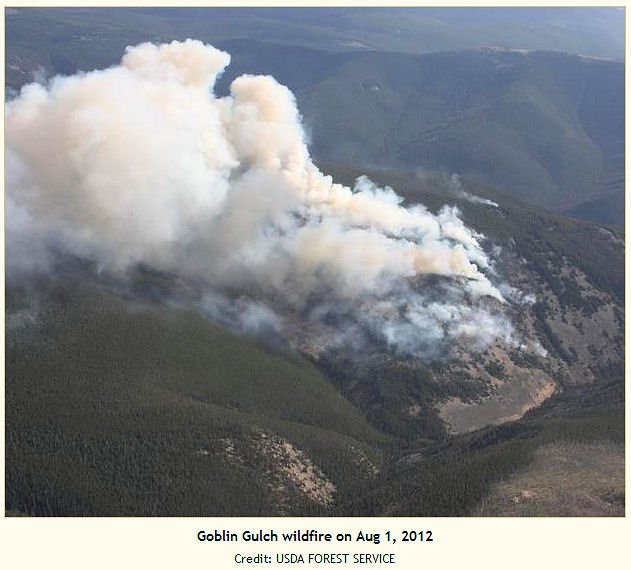
Goblin Gulch FireIt’s 5 percent contained at 283 acres, and the terrain is extremely steep with a heavy timber canopy of mixed conifers. Crews have reported surface fire with individual tree torching. Work on the fire is expected to be slow. “The terrain this fire is in is really extreme,” public information officer Erin Fryer told the Great Falls Tribune. “It’s about straight up and down and very rocky. It’s been real difficult to even get firefighters in on this fire. We have about 50 firefighters on the site right now, but in terrain like that, it’s hard to get them in and out — hard and slow.”

Neptune adds another tanker

Another new airtanker will be added to the national fleet next week if a contract disagreement can be resolved.

Neptune Aviation out of Missoula, Montana, will put their second BAe-146 to work early in the week. Neptune maintenance director Gerry Nielsen told the Missoulian that the new airtanker delivered by Tronos Aviation is ready to go.

“It’s an operational tanker,” he said. “Tronos sent it in with its tank already loaded in. We’ll do one or two test flights to check things out and make sure it’s all correct. Then we wait for the Forest Service.”
Tanker 45
The contract, though, is under protest, so authorization for “next-generation airtanker” contracts is on hold. According to the Missoulian, the contract affects Neptune and three other aircraft companies, which have planned to bring on seven new airtankers at a multi-year cost of over $500 million. Neptune put its first BAe jet, Tanker 40, into service last year on an interim contract, and was awarded a two-plane contract in June. Tanker 41 will begin work in early August, and Neptune plans to acquire its third jet early next year. That third tanker will take the number “10” from the P2V that Neptune retired from service earlier this year.

Oklahoma firefighters scrambling

Gusty winds are pushing fires through the woodlands south of Oklahoma this afternoon, with firefighters struggling to contain the fires in 113-degree heat. State emergency management officials said 25 structures were burned east of Noble; the Houston Chronicle reported that county sheriff’s deputies had directed residents of up to 100 homes south of Lake Thunderbird to evacuate the area.

The Oklahoma Highway Patrol closed part of the highway between Oklahoma City and Tulsa; officials suspect arson and were investigating reports that passengers in a pickup truck were throwing flaming newspapers from the truck. Law enforcement officials are seeking information about persons in a black Ford F-150 pickup; witnesses are encouraged to call (405)869-2501.

Prolongued drought conditions, along with the 100-plus temperatures and gusty winds, have created dangerous wildfire conditions in the state. “It’s difficult for the firefighters to get into the area because it’s heavily wooded on either side of the smaller roads,” said Jerry Lojka with the Oklahoma Department of Emergency Management. “When the winds are blowing 25 mph it just blows the embers and fireballs across the roads as if they weren’t even there.”  The temperature this afternoon at Norman was recorded at 113 degrees, and southwest winds were gusting up to 24 mph.

The Oklahoman reported that police in the city of Norman had shut down State Highway 9 between 84th and 168th within the city limits. The state Transportation Department also closed down both northbound and southbound ramps from Interstate 35 to Turner Turnpike because of the wildfire near Luther, and the Oklahoma County sheriff’s department is assisting with evacuations.

At least 17 families lost their homes to fire and have taken shelter at the evacuation center in Noble.

CNN reported that the largest fire is south of Oklahoma City in Cleveland County. Lojka told CNN that subdivisions in wooded areas are threatened, and there’s no accurate count of homes destroyed by the fire. “It’s almost impossible to keep up with the count at this point,” he said, but it’s “many many homes, many outbuildings and other structures.”

A report by the Tulsa World noted that two National Guard helicopters were assisting. The Red Cross has established an evacuation center at city hall in Noble, and numerous fire departments are providing mutual aid, including personnel from Garvin, Oklahoma and Pottawatomie counties. Oklahoma Gov. Mary Fallin issued a statewide burn ban today, which supersedes all county burn bans and will be in effect until rescinded by the governor. Fallin also declared a state of emergency for all 77 Oklahoma counties; that order allows state agencies to make emergency purchases related to disaster relief and preparedness.

According to the Southern Area Coordination Center, red flag warnings were issued across most of the central and southern portions of Oklahoma for low relative humidity of 10 to 15 percent, with temperatures of 105 to 113 and south-southwest winds of 15 to 25 mph. Fire weather watches are in effect for most of central and southern Oklahoma.

Montana town emptied

Police drove the streets of the town of Lame Deer last night, using loudspeakers to warn residents to grab their belongings and get out of town. An Associated Press story in the Washington Post reported that buses were lined up Thursday night to evacuate the entire population of 2,000 from the Northern Cheyenne Reservation community.

Desi Small-Rodriguez with the tribe’s disaster and emergency services department said the Chalky Fire threatened to burn Lame Deer, the seat of the southeastern Montana reservation. The fire had burned two homes, and then winds pushed the fire straight toward town. Carol Raymond, Rosebud County’s head of disaster and emergency services, had driven from Forsyth to assess the situation. “I figured the whole town of Lame Deer would go up in flames,” she said.

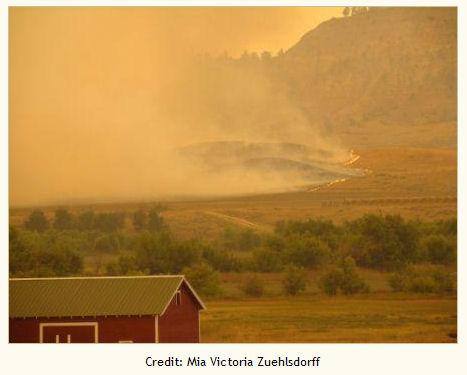
Chalky Fire on Montana's Rosebud Complex
Chalky Fire on Montana’s Rosebud Complex

This is the second major fire to burn on the Northern Cheyenne Reservation this year. The Ash Creek Fire in June burned 18 homes, forced evacuations, and resulted in $20,000 of damage to tribal property. The Chalky Fire is the largest in the Rosebud Complex, which includes six active fires. Crews have made good progress on the fires burning on the Crow and Northern Cheyenne reservations, and officials today lifted evacuation notices and re-opened the roads closed by fire activity. “We got some precip on the fire this morning and that really helped,” said LaDawn Saxton, information officer with BIA Northern Cheyenne Fire and Aviation.

Northern California fires evacuate residents

Dozens of homes in northern California are threatened by two active fires, one near Lake Shasta and one on the Plumas National Forest.

The 900-acre Salt Creek Fire forced the closure of Interstate 5 in both directions shortly after it started Wednesday near Lakehead. One lane in each direction was reopened yesterday, but Caltrans warned that smoke was limiting visibility. An infrared detection flight yesterday evening reported the fire’s size at 900 acres. The earlier estimate of 500 acres was based on ground observations at night and under smoke cover.

An evacuation order was issued for about 100 structures threatened by the fire; more than 300 firefighters are assigned. Containment last night was estimated at 20 percent, with full containment predicted for Sunday evening.
Chips Fire 07/31The Chips Fire on the Plumas has about 425 firefighters assigned. The fire’s 35 miles northeast of Chico near Belden, on the Feather River. Containment was estimated last night at 5 percent; full containment is predicted for August 15. Crews are working in heavy snag areas with brush overstory; the terrain’s extremely steep, rocky, and generally inaccessible.

Though the fire was relatively quiet overnight with cooler temperatures and moderate humidity, crews will be working today in extremely hot and dry conditions, complicated by a very unstable air mass. Fire managers said heat near the north end of the fire could produce large runs and spot fires today if the current inversion lifts. McGowan’s Type 1 team has command of the fire.

More MAFFS on duty

The U.S. Forest Service has requested additional MAFFS-equipped C-130 airtankers, and two aircraft from the 302nd Airlift Wing at Peterson Air Force Base in Colorado will soon be on duty. MAFFS tankers have dropped nearly 889,000 gallons of retardant on fires in eight states since they were activated on June 25.

MAFFS unitAnother USFS request recently prompted the Joint Training and Experimentation Center (JTEC) in Wyoming to prepare an unmanned aerial vehicle for recon missions on the Sawmill Canyon Fire. JTEC, which tests and develops unmanned vehicles, is a partner with the Wyoming National Guard, the University of Wyoming, and the Department of Defense’s Joint Ground Robotics Enterprise.

John Offe, senior electronic technician for JTEC, said the request came from the fire’s incident commander. JTEC’s capabilities include aerial reconnaissance, forward-looking infrared cameras, video, still photos, and night flying.

Offe said the JTEC team began preparing the T-16 aircraft for use on the fire, but it was contained before the JTEC aircraft was launched. Limiting conditions that affect the aircraft’s use include a requirement for restricted airspace and maintaining operations inside of their Department of Defense contracts.

“It’s not a service contract,” said Offe. “We don’t have a contract in place where we can go out and do this kind of work for them. We would love to. That’s our ultimate goal, which is to provide a system like this to somebody, be it game and fish, fire, homeland security, whoever.”

MAFFSThe 302nd Airlift Wing in Colorado Springs, Colo., an Air Force Reserve unit, and three Air Guard units – the145th AW in Charlotte, N.C.; the 146th AW in Channel Islands, Calif., and the 153rd AW in Cheyenne, Wyo. – each have two MAFFS-equipped C-130s able to respond to wildfires throughout the U.S.

More information on the 302nd Airlift is available at www.302aw.afrc.af.mil/

Re-visiting Mann Gulch

The Mann Gulch Fire, 63 years ago this week, took the lives of 13 smokejumpers. Norman Maclean’s 1992 book Young Men and Fire recounted the story of the most deadly event in smokejumper history at that time. Of the four survivors on the fire, only three managed to reach the ridgeline above them and escape the deadly fire.

USFS team recovering bodies from Mann Gulch in 1949. Photo by Dick Wilson, part of the recovery team, courtesy John Maclean.

Norman Maclean re-visited the gulch, in rugged northern Montana, when he was in his 80s. He was accompanied by the two living survivors, Walt Rumsey and Robert Sallee, and they tried to re-create the smokejumpers’ run for safety; Rumsey and Sallee tried to find the “crevice” at the ridgetop where they’d escaped. Maclean concluded, though, that the spot they identified for him on the ridge was considerably east of where they actually were in 1949.

Aerial view of the 1949 Mann Gulch Fire, USFS photo courtesy John Maclean.

H. Wayne Phillips of Great Falls, a former smokejumper, along with two other former smokejumpers and a former paratrooper, recently hiked Mann Gulch looking for answers to Maclean’s questions. The Great Falls Tribune today ran a feature on the hikers’ quest to find the spot where Sallee and Rumsey crested the ridge.

Thanks to John Maclean for use of the 1949 photos.


Montana firefighters expecting high winds

A red flag warning is in effect this afternoon through tomorrow, with a dry cold front predicted to bring strong gusty winds from the northwest at 20 mph with gusts up to 40 mph. Firefighters on the 20,000-acre East Sarpy Fire east of Billings, Montana, will focus on structure protection instead of building fireline. The fire area is not heavily populated, but it includes some ranch homesteads and the Westmoreland Sarpy Creek coal mine.

[UPDATE: The Sarpy Hill Complex is estimated at 51,000 acres this afternoon.]


East Sarpy Fire at noon 08/01/2012

Portions of the fire over the last two days have jumped dozer lines. “Everything we tried didn’t work,” said a veteran helicopter manager. An additional five crews will work on the fire today, along with 20 more engines. Crow tribal engines worked through the night, along with Big Horn County Rural Fire resources, dozers, graders, water tenders, and local ranchers. A Type 2 team will take over the fire today.

The East Sarpy and West Tullock Creek fires burned together late yesterday, and the Dawes Fire burned actively all night. East of Dunmore, residents could see the glow of the Little Dry Creek fire, which is a priority today.

Three other fires recently burned more than 15,000 acres north of Winnett. Crews have contained the Wolf Creek, 15-Mile, and Dovetail lightning-caused fires earlier this week. To the east, Rosebud County crews are working on 28 fires burning in the county. Carole Raymond, Rosebud County’s disaster and emergency services coordinator, told the Billings Gazette that the largest of the fires is burning between Rosebud and Butte creeks.

“That’s the biggest one and they don’t have it even kind of handled,” she said. “It’s just running on them.”

Eastern Washington fire burning fast

An incident management team from Spokane is setting up operations in BridgeportBrewster, Washington to coordinate firefighting efforts on a fire that started yesterday north of Wenatchee and quickly grew to over 700 acres. The Sacramento Bee reported that the fire’s burning in grass, brush, scattered timber, and some wheat land. The Crane Road Fire was estimated this morning at about 2,000 acres. The Spokesman-Review noted that Deputy State Fire Marshal Ron Bowen said residents have been evacuated, and the Seattle Times reported that another 45 firefighters have been assigned.

[UPDATE:  KING5 news reports the fire grew overnight to 10,000 acres.]

Salt Creek Fire temporarily closes I-5

A fire burning along Interstate 5 on the Shasta-Trinity National Forest has forced the evacuation of 100 homes. According to the Sacramento Bee, the fire north of Redding has burned 500 acres and is about 20 percent contained. Don Ferguson with the U.S. Forest Service said crews made progress overnight, but 20 more homes were added to the evacuation list.

The Salt Creek Fire started yesterday in the interstate median; it’s threatening about 20 commercial buildings and 100 other structures, and I-5 was closed for several hours. Thousands of northbound travelers were stuck in traffic in triple-digit heat on the interstate.

The fire’s burning between the O’Brien and Salt Creek exits; major KV power transmission lines are threatened. Resources on the fire include 46 engines, five dozers, six crews, three helicopters, and four airtankers. A Type 2 team will take over the fire this evening. The Redding Record Searchlight has a collection of photos online.