Oregon fires update

The 2,000-acre Barry Point Fire southwest of Lakeview, Oregon, is burning on the Fremont-Winema National Forest and private lands. This morning the fire was transitioned to Oregon Incident Management Team 4 (IC Brian Watts).  On Tuesday the Lake County Sheriff’s Department and Forest Service law enforcement notified residents and others in the area that threats from the fire are severe.

Barry Point Fire, 08/07/12  ~  photo by Fred Way
Barry Point Fire, 08/07/12 ~ photo by Fred Way

The fire’s burning in heavy dead and down fuels on steep, rocky terrain. Strong gusty winds, high temperatures, and extremely heavy brush and timber pushed the fire to the north and northeast.

One of Butler’s DC-7 airtankers dropped on the fire, then returned to the Medford tanker base with a bad tire; crews at the base had noted tire pieces on the runway after the tanker left Medford. The pilot of another plane in the air saw that the tire was damaged, and the tire was changed after the tanker returned to Medford.

The Barry Point Fire is threatening the Dog Mountain Lookout, and several road closures are in effect.

The Holloway Fire is at 100,000 acres with just 5 percent containment, with about half the fire in Oregon and the other half in Nevada. The fire’s spread significantly in the northeast and southeast, but the south flank’s been secured. The fire’s threatening communities, critical infrastructure, critical sage grouse habitat, and other natural and cultural resources between McDermitt and Denio, Nevada.

Holloway Fire on the Oregon/Nevada border

Chris Ourada’s Great Basin Incident Management Team 6 said the fire’s starting spot fires when it’s burning sagebrush, and crews reported torching, fire whirls, long runs, and extreme fire behavior. Repeatedly shifting winds on the west side have pushed the fire over firelines. Firefighters are working in 100+ temperatures and single-digit humidity.

West of Cove Palisades State Park, the Geneva 12 Fire is burning in juniper, bitterbrush, sage, and grass. It’s 80 percent contained at 1,337 acres, and will transfer bck to the local unit tomorrow. Full containment is expected by this evening. Crews today will mop up smokes and hot spots within 300 feet of containment lines, and rehab is under way. The fire’s on the Crooked River National Grasslands managed by the Ochoco National Forest, private land, and BLM’s Prineville District. Some resources will be released today.

The Lava Fire is north of Christmas Valley, about 15 miles northeast of Fort Rock. It was ignited by lightning on July 23. Improved burning conditions yesterday allowed crews to build perimeter along part of the lava flow border. The fire’s about 50 percent contained at 21,300 acres; it’s been actively backing, with individual tree torching in juniper, grass, and sage.

Tanker 42 drops on the Lava Fire.  Photo by Kevin Abel, Lakeview BLM
Tanker 42 drops on the Lava Fire. Photo by Kevin Abel, Lakeview BLM

Incident managers plan to continue firing along the perimeter until there is a line around the entire fire, keeping the fire from moving out of the lava flow area. It’s in a wilderness study area managed by the BLM’s Lakeview District. Containment’s predicted for August 15.

Nevada fires update

The Elko Daily Free Press reported that the 16,000-acre Willow Fire is now the main priority for the BLM’s Elko district. It’s burning north of Battle Mountain; resources on the fire include one of 10 Tanker Air Carrier’s DC-10 aircraft.
Willow Fire 08/07/12Most of the fires in Nevada have not been updated on Inciweb since the middle of July, except for the Lake Fire Complex, which comprises the 162-acre Lake Fire and the 42-acre Murphy Fire on the Bridgeport District of the Humboldt-Toiyabe National Forest. Those fires are just south of Wellington, Nevada, and north of Bridgeport, California. The fires started early Sunday afternoon; both are at about 80 percent containment.
Willow Fire on 08/07/12The Elko Daily Free Press reported on Monday that 11 major fires were burning in north and central Nevada. A 7,000-acre fire southeast of Alamo was at zero containment, another north of Battle Mountain was at 5,000 acres, and a 3,000-acre fire near there was threatening structures. East of Denio, another fire had reached 3,000 acres.

According to the newspaper report, smaller fires were active 31 miles northwest of Winnemucca, 20 miles northwest of Battle Mountain, 22 miles southeast of Winnemucca, 5 miles southeast of Winnemucca, 25 miles southwest of Winnemucca, 55 miles northwest of Winnemucca, and 65 miles northwest of Winnemucca.

The fires were started Sunday afternoon by lightning.

The 20-Mile Fire northwest of Montello likely won’t be aggressively fought from the ground because thunderstorms and heavy rain in steep terrain last month made entry to the fire area impossible. According to fire managers, mopup, rehab, and demob have been delayed by impassible roads. The fire is 98 percent contained at just over 13,000 acres.

Know who vandalized the Hawaii Mars last weekend? Could be worth $5000

Coulson Flying Tankers is offering a $5,000 reward for information about the vandalizing of one of its waterbombers moored at Sproat Lake in Port Alberni, on Vancouver Island in British Columbia.

CEO Wayne Coulson told The Province that the weekend damage might have had catastrophic results because of the danger posed to the two pilots and two flight engineers who operate the “Hawaii Mars.” There was a hole found in the fabric of the vertical stabilizer of the plane after someone apparently climbed aboard from the water on Saturday night.

Coulson Flying Tankers
Coulson Flying Tankers, from the martinmars.com website.

The plane was ordered Sunday on a fire on Bowen Island, then turned around by dispatch, so the crew then flew to Lake Cowichan, southeast of their home base, for a training run. They encountered troubles with stability, according to Coulson, and flew back to Sproat Lake, where they discovered a huge hole in the vertical stabilizer.

He said the vandalism occurred late Saturday when someone took a boat to where the Mars was docked. Neighbors reported noise, but the partyers were gone by the time police arrived. The incident’s under investigation by Port Alberni Royal Canadian Mounted Police, and Coulson estimates the damage at about $25,000. The company is adding security guards to their facility.

Contract protest delays new airtankers

Coulson Aviation and 10 Tanker Air Carrier are protesting the government-awarded contract to Neptune Aviation and Minden Air, along with two other Western companies, and the protest could keep seven new tankers on the ground for most of the fire season.

Tanker 41 at Missoula
Tanker 41 on Friday, August 4 at Neptune’s ramp after her tail got painted. Photo courtesy Bill Moss.

The Missoulian reported that Neptune’s Tanker 41 arrived last week in Missoula, ready for fire assignments. Neptune expects to add a third jet-powered BAe before the end of the month, and Minden also plans to bring on another BAe this summer. The contract awards included airtankers larger than SEATs and smaller than the VLATs.

Coulson and 10 Tanker protested the newly awarded contract in late June, and the General Accountability Office (GAO) is reviewing the case. That review, if it stretches over the allowed 100 days, could keep the new airtankers on the ground until October. Both protesting companies bid on the Forest Service “next-generation” airtanker contracts, and neither was awarded a contract.

Gary Allen, the GAO attorney who is reviewing the protest, told the Missoulian he can’t discuss details.

Rick Hatton with 10 Tanker also said he couldn’t talk about the protest. The DC-10 tankers flew 60 days of fire missions last year, but the company’s struggled for years with landing an exclusive-use contract; fire agencies have thus far limited the very large airtankers to only a call-when-needed contract.

Coulson operates the Martin Mars and other scoopers, along with firefighting helicopters. Coulson has also proposed designing its own C-130 as an airtanker.

Aero Flite Inc. of Kingman, Arizona, operates CL-215 ships and was awarded one of the new contracts. They’ve been in business since 1963. Another contract was awarded to Aero Air LLC of Hillsboro, Oregon; they plan to bring into service a couple of MD-87 jet airtankers next year, while Aero Flite will bring on an Avro RJ85 – a longer version of the BAe-146. OPB News reported that the MD-87 ships can drop 4,000 gallons of retardant.

The new contracts with the four companies were planned to add seven airtankers to the fleet by next year. They were awarded after the President signed a bill to speed up the federal contracting process, which required a 30-day waiting period before the Forest Service could award the contracts. After a June 3 tanker crash claimed the lives of two pilots in Utah,  Oregon Senator Ron Wyden introduced legislation to waive that waiting period.

100,000 gallons and still growing

A wildfire burning in heavy timber 50 miles east of Boise continued to spread even after pilots dropped more than 100,000 gallons of retardant on it. Boise State Public Radio reported that the fire burned through retardant lines on Sunday — the Trinity Ridge Fire grew from 200 acres on Saturday to 1,300 acres Sunday; it is now at 1,800 acres.

Trinity Ridge Fire
Trinity Ridge Fire

The fire gained ground in spite of the 46 runs made by four C-130 MAFFS tankers operating out of Boise. Three SEATs also worked the fire over the weekend.

Dave Olson, incident information officer, said the fire took off Friday in sub-alpine fir and lodgepole, both prone to torching and throwing embers. He said the fire is suspected to be human-caused; firefighters found a burned utility terrain vehicle at the fire’s source. Investigators are seeking the owner of the vehicle.

Additional fire crews have arrived, and a Type 2 team has assumed command.

Yesterday, the fire burned aggressively in the mostly sub-alpine fir and lodgepole pine, with considerable torching and spotting. NWCN.com reported that fire managers say current conditions are much drier then they’d originally thought. “It’s actually drier this year than it was in 2006 and 2007,” said Olson.

This day in fire history, August 5

A day to remember for firefighters across the country.

August 5, 2008 – Buckhorn Fire (Iron 44)
Today marks 4 years since one of the worst wildland firefighting tragedies in northern California — the “Iron 44” helicopter crash on the Buckhorn Fire. The crash on the Shasta-Trinity National Forest claimed the lives of 9 firefighters: Grayback crewmembers Shawn Blazer, Scott Charleson, Matthew Hammer, Edrik Gomez, Bryan Rich, Stephen Renno, and David Steele, along with pilot Roark Schwanenberg and USFS pilot inspector Jim Ramage. For more information, check out wlfalwaysremember.org

August 5, 1949 – Mann Gulch Fire
It was 63 years ago today that a wildfire in Mann Gulch on the Helena National Forest killed 12 Missoula smokejumpers and a Fire Guard. The tragedy led to the study of fire behavior and the creation of wildland fire research centers in Montana and California. For more information, check out wlfalwaysremember.org

Thanks to the Northern California GACC for the reminders.

California fire fee launched

A controversial fire fee imposed by the state will be assessed on more than 15,000 homes in Marin County’s unincorporated areas — even though property owners there already pay for fire protection services.

The new fire fee for rural areas has caused protests in Marin and other California communities. KDRV.com reported that Cal Fire budget reductions in the last year and a half amounted to almost $80 million, and the new protection fee will help offset that loss. Revenue from the new fee is estimated at $84 million per year.

About 845,000 California property owners will receive notice of the fee; buildings are subject to the fee depending on location. The program covers only unincorporated areas of the state — about 31 million acres where fire protection is a state responsibility. Assemblyman Jared Huffman, D-San Rafael, says this is a “highly flawed fee” that legislators had to agree to as part of a budget deal. Huffman said the fee discriminates against rural areas and punishes communities that tax themselves to provide fire protection. He doesn’t think the fee system will survive a legal challenge.

Cal Fire’s Daniel Berlant says the growing number of homes in the interface has increased the state’s costs for suppression. “Services like public safety are vital,” he told Southern California Public Radio. “This new fee will create a stable funding source for public safety and in these tough times we can’t afford not to put money toward fire prevention.”

But many homeowners see the fee as an illegal tax. “This goes on to basically pay the ongoing infrastructure for Cal Fire,” says Republican Senator George Runner with the Board of Equalization. He says the fee paid by a homeowner may not benefit that particular homeowner and is therefore a tax. The Howard Jarvis Taxpayers Association called the fee an “illegal tax” and is expected to sue.

Marin County Fire Chief Jason Weber said the fee will be assessed on 18,000 parcels in Marin for $1.75 million but won’t provide direct benefits to the county. “We want to make sure our communities are protected here in Marin, and $1.75 million is a lot of money we could use locally for wildland fire prevention.” Tiburon Fire Protection District Chief Richard Pearce said his district opposes the tax. “In Marin in particular, it takes $1.75 million from the county and there is no direct benefit,” he said. “We’re already covering the area.”

According to the Silicon Valley Mercury News, Marin officials aren’t alone in objecting to the fee. Others who oppose the program include the California State Association of Counties, California Professional Firefighters, and the California Fire Chiefs Association.

The “State Responsibility Area Fire Prevention Benefit Fee” was signed into law last year. It requires homeowners in designated fire-prone areas to pay an annual fee of $150 for each habitable structure on a parcel. A $35 discount applies to properties that are already protected by an organized fire agency.

Halstead Fire a long-term proposition

The Halstead Fire on the Salmon-Challis National Forest has burned more 18,500 acres, but winds thus far have pushed the fire to the northeast away from the town of Stanley. Boise State Public Radio reported that firefighters are focused on keeping the fire away from Highway 21.

Fire managers say the Halstead Fire will probably burn till the area experiences a “season-ending event.” Bruce Palmer, information officer on the NIMO team managing the fire, says the fire’s burning in rough terrain. “It’s nasty country with a lot of bug kill and heavy fuels,” he says. “And fire behavior has been extreme. The Halstead Fire will be a long-term event and will likely burn until September or even October.”

Halstead Fire morning inversion 07/31

Though the fire is in the wilderness, crews will continue active suppression to keep the fire out of the Middle Fork of the Salmon and other recreation areas. The NIMO team managing the fire brings a lot of flexibility to the assignment; agency administrators sometimes prefer the NIMO team because of its long-term staffing option. “We can draw from the four different teams,” explains Palmer, “so we offer continuity in incident management for a fire that may burn for weeks or even months.” The NIMO teams aren’t subject to the 14-day time-outs in the same way that’s required of other incident management teams, because they can stagger their rest days or days off to maintain continuity of the command for the duration of the incident.

Several ranches and a Boy Scout camp were recently threatened by the fire; the camp was evacuated, according to the Idaho Statesman. The fire’s at 21,915 acres today with 332 personnel assigned.

Fighting another wilderness fire

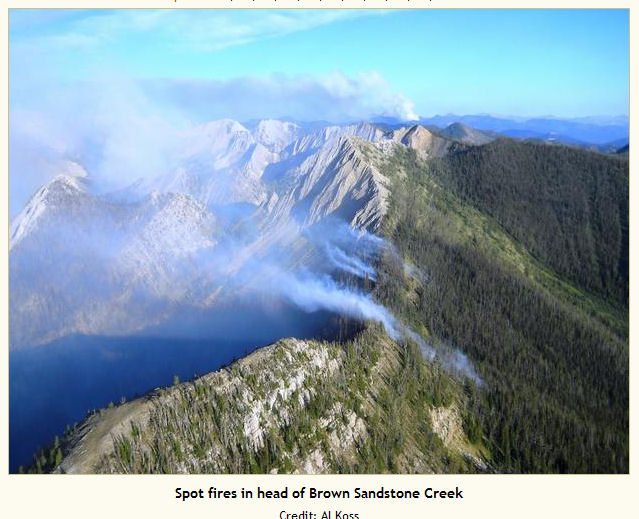
The Prisoner Lake Fire in the Bob Marshall Wilderness in western Montana is being managed for suppression; the fire was reported on July 30 on the Spotted Bear Ranger District. Natural rock barriers have helped contain the spread of the fire, which is estimated at 3333 acres. A number of spots outside the main perimeter were detected by aerial recon on Thursday in the head of Brownstone Creek. A crew of 8 firefighters is working on the half-acre spot fires and mopping up.
Prisoner Lake Fire in the Bob MarshallThe fire’s about 25 miles east of Condon. Trails in the area have been closed for public safety. Closed trails on the Flathead National Forest are: Trail #138 Molly Creek Trail, from the junction with the White River Trail #112 to White River Pass; Trail #380 South Fork of White River, from the junction with Trail #138 to its end; and Trail #626 Haystack Mountain, from the junction with Trail #138 to Haystack Mountain. Closed trails on the Lewis and Clark National Forest: Trail #211 Indian Creek, from White River Pass to the junction with Trail #203, West Fork of the South Fork Sun River.

An area closure has been issued for the areas around the Elbow Pass Complex to the south and east of the Prisoner Lake Fire.

Oklahoma firefighter cops to arson

A volunteer Muskogee County firefighter has admitted that he started seven grass fires last weekend. Dustin Davis, 25, a firefighter for Boynton Fire Department, told the fire chief that he set the fires so he could spend more time with his colleagues. Davis said he missed the camaraderie he’d once felt in the military. Muskogee County sheriff’s deputy Darrin Berry said the fires didn’t cause any injuries or damage.

The Oklahoman reported that fires were set in three rural areas around Boynton within hours of each other Sunday night. After the seventh fire, a man called 911 using Davis’ phone but identifying himself by a different name.
Dustin Davis
The fire chief, who suspected arson, listened to the 911 tape and recognized Davis’ voice. He then confronted Davis about it and got the confession. Berry said they suspected the fires had been set by someone familiar with firefighting, because the fires didn’t do any damage.

Muskogee County Sheriff Charles Pearson said the fire chief, Steve Allen, is a hero. “We’ve had these cases in the past with firefighters, but they’re hard to catch,” Pearson told a NewsOn6.com reporter. “We finally caught one.”

Pearson added that all the fires were set near resources — next to a lake, but not near baled hay or structures. Allen encouraged Davis to use a pager to report fires to fellow firefighters; he’d call the fires in and then show up for firefighting duty. Pearson said Davis was the first one to show up at every fire. Officials expect that he will be charged with seven counts of arson.