Manslaughter charge continues against couple in El Dorado Fire

The case against a couple accused of starting the 2020 El Dorado Fire with a gender-reveal device will move forward after one of four felony counts was dropped by a Superior Court judge in San Bernardino, California.

As reported by Brian Rokos of the Southern California News Group, one of four property-damage felony charges against Refugio Manuel Jimenez Jr. and wife Angelina Renee Jimenez was dismissed; a felony involuntary manslaughter charge remains along with three felony counts of recklessly causing a fire with great bodily injury and and three felony counts of recklessly causing a fire to an inhabited structure.
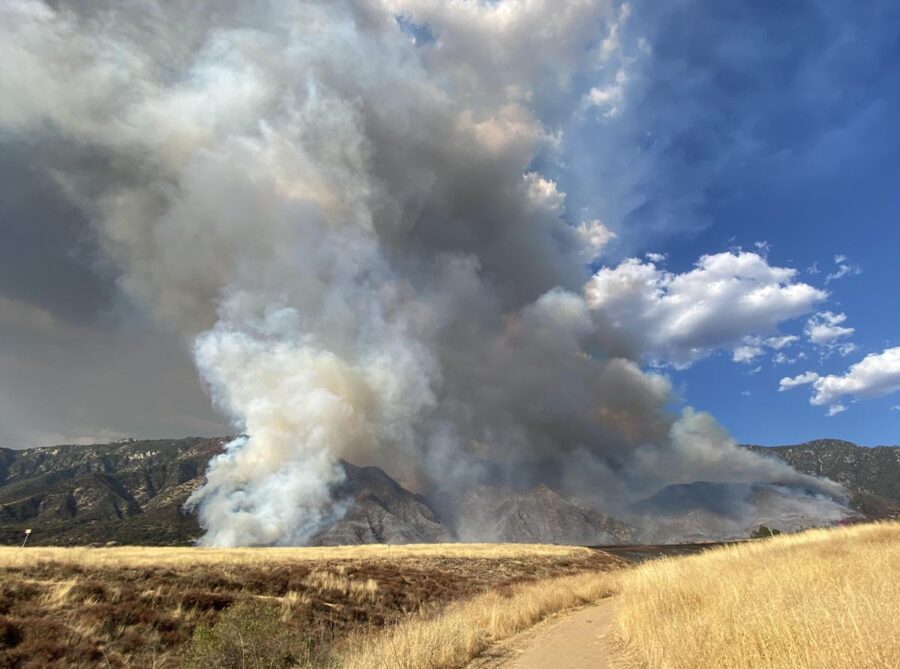
El Dorado Fire
El Dorado Fire, photo by Jeff Zimmerman Sept. 5, 2020.

Attorneys for the Jimenezes argued that the fire was accidentally ignited by the smoky gender-reveal device and sought dismissal of the manslaughter charge. Rokos reported that the deputy county attorney argued that “the Jimenezes should have known better than to set off the smoky device on a 103-degree day with low humidity in a park containing extremely dry brush.”

If convicted of involuntary manslaughter, the Jimenezes could be sentenced to four years in prison. They are currently on leave from their jobs as California correctional officers.

Prior coverage in Wildfire Today of the “Narrative” and related reports on the fatality of a squad leader on the Big Bear Interagency Hotshot Crew highlighted the increasing risks and complicated processes in a comprehensive analyses. Charles ‘Charlie’ Morton died as he was scouting the fire alone on September 17, 2020 when it overran his location.

Excerpts from the reports included:

“In his September 24, 2020 testimony before Congress, John Phipps, the Forest Service’s Deputy Chief of State and Private Forestry, stated “the system is not designed for this,” to illustrate the misalignment between the design of the wildland fire system and the reality that wildland fire responders routinely experience.”

“We continue to ask our wildland fire responders to save communities that are becoming increasingly unsavable. At what point do we declare communities without any semblance of defensible space not worth the risk of trying to save under extreme fire behavior conditions?”

As Bill Gabbert wrote about the reports on their release, they were notable for their in-depth compilation of lessons as well as the suggestion “that perhaps firefighters (or forestry technicians) should be called ‘fire responders’ so they don’t ‘view fire as an enemy.’ Other than that many of their conclusions are very reasonable, even though most of them have been previously identified in various forms. But having so many of them listed in one fatality report is unique, and could be useful. Unless it just disappears into files like so many others.”

One lesson is being applied – to streamline Type 1 and Type 2 team classifications. Other lessons – such as identifying the risk of scouting and implementing tracking devices and drones – are not moving ahead as quickly.
Firefighter health and workplace initiatives featured Jan. 26

Finding time and priority for our health is key for firefighters and fire managers. This week, we offer four activities for you to pick and choose or preferably quadruple-up, starting with two online meetings on Jan. 26 that will highlight initiatives to improve firefighter working conditions.

(1) On Thursday Jan. 26, 1 pm EST, Fire Engineering and Vector Solutions will host a webinar with Chief Todd LeDuc (Ret.), Chief Strategy Officer for Life Scan Wellness Centers, and Frank Leeb, Deputy Assistant Chief with FDNY, on “The Impact of Occupational Cancer: How to Reduce Exposure & the Role of Early Detection.”

The announcement notes that “The International Agency for Research on Cancer (IARC) recently updated its classification of the firefighting occupation to Group 1, ‘carcinogenic to humans,’ after conducting a new international study that found sufficient evidence linking cancer risk to the occupation. The danger is real, but there are strategies and resources that can reduce risk, enhance survival, and support firefighters.”

(2) Later on Thursday (and on Pacific Time), the Grassroots Wildland Firefighters offer their quarterly update starting at 5:30 pm PST. Register here or find out more at their home page at www.grwff.com. This quarter’s updates will likely discuss recent legislation concerning preemptive cancer coverage in the Federal Firefighters Fairness Act and other Grassroots WFF initiatives, as well as the announcement by outgoing president Kelly Martin of the incoming board, which features Luke Mayfield – President, Riva Duncan – Vice President, Bobbie Scopa – Secretary, and Jami Egland – Treasurer. Kudos to Martin’s work with GRWFF and wishing for continued success to the new board.

(3) In related health news, this past week the U.S. Fire Administration announced the pending opening of the National Firefighter Registry. https://www.usfa.fema.gov/blog/ci-011723.html.

As the USFA notes, “By adding your information to the National Firefighter Registry (NFR), you can help researchers better understand how your work affects the risk of getting cancer and how to lower this risk. According to National Institute for Occupational Safety and Health (NIOSH) research, cancer is a leading cause of death among firefighters, and research suggests firefighters are at higher risk for certain types of cancers when compared to the general population.”

A direct link to the NIOSH NFR website is at https://www.cdc.gov/niosh/firefighters/registry.html. Initially the Registry was anticipated to open this past fall; it’s now scheduled to open this winter for confidential sharing of cancer diagnoses and work histories. As the NFR notes, “The more firefighters who sign up for the registry through its secure web portal, the more information researchers will have to learn about cancer in the fire service and how to protect firefighters from developing cancer in the line of duty.”

(4) Finally, a reminder –- there’s an opportunity to learn more of cancer and PTSD risks while adding a cancer/health donation. See our article Share a few hours for cancer awareness (and help fund our profession’s response) for more – and if you need an extra incentive, remember that the Vector-Solutions sponsored donation deadline is Jan. 31.

What a wet West Coast winter foretells for fire season 2023

The above-normal winter precipitation in California and over parts of the American West has already raised the question — even before the floodwaters have receded — of how this winter precip might either dampen the fuel beds or spawn a monster crop of fine fuels come spring and summer of 2023.

There’s a lot of winter and spring to come, and the first-of-the-month fire outlooks are 10 days out, but many are sensing that fire season in wetter locales will begin later. This delay is more likely in California, which is coping with a walloping by deep and repeated atmospheric rivers, resulting in near-record snowpack and flooding that may be familiar historically but not during the most recent drought decades.

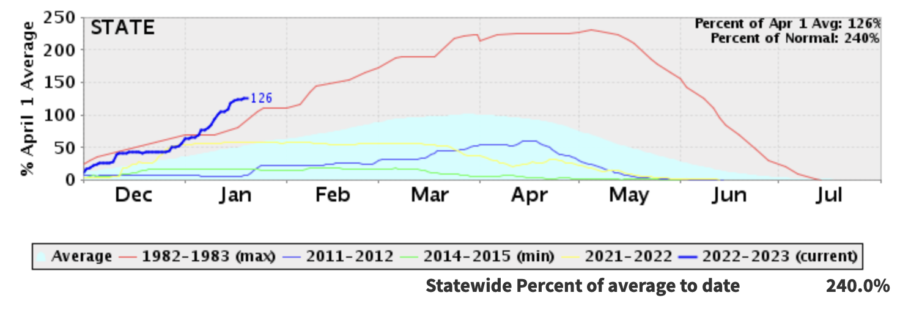
Consider the California snowpack as of Jan. 20, 2023. Whether by graph or map, the message is clear: the snowpack is significant and snowmelt periods will likely be extended. Statewide the snowpack is at 126% of the April 1 normal, but 240% for the current water year-to-date.

Calif Statewide Snowpack years 2023-01-20
California Statewide Snowpack as of Jan. 20, 2023. https://cdec.water.ca.gov/snowapp/swcchart.action

With a focus on California’s rapid switch from drought to flood, it’s clearly a banner water year to analyze — which is too painfully clear to the many who are working through a long recovery from flood damages estimated to exceed $1 billion. As CNN reported, at one point an estimated 90% of California’s population was under some form of flood watch, which equates to 10% of the US population.

Per California Water Watch, the state is at 167% of average precipitation for this date, but storms aren’t a universal event. While the map for accumulated water year precipitation beginning Oct. 1 shows higher departure from average over most of the state, the most-intense  “purple” is being collected in the higher elevations in the central and northern mountains, and sopping the lower coastal regions that were hit full-force by the atmospheric rivers.

See California WaterWatch for regular updates.
See California WaterWatch for regular updates: https://cww.water.ca.gov

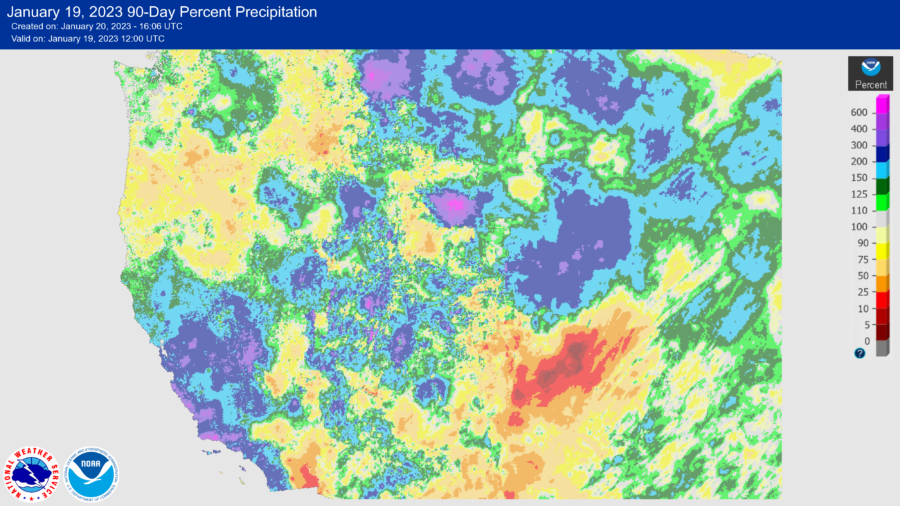
As damaging as the storms have been for so many communities, much of the West continues to feel the effects of long-term drought. A broader west-wide map of  precipitation of the past three months shows the patchiness of these bomb cyclones.

January 19, 2023 90-Day Percent Precipitation
Precipitation for the past 3 months.

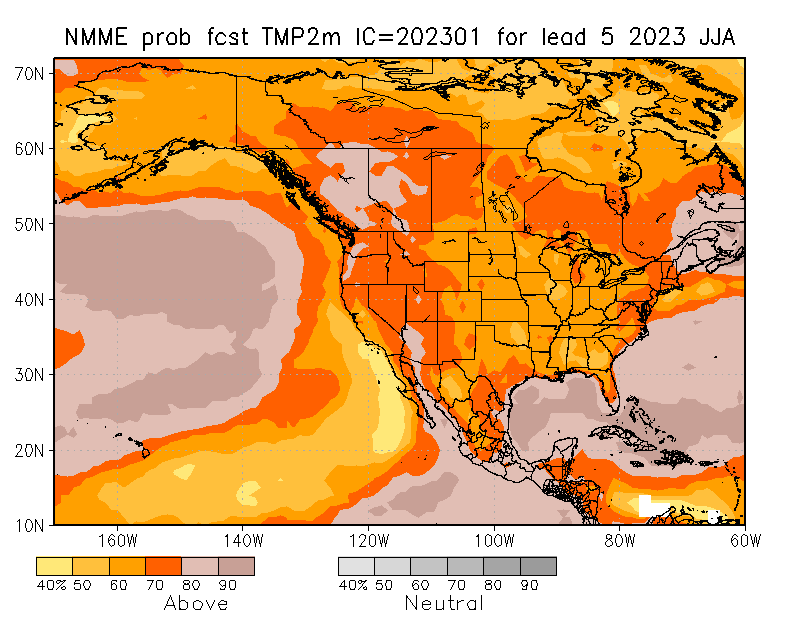
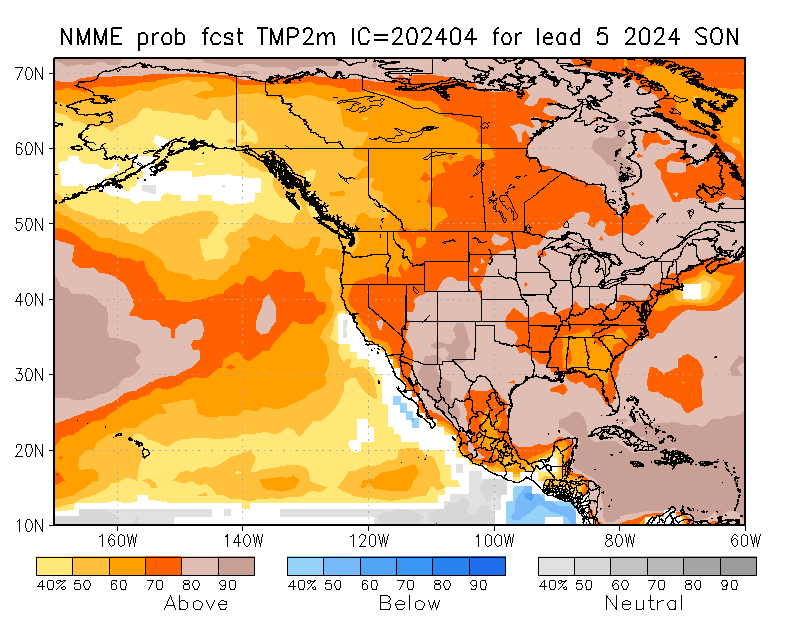
Looking ahead, a range of analysis tools foretell the potential of a warm summer and the likely impacts of long-term drought returning. The five-month lead for June-July-August (JJA), from the North American Multi-Modal Ensemble (or NMME), paints a warm picture for North America, with most of the U.S. West at 70% or higher likelihood for warmer than normal temps. Which will in turn elevate the evaporation potential during growing (and curing) season.

NMME ensemble temperature forecast for JJA 2023.
NMME ensemble temperature forecast for JJA 2023. https://www.cpc.ncep.noaa.gov/products/NMME/prob/images/prob_ensemble_tmp2m_us_season5.png

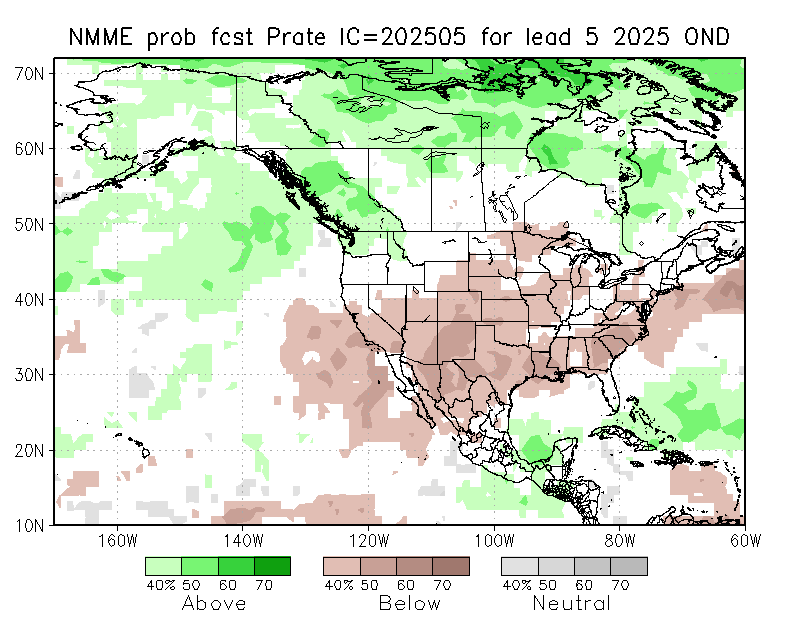
The same JJA outlook indicates a potential for most of North America to receive normal summer precip (though normal is often quite dry for much of the Western regions), with wetter likelihood for Alaska and drier than normal for western and northern Canada, the Pacific Northwest, the lower Mississippi Valley into Texas and south to Mexico and Central America.

NMME ensemble precipitation for JJA 2023. https://www.cpc.ncep.noaa.gov/products/NMME/prob/images/prob_ensemble_prate_us_season5.png

How these ensemble outlooks play out will depend in part on a projected switch from La Niña to neutral or potentially El Niño conditions. And the impact of the winter’s snowpack will depend on how early and warm the spring temperatures rise. More on that potential when we look at the February outlooks.

Thanks to the Analysts … Many of these resources are digested from the outlooks and links prepared and shared by National and Geographic Area analysts. So a thanks for the work these folks do, season in and season out. This update owes much to the analysts who produced the January outlooks for Northern California and Southern California.

Share a few hours for cancer awareness (and help fund our profession’s response)

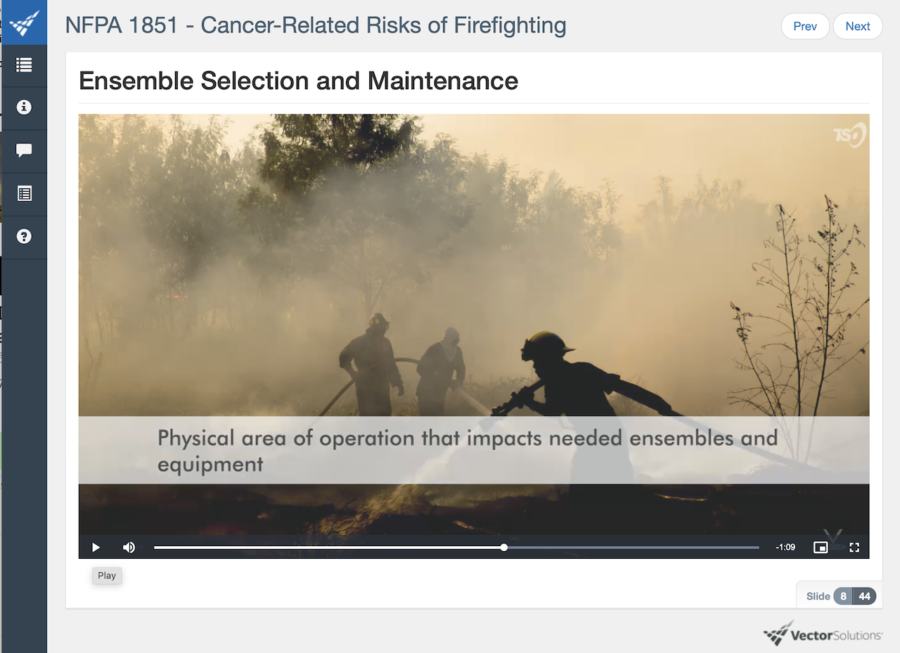
NFPA1851 training, Vector video. Areas of operation include wildland firefighting.
Screenshot of NFPA 1851 training video by Vector Solutions, focused on areas of operation where carcinogens can impact PPE and increase firefighter exposure.

For the past day or so I’ve been dropping into a cancer awareness training video hosted by Vector Solutions. I was recruited in part by Vector’s pledge to donate to the Firefighter Cancer Support Network for every completed course. About halfway through the two-hour course, guided by NFPA 1851’s “Cancer-Related Risks of Firefighting,” I paused the screen, as I have many times, this time at the list of cancers linked to firefighting … and typed out the systemic locations and types of cancers … genitourinary, kidney, testicular, brain, head and neck, non-Hodgkins lymphoma, thyroid, and — as the narrator notes — “skin cancer, especially in wildland firefighters.”

After that I stopped taking breaks, following the chapters that explored the risks and protective actions we can take against them — all the time noting that while fire is fire, NFPA 1851 is by definition a standard focused on “Selection, Care, and Maintenance of Protective Ensembles for Structural Fire Fighting and Proximity Fire Fighting.” While many in the field are cross-qualified in structure and wildland firefighting, of equal concern — whether we’re responding in turnouts or wildland PPE — is that many key cancer risks are shared across the structural and wildland communities.

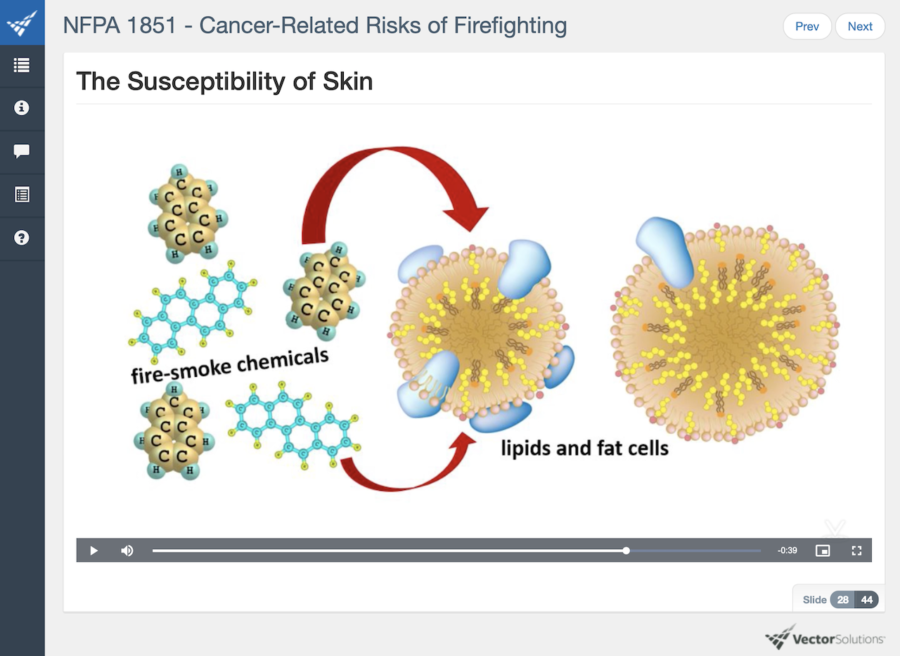
For instance, there is the caution in this training against skin exposure. While those in wildland fire are so often cautioned to protect our airways, the skin exposure to airborne carcinogens and char can be significant in wildland firefighting. The training notes the formidable cocktail of chemicals released in structural fire suppression — and though the vectors and hazards are different, take a moment to compare the protective components of turnouts and SCBAs to wildland Nomex and bandanas. And as the training notes, “For every 5 degrees F increase in skin temperature, there is a 400% increase in the absorption capability of our skin.” And exposed skin is a conduit for carcinogens to bioaccumulate in fat cells and lipids.

Skin exposed to carcinogens can lead to bioaccumulation in fat cells. Screenshot: NFPA 1851 Section training.

To explore the connections between cancer and firefighting, Vector Solutions connected us with Chief Todd LeDuc (@ToddJLeDuc), retired from Broward County Fire Rescue, board member for the International Association of Fire Chief’s (IAFC) Safety Health & Survival Section, and editor of “Surviving the Fire Service.” We’ll have more from our conversation with Chief LeDuc in upcoming posts, but what’s key for now is the importance of awareness noted by LeDuc. Firefighters — structural and wildland — face increased cancer risk, and we should prioritize early detection and treatment while integrating immediate risk reduction. Leduc’s core advice for structural and wildland firefighters?”Get the carcinogen off the body as soon as we can.” He shared the concept to “Shower within an hour” after exposure to clean carcinogens from skin exposed to smoke — or more immediately (and more timely and feasible in wildfire work) is to use wet wipes to clean off during a break.

Another shared yet often hidden fire-service carcinogen is diesel exhaust, a Group 1 carcinogen (as is benzene). As the training notes, the state of California states that “diesel exhaust provides the highest cancer risk of any contaminate.” And as the narrator notes, diesel exhaust is “A real threat that is by and largely preventable, but for the cost” — the cost being that of pollution-trapping entrainment systems or finding alternative fuels and procedures for heavy-engines and generators.

And don’t forget to think of the impacts of 24-hour shift work has on our overall health, including an increased risk of cancer.

We will share additional posts during Firefighter Cancer Awareness Month, but in the meantime you might put aside two hours for the training. Complete the test (I passed at 80%) and “$1 will be donated [by Vector Solutions] to the American Cancer Society and Firefighter Cancer Support Network for each completed course.” Complete the PTSD course for another donation — and consider a matching donation to support firefighter safety in 2023.

LINKS

Fire leaders promote national fire strategy

As the U.S. Fire Administrator and fire leaders tour the East Coast this week there are two key goals — to honor those who died in fires this past year, and to promote an updated national fire strategy. On January 12 in Washington, D.C., Fire Administrator Dr. Lori Moore-Merrell and a range of national fire leaders will close out the week’s events by remembering those killed in fires while also highlighting key strategies and efforts needed to address the fire problem in the United States.

The national strategy grew from an October 2022 Summit on Fire Prevention and Control — a regular summit launched in 1947 by President Harry Truman. The current conclusions, based on a gathering of fire-science panelists, includes key wildlife components.

While many of the recommendations apply to fire wherever it occurs — “to invest in a national apprenticeship program to address the firefighter shortage” that also supports a more diverse and inclusive workforce; to establish a comprehensive firefighter cancer strategy; and to support behavioral health and suicide prevention — two in particular focus on wildfire concerns:

Prepare all firefighters for the climate-driven increase in wildfires in the wildland urban interface (WUI) by providing them with the proper training and equipment.

Create safer communities by implementing and enforcing codes and standards, especially in the WUI and underserved and vulnerable populations, and provide affordable and fire-safe housing.

The USFA web pages focused on the Summit on Fire Prevention and Control develops the science and the strategies — https://www.usfa.fema.gov/about/fire-administrators-summit/ — and we’ll continue our coverage this week on how the strategies may help us address the firefighter cancer issue and find their way to the colleagues, fireground and communities we serve.


Aftermath in Viña del Mar, Chile

December 2022 in Chile was marked by record hot temperatures, with wildfires burning around the capital city of Santiago and producing persistent smoke and public health impacts. On December 22, a fire in a forested canyon of Tranque Sur burned into the coastal resort city of Viña Del Mar (north of Valparaiso), resulting in one death, many injured, and more than 100 homes destroyed. Chile’s president declared a state of emergency and catastrophe. A week later and 800 kilometers (500 miles) south of Viña Del Mar, firefighters responded to a fire in the Galvarino commune where a single-engine air tanker crashed on December 31, killing the pilot, Luis Sevillano Moreno, a Spanish national. 

For the early months of 2023, the forecast for Chile continues for hot, dry conditions.

A Chilean photojournalist, Carlos Vera Mancilla, was at Viña Del Mar as the fire was being controlled. Vera Mancilla has photographed many wildfires and their impacts, including a photo series in the January-February 2017 issue of Wildfire Magazine (https://www.iawfonline.org/wp-content/uploads/2018/02/26.1-Jan-Feb-2017-Wildfire-Final-Web-1.pdf) and excerpted below. One of his earlier photographs, from the 2016 protests in Santiago organized by relatives of the “disappeared”, gained acclaim as an image that conveyed the changing state of democracy in his country: https://www.cnn.com/2016/09/14/americas/chile-girl-protest-photo/index.html. 

Here is what he witnessed in 2022 in Viña Del Mar, with captions drawn from his notes. 

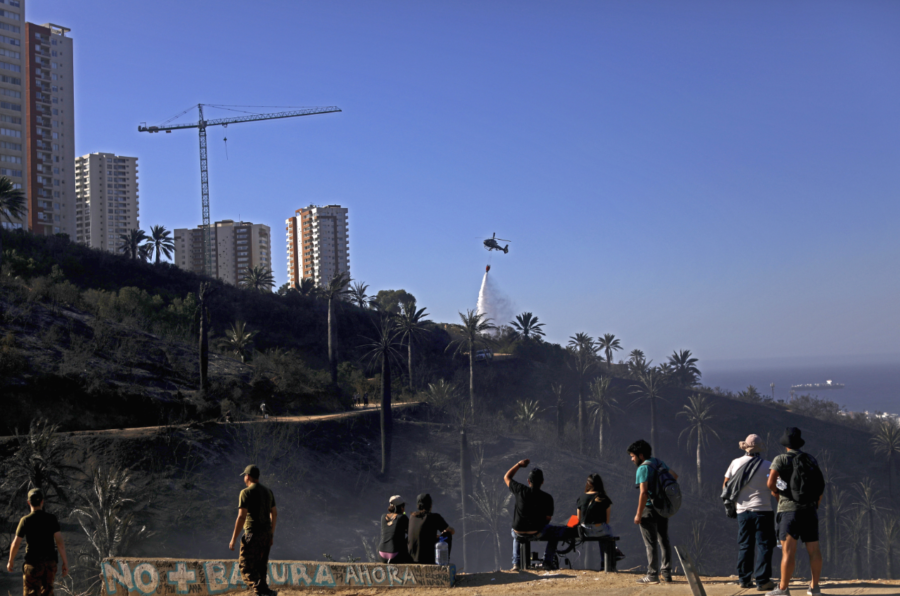
Vina De Mar, Chile - Day 2 Fire Control
Viña del Mar – Alto Forestry Sector. The remaining fires are being controlled on Day 2 (December 23, 2022). Displaced residents look on from the burned Tranque Sur urban sector of “autoconstrucción viviendas” — homes that were self-constructed, built by the residents and community members, sometimes referred to as “mutual aid” — more at https://infoinvi.uchilefau.cl/glosario/autoconstruccion/. The burned houses bordered along real estate and resort complexes. Photo: Carlos Vera Mancilla.
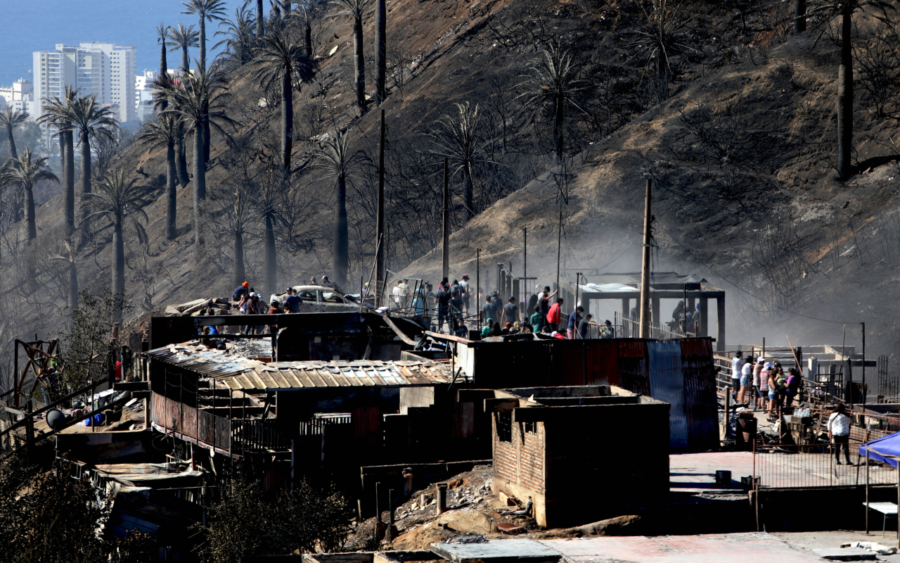
Vina Del Mar, Chile - debris removal.
Authorities and local citizens work in solidarity as they remove debris from burned buildings and provide humanitarian assistance. Photo: Carlos Vera Mancilla.
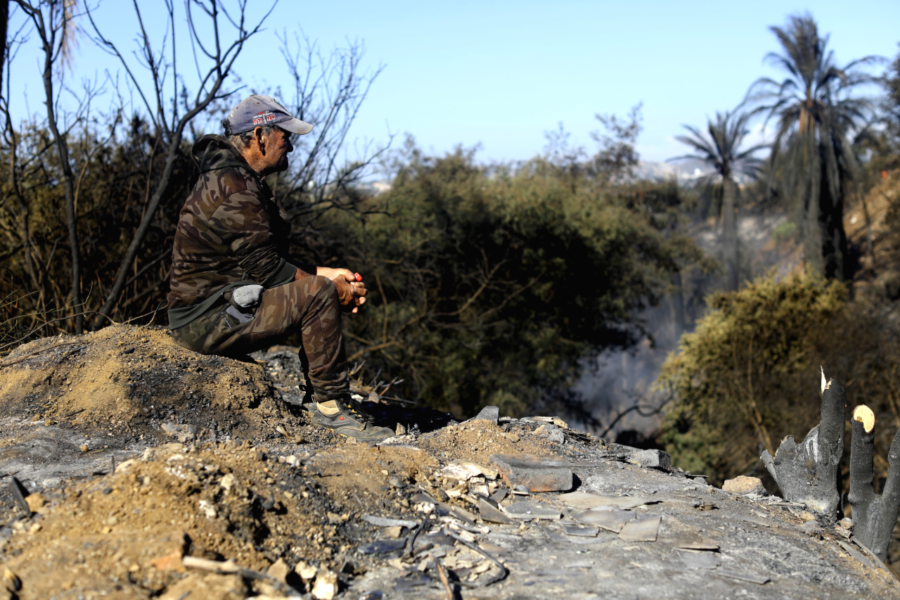
Vina Del Mar, Chile - a resident's sorrow.
Because of negative situations that occurred recently with the national press, I did not dare to consult his name — his sorrow collapsing with the Tranque Sur’s destructive fire. Photo: Carlos Vera Mancilla.
Vina Del Mar, Chile - a forest-urban fire.
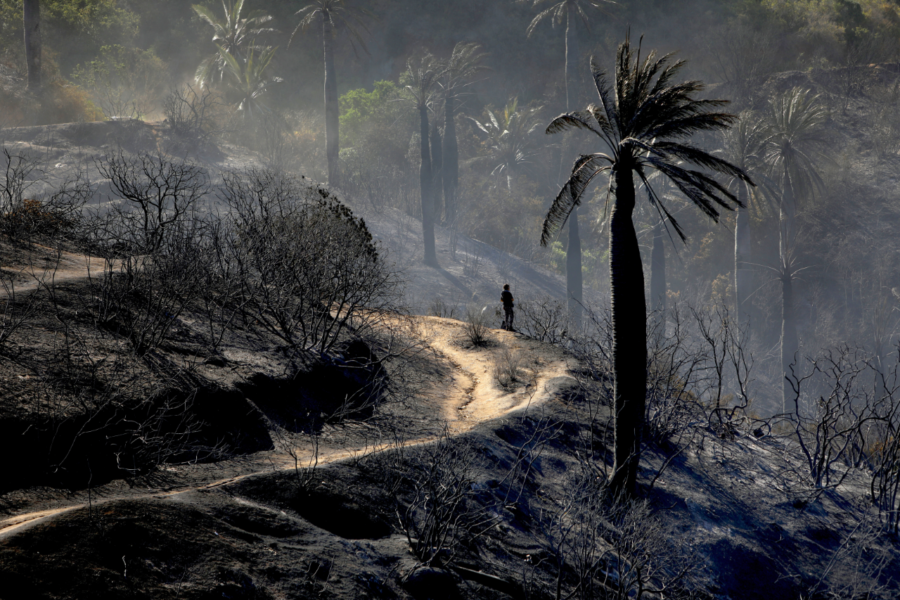
A forest and urban fire. With the desolation of nature and the inhabiting community, there is no convincing explanation for the community of what happened, nor resignation to the disaster as recovery begins. Photo: Carlos Vera Mancilla.

+

Photos of fire damages from January 2017 in Valparaiso, Chile, by Carlos Vera Mancilla, from the January-February 2017 issue of Wildfire Magazine.

[pdf-embedder url=”https://wildfiretoday.com/wp-content/uploads/2023/01/26.1-Jan-Feb-2017-Wildfire-Mancilla_Chile-pages-16-17.pdf” title=”26.1-Jan-Feb-2017-Wildfire-Mancilla_Chile pages 16, 17″]

Outlook for January 2023 – normal, with potential for Texas, Florida

It wouldn’t be a new year (or a new month) for US firefighters without the release of the monthly National Significant Wildland Fire Potential Outlook. For January 2023, from winter into spring, the outlook reflects the series of strong winter storms that have crossed the country west to east and a resulting reduction in fire potential. And with La Niña conditions continuing as the dominant weather influence through February, we will likely see a stormy winter and some moderation of drought … though a transition to neutral El Niño-Southern Oscillation (ENSO) conditions are expected to return in spring (with a 71% chance for neutral), when we may see other teleconnection patterns shaping spring and summer. 

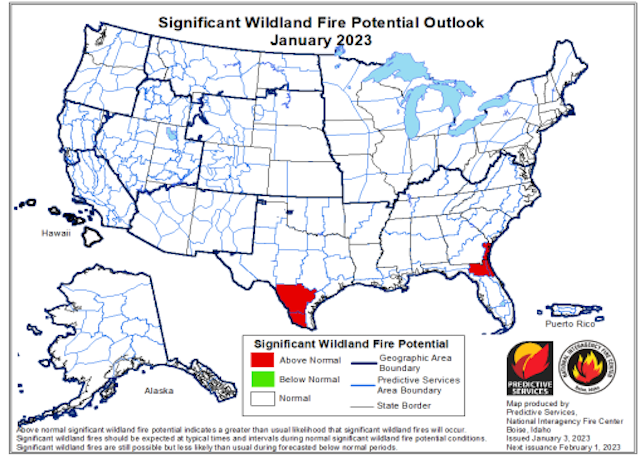
For January 2023, significant fire activity is limited to far southern Texas, northeast Florida and southeast Georgia.

Significant Wildland Fire Potential - January 2023.


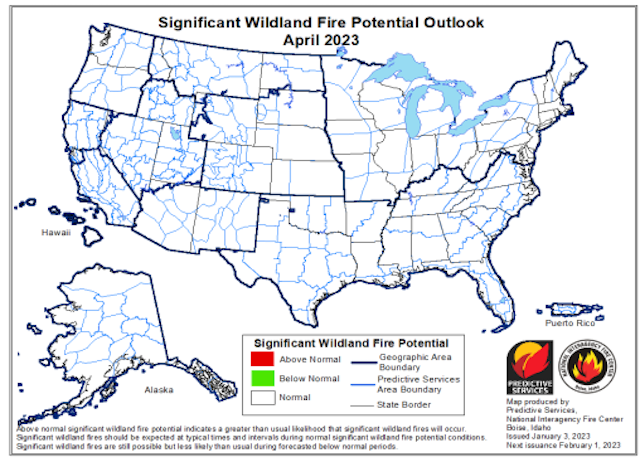
Significant fire activity for February and March is expected to expand from these areas … but by April, with typical spring green-up expected, the entire US can look for normal fire activity.

Significant Wildland Fire Potential - April 2023.

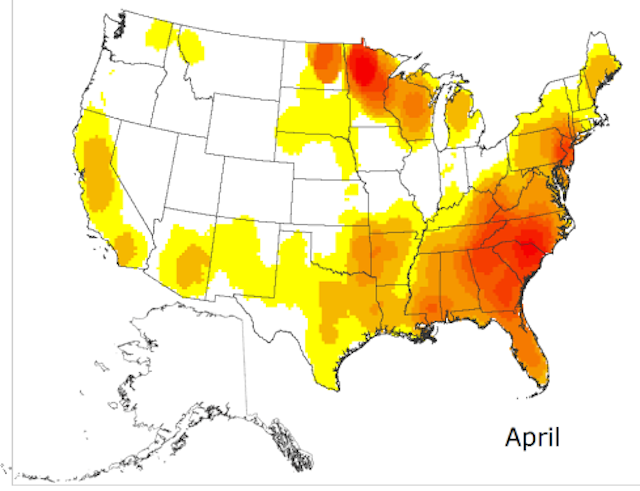
What is normal for January? While the Outlook doesn’t infer fire size or intensity in these outlook-maps, the monthly fire density maps do convey the expansion of what we often think of as prescribed-fire season — with normal fire activity typically focused in the south and southeast in mid-winter and expanding west and north as we move into April.

Normal Fire Season Progression - January.
Normal Fire Season Progression - April.

Here’s a permalink to the January 2023 Outlook.


First flight of teleoperated helicopter aims for agile and safer fire operations

Helitack and on-the-ground firefighters learn to keep eye contact with a helicopter pilot. So it’s unnerving to look into the cockpit of this Robinson R22 and not see a pilot’s helmet as it lifts into a hover. But this is the point – this is a video of the first test flight of an uncrewed, teleoperated helicopter focused on fire missions. And it takes just a moment to spot a focused face in the control van behind the hovering helicopter – the pilot, holding a cautious yet quite committed in-ground hover.

First teleoperated flight of Robinson helicopter with Rotor Technologies
First teleoperated flight of Robinson helicopter with Rotor Technologies. The pilot is in the control van on the right.

On December 2, 2022, Rotor Technologies’ teleoperation tools demonstrated the first and key technical challenge of moving the pilot out of the helicopter. The first three-minute flight of “Birdy McBirdface” (named in honor of  “Boaty McBoatface,” a pioneering British uncrewed submersible) demonstrated the initial flight operations with their CloudPilot system and began testing and refining the remote piloting process.

To get to this launch, company co-founders Dr. Hector Xu and Greg McMillan studied the opportunities for improving aviation with technology. Their research showed that “firefighting came across as a very urgent need,” Xu said after the first series of test flights. “It’s a growing need in terms of the climate crisis. And people don’t have the tools to fight fires.”

After a year and half of programming and prototypes, they’ve launched their CloudPilot teleoperations system that relies on low earth orbit satellites to integrate accurate, real-time location-sharing and communications between the pilot and the helicopter.

While others are developing larger payload aircraft with autonomous piloting, Rotor is focused on light helicopters with real-time but remote piloting. By removing the pilot from the light helicopter, the payload increases from 170 pounds to 400, with a three-hour flight time. Even with that gain, Xu acknowledges that “in suppression operations, we will always be a little payload limited when compared with the competition.”

The advantages of a remote pilot become more apparent in precise and interactive operations, both high risk and more routine, “when flying low and slow in the deadman’s curve, such as ignitions, and providing logistics, food, water, tools. The case that is exciting is working on the fringes of the day. To build technology that is able to fly beyond visual flight restrictions, that improves situational awareness of remote pilots beyond the physical cockpit. The technology we’re building will improve situational awareness in low-visibility situations,” both to avoid inadvertent entry into instrument meteorology conditions (IMC) and to ensure safe flying in IMC. With CloudPilot technologies, even night operations become possible – think of the potential of aerial night ignitions.

Yet what adds the most value to a light helicopter with remote piloting? As Xu notes, “People have been building uncrewed rotorcraft for awhile … trying to build fully autonomous systems. We’re very clear this is teleoperations. A pilot is operating this remotely. Not a lot of people are building this technology, particularly in the civilian operations.”

And it is this clear relationship – between pilot and helicopter, and with fire operations on the ground and in the air – that Xu holds is unique in their approach, which will help build trust in new technologies that will in turn support safer mission operations overall.

Beyond wildland firefighting, use scenarios include disaster response, emergency management and eventually passenger certification.

With their success in the first flights, Rotor Technologies is planning for simulated firefighting scenarios in field tests this summer for their two prototype helicopters.

For more, see Rotor’s Medium post at https://medium.com/@rotor_ceo/first-flight-for-uncrewed-firefighting-helicopter-db5deb15a101.