North America: Hot, dry winter may bring a burning spring

A smoke plume at sunset on the 8 Ball Fire near Clarendon, Texas. Photo by Texas A&M Forest Service Texas.

As we come into the north-flowing warmth of the North American spring, the impacts of snow drought and heat dome are prepping wildland fuels for what may be a transition to a “super” El Nino.

Yet it is spring, and reading the North American Seasonal Fire Assessment and Outlook for April through June we note that there is something assuring in the calm, expert insights from nearly a dozen analysts from Servicio Meteorológico Nacional (Mexico), the National Interagency Fire Center (United States) and Natural Resources Canada.

This is not to downplay a winter with extraordinary fire activity — for the U.S., the latest national Situation Report counts 22,000 fires year-to-date (150 percent of the 10-year average) and nearly 1.8 million acres burned (190 percent of average).

Moving into the spring, the Seasonal Fire Assessment identifies numerous regions likely to see above-normal fire activity (and some will be very active), but overall there are broad regions enjoying what may be a truncated spring green-up with the potential to transition too quickly into what many fear will be a quite literal (and potentially tragic) barn-burner of a summer. 

In the Seasonal Fire Assessment, released April 15, the authors observe that what North America faces is both global and as local as the dry dirt under our feet: “The critical factors influencing significant fire potential for this outlook period are global climate patterns related to sea surface temperatures, particularly in the Pacific Ocean, and large scale, longer-term soil moisture deficit.”

It’s the soil moisture deficit that’s a challenge to overcome … with the current Drought Outlook for mid-April highlighting the drought in the US West (with growing dry holes in the central Rockies) and in much of the Southeast. 

A 12-week drought animation, closing out on April 14, illustrates the expanding deficit, with at least 70% of the U.S. in drought since the beginning of February.

This drought impact has already been noted in a Fuels and Fire Behavior Advisory for the Southeastern United States, issued April 16 for the southern Appalachians, Piedmont and coastal Southeast — basically, a swath from New Orleans to Cincinnati, Ohio to Washington, D.C., to Florida.

The Southern Area analysts caution that “normal” fire conditions may not moderate the extraordinary dry fuels …

Typical fire weather thresholds may not apply when record high fire danger and record heat align – critical conditions may occur with RH 5% above and winds 5 mph below regional thresholds

Do not be fooled by fuels that appear to be green – fire will spread readily under current conditions

Back to the North American Seasonal Fire Assessment, we note that the above normal activity for the southeast U.S. is also appearing in Mexico’s active fire season. 

As summarized by the analysts: “Considering current temperature and precipitation patterns, national drought status, and seasonal forecasts, wildfire activity is expected to escalate across most of Mexico during April and May.” 

While they note that spring is “projected to be comparatively less warm due to slightly above average rainfall, which will enhance soil moisture and effectively modulate fire intensity.” With the potential for warmer and moister conditions, they also note the impacts of variability: “the transitioning to ENSO-neutral in May keeps the potential for extreme dry or wet events … a highly unstable and wetter than normal spring is expected compared to previous years, though significant heat will still characterize the season.” Moving into June, fire activity will move north into northern Baja and moderate in the south.

Moving north, the U.S. is likely to parallel the seasonal north-ward green-up, with notable exceptions: 

In June, above normal potential will continue in much of the Southwest, while also expected into much of southern Nevada, southern Utah, and the Colorado West Slope. Above normal potential will also expand across much of northern California and the Inland Northwest. In the Southeast, above normal potential is forecast to persist for South Georgia and Florida, while also expected for portions of East Texas and Louisiana.

The western U.S., is expecting a summer-long impact from the dire lack of snow water equivalent (SWE). The combination of a record snow drought followed by record heat dome has left key watershed regions at 9 to 53 percent SWE of normal.

Canada, however, is likely to benefit from a winter snowpack more robust than the U.S., with fire activity increasing in June — though the analysts note “minimal skill” in some of the outlooks, due to the movement from La Niña and into ENSO-neutral conditions.

For June, much of the country [Canada] shows at least a moderate probability of positive temperature anomalies, but these are particularly evident throughout British Columbia and Labrador as well as areas surrounding Hudson’s Bay. Precipitation outlooks offer no clear signal and minimal skill. That, combined with likely ENSO-neutral conditions supports higher fire potential in June throughout British Columbia and areas surrounding James Bay, west of Hudson’s Bay, and extending into the eastern Northwest Territories. Near-normal activity is expected in the rest of Canada in June.

After June, the impact of ocean-warming may lead us into a “super” El Niño, with the El Niño outlook moving from moderate to strong to very strong over the next few months.

Beginning in June, there is 79 percent likelihood of some stage of El Niño ocean warming. By August, the probability rises to 90 percent, with 63 percent likelihood of Moderate to Very Strong conditions. For much of the U.S, outlooks suggest warmer than normal temperatures and variable precipitation effects. An analysis from Severe Weather Europe expands the impacts and predicts “global weather disruption” for 2026 into 2027.

For now, the North American seasonal fire assessment maps offer a view of our immediate fire future, April through June. Of note: in the three months of continent-wide fire assessments, only two relatively small regions in Canada indicate below-normal fire activity.

Retired La Grande hotshot dies

By Lance Gomez  
It is with profound sadness that I write to announce the passing of a beloved community staple, coworker, friend, partner and father, Mark Gomez, 67.

He passed away after a brief, yet fierce, battle with a respiratory illness. A light to all those who knew him, Mark “GoGo” Gomez was fittingly born in Los Alamos, New Mexico, known as the land of Enchantment, on Nov. 19, 1956. The middle child of Hilario and Emily Gomez, he learned from an early age how to become the glue that holds people together through laughter, storytelling and love. His early years were spent hunting and fishing in New Mexico, with some time spent in San Diego, where he honed his love of surfing and baseball. Both locations molded my father into the avid outdoorsman he was for the rest of his life.

After graduating from Pojoaque High School in 1974, this same love for the outdoors led him and his first wife, Wendy Friedman, to La Grande, Oregon, nestled deep among the forests and rivers he called home for the rest of his life. After two beautiful children, Sari and Lance, Wendy and my father parted ways. He settled into his careers at Blue Mountain Sports and on the Union/La Grande Interagency Hot Shot crews, where he forged his lifelong friendships and met my mother, Trish Wallace, his forever partner.

The next 37 years for them were filled with adventure, from backpacking across Mexico and mountain biking through Moab to skiing the mountains of the Northwest, hiking in the Eagle Cap Wilderness and firefighting during the summers on the La Grande and Union interagency crews. From fire to fisheries and recreation to engineering, my dad got to live out his passions in his work alongside his La Grande Ranger District family up until his retirement in 2019.

If I had to describe my dad in one word, it would be “fire.” Fire, for the job he cherished and the coworkers-turned-friends-turned family. Fire for his passion of fishing, exploring, and all things outdoors that fueled his career and lifestyle. Fire, for the one he lit under you when he saw your potential and pushed you toward it. Fire, because though sometimes it will burn you, it will always keep you warm and help you find your way.

In his last days, Dad’s doctor told us that “love cannot be divided, it only can multiply.”

Anyone who was lucky enough to know my dad knows this to be true. To know him is to feel infinite bounds of love. Whether he was yelling at you or for you, he was always in your corner, and I like to think we were all better people for being a part of his life. I dream he is at peace now, fishing and exploring on the great river of life. When the wind blows hard through the trees or thunder rolls in the distance, know that is my dad, sharing a bit of himself with you from above.

After many years apart, he joins his mother and father, and his oldest and youngest brothers in the afterlife. He is survived by his spouse, Trish; his sister, Cheryl; his brother, Jeff; his nieces and nephews, who adore him; his children, Sari, Lance and Logan; and his grandchildren, Tuko and Tule.

A celebration of his life will take place on May 11 starting at 1 p.m. at the Hot Lake RV Park at 65182 Hot Lake Lane, La Grande. Bring a potluck side dish and some stories. Hawaiian shirts are most certainly encouraged. Online condolences may be made to the family at lovelandfuneralchapel.com

Director reflects on ‘Elemental’ film as it moves to streaming

The day before the documentary film Elemental: Reimagine Wildfire was set to begin streaming on Apple TV, Google Play and Amazon, the director Trip Jennings received a text: a jury found the power company PacifiCorp liable for the Oregon Labor Day fires that serve as examples in the film of why we need to rethink our relationships and responses to wildland fire.

We were talking with Jennings about the making of the film when the text arrived. He shared the news, and remembered, as a filmmaker and resident of Portland, Oregon, those days of wind, smoke and firestorms, of so many lost homes, and of when the film’s team first saw the footage of sparking power lines that ignited the destructive fires.

The news settled and we turned back to the other topics that he’s been focusing on: the vital dialogues of science, the challenging transitions of policy and funding, and the role of insurance as a potential pivot point to help us face wildfire’s risks to homes.

At the moment we were talking about the film itself, and the continuing conversations that the film prompts.

“Elemental: Reimagine Wildfire” is streaming on Apple TV, Google Play, and Amazon beginning June 13. Select your platform at elementalfilm.com/streaming-pre-sale.

From initial screenings of the film. Jennings learned that the film sells out in communities where there are effective partnerships working to face wildfire issues. In these communities, Jennings said, the audience may have “a little bit of experience with fire, and they’re curious what to do. They want ideas on how to move forward, they’re feeling vulnerable and concerned. And fire folks are excited about the film too and want to share it. Yet it’s hard for firefighters to say, there’s a limit to what we can do.”

Which is one component of the theme in Elemental. That what we’ve been doing isn’t solving the problems. “We point out the limits to suppression,” though Jennings added that “There’s not a world where we’re not going to fund fire suppression.” And the role that fire professionals play in an ongoing paradigm shift is key. In making the film and during screenings, Jennings observed the “incredible and rare social capital of firefighters” and how their observations of the fire challenge is helping communities change. He was also pleased that the film caught enough of the nuances of fire management and fire science so that it resonated with firefighters (as well as fire survivors and politicians).

The role and voices of firefighters, cultural burners (firelighters), fire scientists, community members and policy makers will all be required in reimagining fire (and all are represented in the film). “We need to change the way we’re thinking about the cultural narrative. When we say the problem is in the forest, it’s not a sufficient answer. The forest is a value at risk, not a solution [to be implemented by logging]. If we can separate fire safety conversations from forest product industry conversations. … if we can separate the conversations more, to let fire safety be its own topic and goal, then the film will be a huge win. And then we can have a more nuanced conversation that takes in the science.”

While suppression will always be a component, Jennings observed that what we fund when it comes to fire and fuels management needs to be focused on the values at risk, often the homes, which may not benefit from a distant forest treatment (and he notes that brush and grass fires, and home-to-home burning, can be as destructive as “forest” fires). Or, for that matter, a logging project packaged as fire safety.

Jennings pointed out that federal fuels management funding is often limited to federal lands, when the dollars would be more effective if they went directly to fire-hardening houses. “In California, the best numbers we can find show that only two of every hundred dollars is spent on the the home. The rest is spent on vegetation management. That’s part of what we help communicate in the film” … including the benefit of focusing on the home ignition zone, building on the work of Jack Cohen, the National Fire Protection Association (NFPA) and the Insurance Institute. of Business and Home Safety (IBHS). And to remember “that in one year we lost more homes in Paradise to fire than were built in California.”

Rebuilding homes is very expensive and fraught with legal and practical issues. “We’ve found ourselves in the insurance space,” Jennings said when the film first began to screen, in part because of ongoing work that Jennings and film producer/editor Sara Quinn are doing for the PBS Terra show “Weathered.”

Director Trip Jennings and producer/editor Sara Quinn filming at the El Dorado Fire for 'Elemental.' Photo: Ryan Walsh.
Director Trip Jennings and producer/editor Sara Quinn filming at the El Dorado Fire for ‘Elemental.’ Photo: Ryan Walsh.

“It’s the story of what’s going on for so many people rebuilding after fires. A lot of people who got dropped from insurance after a fire, for instance, if their house didn’t burn all the way down. A lot of recovery efforts seem to help those who have time and financial resources.”

And the rates rise. “We talked to someone who paid $1000 total, now their insurance totals $4500. I might spend that money to improve my home, not on insurance.” When it comes to fuels treatment, he said “I think we need to see that where the money goes. Even if it goes to private homes, that is a huge private benefit but everyone is safer if we spend money preparing homes for wildfires. If we cant get out the loop that we can only spend [fuel treatment and preparedness funds] on public lands.”

With some insurers leaving home insurance markets, Jennings wondered if the challenge of identifying the specific cost of wildfire risk, and charging for that through the home insurance process, may be a watershed moment. Again he echoed the ability of the film to reach targeted audiences. With showings to insurance professionals and risk managers he anticipates they may see the value to more clearly identify homes and home clusters that are ready to coexist with fire, and to offer price adjustments for those prepared homes. “We began with FireWise and now the key may be more granular initiatives. Homes are beginning to be counted with the “Wildfire Prepared Home” program being rolled out by IBHS [in a California pilot program], but whether the neighbors are prepared isn’t counted yet. There’s no idea how to model and price the individual risk within a neighborhood.” Though the IBHS program is a key step that may allow homeowners and insurers to rate a home’s wildfire preparedness, which may also mesh with a wildfire risk-rating process by the First Street Foundation along with NFPA’s “Outthink Wildfire” strategy.

Of course, this week’s news and next week’s developments aren’t in the film, but Jennings believes the film is evergreen, in part because of the conversations it prompts (such as those we’ve had with Jennings over the past two months).

There is this and more in the film, of course, including an examination of the role of cultural burning in re-working our relationship with fire. And if our relationship with fire is complex, it is also, as the title reminds us, elemental. As elemental as the reminder that Jennings shared: the key to coexisting with fire begins within the five-foot zone adjacent to the house. “Since the 2008 WUI code, the science around the first five feet has developed a lot. Maybe it’s more important than any single thing.”

To learn why, and more, watch the film, now streaming.

Canadian smoke update

Residents of eastern Canada and the United States shared unhealthy air quality as hundreds of northern wildfires burn. On June 7, unhealthy to hazardous air advisories were issued for the capital cities of Ottawa, Ontario, and Washington, D.C., and for populations along the smoke paths.

The Fire and Smoke Map from AirNow offers an interactive map-based tool with local precautions. For Ottawa on June 7, AirNow sensors identified a hazardous air quality index (AQI) in the 400s for PM 2.5 (particulate matter that is 2.5 micrometers or smaller; the average human hair is 30 times larger than the largest of PM 2.5 particulates). Due to the hazard of such a PM 2.5 loading, an advisory was issued to avoid all outdoor physical activity.

AirNow sensors with unhealthy air quality from Ottawa, Ontario to Washington, D.C.
AirNow sensors with unhealthy air quality from Ottawa, Ontario to Washington, D.C. Current map at fire.airnow.gov

In Washington, the AQI was unhealthy on June 7, with advisories to keep outdoor activities short and light, and to go indoors if you have symptoms. Sensitive groups should consider moving all activities indoors.

By the evening of June 8, the plume of unhealthiest air had shifted predominantly to the Northeast coast. In New York City, producers cited the effects of smoke when cancelling two Broadway shows and a Shakespeare in the Park performance. On June 6, New York City Mayor Eric Adams cancelled outdoor school activities. “We are taking precautions out of an abundance of caution to protect New Yorkers’ health until we are able to get a better sense of future air quality reports,” he said. “We recommend all New Yorkers limit outdoor activity to the greatest extent possible. Those with preexisting respiratory problems, like heart or breathing problems, as well as children and older adults may be especially sensitive and should stay indoors at this time.”

AirNow map for evening of June 8, 2023.
AirNow map for evening of June 8, 2023. Source: fire.airnow.gov

To track smoke risk, the IQAir Earth Map and the associated World AQI Ranking offer another set of monitoring tools, based on their IQAir network. As of June 7, their World AQI Ranking listed New York City as #2 and Detroit, Michigan as #5 as global cities with the worst air, with Toronto as #15. By the evening of June 8, New York City had dropped to #6, Toronto to #10, and Detroit to #24.

IQAir Earth map for June 7, 2023. Current map at www.iqair.com/us/earth.

in an article for The Conversation, Christopher T. Migliaccio, a research associate professor in toxicology at the University of Montana, wrote on smoke toxicity and precautions to consider when exposed to smoke:

If there is smoke in the air, you want to decrease your exposure.

Can you completely avoid the smoke? Not unless you’re in a hermetically sealed home. The PM levels aren’t much different indoors and out unless you have a really good HVAC system, such as those with MERV 15 or better filters. But going inside decreases your activity, so your breathing rate is slower and the amount of smoke you’re inhaling is likely lower.

We also tend to advise people that if you’re in a susceptible group, such as those with asthma, create a safe space at home and in the office with a high-level stand-alone air filtration system to create a space with cleaner air.

Some masks can help. It doesn’t hurt to have a high-quality N95 mask. Just wearing a cloth mask won’t do much, though.

The BlueSky Canada smoke forecast for June 8 through June 10 offers a specific two-day outlook that doesn’t promise an end to smoke, but indicates that the thickest production may alternate with lighter periods of smoke. By June 10, something like clear skies may appear over Detroit, and the thickest fingers of smoke, from the Quebec fires through Ottawa to New York City, will become more intermittent. A look at the timing of the heaviest smoke may help to plan outside activities during the hours of clearer air.

The BlueSky Canada forecast also shows continued fire and smoke in western Canada and Alberta.

The BlueSky Canada smoke forecast from June 8-10, 2023.
The BlueSky Canada smoke forecast from June 8-10, 2023. For current forecast: firesmoke.ca/forecasts/current/

A student of fire helps launch the Gabbert Fellowship

The IAWF establishment of the Bill Gabbert Fellowship in Wildfire Reporting was initiated by a generous donation from  Mark C. Sedenquist, a long-time supporter of WildfireToday, good friend of Bill Gabbert, and a 50-year student of fire.

Sedenquist worked on the Angeles National Forest in 1973-1974 on Engine 314, and on the Coronado National Forest in 1976 as Silver Peak Lookout.

“Over the last five decades, I’ve become a student of wildland fire,” he told us. “I have many friends in the community — some still serving on incident management teams, others retired.  And just to provide perspective, my home and business burned in the 1993 Altadena Fire in southern California.”

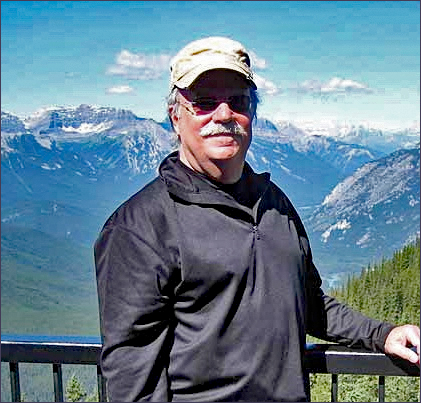
Bill Gabbert, Canada Icefields Parkway
Bill Gabbert on a road trip,
Canada Icefields Parkway

Sedenquist had a long series of email conversations with Bill, and he still serves as a fire reference and resource to others. “Even though I now live in Las Vegas, Nevada, friends and family in California still call me first when they spot smoke in the local hills and want to know what they are looking at. And thanks to the wonder of digital scanners and optical devices, I can usually provide real-time information faster than the local media are providing about their local fires.”

When the Gabbert Fellowship launches its first reporting projects, we’ll be the first to thank Mark Sedenquist, who demonstrates the value of being a student of fire — a concept Bill Gabbert often revisited.

We ask you to join with Mark Sedenquist and others to add your support to the Fellowship fund.

As we solicit donations to help fund the Fellowship, we will also ask for your ideas for what the Fellowship will become — and we’re interested in our readers’ and advertisers’ ideas about its management.

For more on Bill Gabbert’s work, check out these reflections by Chuck Bushey and  Wade Ward.

Rain forecast for western Canada

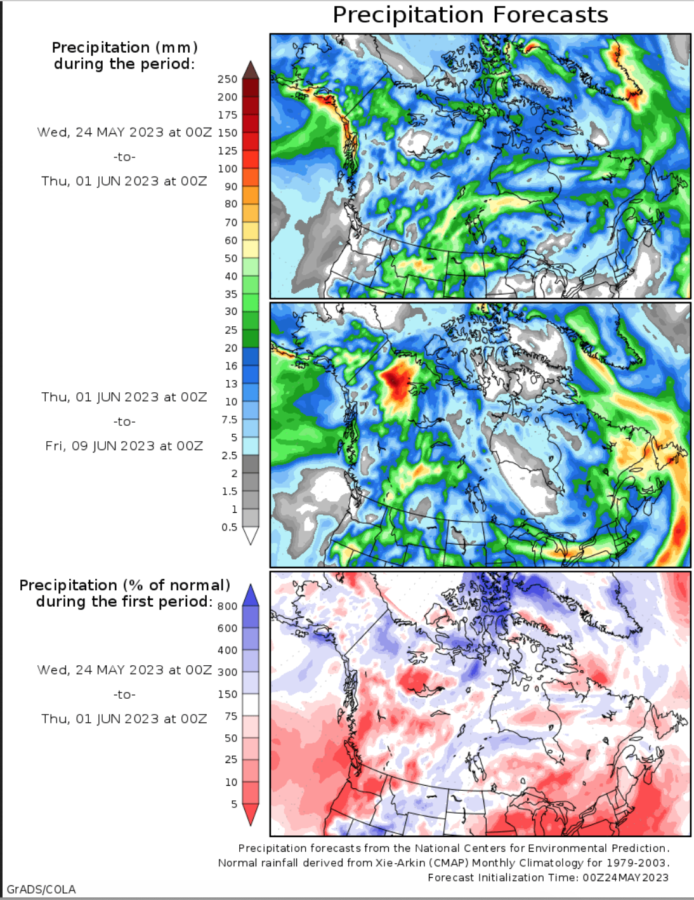
Western Canadian communities and firefighters may catch a welcome break next week with a forecast for precipitation — perhaps a good amount. Over the next week, areas along the Canadian Rockies may receive more than 100 mm (3.9 inches) while the Alberta-Saskatchewan border area may receive 20 mm (less than an inch), with soil moisture predicted to rise throughout the fire-impacted areas. This will likely slow fire spread and smoke volume, though fires at such scale will continue to produce smoke. An overall increase in humidity should lower fire danger.

The western provinces have experienced weeks of active fire behavior and growth, with an intensity comparable to that seen in the 2016 fires that burned Fort McMurray, Alberta and the heat domes and fires of 2021, when fires burned Lytton, British Columbia.

Precipitation forecasts from the National Center for Environmental Prediction

Phys.org reported that some 2,500 firefighters from across Canada backed by 400 military personnel have been deployed across Alberta and that more foreign help has been requested — with crews and incident management teams from the United States, Mexico, Australia, and New Zealand.

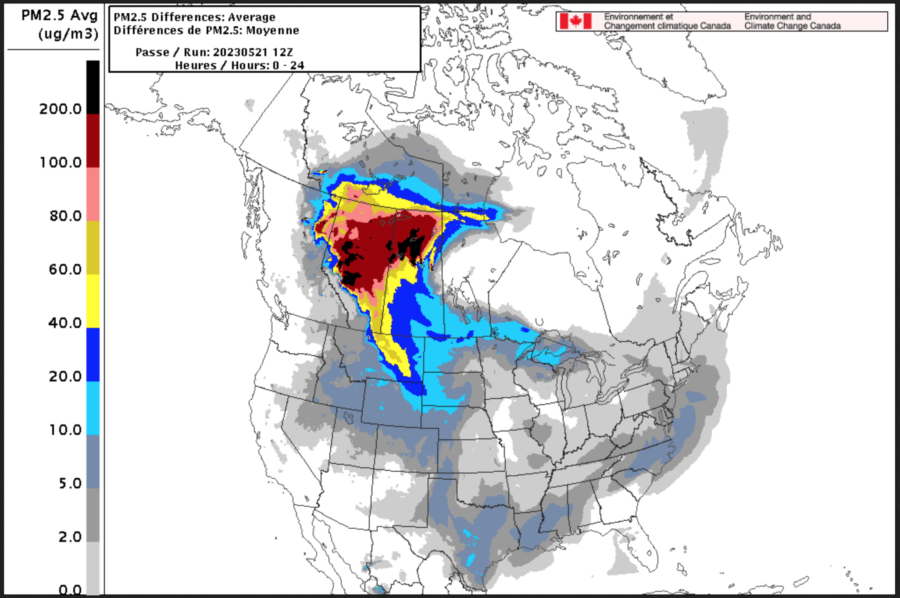
At one point nearly 30,000 Alberta residents were evacuated from their homes. Hazardous air quality and low visibility due to smoke were reported from British Columbia to Saskatchewan and as far south as Colorado and northern Texas.

PM2.5 average05/21 map
PM2.5 average
05/21 map

Situation Reports – National

The home page of the Canadian Wildland Fire Information System features maps of weather, fire behavior, and hot spots.

The Canadian Interagency Forest Fire Center Situation Report for May 20 indicated area burned to-date of 2.1 million hectares (nearly 5.2 million acres), with 15 new fires for a total of 226 currently active fires. Of those fires, 90 are identified as out of control. Canada is in its tenth day at its highest preparedness level of 5.

Situation Reports – Provinces with highest fire activity

Climate Change and Fire

In the Climate Atlas of Canada, an article on “Forest Fires and Climate Change” examines the impacts of climate change on Canadian fires and summarizes studies by Mike Flannigan and other scientists who predict that by 2100, western Canada will see a 50 percent increase in the number of dry, windy days that let fires start and spread, whereas eastern Canada will see an even more dramatic 200 percent to 300 percent increase in this kind of fire weather.  And by 2040, fire management costs are expected to double.

Flannigan, a professor of wildland fire at the University of Alberta, explores the impact in more detail on his website. “Fire is the major stand-renewing agent for much of the Canadian forest,” he says, “greatly influencing forest structure and function.”

The research he summarized indicates that the observed increases in area burned in Canada during the last four decades is the result of human-induced climate change. Additionally, he says it appears that temperature is the most important predictor of area burned in Canada with warmer temperatures associated with increased area burned.

Based on a 2005 analysis, Flannigan says current estimates are that an average of over 2 million hectares burn annually in Canada. Just shy of the third week of May, Canada has already recorded 2.1 million hectares burned.

International meeting opens with fire problem, community solutions

PORTO, Portugal – The opening morning of the Eighth International Wildland Fire Conference featured a range of civil leaders, fire managers, and scientific experts who helped circle the delegates around the dilemma of wildland fire: it is the problem and also (sometimes, but not always) the problem’s solution.

How a problem can be its own solution – the fire conundrum – is part of what drew some 1600 delegates from 90 countries to Porto, Portugal in mid-May.

The week-long conference included technical field trips on May 15 and the official opening May 16, followed by a keynote session labeled simply “The Problem.”

The opening included a videotaped welcome from António Guterres, the United Nations secretary-general, who cautioned that “We must keep global warming below 1.5 C” and if we’re to do so, he said, we must energize fire management that includes all voices, including indigenous leaders and communities. (And even though we must act to limit climate change, a UN World Meteorological Organization report this week has forecast a 66 percent chance we’ll reach the 1.5°C increase for a year during the next five years.)

The conference chair, Tiago Oliveira, board chairman of Portugal’s wildfire service Agency for Integrated Rural Fire Management (AGIF), opened with guidance: “We need to take out the emotional side of fire and replace it with  the rational management of fire.” Yet he also reminded attendees of the emotional reality of wildland fire. “I am a survivor as many of you are and we are here to build a better future. To ask for help as I did in 2017” – when Portugal endured a storm of fires that killed 120 citizens and firefighters. An article in Scientific Reports suggests that the extreme fire season of 2017 may have been a prelude to future conditions and likewise events that are triggered by climate change effects. The immensity and challenge of these fires also led to the creation of AGIF.

“Every day that we are managing fires we are learning,” Oliveira continued. “We come here to build friendships in fire. The more friends we have in the world of forest fires the more successful we will be. And the world needs our contributions. The world needs less bad fire and more good fire.”

Tiago Oliveira, board chairman of Portugal’s wildfire service (AGIF) and conference chair opens the Eighth International Wildland Fire Conference.

Gordy Sachs, chief of All Hazard and International Fire Support for the U.S. Forest Service and chair of the International Liaison Committee that planned the conference, reiterated the conference’s value globally. Statements from prior conferences [held every four years] influenced Sendai Framework for Disaster Risk Reduction and the Paris Agreement on climate, and the 2023 Conference will launch a key transition tool for international cooperation – the Landscape Fire Governance Framework – and will, like prior conferences, make each country and the world safer and more resilient.

Most of the opening, as is typical of international gatherings, offered the sort of civil and governance support that is key to implementing new frameworks. So it was heartening (if also disheartening) to learn from Antonia Cunha, president of Portugal’s North Regional Coordination and Development Commission, that he’s aware and concerned that 26 percent of carbon emissions in 2022 in the region was from forest fires.

Likewise, a commitment from Juan Cabandié, Environment Minister of Argentina, highlighted that his country needs to be more directed at planning and prevention. “We’re the eighth largest country in the world and 70 percent of our land at risk of wildfires,” he said. And to support its goals, Argentina has started its first monitoring system for entire country.

Duarte Cordeira, with Portugal’s Ministry of Environment, also returned the delegates to community. “We know that the best fire management is by the community members. If we want a more resistant forest that can provide economic and sustainable benefits, we cannot have a monoculture. We are increasing our defense with the creation of a protection ring of native forest.” He said already 200 of these native fuel breaks have been planted, with another 470 in the works and a goal of 800 villages. And Cordeira noted the challenge. “Yet 97 percent of rural properties are private,” he said, “so we need to increase subsidy for land consolidation.”

A conference opening offers a frame, and after a break for coffee and Pastéis de Nata, the conference jumped into “The Problem.” More on that soon.

Bill Gabbert’s fire legacy

Longtime fire journalist Bill Gabbert left us way too soon last year, and many of us will miss him and his contributions to the world of wildfire for a long time to come.

It was pancreatic cancer that took him, and he had a rough go of it for his last year or so, but then he was one of the fortunate few who go quietly and easily in their sleep.

Bill Gabbert, Canada Icefields Parkway
Bill Gabbert on a road trip, Canada Icefields Parkway

When the International Association of Wildland Fire (IAWF) accepted Bill’s generous offer to continue the form, format, and platform of his wildfire journalism websites, we were hoping for many conversations with him, with more time to absorb his advice and knowledge.

Those conversations were far too few, though, and the time far too short. But we are now pleased to announce the BILL GABBERT FELLOWSHIP in Wildfire Reporting, which will fund and mentor and publish the sort of innovative wildfire reporting that Bill exemplified.

An initial donation from a longtime supporter of Wildfire Today helped launch the program. Building on an auspicious start, the IAWF is now accepting donations to honor Bill’s work by developing and supporting a funded program to encourage innovators in wildfire journalism.

To remember Bill and support his legacy into the future, just use the red “Donate Online” link at iawfonline.org/donate – unless you specify otherwise, all donations to IAWF this year will support the BILL GABBERT FELLOWSHIP.

Later this year, officers will announce an application process to screen people and projects that feature reporting by fire-savvy writers and innovative media projects for Wildfire Today and Fire Aviation, with some articles jointly produced with Wildfire magazine.

In the next few posts — by Chuck Bushey and Wade Ward — we  share a few memories  from Bill’s friends and colleagues. Let us know if you have more.

A bad (and likely illegal) shooting decision, on video, ignites Arizona fire


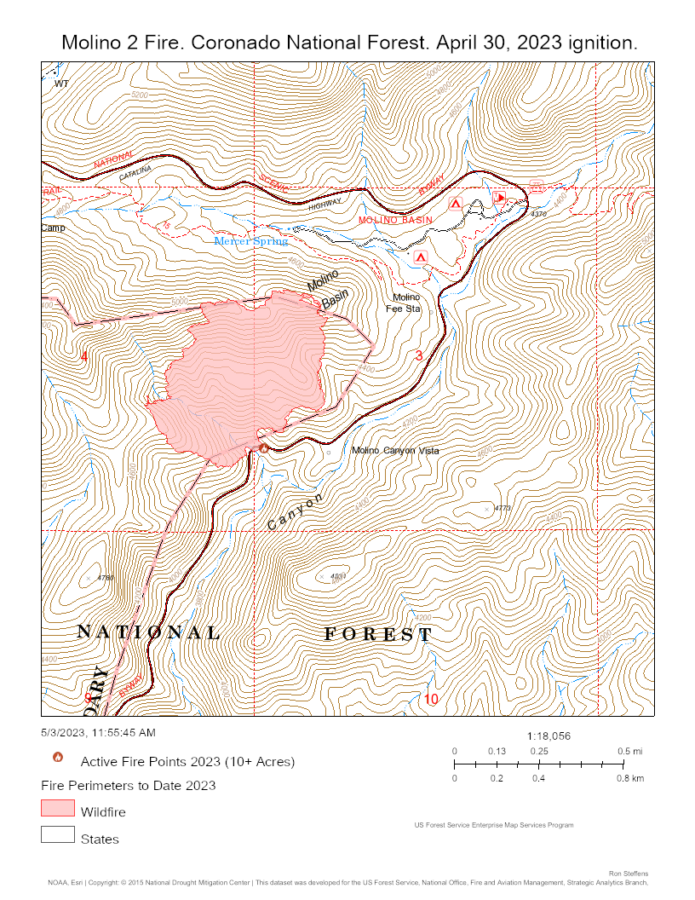
05/04/2023 UPDATE:  Authorities have identified the shooter suspected of starting the Molino 2 Fire. The fire was started Sunday, April 30 and resulted in the closure of the Catalina Highway in the Santa Catalina Ranger District, Coronado National Forest. Video evidence shows the individual shooting illegal shotgun rounds and the start of the wildfire, according to KOLD-13 News.

Coronado National Forest managers and Forest Service Law Enforcement and Investigations expressed their appreciation to members of the public who provided multiple timely and actionable tips about the identity of the suspect who started the wildfire. Investigators identified, located, and interviewed the irresponsible gun owner, who is apparently shooting incendiary shells from a 12-gauge semiautomatic tactical shotgun with an extended magazine. The case has been referred to the U.S. Attorney’s Office.
 ~ K.A.

__________________________________

It’s Sunday, April 30, at milepost 4.5 on the Catalina Highway, in a section of the Coronado National Forest that is a recreation gateway for Tucson, Arizona. The day reaches 100 degrees for the first time of the year, and there’s a Red Flag Warning.

Most folks might think that this is not a good day to demonstrate how adept they are at shooting a shotgun at an oddly dressed torso target with what seems to be incendiary shells. Even a worse day to demonstrate this five times, on video.

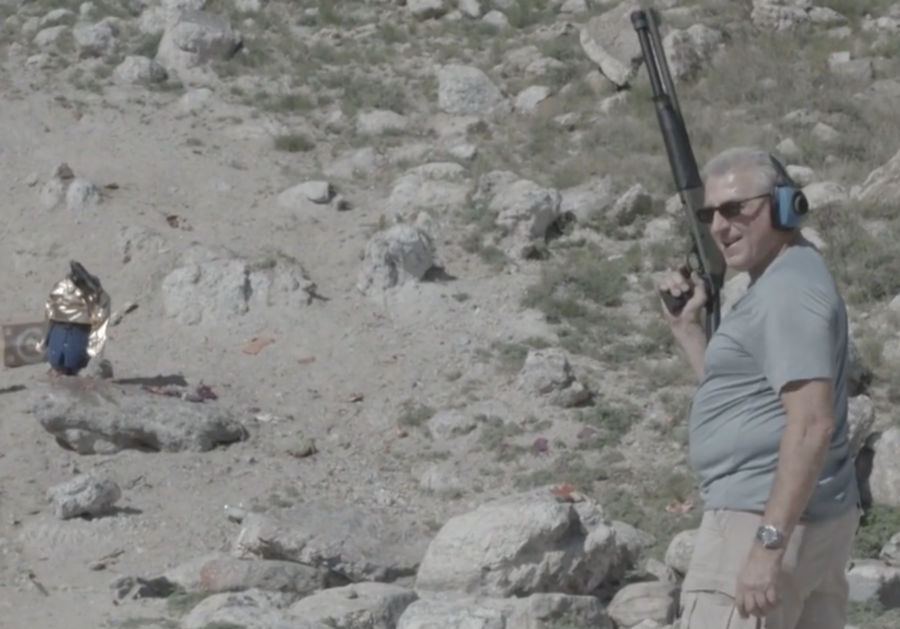
Screenshot from video, showing the target and the shooter whose identity is being sought by Coronado National Forest investigators.

But the correct decision wasn’t what the unnamed man in the video elected to do. His identity is being sought by Coronado National Forest investigators in connection with the Molino 2 Fire.

The forest shared the video in a media release noting that video evidence was obtained showing the suspect and the start of the Molino 2 Fire. Video footage shows an approximately 50- to 60-year-old, white male wearing a light grey shirt with tan cargo pants approaching the scene where others with a camera were shooting at a homemade target. Upon his arrival, they stepped back and allowed him to take five shots using his own shotgun. It appears in the video the suspect had it loaded with incendiary shells  causing sparks to fly and starting the Molino 2 Fire.

The release notes that using incendiary ammo and starting a wildfire are violations of 36 CFR 261.5 (b,c) punishable by up to 6 months in jail and/or $5,000. These violations are considered Class B Misdemeanors. In addition to the fine, some of the cost may be recovered through restitution.

The fire was reported to be contained at 110 acres, with no cost estimate available. The Catalina Highway was closed for a portion of the first day of the fire, causing significant delays of a Sunday afternoon mountain traffic.

The video shows a man who shoots with enough care to wear ear protection. First, he looks back – to recognize the person with the camera, and then he turns and begins what appears to be a very conscious act – as the use of any weapons should be, by ethics and law.

VIDEO:  https://youtu.be/cV1hlbXff7Q

In the video embers are visible flying from where the target is hit, bouncing off surrounding rocks. The shooter fires a total of five shells until he empties his shotgun.

A still-frame from the video. Source: Coronado National Forest.

At 34 seconds into the video, the camera pans left and focuses on nearly a dozen little spot fires. Within 15 seconds the flamelengths are 2-3 feet high and the spots burn together into three distinct fires at the base of a canyon chute.

The techniques and success of fire prevention are often framed by the Three E’s – Education, Engineering and Enforcement. All three E’s are in place in this section of the Catalina Highway (which I know well, as it leads to some of my favorite hiking and running routes, and I’ve managed fires there in the past). With education having already been ignored by the shooter, and the engineering being crossed (since most of this area is closed and flagged off along the highway), then the third E of enforcement is the last tool left, with a 49-second video to support the case, as well as 110 acres of burnt desert and grassland as evidence.

Anyone with information regarding this incident and the suspected shooter is asked to call 520-388-8343 or email the Coronado National Forest at Mailroom_R3_Coronado@usda.gov

Molino 2 Fire, Coronado National Forest. April 30, 2023..

Updates on Nob Fire — and Watch Duty is looking for help

Watch Duty volunteers have been monitoring and sharing updates on the Nob Fire, on the north side of the San Bernardino Mountains. KTLA-5 reported that the fire near Lytle Creek had burned at least 200 acres by Wednesday afternoon. It was reported around 10:15 a.m. and officials said then it had burned about 8 acres but had the potential to spread quickly.

San Bernardino County Fire Department officials initially said the fire started as a scheduled controlled burn, according to the San Bernardino Sun, but the National Forest clarified that it was not a controlled burn, and there have not been any scheduled in the area in recent weeks. There was one scheduled on Wednesday, the Chilao Prescribed Fire — about 20 miles east of the Nob Fire.

Nob Fire, map courtesy CAL FIRE.

In an update around 7 p.m., the fire was estimated at 5 percent containment. According to today’s Inciweb report, the fire is burning in steep terrain and thick brush. Engines, crews, helicopters, and fixed-wing aircraft have been requested.

Forest Road 3N06 (Lytle Creek Canyon) in the area is closed to allow access for firefighters. No evacuations have been requested; Lytle Creek Road is closed at Sycamore Canyon.

Screenshot of Nob Fire via WatchDuty, from April 26, 2023

By the way, if you’re looking to share some time and service, Watch Duty is looking for volunteers. The Watch Duty administrators are seeking additional staffers to support operations and a planned expansion.

Please refer to the volunteer job board at watchduty.org/volunteer for more information.