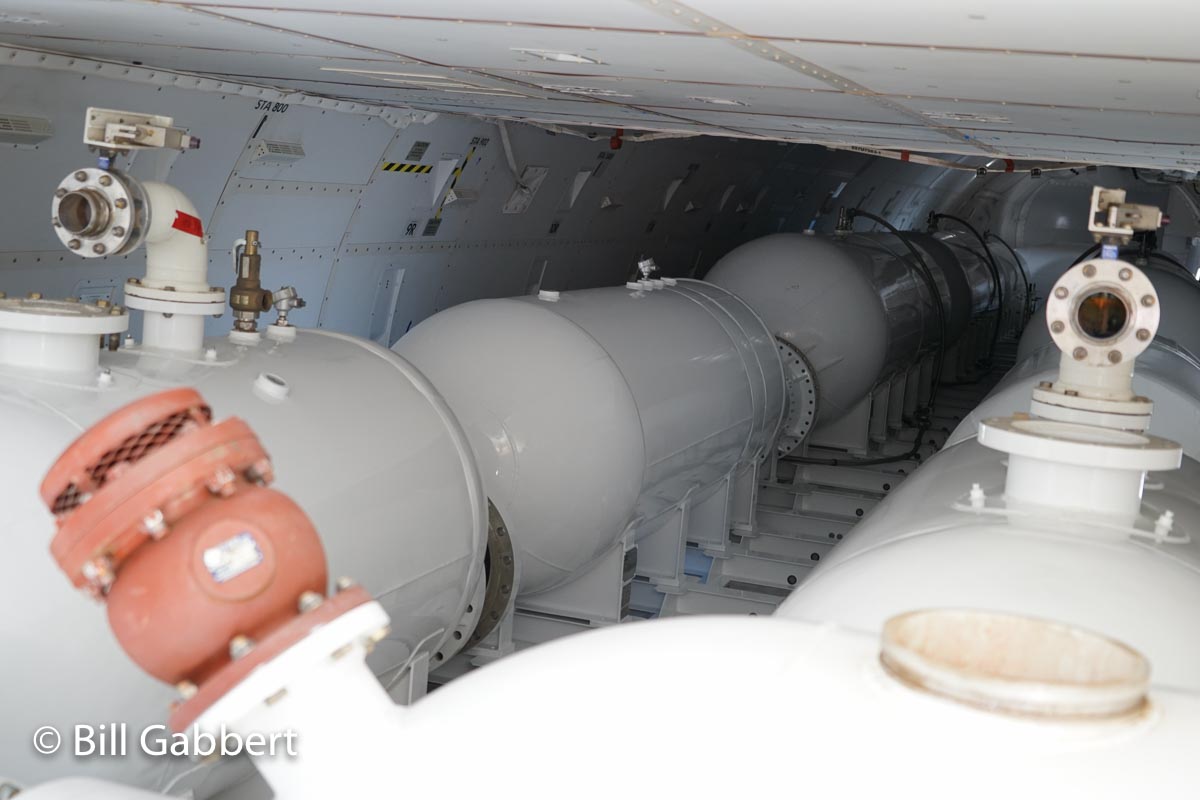
Global Supertanker supplied this photo today of their 747 Supertanker undergoing ground tests of the retardant delivery system. The tanks can hold 19,200 gallons.
****
If you want a high resolution professional quality print of Tanker 944, or a cell phone case with a photo of the air tanker…
An interview with Jim Wheeler about the 747 SuperTanker that can carry 19,600 gallons of fire retardant or water. Mr. Wheeler is the President and CEO of Global Supertanker Services LLC. The interview was filmed at McClellan Air Field in Sacramento, California March 22, 2016 by Bill Gabbert for FireAviation.com
As the sun was rising in Sacramento this morning I took these shots of Tanker 944, a 747-400, as it departed from McClellan Air Field en route to Marana, Arizona. It had been on static display during the Aerial Firefighting conference.
Tanker 944, a 747-400, departing McClellan Air Field as the sun was rising March 24, 2016.
If you want a high resolution professional quality print of Tanker 944…
One last picture of the 747 air tanker — for a while anyway. On the way to the Aerial Firefighting conference dinner Tuesday night at McClellan Air Field in Sacramento I saw the aircraft silhouetted by the sunset, and could not resist.
Above: Tanker 944 at McClellan Air Base in Sacramento, California, March 22, 2016. Photo by Bill Gabbert.
The 747 SuperTanker arrived at McClellan Air Field in Sacramento today after flying in from Marana, Arizona where it received a new paint job. It will be on static display for attendees the Aerial Firefighting conference until Wednesday, March 23.
Bob Soelberg, Senior VP and Program Manager of Global Supertaker, said the retardant delivery system still needs a few tweaks before it can actually drop water or retardant, but they hope to have it ready to fight fire later this year.
Retardant delivery system on Tanker 944 at McClellan Air Field, March 22, 2016. Photo by Bill Gabbert. Tanker 944 at McClellan Air Field, March 22, 2016. Photo by Bill Gabbert. Retardant delivery system on Tanker 944 at McClellan Air Field, March 22, 2016. Photo by Bill Gabbert. Retardant nozzles on Tanker 944 at McClellan Air Field, March 22, 2016. Photo by Bill Gabbert. Tanker 944 at McClellan Air Field, March 22, 2016. Photo by Bill Gabbert. Tanker 944 at McClellan Air Field, March 22, 2016. Photo by Bill Gabbert.
If you want a high resolution professional quality print of Tanker 944…
747 Supertanker just after receiving the new paint job. Global SuperTanker photo.
The reborn 747 Supertanker is scheduled to fly in to McClellan Air Field around mid-morning on Tuesday March 22. It will be one of the aircraft on static display at the Aerial Firefighting Conference in Sacramento March 22 and 23. Yes, we have been assured, it really does exist and recently received a new paint job at Marana, Arizona. The paint is so fresh that Bob Soelberg, Senior VP and Program Manager of Global Supertaker, said they postponed their flight by a day over concern that the rain on Monday might damage the new paint. The weather on Tuesday is predicted to be kinder to still-curing livery on the huge aircraft.
Global Supertanker purchased all the physical assets and intellectual property related to Evergreen’s original SuperTanker except the 747-100 airframe itself. The company refurbished the 19,600-gallon retardant delivery system and installed it in a 747-400 airframe to become the third generation of the 747 air tanker.
The SuperTanker was approved by the Interagency AirTanker Board years ago so it remains to be seen how much if any additional flight or ground testing may be required to regain the Board’s certification. It would have been interesting to see the aircraft perform a demonstration drop during the conference this week but Mr. Soelberg said they still have a few tweaks to make on the delivery system before it’s 100 percent ready to drop water or retardant.
CAL FIRE is considering putting a very large air tanker on a Call When Needed Contract. Before this development there was only one choice, the DC-10 operated by 10 Tanker Air Carrier. Representatives from CAL FIRE will be at the conference this week and I’m sure they will be looking at the new, or reborn, kid on the block.
747 Supertanker just after receiving the new paint job. Global SuperTanker photo.
The company building Version 2.0 of the 747 Supertanker has leased a hangar at the Colorado Springs Airport. The Gazette reports that Global SuperTanker Services will occupy what has been a vacant 14,880-square-foot hangar. The space will serve as its headquarters for storing equipment for maintaining their Boeing 747-400 jet.
The company announced last August that they purchased the retardant system, related Supplemental Type Certificate (STC), and patents from the ashes of the bankrupt Evergreen company, the developer of the 19,600-gallon air tanker. They have removed the system from the 747-100 (Version 1.0) and installed it in a newer 747-400BCF (Boeing Converted Freighter) (N492EV) with more powerful engines.
Global SuperTanker employs eight people with plans to add five more this year. The company plans on acquiring additional large firefighting aircraft, starting next year, [CEO Jim] Wheeler said.
The Colorado Springs Airport is co-located with Peterson Air Force Base. During wildfire season the base makes two C-130 aircraft available for deployment as air tankers outfitted with the slip-in Modular Aerial Firefighting System (MAFFS).
The 747-400BCF (Boeing Converted Freighter) that is being converted into the third generation Supertanker is in Victorville, California where scheduled maintenance, a C Check, is being performed.
A phoenix is a long-lived bird that is cyclically regenerated or reborn. Associated with the sun, a phoenix obtains new life by arising from the ashes of its predecessor.
The 747 SuperTanker is being given new life. A newly-formed company named Global SuperTanker Services has purchased the retardant system, related Supplemental Type Certificate (STC), and patents from the ashes of the bankrupt Evergreen company, the developer of the 19,600-gallon air tanker. They will be removing the system from the 747-100 and installing it in a newer 747-400BCF (Boeing Converted Freighter) (N492EV) that has more powerful engines.
The aircraft is at Southern California Logistics airport in Victorville, California where it will undergo a C-Check and receive any other maintenance that is necessary. The company that developed the original STC for the SuperTanker, Adaptive Aerospace, will be providing an amendment to cover the new installation and improvements in the retardant dispensing system that will be added. Jim Wheeler, President and CEO of Global SuperTanker Services, said they expect the STC to be approved by the FAA by October, 2015. After testing and crew refresher training, a new grid test will be performed this fall.
The company’s headquarters will be in Colorado Springs.
Evergreen’s 747 SuperTanker first dropped on a fire in 2009 and last received Call When Needed contracts from CAL FIRE and the U.S. Forest Service in 2013. When it received the CWN contract the aircraft had been sitting at Marana without engines and needed a million-dollar “C” check in addition to other maintenance. The company decided that with an expensive expedited “C” check and the other needed work, it could have been ready to fight fire about the time the 2013 western fire season was drawing to a close. And the CWN contract had no guarantee of any revenue. So Bob Soelberg, the Vice President of Evergreen Supertanker Services at the time, said they would wait until the next year to get the maintenance done. A few months later, bankruptcy, and the company ceased to exist.
Mr. Wheeler said they have hired most of the core personnel that worked on the SuperTanker program at Evergreen, including Mr. Soelberg who managed the program there. He is now the Senior VP and Program Manager for the new company. The Chief Pilot is Cliff Hale who has previous experience as an air tanker pilot.
The retardant is forced from the aircraft by compressed air using the same principle seen in the transportable Modular Airborne FireFighting System (MAFFS) that can be installed in a few hours into C-130s operated by the military. Unlike the newest version of the MAFFS2 which has two on-board air compressors, the SuperTanker will rely on suitable air compressors to be pre-positioned at an air tanker base. When MAFFS are deployed they meet up with one of the six specialized air compressor systems managed by the U.S. Forest Service that can refill the air tanks in 14 minutes when the on-board compressors fail to work properly, which is not uncommon according to a MAFFS crew member we talked with.
Mr. Wheeler told us they will consider installing an air compressor in a year or so.
The first generation MAFFS1 units, no longer used, did not have onboard air compressors and were refilled on the ground. The contracts for the MAFFS2 units specified that the air tanks had to be refilled by the onboard air compressors in no more than 30 minutes. It actually takes 15 to 20 minutes to refill them while airborne.
Mr. Wheeler said in a news release, “The current worsening trends in wildfires globally demand more capable response tools. The Boeing 747-400 represents a modern, strong, high performance platform capable of flying more than 4000 nautical miles at a cruise speed of 565 miles per hour, at pressurized altitudes, fully loaded, then directly deploying nearly 20,000 gallons of a range of liquids including retardant, water, gel and foaming agents.”
The word “Global” in the company’s name is meant to represent their goal of marketing the aircraft around the world. In a few weeks some of their representatives will be attending a conference in Australia to help promote their services.