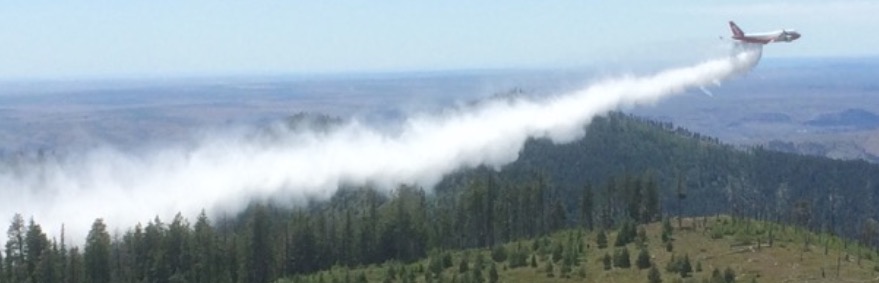
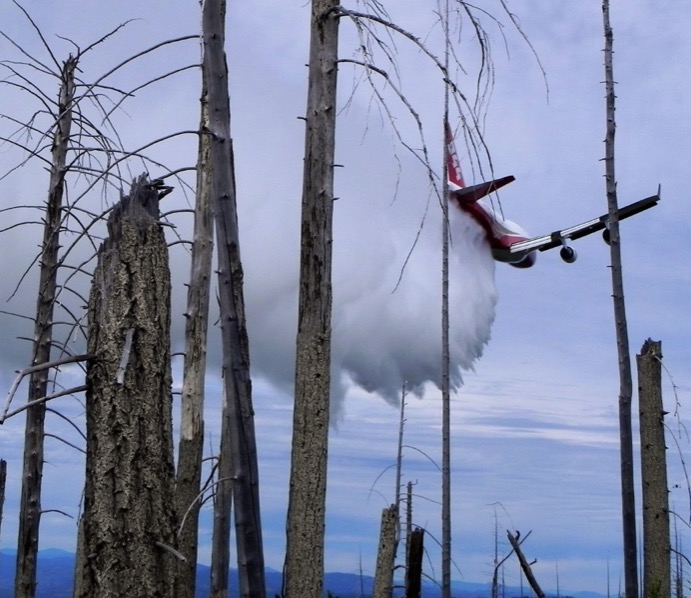
Above: Tanker 944’s flight over Israel November 27, 2016.
After being deployed November 24 to assist firefighters in Israel, the 747 Supertanker returned to Colorado Springs November 30. While overseas it dropped on two fires during two sorties, discharging the full 19,200-gallon load each time.
The Israelis were extremely aggressive in attacking emerging fires, according to Chief Pilot Cliff Hale and Sr. VP Program Manager Bob Soelberg of Global Supertanker Services. Talking with them on a speakerphone Friday they said there were more than 40 air tankers in the country while they were there, including the 14 privately owned Single Engine Air Tankers the country has under contract.
At all times surveillance aircraft were airborne, able to quickly detect new fires and track any vehicles leaving the scene. About 39 people were arrested for arson during the recent fire bust.
At times the crew was on hot standby, with orders to be wheels-up within 15 minutes if necessary.
Frequently there were multiple air tankers loitering off the coast out over the Mediterranean ready to drop within minutes on new fires. In flight planning the Supertanker crew was told to take off with enough fuel for three hours of loitering. They also carried another three hours of fuel for working over a fire.
As you can see in the screengrab from FightRadar24, they were flying a racetrack pattern as they waited for an assignment. Other air tankers loitering at the same time were, of course, flying at a different altitude.
Tanker 944, a 747-400, at Colorado Springs, May 4, 2016. Photo by Bill Gabbert. Found on Instagram: “Supertanker Watch Party”.
The 747 Supertanker, T-944, drops on a fire in Israel northwest of Jerusalem on November 26, 2016. Screen grab from video by @ShaiBenari
The 747 Supertanker, Tanker 944, dropped on a wildfire in Israel today northwest of Jerusalem. This was the first drop on a fire this version of the Supertanker has made.
After a 12.5-hour non-stop flight from Colorado Springs the aircraft arrived in Tel Aviv at about 10:25 a.m. MST time on November 26, which was after dark at the Ben Gurion International Airport.
The drop made today occurred at around sunset.
Jim Wheeler, President and CEO of Global SuperTanker Services, said it dropped the entire 19,200-gallon load of water. While sometimes air tankers in Israel drop fire retardant, he explained that the authorities often prefer water when the aircraft is working over populated areas.
Shai Ben-ari (@ShaiBenari) recorded a video of the drop. The image above is a screen grab from the video. And, here is another video, by @Israel, which shows the entire drop. Below is a screen grab from that second video.
Screen grab from a video by @Israel of the Supertanker dropping northwest of Jerusalem, November 26, 2016.
Before the drop the 747 took off from Tel Aviv and loitered over the Mediterranean for a while before it apparently made a dry run over the fire and then dropped on the next pass. The entire flight lasted about two hours.
Four CL-415 water-scooping air tankers at Cody, Wyoming during the week of August 1, 2016. Some of them had been working the nearby Whit Fire and scooping out of Buffalo Bill Reservoir six miles from the fire. Photo by Becky Lester Hawkins.
Ten additional air tankers brought on temporarily
In the last few weeks the U.S. Forest Service has brought on ten additional air tankers on a temporary basis. This includes CL-415 water-scoopers, CV-580’s, and Modular Airborne FireFighting System (MAFFS) C-130’s. Two of the aircraft were acquired through Call When Needed (CWN) agreements; four via agreements with Alaska and Canada; two MAFFS through an agreement with the Department of Defense; and two water scoopers through other contracts.
HC-130H’s
The U.S. Forest Service expects to have two HC-130H aircraft at McClellan Air Field in September. These are part of the seven aircraft fleet of HC-130H’s that the agency is receiving from the Coast Guard.
Tanker 118, an HC-130H, at McClellan Airport. Photo by Jon Wright, July 25, 2015.
Last year one of the HC-130H’s worked out of McClellan using a MAFFS, a slip-in 3,000-gallon pressurized retardant system that pumps the liquid out the left side troop door. That was aircraft #1721 designated as Tanker 118, still painted in military colors. T-118 is now undergoing scheduled depot-level maintenance and should be replaced in September of this year by #1708 designated as Tanker 116. It will also use a slip-in MAFFS unit, one of the eight owned by the USFS, but should be sporting a new USFS air tanker paint job. After T-118 left, another former Coast Guard aircraft took its place, #1706. It is being used for training the contracted pilots and will not serve as an air tanker.
Early in 2015 the plan was to have two HC-130H’s at McClellan. One would be used as an air tanker, and the second would be used as a training platform. Below is a portion of that early 2015 plan which we covered February 9, 2015.
The USFS plans in early 2015 for incorporating the seven HC-130H aircraft into a Government-Owned/Contractor-Operated fleet of air tankers. Click to enlarge.
Eventually the USFS hopes to have all seven converted to air tankers with removable retardant tanks. A contract for the installation of the retardant delivery systems was awarded to the Coulson Group in May. There is also much other work that has to be completed on the aircraft including programmed depot maintenance, painting, and wing box replacement on most of them. The work is being done or coordinated by the U.S. Air Force. They were directed by Congressional legislation to use their own funds, up to $130 million, so it is no surprise that the schedule keeps slipping as delays continue to occur in awarding contracts and scheduling the maintenance.
The USFS has two water-scooping CL-415 air tankers on exclusive use contract. As noted above they recently temporarily brought on two more on a call when needed basis. All four are operated by AeroFlite and as seen in the photo above were together at Cody last week.
Air Spray
There was some discussion in the comment section of another article on Fire Aviation about the status of the BAe-146 aircraft being converted to air tankers by Air Spray. The company has five of the 146’s; two are out of the country and the other three are at the company’s Chico, California facility. Ravi Saip, their Director of Maintenance/General Manager, told Fire Aviation that they expect to begin flight testing one of them in air tanker mode around the first of the year. After they receive a supplemental type certificate from the FAA, work on the second one would shift into high gear. Then conversion of the other three would begin.
Air Spray’s T-241 finishing its amphibious conversion at the Wipaire facility in Minnesota. Air Spray photo.
Air Spray also has eight Air Tractor 802 single engine air tankers that they have purchased since 2014. Five of them have received the amphibious conversion by adding floats, and the other three are stock, restricted to wheels.
Air Spray’s Tanker 498, an L-188 Electra, is currently in Sacramento being inspected and carded by CAL FIRE so that it can be used in a Call When Needed capacity.
747 SuperTanker
Jim Wheeler, President and CEO of Global SuperTanker Services, told us that the FAA has awarded a supplemental type certificate for their reborn 747 SuperTanker — a major and sometimes very difficult barrier to overcome. Within the next two weeks they expect to receive the airworthiness certificate.
T-944 at Colorado Springs May 4, 2016. Photo by Bill Gabbert.
Beginning next week representatives from the USFS will observe some additional static tests and then there will be an airborne descent test, a new test added in 2013, releasing retardant in a downhill drop. That test was not required when Version 1.0 of the 747 was certified. It may have been added after it was discovered that the first BAe-146’s that were converted and issued contracts still retained hundreds of gallons of retardant after downhill runs.
These steps should take less than two weeks, Mr. Wheeler said, after which they will submit the results to the Interagency AirTanker Board.
Jennifer Jones, a spokesperson for the USFS, told Fire Aviation that the company was offered an opportunity to submit a proposal for a call when needed contract solicitation in 2015, along with numerous other companies, but declined to do so. Their next opportunity to obtain a contract will be when another general solicitation is issued in 2017, or perhaps sooner, Ms. Jones said. The agency issued a Request for Information a few weeks ago, which is usually followed some months later with an actual solicitation.
Judging from the list of CWN air tankers with contracts, apparently it is possible to submit a proposal and receive a USFS CWN contract even if the aircraft exists mostly on paper and could be years away from being FAA and Interagency AirTanker Board certified.
In the meantime Mr. Wheeler realizes that the USFS is not the only organization that hires air tankers and has been talking with a number of other agencies in various states and countries as well as companies involved in marine firefighting.
Global SuperTanker is in the process of finishing repairs on the 747 in Arizona after some of the composite flight control surfaces (flaps, spoilers, elevators) and engine cowlings were damaged by golf ball sized hail at Colorado Springs several weeks ago. There was no windscreen or fuselage damage.
Mr. Wheeler said that was the first severe hailstorm within the last seven years at the Colorado Springs airport. But, after the aircraft left to be repaired in Arizona a second hailstorm struck the airport that some have said was a 100-year event and did much more damage than the first one.
Permanent base for the HC-130H air tankers
On September 2, 2015 the USFS formally requested information from facilities that could support the seven-aircraft HC-130H fleet (Solicitation Number SN-2015-16), with responses due September 16. The agency was only asking for information from interested parties, and will not award a contract based on the Request for Information. A few politicians fell all over themselves arguing that the aircraft should be based in their state.
Since then no decisions have been made. Ms. Jones told Fire Aviation:
The U.S. Forest Service continues to cooperate with the Department of Defense to identify potential federal facilities, which must be considered first.
It is unlikely that more than one or two of the seven HC-130H’s would be at the new base at at any one time, except during the winter when they would not have to be dispersed around the country to be available for firefighting. While the base might not be a huge expansion of the aerial firefighting capabilities in an area, the stationing of the flight crews, maintenance, and administrative personnel would be a boost to the economy of a small or medium-sized city.
Yesterday we showed you a couple of videos produced by Global Supertanker, the company that resurrected the 747 air tanker first created by Evergreen. Here are two more featuring the new Tanker 944. I was surprised how interesting it was to see a HUGE aircraft being painted and having the retardant delivery system installed.
Warning: Trying to access array offset on value of type bool in /home/customer/www/wildfiretoday.com/public_html/wp-content/themes/jupiterx/lib/api/image/functions.php on line 61
Deprecated: ltrim(): Passing null to parameter #1 ($string) of type string is deprecated in /home/customer/www/wildfiretoday.com/public_html/wp-content/themes/jupiterx/lib/api/utilities/functions.php on line 206
Deprecated: preg_replace(): Passing null to parameter #3 ($subject) of type array|string is deprecated in /home/customer/www/wildfiretoday.com/public_html/wp-content/themes/jupiterx/lib/api/image/class-image-editor.php on line 177
Warning: Undefined array key "extension" in /home/customer/www/wildfiretoday.com/public_html/wp-content/themes/jupiterx/lib/api/image/class-image-editor.php on line 179
Deprecated: preg_match(): Passing null to parameter #2 ($subject) of type string is deprecated in /home/customer/www/wildfiretoday.com/public_html/wp-includes/functions.php on line 3089
Deprecated: is_file(): Passing null to parameter #1 ($filename) of type string is deprecated in /home/customer/www/wildfiretoday.com/public_html/wp-includes/class-wp-image-editor-gd.php on line 95
Deprecated: preg_match(): Passing null to parameter #2 ($subject) of type string is deprecated in /home/customer/www/wildfiretoday.com/public_html/wp-includes/class-wp-image-editor-gd.php on line 95
Above: A screen grab from the 747 Supertanker video, “Mountain Flying”.
Global SuperTanker bought the retardant system and the intellectual property formerly owned by Evergreen, the organization that first put it in a 747-100 air tanker. It now resides in a 747-400 operated by Global SuperTanker which in recent weeks has been going through some of the final stages of installation, testing, and crew training.
Initial new hire training run at Keller Butte in North central Washington state. Global SuperTanker photo.
On June 17 the aircraft traveled to Moses Lake, Washington to conduct crew training in mountainous terrain on the Colville Indian Reservation near Moses Lake, Washington. Training flights were under the direction of experienced Lead Plane pilot Jamie Tackman flying a King Air 90, and were recorded by video cameras located on the Keller Butte fire lookout tower and in a helicopter orbiting overhead.Tanker 944, along with the Lead Plane, made seven round trips to the training area, completing a mix of “show me” and low level dry runs plus various full load and segmented water drops.
Three FAA inspectors from Denver and Seattle observed the flights.
T-944 makes a training drop on Keller Butte . Global SuperTanker photo.
Jim Wheeler, President and CEO of Global SuperTanker Services, said they do not know if the aircraft will have to go through the retardant drop testing in which the liquid is caught in hundreds of cups placed on the ground. The retardant system is basically the same that was used in Version 1.0 operated by Evergreen, which was previously approved by the Interagency Airtanker Board (IAB). The Board wants some additional data from static drops that will be conducted soon, then a decision will be made about what other data or testing they will need, if any.
Global SuperTanker Services is now preparing the aircraft, ground crew and their facilities for inspections by the FAA, CAL FIRE, U.S. Forest Service, Interagency Airtanker Board, and other state or regional fire agencies interested in CWN (Call When Needed) contracts for the 2016 fire season.
The company has produced videos showcasing the rebirth of the 747 air tanker, Tanker 944. Some have been removed but here is one of them. It appears to have been filmed during the training at the Colville Indian Reservation.
On May 4, 2016 Air Tanker 944, a 747-400, made a dry run over the Colorado Springs airport and then conducted a practice drop with water. We were there to shoot this video and the still photos.
And here is a bonus video at no additional charge. Just after the 747 began taxiing before take off, three F-18’s landed. They taxied pretty close to where I was standing. A little military aircraft porn.
The practice drop by the 747 Supertanker occurred as planned this morning. After takeoff from the Colorado Springs Airport the aircraft followed a very detailed route specified by the FAA and made one dry run. After that it circled around and made a water drop between a runway and a taxiway. The FAA restricted them to half a load, only allowing them to drop about 9,800 gallons.
****
(Originally published at 10:21 a.m. MDT, May 4, 2016)
The 747 SuperTanker will be making a dry, low pass and after that a practice water drop at the Colorado Springs airport Wednesday morning, approximately between 10:45 and noon.
Tanker 944, a 747, at the Colorado Springs Airport Wednesday May 4 2016
The first drop from Tanker 944, the 747-400. Photo by Jessie Ryan provided by Global Supertanker.
Global Supertanker has started airborne drop tests of the 747-400 Supertanker they have been working on since last year. The first drop occurred Sunday, May 1 near Marana, Arizona, and it was described by the company as a “successful test flight”. Most air tanker companies do the initial tests with water, which is far less expensive than fire retardant, and does not have as many restrictions about where it can be dropped — 19,200 gallons at a time.
Most of the retardant delivery system was taken from Version 1.0 of the 747-100 Supertanker that was built and used for several years by Evergreen. When that company declared bankruptcy Global Supertanker bought the system and the intellectual property. They refurbished the hardware and upgraded parts of it, then installed it in an upgraded aircraft, a 747-400. It was first seen by the general public at the Aerial Firefighting Conference March 22 at McClellan Air Field near Sacramento.