The FBI released more information Monday about the January 5 shooting in Arizona that left one person deceased:
A Forest Service Officer stopped to render assistance to a vehicular traffic accident. An altercation occurred between the officer and the subject, Tyler Miller of Kansas. It was later determined the officer was injured and treated on the scene by EMS personnel. Miller was shot and transferred to a medical center and later declared deceased.
***
(UPDATED at 12:50 p.m. MST January 7, 2018)
According to KWCH, the person killed in the shooting that involved a U.S. Forest Service law enforcement officer January 5 has been identified as Tyler Miller. The uninjured USFS officer has not been named.
The FBI says 51-year-old Tyler Miller was injured and later died at a hospital. The officer’s name was not released, he suffered no injuries.
According to the office of the Kansas Secretary of State, Miller is the owner of TNT Bonding in Hutchinson [Kansas]. The family’s attorney, Matt Bretz, says Miller is a well-respected entrepreneur from Hutchinson.
The FBI says Miller was involved in a wreck earlier that evening.
***
(Originally published at 8:14 a.m. MST January 6, 2018)
A U.S. Forest Service law enforcement officer was involved in a shooting Friday January 5 north of Sedona, Arizona. According to local media the officer was not injured but one person was transported and pronounced dead at a hospital.
State Route 89A was closed for about five hours as the FBI investigated the incident.
On December 11 a wildland firefighter for the U.S. Forest Service was shot while driving a vehicle in Monterey County, California. The victim, Division Chief Peter Harris, was shot in the neck and ear. The suspect, Jacob Kirkendall, fled but was found and arrested.
Lake Mead National Park (@lakemeadnps) distributed this photo yesterday via Twitter with a description:
Thanks to COL Paul Murray @99ABWCC and the team from @NellisAFB for hosting @lakemeadnps and the @NatlParkService at #AviationNation.
Happy 70th birthday @usairforce
12:29 PM – Nov 12, 2017 · Nellis Air Force Base, NV
Bill Gabbert of Wildfire Today sat down with Josh Brolin in Phoenix about a week before the opening of the movie about the Granite Mountain Hotshots, “Only the Brave”. He explained that he and the other actors felt that the subject of the film was very meaningful.
(Originally published at 10:56 p.m. PDT October 11, 2017)
A red carpet premiere of “Only the Brave” occurred October 10 in Phoenix. Actors in the film that appeared included Josh Brolin, James Badge Dale, and Miles Teller. Director Joseph Kosinski also appeared, along with producers Lorenzo Di Bonaventura, Thad Luckinbill, Molly Smith, and Trent Luckinbill.
Many family members associated with the fatalities of the 19 firefighters and others affiliated with the film also were present.
After the red carpet event, the participants viewed the film.
While CAL FIRE embraced the DC-10 and used it extensively until the state ran out of money, the USFS was very skeptical, to say the least. The agency is extremely slow in making any changes to their aerial firefighting program. They appear to have a bias against Very Large Air Tankers, like the DC-10 and 747, and water-scooping air tankers, even though they have all been used very successfully by other agencies. Finally after it had proven itself over a few years, a DC-10 received a Call When Needed contract, and later an Exclusive Use Contract, and Incident Commanders and Air Operations personnel were often very happy to see it in the air over their fires.
A lot of people, including some who leave comments on this site, have viewpoints about the effectiveness and performance of specific models of air tankers. Some of them are based on indisputable facts, and others are opinions developed from…. something else. So, like reading political news, be careful when consuming information.
On July 24, 2012 we wrote an article on Wildfire Today with quotes from evaluations of a DC-10 that were written by lead plane pilots hours after they had directed it on fires. The DC-10 almost always carries at least 11,600 gallons of retardant, rarely having to reduce the load because of density altitude issues.
Here’s the article:
****
Evaluations of Tanker 911, one of the DC-10 very large air tankers
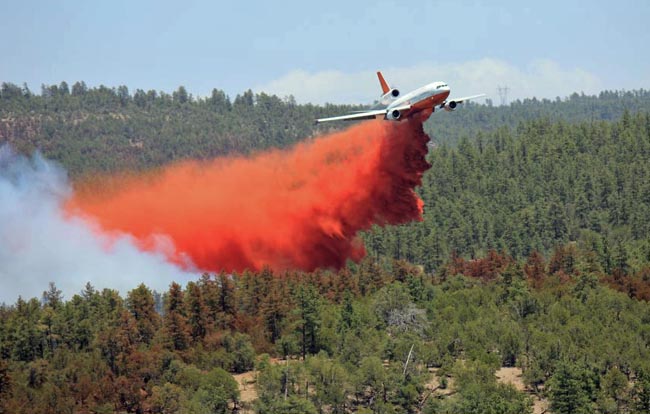
Tanker 911 dropping on the Poco Fire in Arizona, 2012. Photo by Ian James.
We have seen the written evaluations of Tanker 911, one of the DC-10 very large air tankers, for some of the retardant drops the aircraft completed on fires in Arizona and Utah in June and July. The forms were signed by individuals identifying themselves as lead plane pilots.
The evaluation form consists of two parts; a narrative section, and assigning a grade for specific aspects of performance: Reload Turn Times, Maneuverability, Steep Terrain Operations, Drop Patterns, and Uniformity of Coverage. All of the grades were “Above Average” or “Exceeded Expectation”.
Here are the details that were hand written in the narrative section on the forms:
Poco Fire, Phoenix, Arizona; Gallons Delivered 11,700 x 6; June 16-19, 2012
Six loads
All drop patterns were good and uniform. Flat and steep terrain – excellent performance in all profiles.
CL [Coverage level] 6 utilized in timber and mixed brush.
Quantity and mass of load delivered allowed for higher than standard drop altitudes to minimize exposure in challenging terrain and still achieve good pattern on the ground.
Quantity delivered also means 1 pass, 1 exposure instead of 7 from a legacy platform carrying 2,000 gallons!
Very uniform and consistent pattern on the ground. Very accurate starts. Performed some split loads as needed.
Fox Fire, Tucson, Arizona; Gallons Delivered 11,700 x 2; 2 loads; 3 drops; June 18, 2012
1 – CL 6 – Split Load – Started and stopped to tie in a road in front of structures. Very accurate start and stop. Last 2,000 gal reinforced first drop.
2 – CL 4 – One drop. Excellent coverage! It would have taken 6 or 7 loads from a legacy platform to get same length of line.
Quick effective line production.
Six Shooter Fire, Globe, Arizona; Gallons Delivered 11,700; 1 load; 8 drops; June 17, 2012
This was an initial attack fire. The location of this 5-acre fire, 1,500 to 2,000 ft below a ridge line, necessitated a substantial decent profile to get over the target on speed and altitude. The DC-10 was very capable and provided excellent coverage on and around the entire fire. The fire was successfully stopped at the same perimeter when the tanker dropped!
Excellent drops and performance.
Shingle Fire, Cedar City, Utah; Gallons Delivered 11,700 x 4; 4 loads; July 2-3, 2012
CL 6
Good coverage and line production. Excellent pattern on the ground and saved lots of time vs utilizing smaller aircraft. We would not have been able to get the line needed done without this tool.
Long turn arounds loading at [illegible; looked like “IVA”, “IWA”, or “IUA”]. 2 hour flights but dollars/gal still comperable considering speed and gallons!
**** DC-10 air tanker delivers 373,600 gallons of retardant
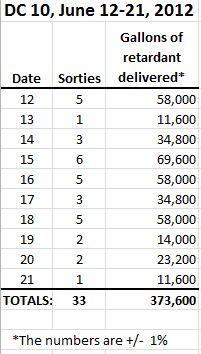
One of the DC-10 air tankers has dropped about 373,600 gallons of retardant during 33 sorties on seven wildfires in Arizona and New Mexico over the last 10 days. The fires were: Little Bear fire, 257 fire, Grand fire, Poco fire, Six Shooter fire, Fox fire, and 177 fire. They were all in Arizona except the Little Bear which was in New Mexico.
Eight of the nine air tankers currently on exclusive use contracts with the U.S. Forest Service are 50+ year old P2Vs designed for maritime patrol. Their average retardant load is 1,948 gallons according to a 2007-2009 air tanker study. If all of those 373,600 gallons the DC-10 dropped in those 10 days had been delivered by a P2V it would have taken about 192 round trips to the fires.