Tinder Fire forces evacuations, burns structures in central Arizona

3D Map of the Tinder Fire

Above: 3D map of the Tinder Fire showing the perimeter at 1 a.m. MST April 30, 2018. Looking South. Perimeter by USFS.

(Originally published at 10:29 a.m. MDT April 30, 2018)

Structures have burned and evacuations are taking place at the Tinder Fire in Arizona. A mapping flight at 1 a.m. MT on Monday showed that it had burned 8,623 acres east of Highway 87 between Payson and Winslow, Arizona.

(To see all articles on Wildfire Today about the Tinder Fire, click here.)

Firefighters were actively engaged in structural protection Sunday night. The Incident Management Team (IMT) led by Bea Day reports that structures have burned but no details are available. The fire remains active in the communities affected by the fire and the priority is providing for emergency responder and public safety. Coconino County will be assessing damages and providing updates as they are able.
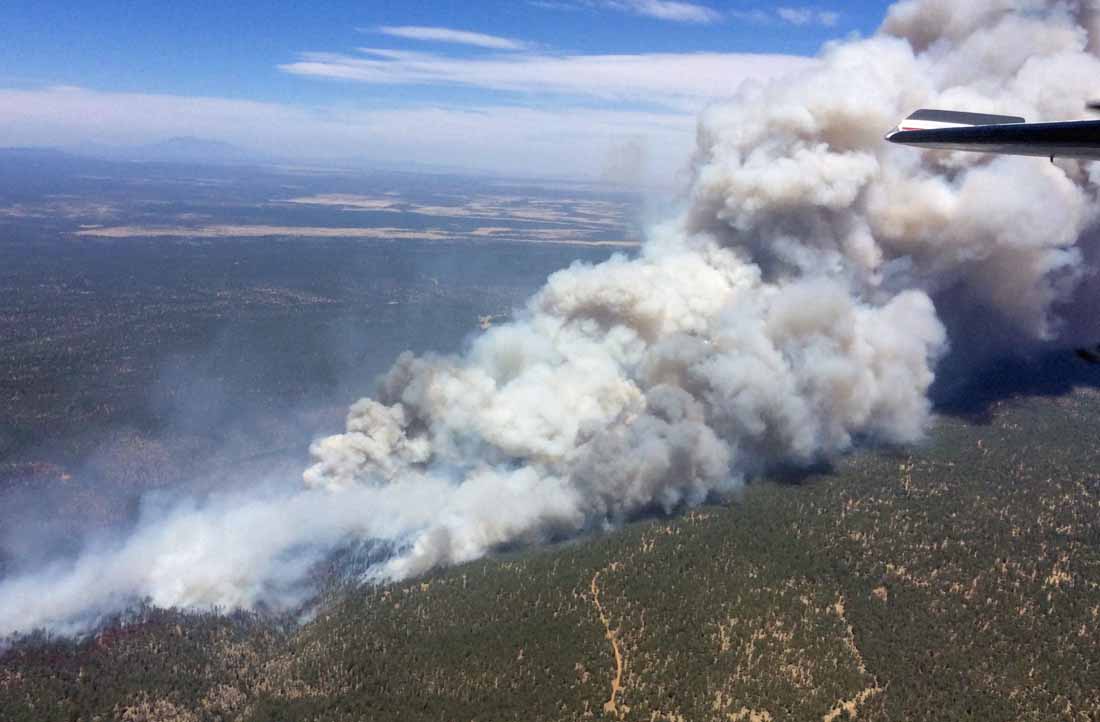
Tinder Fire
Tinder Fire, April 29, 2018. InciWeb photo, uncredited and undated.

The fire started April 27 during Red Flag Warning conditions. A map released Sunday morning showed that it had burned about 500 acres. A strong southwest wind pushed it to the northeast away from its origin near Highway 95 east of Blue Ridge Reservoir. A new map from 1 a.m. Monday  showed that it spread near a community on the east side of Highway 87/282.
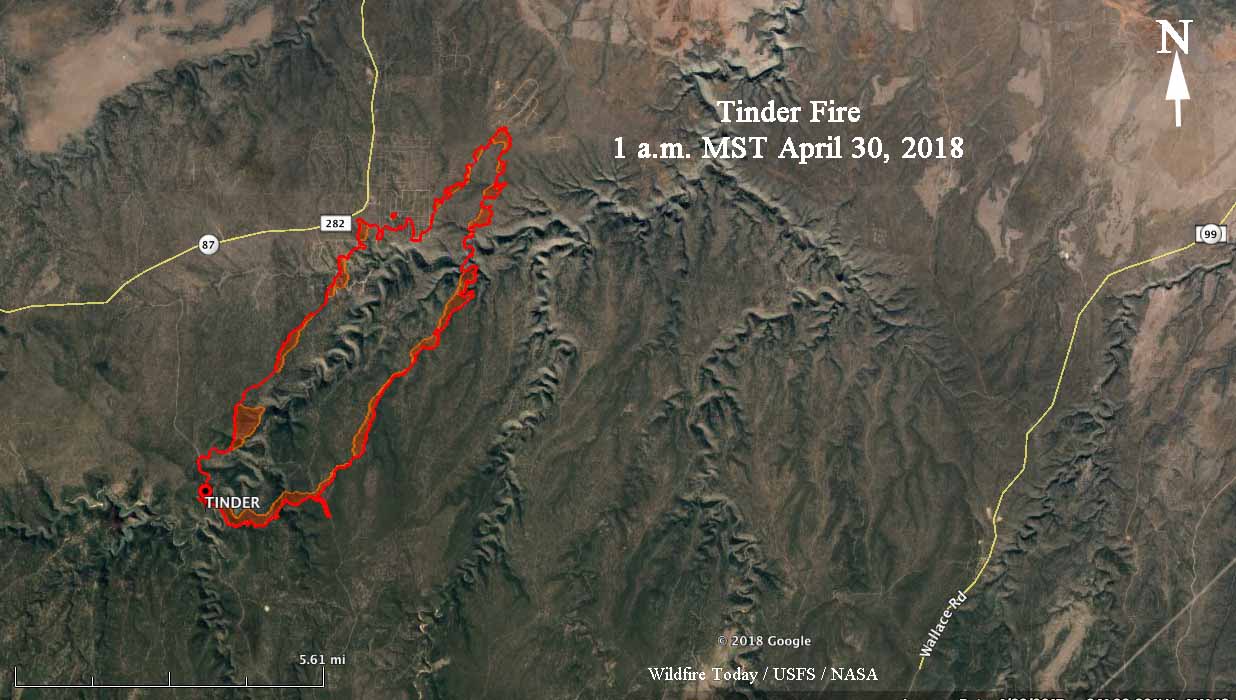
Map of the Tinder Fire
Map of the Tinder Fire showing the perimeter at 1 a.m. MST April 30, 2018. Perimeter by USFS.

The resources assigned to the fire include 13 crews, 5 helicopters, 23 engines, 3 dozers, 2 water tenders, and overhead, for a total of 510 personnel.

On Monday the fire is just outside a Red Flag Warning area, but strong southwest winds will continue to be a challenge for firefighters through Tuesday.  The IMT reports that there is a potential for very active to extreme fire behavior with rapid rates of spread and moderate to long range spotting. The weather forecast indicates that the fire will continue to move to the northeast.

The Coconino County Sheriff’s Office has ordered evacuations for communities affected by the fire that are north, east, and west of Hwy 87. Visit https://www.facebook.com/CoconinoCounty for details. Blue Ridge area residents can call the County’s Call Center, 928-679-8393, with questions about evacuations and structures.
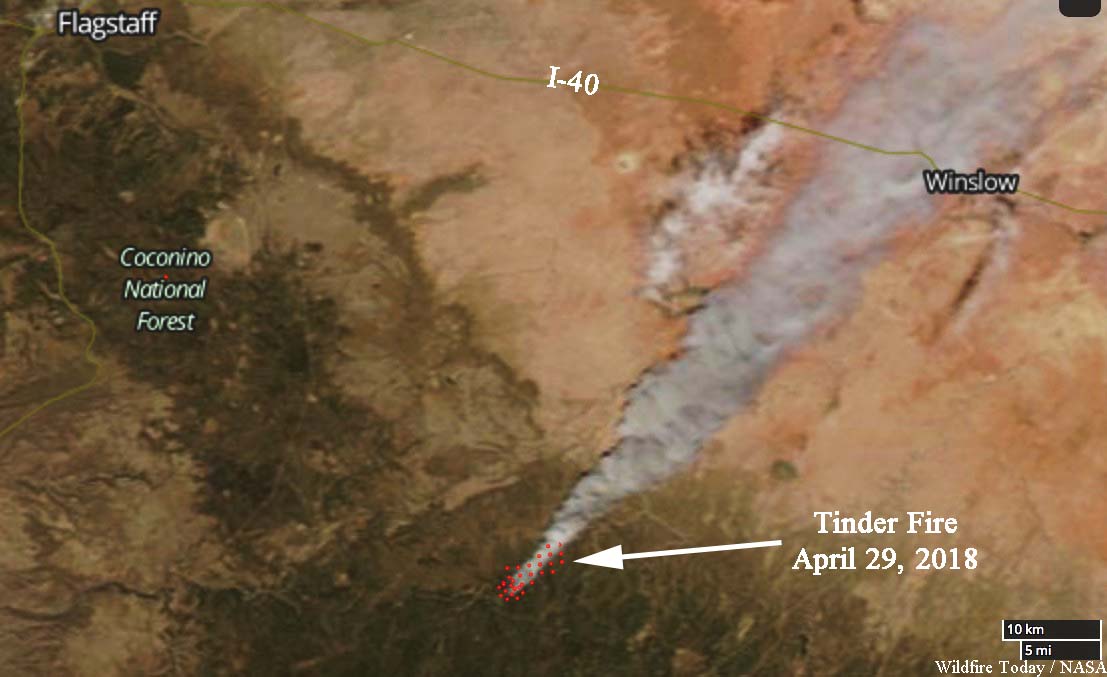
Satellite photo Tinder Fire
Satellite photo of the Tinder Fire, April 29, 2018. NASA.
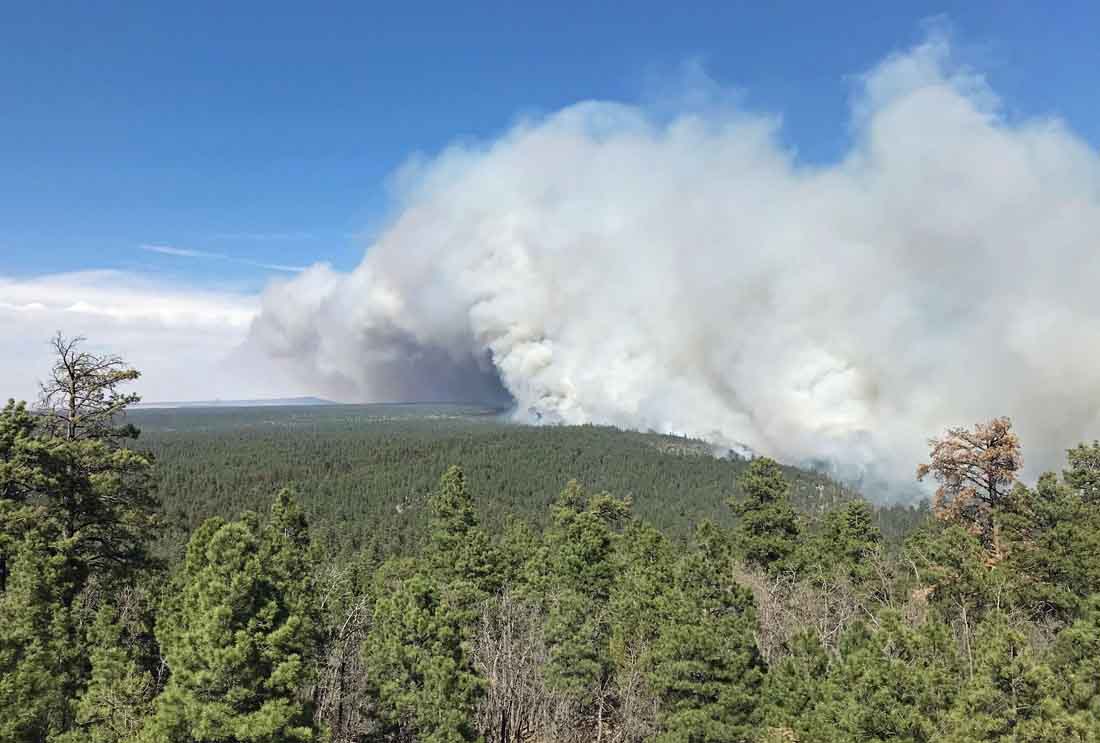
Tinder Fire
Tinder Fire, April 29, 2018. InciWeb photo, uncredited and undated.

Below is video of the fire recorded over the fire Monday morning.

Rattlesnake Fire burns almost 17,000 acres in eastern Arizona

Rattlesnake Fire

Above:  The Rattlesnake Fire, posted to Inciweb approximately April 20, 2018. Photographer unknown.

Growth on the 16,891-acre Rattlesnake Fire 20 miles southwest of Alpine, Arizona has slowed in recent days, but the perimeter continues to expand as firefighters conduct burnout operations to secure firelines.

Fire managers continue to monitor lines on the western flank near the Black River where a few areas of concern are still active. Some firefighters were moved from the west to the east side which has more active fire. Burnout operations were conducted along Forest Road 25 on Saturday.

Map of the perimeter Rattlesnake Fire
Map of the perimeter of the Rattlesnake Fire, April 22, 2018. USFS.

K-MAX lifts vehicles out of Grand Canyon


Warning: Trying to access array offset on value of type bool in /home/customer/www/wildfiretoday.com/public_html/wp-content/themes/jupiterx/lib/api/image/functions.php on line 61

Deprecated: ltrim(): Passing null to parameter #1 ($string) of type string is deprecated in /home/customer/www/wildfiretoday.com/public_html/wp-content/themes/jupiterx/lib/api/utilities/functions.php on line 206

Deprecated: preg_replace(): Passing null to parameter #3 ($subject) of type array|string is deprecated in /home/customer/www/wildfiretoday.com/public_html/wp-content/themes/jupiterx/lib/api/image/class-image-editor.php on line 177

Warning: Undefined array key "extension" in /home/customer/www/wildfiretoday.com/public_html/wp-content/themes/jupiterx/lib/api/image/class-image-editor.php on line 179

Deprecated: preg_match(): Passing null to parameter #2 ($subject) of type string is deprecated in /home/customer/www/wildfiretoday.com/public_html/wp-includes/functions.php on line 3089

Deprecated: is_file(): Passing null to parameter #1 ($filename) of type string is deprecated in /home/customer/www/wildfiretoday.com/public_html/wp-includes/class-wp-image-editor-gd.php on line 95

Deprecated: preg_match(): Passing null to parameter #2 ($subject) of type string is deprecated in /home/customer/www/wildfiretoday.com/public_html/wp-includes/class-wp-image-editor-gd.php on line 95

Warning: Trying to access array offset on value of type bool in /home/customer/www/wildfiretoday.com/public_html/wp-content/themes/jupiterx/lib/api/image/functions.php on line 61

Deprecated: ltrim(): Passing null to parameter #1 ($string) of type string is deprecated in /home/customer/www/wildfiretoday.com/public_html/wp-content/themes/jupiterx/lib/api/utilities/functions.php on line 206

Deprecated: preg_replace(): Passing null to parameter #3 ($subject) of type array|string is deprecated in /home/customer/www/wildfiretoday.com/public_html/wp-content/themes/jupiterx/lib/api/image/class-image-editor.php on line 177

Warning: Undefined array key "extension" in /home/customer/www/wildfiretoday.com/public_html/wp-content/themes/jupiterx/lib/api/image/class-image-editor.php on line 179

Deprecated: preg_match(): Passing null to parameter #2 ($subject) of type string is deprecated in /home/customer/www/wildfiretoday.com/public_html/wp-includes/functions.php on line 3089

Deprecated: is_file(): Passing null to parameter #1 ($filename) of type string is deprecated in /home/customer/www/wildfiretoday.com/public_html/wp-includes/class-wp-image-editor-gd.php on line 95

Deprecated: preg_match(): Passing null to parameter #2 ($subject) of type string is deprecated in /home/customer/www/wildfiretoday.com/public_html/wp-includes/class-wp-image-editor-gd.php on line 95

Deprecated: ltrim(): Passing null to parameter #1 ($string) of type string is deprecated in /home/customer/www/wildfiretoday.com/public_html/wp-includes/formatting.php on line 4558

The two vehicles drove off the edge in 2017

Continue reading

Record number of attendees at Arizona wildfire academy

Above: Students use sand tables to visualize initial attack scenarios and learn how to make sound decisions in this S200 Initial Attack Commander course during the 2018 Arizona Wildfire and Incident Management Academy in Prescott, Arizona. Courtesy photo. 

An annual wildfire training camp’s enrollment ballooned to record numbers this year on the heels of an especially active fire season — and the release of Only the Brave.  

At least 1,020 students are partaking in the 51 classes offered at this week’s Arizona Wildfire and Incident Management Academy in Prescott, said Tony Sciacca, Executive Director of the academy, as reported by The Daily Courier in Prescott. In its 16 years of operation, the academy’s previous highest enrollment  was 730.

The academy has a capacity of 1060.

“It’s a significant jump,” Sciacca told the newspaper.

During the training, which began March 10 and lasts through Friday at Embry Riddle Aeronautical University, attendees can pick from more than 50 NWCG, FEMA and other skills classes. Class offerings range from the entry-level S-130/190 to more advanced leadership or communications roles.

The Goodwin Fire burned 28,500 acres just outside of Prescott last year.  That, along with high-profile wildfires in California, might have piqued some interested in the academy, which is largely attended by Arizonans.

Additionally, there stands to be more money to go around this year. Arizona’s governor last month called for the doubling of the state’s investment in fire prevention funding for the upcoming fiscal year, from $1 million to $2 million.

And while it’s impossible to say, interest in wildland firefighting has surely increased since October’s release of Only the Brave. That film, of course, is based on the Granite Mountain Hotshots that fought not only wildfires for several years, but also battled with the establishment to finally be certified as the first Type 1 Interagency Hotshot Crew managed by a municipal fire department — the Prescott, Arizona Fire Department.

Drone catches fire, ignites wildfire north of Flagstaff

(UPDATED at 11:33 a.m. MST March 7, 2018)

The drone that landed, caught fire, and ignited what became a 335-acre fire in Northern Arizona was battery-powered and approximately 16″ x 16″, a spokesperson for the Coconino National Forest said. The operator reported the fire and was later cited for causing timber, trees, slash, brush, or grass to burn. The spokesperson did not know exactly how the drone caught fire.

****

(Originally published at 4:42 p.m. MST March 6, 2018)

Kendrick Fire Arizona

This article first appeared on Fire Aviation.

There’s no doubt that Unmanned Aerial Systems can play an important part in improving situational awareness for wildland firefighters.

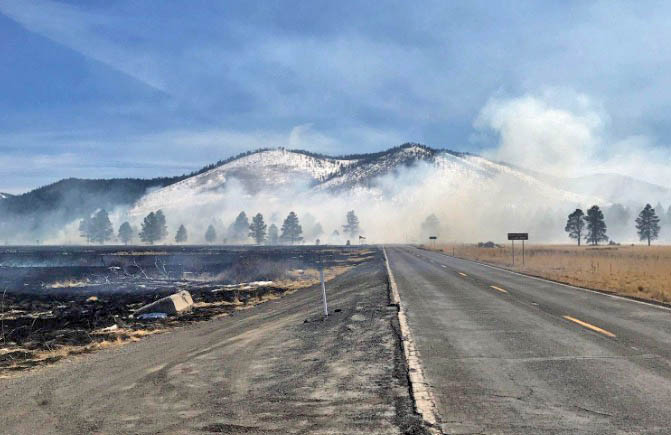
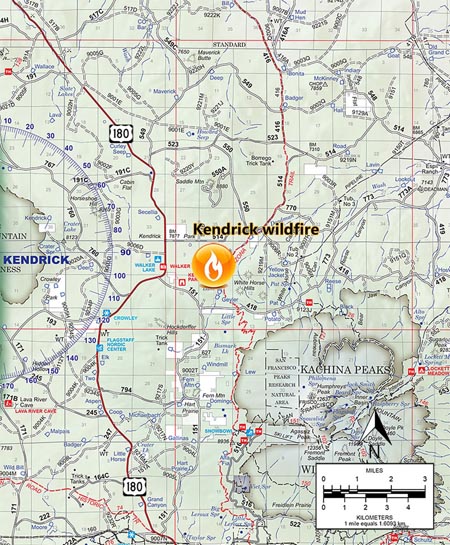
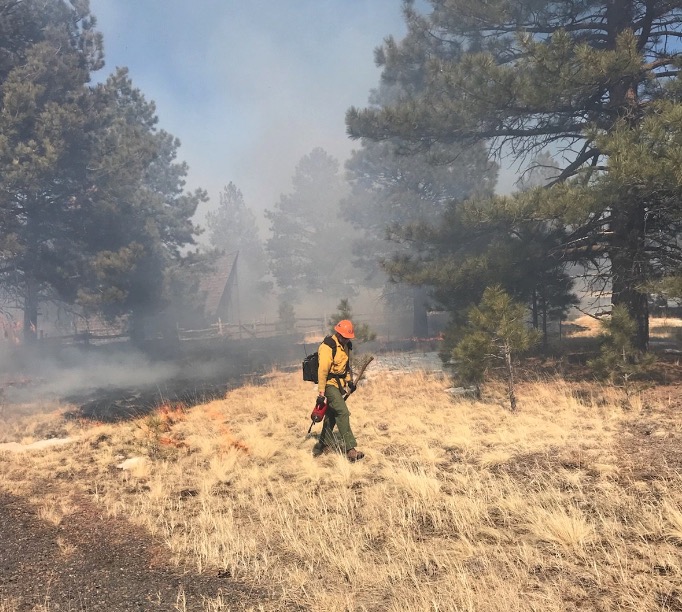
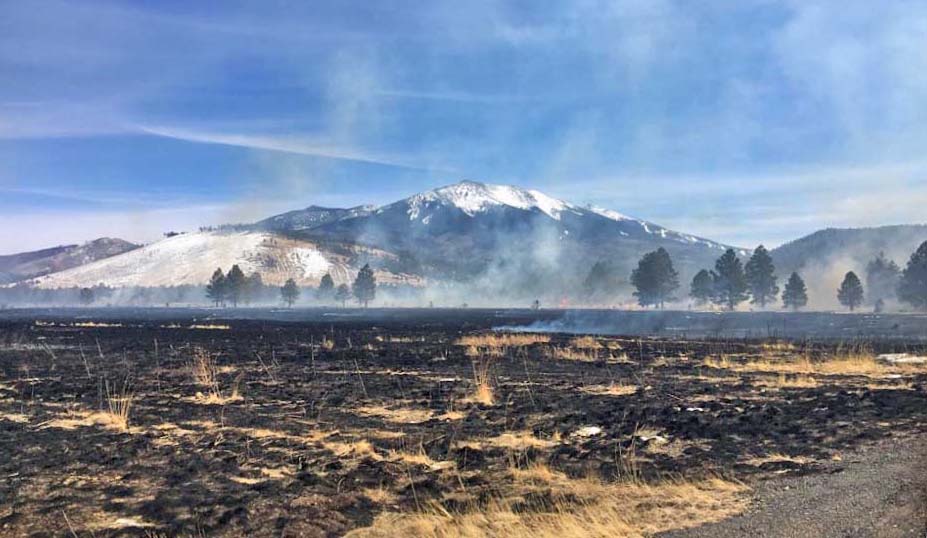
But today investigators have determined that the preliminary cause of a wildfire north of Flagstaff is a drone that landed and caught fire. At 3:25 p.m. MST Tuesday the Coconino National Forest said firefighters had stopped the spread of the resulting wildfire after it burned 335 acres near Kendrick Park by Forest Roads 514 and 524.

map kendrick fire

There is no information yet about the operator of the drone or if it was powered by a battery or gasoline.

All of these photos were provided by the Coconino National Forest.

Kendrick Fire Arizona

Thanks and a tip of the hat go out to Tom.

Typos or errors, report them HERE.

Drone lands, catches fire, ignites wildfire

Kendrick Fire Arizona

(UPDATED at 11:27 a.m. MST March 7, 2018)

The drone that landed, caught fire, and ignited what became a 335-acre fire in Northern Arizona was battery-powered and approximately 16″ x 16″, a spokesperson for the Coconino National Forest said. The operator reported the fire and was later cited for causing timber, trees, slash, brush, or grass to burn. The spokesperson did not know exactly how the drone caught fire.

****

(Originally published at 4:32 p.m. MST March 6, 2018)

Just a couple of hours ago we wrote about how proud the Department of the Interior is of their drone program (as they should be). And there’s no doubt that Unmanned Aerial Systems can play an important part in improving situational awareness for wildland firefighters.

But today  investigators have determined that the preliminary cause of a wildfire north of Flagstaff is a drone that landed and caught fire. At 3:25 p.m. MST Tuesday the Coconino National Forest said firefighters had stopped the spread of the resulting wildfire after it burned 335 acres near Kendrick Park by Forest Roads 514 and 524.

kendrick fire map arizona drone

There is no information yet about the operator of the drone or if it was powered by a battery or gasoline.

All of these photos were provided by the Coconino National Forest.

Kendrick Fire Arizona

Kendrick Fire Arizona

Thanks and a tip of the hat go out to Tom.
Typos or errors, report them HERE.

Five lessons learned at Prescott fire managers meeting

State Foresters meeting prescottThis week in Prescott, Arizona the National Association of State Foresters held their annual “Chiefs, Managers and Supervisors Meeting”. The goal of the 120 attendees was to discuss the policies, technologies, and procedures that will improve the efficiency and effectiveness of fighting wildfires.

One product from the event was a list of the top five lessons learned:

  1. Change starts with coordinated leadership. The work the nation’s state foresters are doing together to improve wildfire preparedness, detection, and suppression is critical to protecting communities small and large across the country. When state foresters lead the charge on these issues, and act as one, their voice is amplified in Congress – and more importantly – outside of Congress in the public domain where change-making starts.
  2. Speak the same language and use the same metrics whenever possible. When the states share similar language to characterize their wildfire fighting programs, national and regional wildfire fighting coordination is improved and lives are saved. Additionally, with a standardized method of measuring wildfire costs across the nation, we can track exactly where money for wildfire prevention and suppression goes and to what benefit, ultimately allowing for more efficient resource allocation.
  3. Stay the course on advocating for federal forest management and wildfire funding reform. A positive resolution is closer than ever. The USDA, Department of the Interior, the International Association of Fire Chiefs, and other national partners are in agreement on the broad strokes of federal forest management reform and a wildfire funding fix, which means the state foresters are in a good position to propose and advocate for what specific changes need making.
  4. Words matter; and actions even more. It’s time to stop talking about how we can better support and protect wildland firefighters; how we can better contain costs, employ new technologies, and help prevent catastrophic post-fire damage. In many cases, we have the information we need to set smarter federal forest management and wildfire policies. It’s time to put that information to use – to change policies to save lives.
  5. Sharing processes that work, works. Better decisions and better outcomes come out of sharing experiences and expertise between state forestry and fire agencies. One of the best ways to contribute to cooperative networks is to get connected.