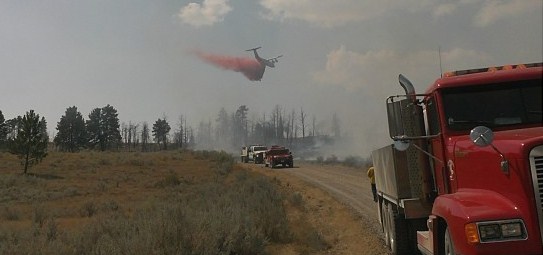
A P2V air tanker reloads at Rapid City while working on the Myrtle fire, July 21, 2012. Photo by Bill Gabbert
Four students studying journalism at Washington State University have written an article that summarizes the state of the federal air tanker program. It is interesting in that it quotes several knowledgeable people who have close ties to management of the fleet, including Jim Hall, former Chair of the National Transportation Safety Board, and Ron Hanks, head of aviation safety with the U.S. Forest Service. They also interviewed Dick Mangan, past president of the International Association of Wildland Fire.
Mr. Hall, who chaired the 2002 Blue Ribbon Panel following the crashes of two air tankers that killed five aviators that year, continues to lament the current state of the air tanker program, much as he did earlier this summer.
Mr. Hanks apparently told the student reporters:
Right now, we have 17 aircraft, and that includes the Canadian aircraft that we have borrowed.
That puts an extremely favorable spin on the fact that as the fire season ends there are nine large air tankers on exclusive use contracts, plus two BAe-146s that were put on temporarily as “additional equipment” on Neptune’s contract. The Canadian air tankers and lead planes that Mr. Hanks referred to were borrowed for a month or so last summer. In 2002 we had 44 large air tankers.
Here is a video that illustrates the student’s story;
Devore Fire, Cajon Pass in southern California, 11-5-2012. Photo by Rick McClure
Rick McClure, a free-lance photographer for the Associated Press and fire publications, got this spectacular photo of Tanker 41, a BAe-146, dropping on the Devore Fire in Cajon Pass in Southern California November 5, 2012. He shot it with a Nikon D5000 at f/6.3, 1/640. And he was not half a mile away using a huge telephoto lens. This was a zoom lens at 150 mm.
Mr. McClure told us “I actually couldn’t run fast enough to get totally out of the drift.” One other photo he got for us is at our new sister site, Fire Aviation.
The Devore Fire burned 350 acres along Interstate 15 in the San Bernardino National Forest.
Tanker 41, a BAe-146, drops retardant on the Devore Fire in Cajon Pass in southern California, November 5, 2012. Photo by Rick McClure
Rick McClure just sent us this excellent photo of Tanker 41, a BAe-146, dropping on the Devore Fire in Cajon Pass in southern California. He used a Nikon D5000 and shot it at f/10 and 1/400. He was not miles away using a huge telephoto lens — he used a zoom lens set at 60 mm for this photo.
Mr. McClure said: “I actually couldn’t run fast enough to get totally out of the drift.”
The fire jumped Interstate 15 eventually burning 350 acres before it was knocked down by firefighters and aircraft.
One more photo that Mr. McClure sent us is on our sister site, Wildfire Today.
A BAe-146 air tanker drops on a fire near Pompeys Pillar, MT, Sept. 2, 2012. Photo by Lisa Openshaw, Shepherd Volunteer Fire Department
On Sunday firefighters stopped a fire after it burned 326 acres north of Pompeys Pillar in Montana (see photo above).
The National Interagency Fire Center moved the national preparedness level from four to three.
Elizabeth Reinhardt of the USFS and Dick Bahr of the NPS are quoted in an article about how larger and more frequent fires over the last several decades have limited the size of some fires, as they move into the previously burned areas.
Wildfire south of Porto, Portugal, September 2, 2012
Hot, dry, and windy weather led to several large wildfires in Portugal on Sunday.
Here are a couple of photos taken at Missoula, Montana today. Tanker 41 is the second BAe-146 that Neptune Aviation has leased from Tronos, a company based on Prince Edward Island in Canada. The air tanker can’t be put into service for the U.S. Forest Service until the agency resolves a protest about the contracts that were recently awarded for next generation air tankers.
The photo below shows smokejumpers loading onto a Twin Otter aircraft after being dispatched to a fire.
Smokejumpers loading onto an aircraft at Missoula, August 11, 2012. Wildfire Today photo.
And, for a bonus, we have a photo of the TBM air tanker that Missoula’s Museum of Mountain Flying purchased last year. The TBM flew into Missoula on October 10, 2011 and is on display at the museum. TBM’s could carry about 600 gallons of retardant. This compares to the 3,000 the BAe-146 can hold. or the 20,000 gallon capacity of the 747 supertanker.
A TBM air tanker at Missoula’s Museum of Mountain Flying. Wildfire Today photo.
Minden’s BAe-146 shortly after the company acquired the aircraft. Photo: Minden, used with permission
The Minden Air Corp, based at the Minden-Tahoe airport in Minden, Nevada, is in the final stages of converting a four-engine jet airliner into a next generation air tanker. The BAe-146 was manufactured in 1989 and Minden acquired it, serial number E2111, in January 2009. The new air tanker will be several decades younger than the two P2V’s currently being flown by Minden and the nine operated by Neptune.
Tim Christy, the Director of Flight Operations for Minden, told us that he expects the air tanker to leave the hangar later this month after which “we will start running water through it”. The tank system is conventional, consisting of a 3,000 gallon internal retardant tank and a computer controlled constant flow door system which will rely on gravity, rather than a pressurized system, to force the retardant out of the tank.
Minden’s BAe-146 during the conversion process. Photo: Minden, used with permission
Mr. Christy said the conversion process is slow. They have to make sure that everything they do conforms with FAA regulations and have been recording every single part that goes on the aircraft.
He said they have a second BAe-146, serial number 2106, which they will convert into an air tanker as soon as they finish the first one. He expects the second conversion to go much faster than the first.
If everything goes well, Mr. Christy hopes to have the first one flying on fires during the 2012 fire season.
Neptune leased a BAe-146 converted air tanker last summer and obtained “interim approval” from the Interagency Air Tanker Board which will be valid through the end of December, 2012. It will not receive full approval from the Board until after it is evaluated sufficiently on actual wildfires and at air tanker bases. There has been speculation that the BAe-146 operated by Neptune uses air pressure or some other pumping system to force the retardant out of the tank, but Dan Snyder, the President of Neptune, told us today that their BAe-146 uses a gravity drop system. This was confirmed by Jennifer Jones, a spokesperson for the U.S. Forest Service at Boise. Their aircraft, Tanker 40, made a handful of drops this fall in Texas and a few last month in California. Neptune leases the ship from Tronos, and presently it is back at Tronos’ base on Prince Edward Island in Canada for a major scheduled maintenance which usually takes about 21 days.
Minden owns their BAe-146 and is performing their own conversion, rather than leasing a previously converted aircraft from Tronos.
Here are some stats about the BAe-146:
Water or retardant capacity: 3,000 USG
Range: 1,800 miles
Cruising speed, about 498 mph
Typical drop speed expected to be, according to Tronos, 120 knots (138 mph) @ 150 feet (46 meters)
Short take-off length and steep field approach
Air-brake and flap combination improves low speed maneuverability
387 aircraft were manufactured from 1978-2001
Engines: four Textron Lycoming turbofans
Passenger capacity as an airliner: 82-112
Minden’s two P2Vs, air tankers 48 and 55, will begin active contracts with the U.S. Forest Service next month, with one starting on February 15 and the second on April 1. Neptune will bring on one P2V in February, two in March, and the other six later.The loss of Aero Union’s eight P3 air tankers after the company went out of business has affected the contracting of the 11 to 12 remaining large air tankers. Mr. Christy of Minden told us that their company at this time is not interested in bidding on the P3s that are going up for auction. Mr. Snyder of Neptune said they have little interest in the aircraft but will probably go down to Sacramento and take a look at them.
This photo appeared at FlightAware, having been uploaded there on May 15. Could this be the project that Minden is working on, converting a BAe 146-200 into an air tanker that we told you about on March 28? According to the flight tracker at FlightAware, this aircraft, N146FF, last landed on May 15, at Missoula, but there is a rumor that it was at another airport yesterday.
UPDATE May 27
Wildfire Today has confirmed that Tanker 40 is Neptune Aviation’s BAe-146 conversion, which further explains why it was last reported landing at Missoula, the home of Neptune.
Minden’s BAe-146 conversion, Tanker 46, is currently at Fox Field in southern California.
So there are two or three BAe-146 conversion projects currently nearing completion:
But keep in mind, before any air tanker can contract with a federal agency in the United States they will have to get a Supplemental Type Certificate from the FAA, as well as certification from the Interagency Air Tanker Board.
Below is the photo that we ran on March 28 of the Tronos project.
BAe-146-200 makes its first drop on October 28, 2009. Tronos photo.
UPDATE July 15, 2010
We just want to summarize the information we have. It appears there are two BAe-146 air tanker conversion projects underway:
Neptune, at Missoula, MT: Tanker 40, N146FF (formerly N608AW), serial #E2049, registration issued May 12, 2010, airworthiness issued May 23, 2010; owner: Aircraft Holdings Network Inc trustee, Las Vegas, NV. This aircraft was apparently converted by Tronos.
Minden, at Minden, NV; Tanker 46, N446MA, serial #E2111, registration and airworthiness issued May 26, 2010; owner: Minden Air Corp, Minden, NV