Australia’s firefighting fleet expanding

Australia is expanding its aerial firefighting fleet to include multi-use aircraft to respond not just to fires but also to natural disasters such as floods and major storms.

abc.net.au reported that longer and overlapping fire seasons are increasing  pressure on the country’s firefighting fleet. The new federal budget includes an extra $35 million to source more multi-use aircraft, while a national audit is underway to ensure Australia has the capacity to meet building demand.

Country Fire Service helicopter pilots

National Emergency Management Authority (NEMA) deputy coordinator general Joe Buffone said recent fire seasons illustrated the demand for more versatile aircraft.

“The key focus is to broaden the fleet so that it’s multi-use,” said Buffone. “This means aircraft will be able to be changed around so they can do evacuation, resupply, support remote communities, and help other emergencies way beyond just fire.”

NEMA reports that the Australian government will ensure that the country  is better prepared by funding more aircraft to respond to fires, floods, and other severe weather events.


NEMA logoThrough the 2024-25 budget, the government will provide an additional $35 million over the next two years to the National Aerial Firefighting Centre (NAFC), for delivery of national, state and territory aircraft for fire and emergency services. This investment will provide a range of aerial assets, from specific firefighting aircraft to a mix of fixed-wing and rotary multi-use aircraft, boosting protection for communities as they face more intense, frequent, and concurrent disasters.

CFS
 

Australian Flying reported last month that Aerial  Application Association of Australia (AAAA) CEO Matt Harper welcomed the news that the government will spend $35 million through NAFC in support of aerial firefighting. The funding will help establish a sovereign aerial capability, as recommended by the Royal Commission into National Natural Disaster Arrangements, and it’s expected to ease pressure on military personnel and firefighting aircraft.

Australian Meteorology
Australian Meteorology — bom.gov.au

Harper said AAAA members invest heavily in their helicopters and SEATs, and they employ and train pilots, ground support, and mechanics. He added that because Australian firefighting expertise is internationally recognized, many of their members are headed to the northern hemisphere for the summer fire season. “Any consideration of future capability will need to balance speed and accuracy with cost and sustainability,” said Harper, “and we look forward to continuing to work with NAFC to demonstrate the vital role of Australian owned, crewed, registered, and maintained aircraft.”

Murray Watt, Minister for Emergency Management, said the increased funding boosts the government’s total contribution to national aerial capability to approximately $48 million a year.

As of March 2024 the fleet comprises 162 aircraft, including:

        • 6 large fixed-wing airtankers
        • 15 heavy helicopters
        • 70 medium and light helicopters
        • 56 fixed-wing airtankers
        • 15 light fixed-wing aircraft

The fleet is supplemented by additional state-owned and state-contracted aircraft hired for peak demand periods. In total more than 500 aircraft, provided by over 150 operators, are available for firefighting across Australia.

“With this investment, we are not only increasing the number of aircraft available,” said Minister Watt, “but also broadening the type of aircraft so they can be used for different activities such as heavy lift, transportation and evacuations, and resupply operations.” He added that international requests for crewed aircraft are likely to increase as fire seasons in the northern hemisphere expand — enough that their season and the Australian fire season are overlapping now in higher-risk climate and extreme weather.

Longer and overlapping fire seasons are upping the pressure on the Australian existing fleet. Country Fire Service photo.

Buffone said the investment should reduce the need for the Australian Defence Force to step in during disasters. “There are some pressures on the system,” he explained. “We’ve got the northern hemisphere that quite often overlaps with the southern hemisphere season, so there’s more demand on aircraft. We’re trying to make sure we can actually have aircraft for aerial firefighting and for other emergencies.”

Most but not all of the aircraft contracted under NAFC are Australian-owned and registered, including several large airtankers, 15 large helicopters that can carry up to 11,000 litres (~3000 gallons), along with a mix of smaller rotary-wing aircraft.

South Australia's aerial fleet made 1,602 drops during summer, putting 4.68 million litres of water on fires. Country Fire Service photo.
South Australia’s aerial fleet made 1,602 drops during summer, putting 4.68 million litres of water on fires. Country Fire Service photo.

Country Fire Service state aviation operations manager Nik Stanley said South Australia deployed its largest-ever firefighting fleet last summer.

“We had 31 aircraft for this season and we have that number for the next four seasons to come,” he said. “We are continuously evaluating our fleet, every year … looking at the capabilities that we have available, are they still suitable for us moving forward.”

Australia’s ‘Black Summer’ bushfires’ impact on tourism still being uncovered

Researchers are still learning the full impact of the Australian brushfires that burned nearly 60 million acres, or 24 million hectares, between 2019 and 2020.

Numerous reports have looked into different facets of the disastrous season, including the massive loss of plant life and firefighter experiences during the bushfires. Australia also created the Bushfire Royal Commission,  later renamed the Royal Commission into National Natural Disaster Arrangements. The commission produced a report that modernized the nation’s disaster preparedness and recovery.

Air-Crane about 10 years ago in the North Grampians.
Air-Crane about 10 years ago in the North Grampians — photo ©Kenny Chapman

The most recent report on the bushfires focused on how they affected the  nation’s tourism industry, specifically how previous reports underestimated the financial losses.

“Our novel research into the losses from the tourism shutdown resulting from Australia’s 2019-20 fires found that flowing on from direct impacts of AU $1.7 billion, indirect impacts along supply chains resulted in $2.8 billion in total output losses and $1.6 billion in reduced consumption,” the University of Sydney researchers’ report said. “We calculated significant spill-over costs, with total output losses being an increase of 61 percent on top of the direct damages identified.”

The study was reportedly the first time researchers documented changes throughout Australia’s entire supply chain, rather than focusing on specific parts of the Australian economy. Researchers said the ability to fully quantify disasters’ effects on a nation’s economy will become more important as climate change intensifies natural disasters.

“Natural hazards may increase economic inequalities, with the burden of climate adaptation and mitigation adding to the costs of governments already struggling under business-as-usual,” the report says. “Australia’s reputation as a pristine destination could become permanently damaged in the longer term under global warming, with fewer people traveling in Australia in our peak summer holiday season; similarly, people may start to avoid other countries and regions that are increasingly in the media for their wildfires and other natural hazards.”

Click here to read the full study.

Researchers are still learning the full impact of the Australian brushfires that burned nearly 60 million acres, or 24 million hectares, between 2019 and 2020.

Numerous reports have looked into different facets of the disastrous season, including the massive loss of plant life and firefighter experiences during the bushfires.

Bushfires north of Perth in Western Australia

Residents near Perth on the southwestern coast of Australia  are being warned to evacuate or risk losing their lives, with an emergency bushfire warning in place.

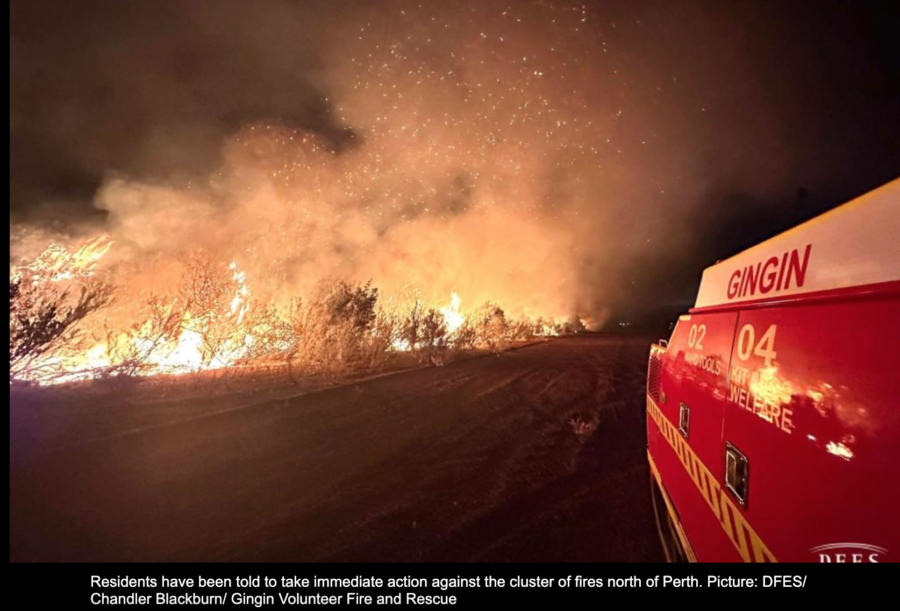
The bushfire alert was in effect on Monday morning, and the Department of Fire and Emergency Services (DFES) warned that homes and lives were at risk. Residents in other towns including Bindoon, Breera, Gingin, Lennard Brooke, Mooliabeenee, and Moondah were warned that they were “in danger and need to act immediately to survive,” with homes on Wowra Drive and Lennard Road under direct threat by fire.

Gingin Volunteer Fire & Rescue
Photo by Chandler Blackburn, Gingin Volunteer Fire & Rescue
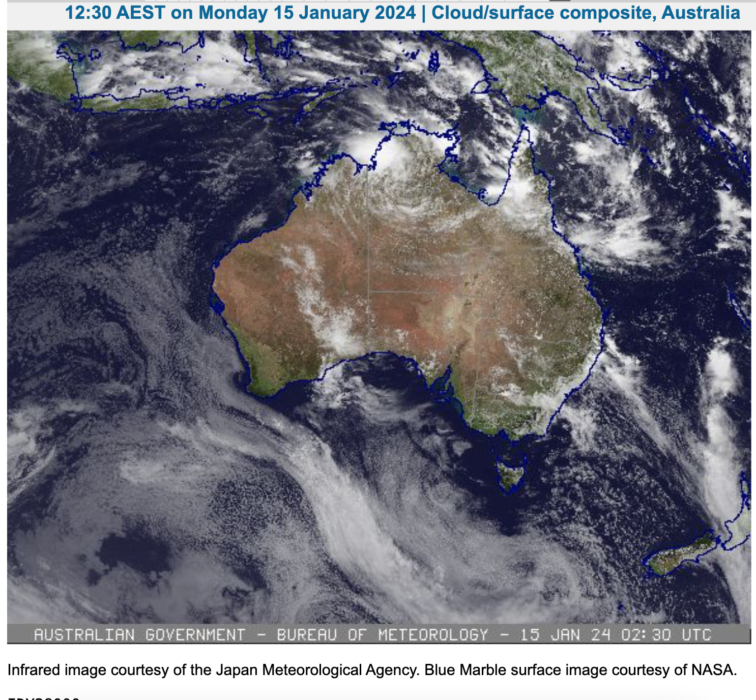
Infrared image, Australia, 15. January 2024
Residents were told to take immediate action with the cluster of fires north of Perth and were warned to either leave for safety — or take shelter in their homes if it’s not safe to evacuate. Residents not at home were warned to not try to return.

More than 200 firefighters and aviation support staff are fighting the cluster of fires in the Gingin and Chittering shires, and a severe heat warning indicated that temperatures were rising into the mid-forties (40°C = 104°F).

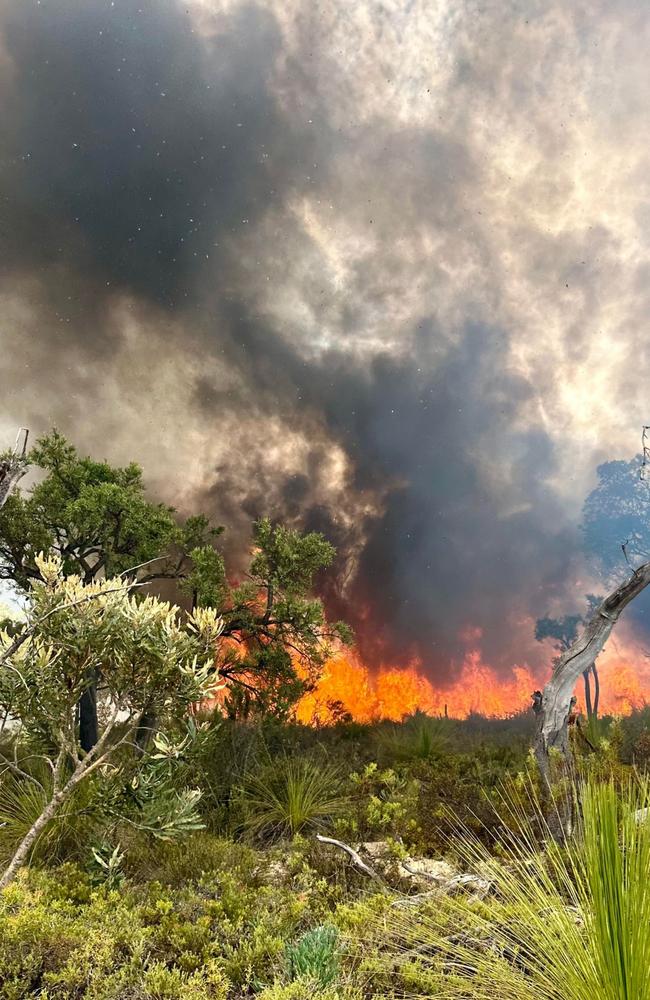
An emergency bushfire alert has been issued for residents just an hour away from Perth. Picture: DFES/ Nikki Woods/ Gingin Volunteer Fire and Rescue
Nikki Wood photo, DFES – Gingin Volunteer Fire & Rescue
An emergency bushfire alert has been issued for residents just an hour away from Perth, the Australian reports. Warnings were issued for Bambun, Coonabidgee, Breera, and Lennard Brooke. “There is a possible threat to lives and homes as a fire is approaching in the area and conditions are changing,” the DFES warned.

Bushfire-prone weather conditions are expected for the rest of this week, with a thunderstorm warning adding to the fire danger. The Bureau of Meteorology issued an extreme fire danger warning for the areas of Barrup and Blackwood with hot, dry and windy conditions increasing fire danger. Lightning and wind from thunderstorms in the South West Land Division could also ignite and exacerbate fires, and heatwave warnings were issued for much of Western Australia.