Fire Captain dies from bacteria possibly inhaled on wildland fire

Matt Moore
Matt Moore. Photo courtesy of the Murrieta Firefighters Association

This is scary as hell. A firefighter has died after being infected with a rare brain-eating amoeba that usually lives in soil. A biopsy showed his brain had been invaded by the parasite Balamuthia mandrillaris.

From The Californian:

“MURRIETA — Murrieta Fire Capt. Matt Moore died Monday night at UCSD Medical Center in San Diego, succumbing to complications from meningitis, fire department officials said.

Moore, 43, a 17-year veteran of the department, had been hospitalized in a coma for the last two weeks.

He had been in various hospitals since November battling an aggressive form of meningitis. It is believed Moore inhaled a parasite while fighting the region’s wildfires late last year. The parasite reportedly caused swelling in his brain.

He is survived by wife, Sherry; daughter, Alyssa, 16; sons Trent and Brandon, both 13; brother, Mark Moore, who also is a captain in the city’s fire department; sister, Jill; and parents Carol and Phil Moore.

The fire department will hold a procession today to bring Moore’s body to England Family Mortuary in Temecula from the medical center in San Diego’s Hillcrest community.”

CAL FIRE proposes to close 20 fire stations

Governor Schwarzenegger

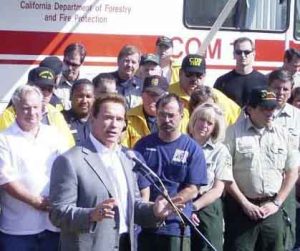
Governor SchwarzeneggerThe California Department of Forestry and Fire Protection, which now prefers being called CAL FIRE, may have to close 20 fire stations due to a $50 million budget cut for the agency being ordered by the Governator. To help solve the state’s budget woes, Governor Schwarzenegger is also pushing a 1.25% surcharge on all residential and commercial insurance premiums.

More information from the Auburn Journal:

Proposed state budget cuts could close 20 Cal Fire stations statewide including Auburn’s Bowman station.

Gov. Arnold Schwarzenegger has asked Cal Fire to cut more than $52 million from its budget, which amounts to about 10 percent of its general fund.

“To do that we are going to have to close a number of our facilities and reduce a number of our positions,” said Daniel Berlant, department information officer for Cal Fire.

He said the positions cut would not be in fire protection but in resource management and at the State Fire Marshal’s office.

He said Auburn’s Cal Fire station is on a list of stations targets for proposed closure.

“There are other stations (in the Auburn area) that can respond in a timely manner if there were to be a wildfire,” Berlant said.

He said if the Auburn station were to close employees would be redistributed to other locations.

“No current employees would lose their jobs,” Berlant said.

The governor has also proposed a wildland firefighting initiative within the budget that would recommend a surcharge to property owners statewide, which would pay for all facilities to remain open, Berlant said.

A 1.25 percent surcharge on residential and commercial insurance, like homeowners insurance, could bring in as much as $120 million to the state fire agency.

“It would increase our funding and we could increase our staffing to respond to wildland fires before they become infernos like the San Diego fires of last October,” Berlant said.

Teenagers arrested for starting fire near Julian, CA

From the San Diego Union:

JULIAN – Two Julian teenagers, accused of starting the 850-acre Angel fire that destroyed one house and a large part of an Episcopal church retreat, will appear in court later this month for a preliminary hearing on felony charges of recklessly starting a fire.

If convicted, Francisco Javier Abarca, 19, and Mario J.W. DeLuca, 18, both of Julian, could also be held liable for the $3 million cost of fighting the September fire, officials say.

The blaze, caused by an illegal campfire, forced the evacuation of hundreds in the mountain town on Sept. 15. Seventeen buildings were destroyed at Camp Stevens, which was purchased in 1952 jointly by the Episcopal Dioceses of Los Angeles and San Diego.

Abarca and DeLuca are charged with a form of arson that does not require prosecutors to prove they intended to burn forest or buildings. If convicted, the teens face a maximum of three years in prison.

The arrests of Abarca and DeLuca in January were not publicized by authorities.


Redding Smokejumpers Mistaken for Invaders

Smokejumpers

SmokejumpersShortly after 9/11, the Redding, California Smokejumpers, using a location for the first time for practice jumps, were mistaken for an invading army by a local woman who considered getting a rifle.

From the Redding Record Searchlinght:

“Smokejumpers preparing for the coming fire season could be dropping into the Swasey Drive Recreation Area as early as next week.

The U.S. Forest Service’s Region 5 Smokejumpers, whose base is in Redding, will be using parts of the 1,200-acre area managed by the U.S. Bureau of Land Management for training through the summer, said Bob Bente, the smokejumpers’ training foreman.

The spot west of town will be one of five around the north state used for training.

“It’s a new area,” he said.

Terrain in the recreation area, which is popular among mountain bikers and hikers, is similar to what smokejumpers — firefighters who get to backcountry blazes by parachute — might encounter on calls, said Francis Berg, assistant field manager in the BLM’s Redding office.

“Yet it’s close to town so they can get out there pretty quickly,” he said.

Bente said he wanted to give the public a head’s up that the chutists will be coming down. The parachutes should be visible from Placer Road near Swasey Drive, with the first jumps possibly Tuesday or Wednesday, he said.

Shortly after the terrorist attacks of Sept. 11, 2001, the smokejumpers used a new jump spot south of town, he said. The sight of people parachuting from a plane caused a stir among nearby residents, including one woman who thought it could be an invasion.

“She actually contemplated getting a rifle,” Bente said.”

Esperanza Fire: One Trial or Six?

The 5-person crew of Engine 57 from the San Bernardino National Forest was killed while trying to protect a house during the Esperanza Fire in Southern California on October 26, 2006.

From the Press-Enterprise :

“Raymond Lee Oyler, charged with murder and arson in the deaths of five U.S. Forest Service firefighters, wants the 45 charges against him divided into six separate trials.“Very weak charges have been joined with particularly strong ones,” Mark R. McDonald, Oyler’s attorney, argues in the motion filed Friday.

The defense attorney claims putting all the charges in one trial, especially when some carry a death penalty, “will substantially prejudice Mr. Oyler in his right to a fair trial.”

The motion, which will be heard March 21, “is not unusual; it’s an effort to sever the capital counts from the non-capital counts,” said Deputy District Attorney Michael Hestrin. He said he will file a written response with Riverside County Superior Court Judge Jeffrey Prevost.

McDonald argues that Oyler should face six separate cases with the charges arranged on the types of evidence gathered from May through October 2006, when 62 fires struck the Banning Pass area.

Oyler is charged with starting 23 of them. He also faces five murder counts and 17 charges of using a device to commit arson.

He was arrested shortly the deadly Esperanza Fire, which began Oct. 26, 2006. Arson investigators said the 43,000-acre blaze was started by a device made of six wooden matches attached to a lit cigarette with a rubber band.

Driven by Santa Ana winds, the fire moved from its 1 a.m. flashpoint near Cabazon up the side of the San Jacinto Mountains. The five firefighters who perished were trapped by flames as they defended a home.

During Oyler’s preliminary hearing last year, investigators described six distinct devices used to set the fires the former Beaumont mechanic is charged with.

“Only two of the fires bear any forensic connection to Mr. Oyler,” McDonald argues. DNA was collected from the remains of cigarettes laid across wooden matchsticks on arson fires set June 9 and 10, 2006, in the Banning Pass area.

McDonald wants the case broken down into cigarettes placed over matches; matches bound by a rubber band to a cigarette (including the Esperanza Fire); “open flame device” fires which investigators declared arson by process of elimination; wooden matches; cigarette-and-paper match devices; and matches affixed to a cigarette with a strip of duct tape.

Oyler, 37, remains in custody without bail. He has pleaded not guilty to all charges.”

Ex-San Diego Fire Chief: "The Time for Action is Now"

Chief Bowman
Chief Bowman
Chief Bowman

An excerpt from the North County Times:

“RANCHO BERNARDO — In unveiling a report on regional firefighting strategies at a news conference Tuesday, former San Diego fire Chief Jeff Bowman said, “Much of what government does is this.”

Bowman stooped down to pick up a pile of documents nearly a foot thick. “This is what we produced after the (2003) Cedar fire.”

There is no need for more studies, said Bowman, who lives in Escondido.

“The time for action is now,” he said.

Speaking from a hilltop cul-de-sac where three Rancho Bernardo homes were incinerated in the Witch Creek fire last fall, Bowman and other members of a group called the San Diego Regional Fire Safety Forum outlined a checklist of actions they believe the region must take to avoid a similar catastrophe.

They called on the region’s most influential agencies to buy four new firefighting helicopters and 50 fire engines, and consolidate the numerous rural fire districts into a regional fire authority like one in Orange County, among other things.”

Yesterday, Feb. 19, the San Diego City Council unanimously approved the acquisition of a second helicopter for the city Fire-Rescue Department. They estimate it will cost $16 million and should be in service by August.

Photo of Chief Bowman, courtesy of SignOnSanDiego, 2006.

Man Convicted of Starting the Day Fire

Day Fire mapYesterday a federal jury convicted a homeless man, Steven Emory Butcher, of starting the Day Fire, which in 2006 burned over 160,000 acres in the Los Padres National Forest. The charges included willfully setting debris on fire in the forest and allowing a fire to escape from his control. The same jury also found him guilty of causing the 2002 Ellis Fire that burned about 70 acres in the same area.

The 49-year-old man faces up to 11 1/2 years in prison. The fire started in a remote area where Butcher camped for part of the year. It burned for four weeks through 254 square miles of chaparral and scattered pines in and around the Sespe Wilderness, a remote area with steep and rugged terrain. It destroyed 11 structures. The costs for suppression were over $73 million.

Report Released on 2007 Southern California Fires

2003 Fires, Lessons Learned

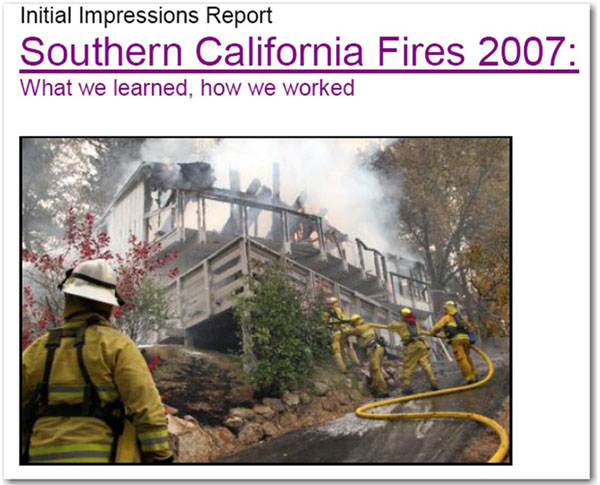
2003 Fires, Lessons LearnedThe Lessons Learned Center organized a group of five people to analyze the fires in the fall of 2007 in Southern California to determine the potential for lessons learned. They just released their 44-page report. It is very interesting reading.

The five-person team consisted of Dan Frazee, Phoenix, AZ Fire Department, Dennis Baldridge, U.S. Forest Service, Kevin Pfister, BridgerTeton National Forest, Dave Christenson, Wildland Fire Lessons Learned Center, and Jim Hollingsworth, Cal Fire.

Another "Blue Ribbon Task Force" Makes Recommendations in California

concrete Homes sign
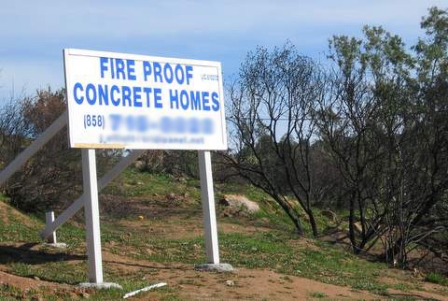
A sign installed in Harbison Canyon within the footprint of the 2003 Cedar Fire east of San Diego. The fire burned 273,246 acres and 2,232 homes. Photo by Bill Gabbert, 2004.

The second Blue Ribbon Commission Task Force in California since the fires of 2003 presented its report yesterday about how to deal with large wildland fires in the state. The recommendations include more engines, more aircraft, more firefighters, fire safe construction, and better systems for real time communications and intelligence. Many of these were in the report following the 2003 fires but were not implemented because of the state’s fiscal problems.

Click here to download the 106-page report (788 KB).

Here is how the LA Times began their story on the report:

Three months after massive brush fires burned hundreds of homes across Southern California, a blue-ribbon task force on Friday made dozens of recommendations aimed at improving the response to large-scale blazes.

But many of the proposed measures are similar to those made after the devastating wildfires of 2003 — and many of those were never implemented because there was no money available.

And because the state is in a fiscal crisis, it remains unclear whether the new recommendations will fare any better. Several reports over the last decade have said California needs to increase the number of firefighting aircraft as well as boost the number of firefighters.

UPDATE: January 18, 2018. The links above no longer work, but found a copy of a 2004 Blue Ribbon Report about the 2003 fires. It is a huge 21 MB file.

Man Charged for Starting Catalina Island Fire

The Long Beach, California Press-Telegram has information about the fire on the island off the California coast last May which burned several structures, including one home:

“An Indiana man has been charged for allegedly starting the Santa Catalina Island fire in May, authorities said Tuesday.

Gary Dennis Hunt, 49, was charged with two felony counts in his arrest warrant: one for recklessly causing a fire to an inhabited structure and one for recklessly causing a fire to a structure or forest. Three Catalina Island addresses were listed in the counts.

According to the Los Angeles County district attorney’s office, Hunt was a subcontractor working on the island. Despite posted signs about extreme fire danger and prohibition of open flames, he allegedly used an open-flame torch on May 10 to cut the cables on the island’s radio tower, Ambrose said.

That allegedly started the fire, which burned 4,750 acres and cost $5 million to fight.”