
Erickson Incorporated has been contracted through Australian partner Kestrel Aviation for a third S64E Aircrane helitanker to support firefighting efforts in the State of Victoria, Australia. In total, Erickson has six Aircranes currently working in the country.
Continue readingGAO denies protests of Next-Gen air tanker solicitation
 The Government Accountability Office has denied two protests over the solicitation for “up to seven” Next-Generation air tankers published by the U.S. Forest Service. Erickson Aero Tanker and Coulson Aviation protested some of the terms of the solicitation process before any announcement was made about awarding contracts. The USFS had hoped to have the air tankers working by May 30, but the protests halted the contracting process. Coulson’s was denied on July 8 and Erickson’s on July 17.
The next step is for the USFS to decide what companies they want to issue contracts to, and then they have to abide by a strange law that requires they notify Congress of their intent, and then wait 30 days before actually awarding any contracts.
At that point, the process will again be vulnerable to an another round of protests over the awards themselves, each of which will take up to 100 days to be adjudicated by the GAO.
Wildfire conditions in Australia the worst in 40 years
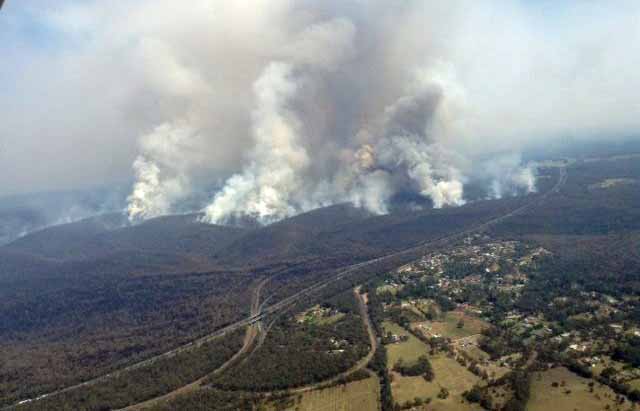
Australian fire officials on Sunday warned that residents of New South Wales are facing the worst wildfire conditions in more than 40 years. Already more than 200 homes have been destroyed and another 120 damaged. One man has died so far trying to protect his property. The weather forecast for Wednesday is even more severe.
The last time firefighters faced a situation like this was in the late 1960s.
Monday some areas received lightning with little or no rain.

Assistant police commissioner Alan Clarke said mandatory evacuation orders would be enforced in some areas, describing the risk as “far more extreme” than in past fires.
“Police will be doing forced evacuations if the risk is necessary,” Clarke told reporters.
“At the end of the day we hope we have buildings standing, but if we don’t have buildings standing we don’t want bodies in them.”
The typical wildfire season in Australia is from December through February, but this year firefighters are having to deal with numerous large fires weeks earlier than normal. The contracts for large Erickson Air-Crane helicopters that can carry 2,650 gallons of water were not yet in effect but two of the ships were rushed into service to assist firefighters.
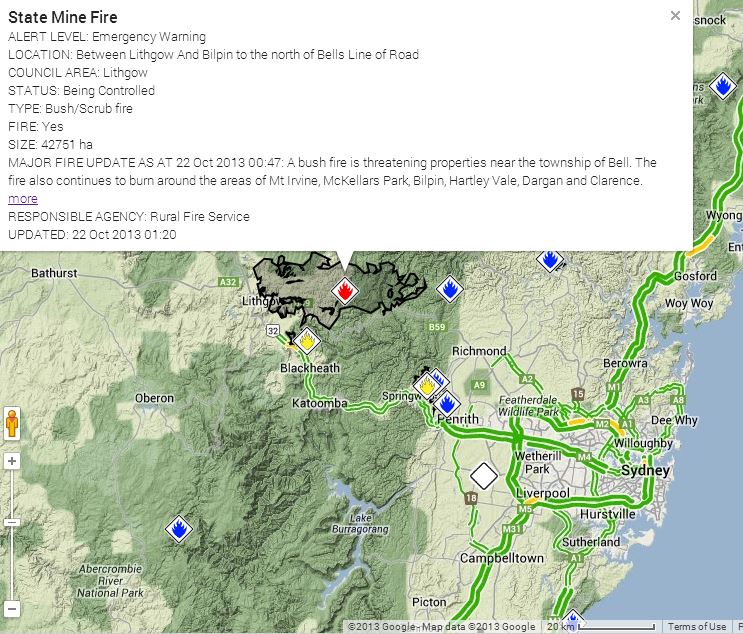
One of the largest fires is the State Mine Fire about 70 km northwest of Sydney between Lithgow and Bilpin which as burned 42,751 hectares (105,000 acres). It is likely to merge with the New York Road/Mt. Victoria Fire just to the south, which is 2,017 hectares (5,000 acres).
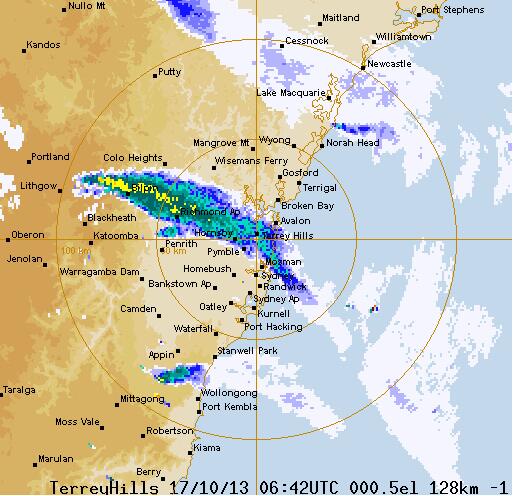
Two sources for current maps of fires in Australia: New South Wales Rural Fire Service, and ESRI.
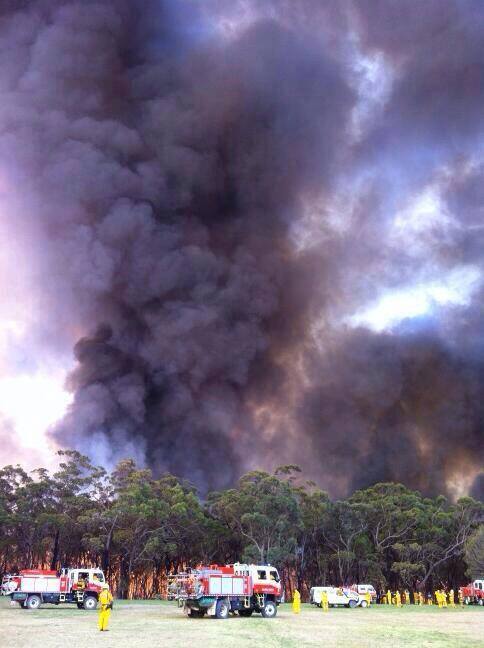
Australians impatient to get Air-Cranes into the air

The Australian government has been contracting for Erickson Air-Crane helicopters during their down-under fire seasons since ”Millie” (N223AC) was deployed there in 1997. They seem to have a special fondness for the ships which can carry 2,650 gallons of water, especially since the 2001-2002 bushfire season when ”Georgia Peach” (N154AC) and “Incredible Hulk” (N164AC), were rushed out from the U.S.A on board a Russian Antonov An-124 air freighter to assist with bushfires near Sydney, working with “Elvis” which was already “in the building”.
Their fire season this year has caught the Aussies by surprise, starting in New South Wales weeks earlier than usual — before the contract for the Sky-Cranes begins. While at least two Air-Cranes had already been shipped to the country from Greece by air freighter, not all of the flight crews had arrived when dozens of very large bush fires broke out that so far have burned about 200 homes and caused the death of one person. There is a bit of a controversy going on with some residents not able to understand why the huge helicopters can’t be used to fight fires without a flight crew.
One headline shouted the news:
Critical US water bomber grounded during NSW bushfire crisis
Reports say that by this weekend both Air-Cranes were actively fighting the fires.

Erickson to buy Evergreen Helicopters, Inc.

As we reported on Wildfire Today earlier this afternoon, Erickson Air-Crane, Inc. has signed an agreement to purchase Evergreen Helicopters, Inc., a company with approximately 400 employees. This will be the second major acquisition Erickson has made in the last three months. In November they reached an agreement to buy Air Amazonia, a subsidiary of HRT Participacoes in Brazil, along with their 14 helicopters. Both acquisitions are expected to close in the second quarter of this year.
For the $250 million price tag, Erickson will get 52 helicopters and 12 fixed wing aircraft from Evergreen Helicopters. The 64 aircraft are a mix of leased and owned. Evergreen’s 747 “Supertanker”, which can carry up to 20,000 gallons of fire retardant, is not part of the deal and will remain with Evergreen. The 747 is still configured as an air tanker but has not fought fire recently. The company has not been interested in accepting the U.S. Forest Service’s only offer of a call when needed contract.
From Air Amazonia Erickson will receive 14 passenger transport and medium-lift helicopters, (7) S-61, (5) Bell 212, and (2) A350 that have been used in the oil and gas industry. At this time Erickson has no plans to use the Amazonia helicopters for aerial fire suppression.
Erickson Air-Crane, headquartered in Portland, Oregon, for decades has built, operated, and sold Erickson S-64 heavy-lift helicopters, using a license acquired from Sikorsky. Up through 2007 the company concentrated on firefighting (53% of their business) and timber harvesting (38%). With the planned diversification the company expects to add contracts for Department of Defense work amounting to approximately 43% of their revenue, as well as increasing the oil and gas component. They think that about 30% of their work will be in Afghanistan. After the acquisitions, firefighting will provide about 19% of Evergreen’s revenue.
Since the company went public in April 2012 their stock price has risen from $8.00 to $15.11 today. According to Zacks.com:
In 2012, the company generated revenues of $180.8 million, up 18.4% year over year. The increase in revenue was driven by new firefighting contracts, an active fire season and the company’s expansion of infrastructure construction, especially in support of the oil-and-gas market in South America.
Maybe we’re entering a period of merger-mania. As we reported December 12, 2012, Aero Air of Hillsboro, Oregon, purchased the air tanker operations of Butler Aircraft from Travis Garnick. Aero Air acquired Butler’s three DC-7 air tankers, support equipment, and spare parts in Madras, Oregon. Kevin McCullough, now the President of Aero Air, and Jack Erickson, founder and former owner of Erickson Air-Crane, became co-owners of Aero Air in 1998. Aero Air is currently converting some MD-87s into air tankers and hopes to snag a contract for “next-generation” air tankers, when and if the U.S. Forest Service ever issues the contracts. It has been 476 days since the U.S. Forest Service issued a solicitation for next-generation large air tankers, but no contracts have been awarded.
Below are examples of the aircraft Erickson will be acquiring.
–From Evergreen Helicopters:


–From Air Amazonia:

Thanks go out to Kelly
Erickson buys back the Air-Crane it sold to power company
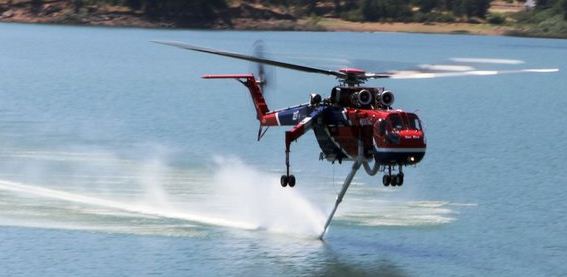
Erickson Air-Crane has bought back an Air-Crane helicopter that it sold two years ago to a power company in California. In 2010 Erickson sold a $30 million S-64F Air-Crane to San Diego Gas and Electric which acquired it to facilitate the construction of a powerline in eastern San Diego County. The company also made it available for fighting wildfires, using the call sign Helicopter 729 when operating on a fire, and “Sunbird” when working on the powerline. The Air-Crane can carry 2,650 gallons of water when suppressing a fire.
Erickson paid SDG&E $21.75 million, according to Portland Business Journal, to purchase the Type 1 helicopter in October.
In conjunction with the aircraft transaction, Erickson entered into an agreement with SDG&E to provide an Air-Crane for fire suppression support in San Diego County this Fall. SDG&E leased the aircraft for a 3-month period from September through November 2012, with an option to renew the lease for the same period each year through 2016.
Erickson added the aircraft to its fleet which now expands to 18 Air-Cranes. The company said it will allow the Company to meet the growing demand for heavy-lift aerial services in the oil-and-gas and powerline construction sectors.
Erickson Air-Crane went public April 11, 20121, selling stock at an initial public offering. Listed as EAC on NASDAC, it sold for about $8 that day, which netted $32 million for the company, about half of what they hoped for a few months earlier. The company used the proceeds to help pay down their debt which as of December 31, 2011 was $130.6 million. Since the IPO the stock price has ranged from $5.35 to $8.50 and closed at $8.03 Friday.
In 2007, ZM Private Equity Fund bought the company, and in 2009 moved the headquarters to Portland. ZM retained 63 percent ownership after it went public with the sale of stock.
Australia to contract for aerial resources

 The National Aerial Firefighting Centre in Australia intends to award new contracts for helicopters and fixed wing aircraft for fighting wildfires. Over the next few months they will be accepting tenders or requests for proposals for:
- Type 1 (High Volume) rotary wing firebombing services
- Type 1, 2, and 3 rotary wing services
- Type 4 fixed wing firebombing services
- A number of other specialist aircraft services, including intelligence gathering
- A small number of conventional light fixed wing aircraft services for reconnaissance
- Very Large airtankers
- Type 1 and 2 multi-engine airtankers
- Scooping or self-filling fixed-wing aircraft
- Proposals to supply data integration services for AFAMS – the national aircraft tracking and event logging system
The request for proposals for very large air tankers is a little surprising after their experiment during the 2009-2010 fire season. After that trial the Aussies were not entirely pleased with the overall performance of a DC-10, however most of the problems were a result of insufficient skill on the part of the crew, rather than the aircraft — for example dropping far too low or completely missing a target. The first pilots who flew the DC-10 very large air tankers had little or no previous experience flying air tankers when that program began. In the last two to three years they have gained a quite a bit more experience flying low and slow over mountainous terrain and have a good reputation in the United States. The two DC-10s have proven to be a reliable and valuable aviation asset.
Erickson Air-Crane intends to purchase company with 14 helicopters in Brazil
Revised November 8, 2012
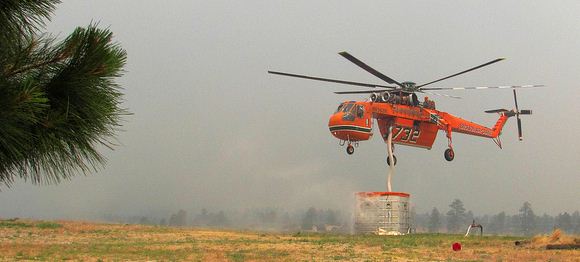
Erickson Air-Crane, a company in Portland, Oregon, that builds, operates, and sells Erickson S-64 heavy-lift helicopters, intends to purchase Air Amazonia, a subsidiary of HRT Participacoes, a company in Brazil, along with their 14 helicopters.
Erickson’s Air-Cranes are used extensively in fighting wildland fires. At least 15 Air-Cranes or Ch-54 helicopters were on contract with the U.S. Forest Service in 2012. The company has been sending some of the ships to Australia since 1998 to fight fires there during the down-under summer, which of course is winter in the United States. During the 2011-2012 summer there, Erickson had three of them in Australia — aircraft named Elvis, Elsie, and Marty.
The Mail Tribune has some details about the transaction:
“It plays well to our unique capabilities,”Udo Rieder [Erickson’s president and chief executive officer] said during a conference call with analysts on Wednesday.
He said the deal for 14 medium and light helicopters will significantly increase Erickson’s capability in South American markets, adding revenue and making good use of the company’s capital.
“It will reduce the impact of the seasonality of our business and expand our footprint in the gas and oil industry,” Rieder said.
HRT owns seven Sikorsky-61 aircraft, which are smaller but have many similarities to Erickson’s current fleet.
“We’ve always talked about adding medium-lift capability to our operation,” Rieder said. “It’s complementary to our business. The S-61s are little sisters to the air-cranes. Many of the parts are similar and some are identical — the cockpits are the same. This would give us quite a bit more capability at our Central Point facility. This will provide a platform to bring in S-64s and exchange equipment fairly quickly in Brazil and Peru.”
He said the company is unsure of what it will do with the Bell 212s and Eurocopter AS-350s that are part of the deal.
“We have the option to move them anywhere we want near-term,” he said. “We’ll wait and see what the demand is, but we’ll pretty much absorb all the aircraft there.”
The deal, however, isn’t expected to close until the second half of 2013, Rieder said, because of “fairly complex regulatory requirements and licensing matters.”
Below is a portion of the text from an announcement by Erickson:
===============================================================
Erickson Air-Crane Inc. Announces Letter of Intent to Acquire Brazilian Oil and Gas Aerial Services Business
Plans Purchase of Air Logistics Business from HRT Participaes em Petroleo, S.A.
Early Stage Transaction Announcement, Closing Expected in Second Half 2013
14 Aircraft Fleet to Position Company as a Leading Air Services Provider in Brazil
PORTLAND, Ore. — (BUSINESS WIRE) — Nov. 6, 2012 — Erickson Air-Crane Incorporated (NASDAQ: EAC) (Erickson Air-Crane or the Company), a leading operator and the manufacturer of the powerful heavy-lift helicopter, the Erickson S-64 Aircrane, today announced that it had entered into a non-binding letter of intent to acquire 14 helicopters and associated personnel and assets from HRT Participacoes em Petroleo, S.A. (HRT).
The letter of intent is non-binding and, for the acquisition to be completed, requires that EAC provide operational services to HRT in the Amazon, including both cargo and passenger transport, through a three-year, renewable contract.
Udo Rieder, Chief Executive Officer of Erickson Air-Crane, commented, We are very pleased to have identified what we believe is a strong future partner. Were confident that this acquisition can be an excellent path to diversification and growth. Brazil is one of the most dynamic and fastest growing industrial markets in the world and we are uniquely suited to provide our expertise and leverage the full capabilities of this fleet and our investment.
About Erickson Air-Crane Incorporated
Erickson Air-Crane specializes in the operation and manufacture of the Erickson S-64 Aircrane (the Aircrane), a versatile and powerful heavy-lift helicopter. The Aircrane has a lift capacity of up to 25,000 pounds and is the only commercial aircraft built specifically as a flying crane without a fuselage for internal loads. The Aircrane is also the only commercial heavy-lift helicopter with a rear load-facing cockpit, combining an unobstructed view and complete aircraft control for precision lift and load placement capabilities. Erickson Air-Crane owns and operates a fleet of 18 Aircranes, which are used to support a wide variety of government and commercial customers worldwide across a broad range of aerial services, including firefighting, timber harvesting, infrastructure construction, and crewing. Erickson Air-Crane also manufactures Aircranes and related components for sale to government and commercial customers and provides aftermarket support and maintenance, repair, and overhaul services for the Aircrane and other aircraft. Founded in 1971, Erickson Air-Crane is headquartered in Portland, Oregon with its principal manufacturing facility based in Central Point, Oregon. For more information, please visit http://www.ericksonaircrane.com.
Thanks go out to Joseph