
F4U-7 Corsair
Continue readingTwo MD-87 firefighting airtankers will deploy to Australia
This will bring Australia’s fleet of large air tankers up to 11 for the 2019/2020 bushfire season
Continue readingMD-87 airtanker experiences engine failure after takeoff

Above: Tanker 101, showing the added external tank, December 12, 2017 at Rapid City Airport. Photo by Bill Gabbert.
(Originally published at 8:38 p.m. MDT August 1, 2018; updated at 6:16 a.m. PDT August 2, 2018)
An engine malfunctioned on an airtanker operated by Erickson Aero Air on July 30 after taking off from the Coeur d’Alene Airport in Idaho. A person we talked with at the airport said they heard a very loud “boom” as the engine failed, and said the aircraft was an MD-87 airtanker. Mike Ferris, a PIO for the U.S. Forest Service, the agency that contracts for the large and very large airtankers used by the federal government, confirmed Wednesday evening that “an Erickson Aero Tanker MD-87 did have an engine upset shortly after takeoff from the Coeur d’Alene Airport on Monday at approximately 1430 PDT.” He said the aircraft landed safely after the incident.
The Coeur d’Alene Post Falls Press reported that unofficial sources told them that hot debris from an airtanker engine started multiple fires after pieces fell to the ground north of the airport. They also wrote that the runway was closed while “unspecified debris” was removed. The newspaper was not able to find any government officials who would comment about the cause of the fires, saying it was under investigation.
Kootenai County government reported on their facebook page that “several small fires resulted from an aircraft incident” at the airport.
(UPDATE at 6:16 a.m. PDT August 2, 2018: Late yesterday Jim Lyon, Deputy Fire Marshal/PIO with Northern Lakes Fire District, confirmed that a jet-powered airtanker under contract to the U.S. Forest Service, at approximately 2:30 p.m., “had mechanical problems on take-off and was able to make an immediate circle route to return to base safely. In so doing, it appears the plane was discharging some sort of material as a result of the mechanical problem, starting several fires throughout the area of approximately a five-mile radius of the airport.” Marshal Lyon said “up to eight fires” started by the incident were under control by the evening of July 30.)
Below is an excerpt from a July 31 article in the Spokesman-Review about the incident:
Jim Lyon with the Northern Lakes Fire District said crews battled about seven fires, but none grew to the size of a major wildfire. The first blazes started about 2 p.m. and spread from there.
Shoshana Cooper with the U.S. Forest Service in north Idaho said the fires burned to the northwest, south and east of the airport near U.S. Highway 95. She said they burned mostly grass and brush and were not affecting structures. As of 3:30 p.m., no structures had been lost.
Multiple aircraft were sent in to drop retardant on the blazes, but firefighters weren’t sure early Monday afternoon how large the fires had grown.
KXLY reported that a firefighter was injured while working on one of the fires near the airport:
A Kootenai County Fire and Rescue firefighter was injured Monday evening when he was struck by a vehicle that was backing up on Dodd Road by Strayhorn while responding to fires burning near the Coeur d’Alene Airport. He was evaluated at the scene. His injuries were not life threatening, but he was transported to Kootenai Health as a precaution.
The airport resumed normal operation at about 6:30 p.m. Monday.
We were not able to find a SAFECOM report about the incident, and very few people are willing to talk about it. Our calls to personnel at Erickson Aero Air late in the afternoon August 1 either were not returned right away or the employees we talked with said they were not able to comment.
This is not the first time that an engine on an Erickson Aero Tanker MD-87 has exploded with falling debris causing problems after hitting the ground. On September 13, 2015 debris from a failed engine landed in a residential area of Fresno, California. One chunk of metal crashed through the rear window of a car, while other shrapnel was found in city streets.
See huge hole in back window? A piece of airtanker dropped onto a woman’s car off Barton & Swift. @FresnoPolice here. pic.twitter.com/x20xt2M9Ok
— Connie Tran (@MissConnieTran) September 13, 2015
There has been concern about retardant ingested into the engines, when the MD-87 is making a drop, since at least 2014. A SAFECOM filed back then considered the possibility after engine surges or intermittent power was a problem for one aircraft after making a drop. Photos were taken of retardant stains on the fuselage caused by retardant flowing over the wing.
The first fix that Erickson Aero Air implemented was in 2014, “a new spade profile that has proved to eliminate this problem by keeping the fluid column much more vertical.”
 Airtanker 101, showing the added external tank December 12, 2017 at Rapid City Airport. Photo by Bill Gabbert.
Then in June 2017 the company took a much more radical step. They had an external tank, or pod, fabricated and installed below the retardant tank doors, which lowered the release point by 46 inches, mitigating the problem, said Kevin McLoughlin, the Director of Air Tanker Operations.
On December 12, 2017 I was given a tour of Tanker 101 by the flight crew while it was in Rapid City, and I noticed there was evidence of retardant flowing over the top of the wing. If you check out the profile photo of Tanker 101 at the top of this article, you will see that the top of the wing is not much lower than the height of the engine intake.
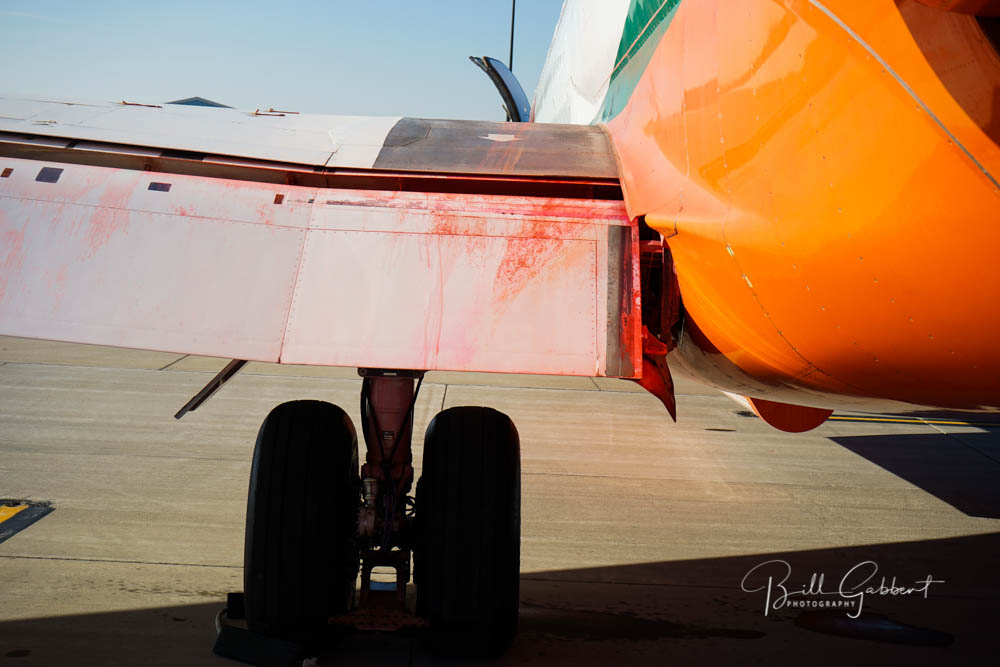 Tanker 101, an MD-87, with evidence of retardant stains on top of the wing, December 12, 2017 at Rapid City Airport. Photo by Bill Gabbert.
Another unique characteristic of the MD-87 is that it is required by the FAA to lower the gear while dropping — in fact it is specified in their Supplemental Type Certificate (STC) issued by the FAA. That 10-page STC uses the words “stall” or “stalling” 60 times, an average of 10 times on every page.
Our view:
How many second chances should an airtanker design get after exploding engines on two occasions and dropping hot shrapnel over a city and at an airport? The FAA and the Interagency Airtanker Board should rescind the Supplemental Type Certificate and the IAB approval and carding of the airtanker before something much worse happens than a car being damaged while parked at a home, or shrapnel closes a runway, multiple wildfires are ignited, and a firefighter is injured putting out the blaze. I fear not only for the safety of the flight crews in the MD-87s, but also people on the ground who have every right to expect that firefighting airtankers on U.S. Forest Service contracts will not kill or injure them with exploding engines — and that an airtanker hired to suppress fires will not start them.
Thanks and a tip of the hat go out to Tom.
Typos or errors, report them HERE.
Five MD-87s at Madras

Tom Brown found five Erickson Aero Tanker MD-87 tankerss at Madras, Oregon on May 5 and was able to grab this photo of all of them.
Thanks Tom!
In June 2016 I also saw five of Erickson’s MD-87s at Madras. They were parked in single file and my 24mm lens was not wide enough to get them all. The one missing in the photo below also had “Spanair” on the side.
Erickson bought at least seven MD-87s. They began flying two of them as airtankers in 2014.
 MD-87’s at Madras, Oregon June 13, 2016. Photo by Bill Gabbert.
FAA requires Erickson’s MD-87s to drop retardant with landing gear down
It is specified in their Supplemental Type Certificate.
Continue reading20 large air tankers to be on exclusive use contracts this year

We also have updates on the MD-87’s, as well as the HC-130H aircraft the USFS is receiving from the Coast Guard.
Continue readingTanker 60 makes emergency landing at Chico
Air Tanker 60, an Erickson Aero Tanker DC-7B, made an emergency landing at the Chico, California airport Thursday morning. A person who was monitoring radio traffic told Fire Aviation that the pilot declared an emergency after shutting down the #3 engine and losing all hydraulics. The video was apparently captured by someone on the nearby Eaton Road that borders the airport.
The pilots deserve kudos for keeping the aircraft on the runway.
Click on the image above and you’ll be taken to the Action News Now website where you can view it. The resolution on the video is very poor, but you can pretty much tell what is happening.
 File photo of Tanker 60 taken by Bill Gabbert at Madras, Oregon June 13, 2016.
This DC-7B is 58 years old, manufactured in 1958. Over the last three to four years several P2V air tankers in that same age range have had serious problems with hydraulics that resulted in problems as they landed.
In 2006 a P2V operated by Neptune lost an engine due to a bad piston shortly after taking off from Chico. Pilot Dale Dahl dumped the retardant east of the airport and landed without incident.
Erickson adding a second tank to their MD-87 air tankers

In order to eliminate the problem of retardant from the MD-87 air tanker entering the tail-mounted engines, Erickson Aero Tanker is making a major modification to their tank system. The company is adding an external tank on the belly of their MD-87s. This tank will have an exit point for the retardant that is quite a bit lower than the previous spade opening that was virtually flush with the belly.
Chuck Rhodes, Maintenance Supervisor for Erickson Aero Tanker, told us that the new exit point is in clean air well below the slip stream. At that location, the company expects the air flow will carry the retardant straight back, and will not force it up onto the wings and into the engines as before.
 Chuck Rhodes, Erickson Aero Tanker Maintenance Supervisor, with Tanker 60, a DC-7 (not an MD-87), at Madras, Oregon, June 13, 2016. Photo by Bill Gabbert.
After experiencing what Erickson called “intermittent engine surges when dropping [retardant at] high coverage levels”, they installed air deflectors in front of the exit points for the retardant. But since they are taking this extraordinary step of a major modification to the tanking system, apparently the deflectors were not as effective as they had hoped.
The air tankers will still have the internal tanks and the capacity will remain at 4,000 gallons. Mr. Rhodes said they will not carry a full load this year until the company becomes more familiar with the new system.
This modification will require that the company start over again with the approval process, which includes receiving a Supplemental Type Certificate from the FAA and certification from the Interagency AirTanker Board.
The two MD-87s on exclusive use contract were scheduled to begin their mandatory availability periods on June 5 and 10, but the start dates are being pushed back by weeks, if not months.
In other Erickson news, they have four MD-87s and one MD-83 parked at the Madras, Oregon airport that have been stripped of their engines and have not been converted to air tankers. (See the video below.) The MD-83 is being used for parts, while they expect the MD-87s will be converted into air tankers after the bugs are worked out in the tanking system.
Erickson also has DC-7s. Tanker 62, now located at Redmond, will likely work on an exclusive use contract with the Oregon Department of Forestry (ODF) from July into mid-September. Tanker 66 has the option to work on a call when needed basis with the ODF. Mr. Rhodes said the company hopes Tanker 60 will receive a contract with CAL FIRE.
 Erickson Aero Tanker 66 at Redmond, Oregon, June 13, 2016. Photo by Bill Gabbert.
Tanker 62 in Medford
 Tanker 62 in Medford. Photo by Tim Crippin.
Tim Crippin got this shot of Tanker 62 in Medford, sporting its new Erickson paint scheme. He said it was there for pre-season training. Thanks Tim.
Report that pieces of metal fell from Erickson MD-87 air tanker over Fresno, California
(UPDATE at 9:20 p.m PT, September 13, 2015)
KMPH reports that the pieces of metal that fell into a Fresno neighborhood Sunday afternoon September 13, breaking a car window, came from an engine that failed on an air tanker, reportedly an Erickson MD-87. Below is an excerpt from their article:
…The plane had departed the Fresno Airport around 3:30 p.m. Sunday when, according to the Federal Aviation Administration and Fresno Firefighters, the pilot reported a left engine failure.
Shortly after, families in a neighborhood near Ashlan and Highway 168 said they heard a boom and saw smoke coming from the plane.
In the process, pieces of the plane’s engine fell into a neighborhood. At least one piece shattered a windshield. Others landed on the streets.
The plane returned to the airport moments later…
****
(Originally published at 5:43 p.m. PT, September 13, 2015)
See huge hole in back window? A piece of air tanker dropped onto woman’s car off Barton & Swift. @FresnoPolice here. pic.twitter.com/x20xt2M9Ok
— Connie Tran (@MissConnieTran) September 13, 2015
Witness says it was a piece of metal from the #EricksonAeroTanker plane that damaged the back of her car! pic.twitter.com/q0ZWjqCQMx — Connie Tran (@MissConnieTran) September 14, 2015
Approximately 20 small pieces of metal found on Swift Ave. Believed to have fallen off of the #EricksonAeroTanker. pic.twitter.com/qVAdSN7MJv
— Connie Tran (@MissConnieTran) September 14, 2015

Thanks and a tip of the hat go out to Barbara and Steve.
Typos or errors, report them HERE.
UPDATE, September 15, 2015: The Fresno Bee published an article on September 14 with additional information.
We don’t know what caused the engine to fail, and it might not be related, but here is a link to a story we ran in June of 2014 about all three of Erickson’s MD-87s being recalled“ due to intermittent engine surges when dropping [retardant at] high coverage levels”.