
Four companies filed protests with the GAO
Continue readingProtests of air tanker contracts have been common
A history of protests since 2013
Continue readingTwo companies file protests over air tanker contracts
Five additional large air tankers on contract were announced March 26
Continue readingGAO decides against Forest Service in Global SuperTanker’s contract protest

The Government Accountability Office said the FS failed to provide a reasonable justification for limiting the maximum size of the retardant tank.
Continue readingGAO denies protests of Next-Gen air tanker solicitation
 The Government Accountability Office has denied two protests over the solicitation for “up to seven” Next-Generation air tankers published by the U.S. Forest Service. Erickson Aero Tanker and Coulson Aviation protested some of the terms of the solicitation process before any announcement was made about awarding contracts. The USFS had hoped to have the air tankers working by May 30, but the protests halted the contracting process. Coulson’s was denied on July 8 and Erickson’s on July 17.
The next step is for the USFS to decide what companies they want to issue contracts to, and then they have to abide by a strange law that requires they notify Congress of their intent, and then wait 30 days before actually awarding any contracts.
At that point, the process will again be vulnerable to an another round of protests over the awards themselves, each of which will take up to 100 days to be adjudicated by the GAO.
Protests delay awards of air tanker contracts
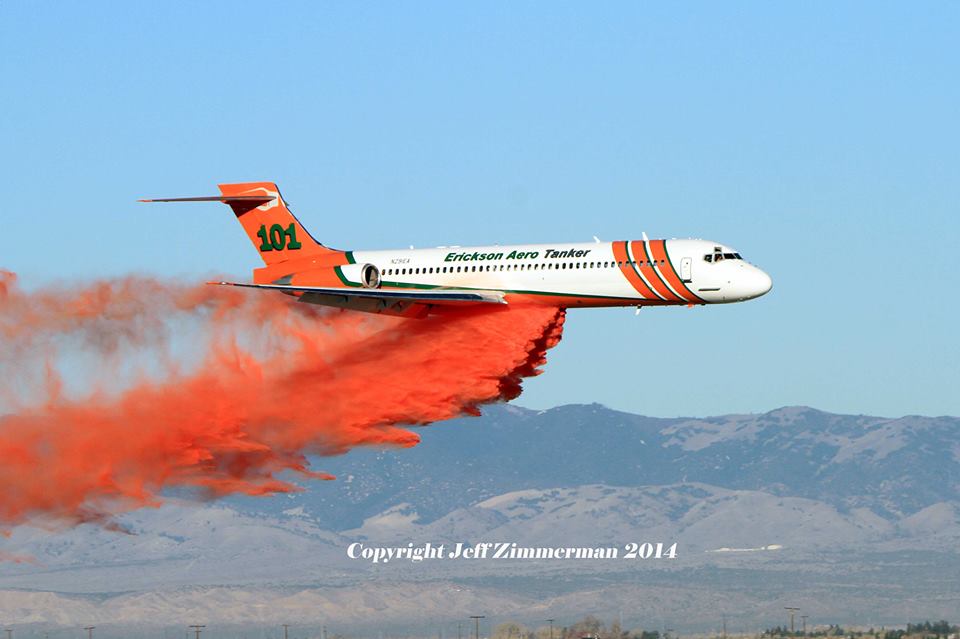
The U.S. Forest Service (FS) had hoped to have as many as seven additional “Next Generation” large air tankers working under contract on May 30, 2015, but protests filed by two companies could push that date back by several months.
The FS first awarded contracts for Next-Gen air tankers in 2013 at the end of a 555-day process that also included protests which delayed the awards. Next-Gen air tankers are required to have capabilities not present in the previous generation of Korean War vintage machines. They must fly faster, be powered by turbine or jet engines, and have a capacity of at least 3,000 gallons of fire retardant.
Two companies have filed protests about this latest round of potential contracts, Coulson Aviation and Erickson Aero Tanker. The protests were lodged with the U.S. Government Accountability Office which has the responsibility of deciding whether the protests have merit, which they are required to do by July 9 for Coulson’s protest and July 17 for Erickson’s. Both companies later amended their original complaints, which complicates the procedure for the GAO, so it is unlikely that anything will be decided much before those mid-July due dates.
No contracts have been awarded yet, nor has the FS announced what their intentions are about the contracts. The two companies are protesting the terms of the solicitation which was first posted on February 19, 2015, and then amended five times. Responses from bidders were due on April 9, 2015.
In researching this article we reached out to Erickson Aero Tanker and Coulson Aviation, but did not receive replies by our publication deadline.
When the awards were announced for the first round of Next-Gen contracts in May, 2013, Neptune Aviation did not receive one of the seven contracts and filed a protest. A few weeks later Neptune dropped their protest which allowed the FS to finalize the contracts form the other seven air tankers. It was disclosed later that the FS and Neptune had entered into a written agreement under which the agency agreed to award Neptune a sole-source contract for two Next-Gen large airtankers in exchange for Neptune withdrawing its protest.
In December, 2013 the FS awarded the promised sole source contract to Neptune for the two air tankers beginning in 2014. The estimated minimum value of the contract was $141,000,000 and had a base period of four years with the possibility of adding five more. If those five years were tacked on it would could have brought the value of the contract up to almost half a billion dollars.
The basis for awarding the non-competitive sole source contract to Neptune, according to the FS, was that the company was in danger of going out of business. The agency used the industrial “mobilization exception” to the requirement to conduct a competitive procurement. Their rationale was that without Neptune, the FS could not field an adequate number of air tankers. In March, 2014 we wrote a very detailed article about the sole source award and how it developed.
That sole source contract was protested by three companies, Coulson Aviation, 10 Tanker Air Carrier, and Minden Air Corp. The GAO upheld the protest, writing in their March 2014 decision that the sole-source award to Neptune in exchange for Neptune’s withdrawal of an earlier protest, was not a reasonable basis for the agency’s action. GAO also disputed the claim that Neptune was in danger of going under, and recommended that the FS reimburse Coulson, 10 Tanker, and Minden for their costs of filing and pursuing the protests, including reasonable attorneys’ fees.
GAO releases details of air tanker contract protest decision
 The General Accountability Office has released their 23-page decision documenting why the agency sustained the protest filed by three companies over the sole source air tanker contract that the U.S. Forest Service awarded to Neptune Aviation December 12, 2013. The non-competitive contract, worth $141 million to $496 million, specified that Neptune would supply two or more next-generation air tankers, BAe-146s, for the next four to nine years beginning in 2014.
In our previous article about the decision we included the text of a press release issued by the GAO, but this 23-page document provides much more detail.
GAO sustains protest of air tanker contract

(Originally published at 3:15 p.m. MT, March 31, 2014; updated at 8:40 a.m. MT April 1, 2014 with the text of a statement released by the GAO, and again at 11:20 a.m. MT April 1, 2014 with a response from the USFS.)
The Government Accountability Office announced today that they sustained the protest filed by three companies over the sole source air tanker contract that the U.S. Forest Service awarded to Neptune Aviation December 12, 2013. The non-competitive contract, worth about $141 million, specified that Neptune would supply two or more next-generation air tankers, BAe-146s, for the next four to nine years beginning in 2014.
A spokesperson for the GAO said their review concluded that the U.S. Forest Service “could not reasonably justify” the non-competitive process used in awarding the contract to Neptune.
The three companies that protested the sole source contract were Coulson Aviation (USA), Inc; 10 Tanker Air Carrier, LLC; and Minden Air Corp. If only the minimum two air tankers were signed up, the value of the contract would be about $141 million. If the options for five additional tankers were utilized, it would be hundreds of millions.
The protest automatically halted the activation of the sole source contract when it was filed in December.
We asked the USFS for their reaction to the GAO decision, and if other air tankers will be brought on, either by activating options under existing legacy or next-gen contracts, or will additional contracts be pursued? We received the following statement issued by their Washington office Tuesday morning:
The U.S. Forest Service is committed to ensuring that we have all of the resources we need to fight wildland fire and protect the lives and property of the American people. Airtankers are an important part of our efforts and we are currently reviewing the GAO recommendation.
In the protest filed with the GAO, hundreds of pages were submitted, listing dozens of reasons why the three companies felt the sole source contract should be terminated.
The Coulson company argued that on several occasions they told the USFS that they could supply more than the one C-130, but were told that the funding situation was too uncertain to commit more air tankers. Then a few months later, the USFS issued a contract potentially worth at least $141 million.
10 Tanker made similar offers, and in fact had a second DC-10 fully certified and on a call when needed contract that they would have liked to convert to an exclusive use next-gen contract. They also said they are working on retrofitting a third DC-10 which they expect to have ready to go by the end of calendar year 2014.
This was the third USFS air tanker contract that has been officially protested in the last two years. Two of those were sustained by the GAO, the recent sole source contract and the original attempt to issue contracts for next-gen air tankers, while the third, filed by Neptune, was dropped five months before the company received the sole source award in December.
Neptune will have six Korean War vintage P2Vs (2,082 gallons each) and one jet-powered BAe-146 (3,050 gallons) on exclusive use contract this year in what the U.S. Forest Service calls the “legacy” air tanker category. The company expects to have four additional BAe-146s ready to fight fire this year that are not currently on contract.
10 Tanker Air Carrier has one DC-10 Very Large Air Tanker on exclusive use contract and another on a call when needed contract. The company is in the process of retrofitting a third DC-10. They each carry 11,600 gallons of fire retardant.
Coulson has one 3,500-gallon C-130Q on exclusive use contract and hopes to acquire and convert a second C-130.
Minden has a contract for a BAe-146 but it has not yet been tested or approved by the Interagency AirTanker Board.
The complete text of a statement by the GAO about the decision is below. It was written March 31 and released April 1, 2014.
****
“The following is a statement from GAO regarding today’s decision resolving bid protests filed by Coulson Aviation (USA) Inc., 10 Tanker Air Carrier, LLC, and Minden Air Corp., B-409356.2 et al., March 31, 2014.
On March 31, the U.S. Government Accountability Office (GAO) sustained, or upheld, the protests filed by Coulson Aviation (USA) Inc., of Port Alberni, British Columbia, Canada, 10 Tanker Air Carrier, LLC, of Albuquerque, New Mexico, and Minden Air Corp., of Minden, Nevada, challenging the sole-source award of a contract by the Department of Agriculture (USDA), U.S. Forest Service, to Neptune Aviation Services, Inc., of Missoula, Montana, for airtanker services to support wildland firefighting. The contract contemplates Neptune providing at least two modern large airtankers for up to 9 years (the contract also contains options to add up to five additional aircraft in each year). The total estimated value, based on all possible aircraft over all years, is approximately $496 million.
Continue reading
A sole source air tanker award, how it developed

Today, March 11, the Government Accountability Office will hold a hearing at their office in Washington, DC to consider the protests filed by three air tanker companies over the propriety of the U.S. Forest Service’s (USFS) noncompetitive contract award to Neptune Aviation Services, Inc., for next-generation large airtankers. The hearing was scheduled to begin at 9 a.m. ET, but was a closed session, open only to GAO personnel, attorneys for the three companies that protested the contract, and two individuals from the Department of Agriculture who have been asked to be available to testify, Lisa Wilusz, a Senior Procurement Executive, and Gregory Parham, the Chief Acquisition Officer. Even the owners of the protesting companies are prohibited from attending, to prevent them from being exposed to their competitors’ trade secrets.
Protesting the sole source award for two BAe-146 air tankers to Neptune, are Coulson Aviation (USA), Inc; 10 Tanker Air Carrier, LLC; and Minden Air Corp. If only the basic two air tankers are signed up, the value of the contract would be about $141 million. If the options for the five additional tankers are utilized, it would be hundreds of millions.
The GAO is required to make their decision about the propriety of the sole source award by March 28.
Fire Aviation has reviewed almost three dozen documents filed by the protesting companies as well as the USFS’ Motion to Dismiss the protests. The files contain letters of protests, supplementary protests, transcripts of Congressional hearings, “declarations” written by some of the principles, an NTSB report, and an article from FireAviation.com. While it remains to be seen which side the GAO will favor, regardless of the outcome it is clear that after the dust settles the attorneys will probably close shop for two weeks and take their families to Bora Bora.
Most of the documents have redactions, some more than others. One or two are virtually useless as a result, but most still contain a great deal of information. We will elaborate on them, but first, get a cup of coffee–it’s a long story.
Continue reading
Type 2 helicopter contracts contested

WorldWind Helicopters has protested the contracts that were awarded for 31 Type 2 helicopters used to fight wildland fires. On December 17 the U.S. Forest Service announced exclusive use contracts for the award period that began December 17 and ends April 30, 2015 with options for three additional years. The solicitation was first announced on April 5, 2013 and took over eight months to complete.
WorldWind Helicopters began the 2013 fire season with three helicopters on contract, but after the company had some problems making the one at Peppermint, California available when the season started, the USFS cancelled their contract for that location and later awarded it to Hillsboro Aviation.
WorldWind again submitted bids for three helicopters on this latest contract but was only given two, for John Day, Oregon and Arroyo Grande, California, for a Bell 210 and Bell 205, respectively. The USFS did not announce any award for one line item, Trimmer, California, leaving it blank on the list.
This is the fourth time in the last two years that USFS fire aviation contracts have been protested. The others were for the next-generation air tankers which were protested twice (for the first and second decisions) and the no-competition award to Neptune for two BAe-146 air tankers. In all three previous instances, the companies that fought the awards ultimately received favorable outcomes. Coulson and 10 Tanker, which did not receive awards for next-gen air tankers, got them after the protest of the first decision. Neptune, which protested the second version of the next-gen contracts, suddenly and without explanation dropped the protest a few weeks after filing it, but six months later received no-competition contracts for two BAe-146s.
The Government Accountability Office will be arbitrating the bid protest. Their decision is due by April 7, 2014. The GAO can’t do much until the USFS provides to them a report on the protest, which has not yet been received by the GAO.
When the next-gen air tanker contract was protested the first time by Neptune, several months later the attorneys and U.S. Forest Service officials dealing with the protest decided that three of the seven line items on the solicitation were exempt because the company did not bid on those line items. As a result, three companies were issued five-year exclusive use contracts at that time. It is possible that in this 32-line-item helicopter solicitation there could be some unaffected contracts that could go forward, while the individual line items protested by WorldWind would be in limbo until a final decision is reached by the GAO, or the protest is dropped by WorldWind.
Below is a diagram outlining the GAO’s timeline for handling a bid protest. This particular protest was filed on December 26, 2013.
Continue reading