Recent firefighting efforts on the Vista Fire in southern California relied on a relative newcomer to the wildfire suppression toolbox, the Quick Reaction Force, or QRF.
Operated by Coulson Aviation, the QRF is a trio of Chinook CH-47 helicopters converted into state-of-the-art helitankers. They are strategically located in southern California and available for rapid response to the brushfires that occur throughout the region.
The force is supported by a fourth helicopter, a Sikorsky S-76, equipped with a suite of thermal and HD cameras as well as mapping software for accurate detection and reporting of a fire’s perimeter and hotspots.
Easily recognizable by their sheer size and dual main rotors, each helitanker is capable of carrying 3000 gallons of water or retardant. For comparison, the Sikorsky S70 Firehawks carry 1000 gallons. The QRF is also configured for night operations, and flight crews maintain additional qualifications and currencies for operating with night vision goggles.
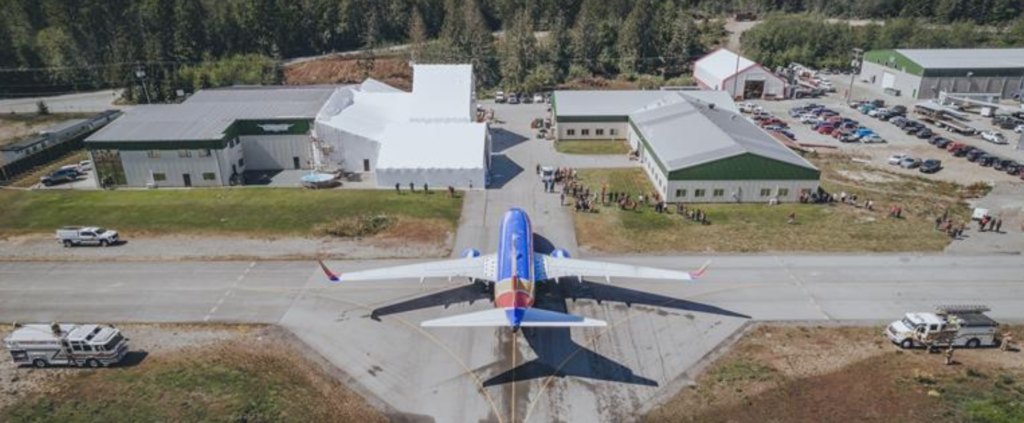
Coulson Aviation has its first Boeing 737-700 from Southwest Airlines and will convert it at its base in Port Alberni, British Columbia. According to FlightGlobal, the latest arrival (N7841A) is the first of up to 10 aircraft that will be converted under Coulson’s Next Gen Fireliner program. Earlier Fireliner conversions used older 737-300s that were also sourced from Southwest.
The MSN28015 aircraft was operated by Denmark’s Maersk Air before it landed with Southwest in 2016. It’s accumulated over 60,000 flight hours.
Britt Coulson, chief operating officer of Coulson Aviation, says the Fireliner is the go-to large airtanker for foreign governments’ purchase because of its multi-role capability — it can transport passengers when not deployed on a fire. It will carry 19K liters (a bit over 5000 gallons).
The British Columbia Aviation Museum announced last month that it had acquired Martin JRM Hawaii Mars, and yesterday the Pima Air and Space Museum (PimaAir.org) announced it has acquired the Philippine Mars.
Coulson Aviation said the Philippine Mars — one of just seven flying boats built by Martin JRM Mars — will be transported to the PASM east of Tucson later this year, according to a feature story by Vintage Aviation News.
“This has been an exciting month for both Martin Mars waterbombers,” said Coulson CEO Wayne Coulson. “As a fitting tribute to their years of service and years of hard work by many people in B.C. and the U.S., we are pleased to see both Mars aircraft landing to rest at world-class institutions in 2024.” The Mars aircraft were built between 1942 and 1947, and the giant aircraft flew cargo between Hawaii and the Pacific Islands in support of the U.S. Navy. After World War II the aircraft and crews flew in the Korean War, making medical air transport flights between Hawaii and California, and then doing hauling cargo between Hawaii and California before they were decommissioned back in 1956.
The first was christened The Old Lady; after that the production planes were called Hawaii Mars, Philippine Mars, Marianas Mars, Marshall Mars, Hawaii Mars II (named after the original Hawaii Mars was destroyed), and lastly, Caroline Mars. Hawaii and Philippine are the only Martin JRM Mars aircraft remaining today.
In 1958 the remaining four were sold to a consortium of timber companies in British Columbia and converted into waterbombers that could carry 7200 U.S. gallons. In 2007 Coulson purchased the Hawaii Mars and the Philippine Mars, launching its fixed-wing air operations for aerial wildland firefighting.
“We are pleased to have the Philippine Mars join our museum where we will preserve this World War II-era aircraft for decades to come,” said Scott Marchand, CEO of the museum at Pima. The Philippine Marsis expected in Arizona later this year. The museum — at PimaAir.org — features some 400 historic aircraft, an amazing collection ranging from a Wright Flyer to a 787 Dreamliner.
Pima map
Sited on 80 acres at the eastern edge of Tucson, the museum opened to the public in May of 1976 and has for 40+ years grown and expanded. Today the facility includes six indoor exhibit hangars (three dedicated to WWII), along with extensive outdoor grounds and interpretive displays and other features to welcome visitors and charm aviation enthusiasts. Admission’s under $20 with discounts for kids, seniors, and locals. The museum’s about 5 miles from the Tucson International Airport, and it’s open 7 days a week, closed only on Thanksgiving and Christmas. You can’t visit this place just once.
Two pilots walked away from an airtanker crash on Monday while fighting bushfires in Western Australia. Initial reports indicate that Coulson’s 737 took off from Busselton about 3:25 p.m. and went down about 4:40 p.m. in Fitzgerald River National Park, about 460 kilometres southeast of Perth. According to news.com.au the Australian Maritime Safety Authority (AMSA) detected an emergency beacon activation from the airtanker approximately 185 kilometres west of Esperance. The agency issued a statement saying there were no other crew aboard the airtanker when it crashed. Both pilots were transported by helicopter to Ravensthorpe Health Service, and ABC.net.au news reported that the pilots were not seriously injured. The Western Australia Department of Fire and Emergency Services (DFES) and the Australian Transport Safety Bureau (ATSB) are conducting separate investigations into the crash.
The Alberni Valley News (in British Columbia, where Coulson is based) reported the investigators will interview pilots and then examine the wreck. “Initially, investigators will interview the pilots and witnesses to understand the circumstances of the accident, and determine the accessibility of the accident site with the aim of conducting an on-site examination of the aircraft wreckage,” said the ATSB in a statement.
This is the second incident for Coulson Aviation during firefighting operations in Australia, after a C-130 heavy airtanker crashed in 2020, killing all three on board.
Tanker 139 — the 737 — had just been awarded a contract last month. This flight was the airtanker’s third drop of the day.
737 flight path, FlightRadar24 image.
A news report by aerotime.aero said the 737 flew for more than 40 minutes before it crashed in the Fitzgerald River National Park. According to flightradar24.com, its last recorded altitude was 675 feet (205.7 meters) at 4:13 local time (UTC +8). A report by samchui.com indicated the ATSB was assembling a team from its Perth and Canberra offices with experience in aircraft operations and maintenance, human factors, and data recovery to conduct the evidence-collection phase of the investigation.
Coulson Flight Path: Twitter/ @flightradar24
This airtanker is a Coulson Flying Tankers 737-300 Fireliner registered as N619SW. The 737 was delivered new to Southwest Airlines in 1995 and was acquired by Coulson in 2019. It entered firefighting service in the U.S. after conversion in summer 2022, and it flew to Australia in December 2022.
Adding two more large airtankers will boost firefighting capability for Western Australia as emergency services personnel prepare for a busy bushfire season. A C-130 Hercules from Coulson Aviation was added on December 5 and is expected to serve in Western Australia (WA) for four seasons. The WA Minister for Emergency Services’ office said the Coulson contract was secured with an $11 million investment to ensure there is a locally based airtanker in the state for the first time.
The Australian Rural & Regional News reported that a Commonwealth-funded Boeing 737 will arrive later this month and will also be based in WA. This arrangement has been secured from the Australasian Fire and Emergency Service Authorities Council National Resource Sharing Centre. Both airtankers can carry more than 15,000 litres — just under 4,000 gallons — of fire suppressant, and both will be based at Busselton-Margaret River Airport in the South-West.
Australia Aerial Firefighting C-130 Hercules Firetanker — Coulson Aviation photo
Western Australia’s aerial fleet comprises 36 rotary and fixed-wing suppression and aerial intelligence aircraft, and for the second consecutive year will feature two Black Hawk helicopters.