UK wildfire preparedness “decades” behind others

University of Birmingham researchers at a burn on Dorset Heath, United Kingdom.

By Dr Kerryn Little

Wildfire preparedness in the United Kingdom is decades behind others – and we are running out of time to catch up.

In New Zealand where I grew up, I was part of a volunteer rural fire brigade that specifically fought wildfires, and a national Fire Danger Rating System communicated elevated wildfire danger warnings (think road signs of wildfire danger level, like Australia and the USA have).

Given the similarities between New Zealand’s and the UK’s maritime climate and vegetation, I had imagined the UK was similarly equipped to deal with wildfires.

When I moved to the UK in 2020, I learned this was not the case at all – despite the fact that the UK experiences more vegetation fires (~30,000 annually) and has a much higher population density within the ‘rural-urban interface’ where vegetation and people, property and critical infrastructure co-exist.

Wildfire wave

Historically, the UK’s temperate, humid climate and vegetation have protected us from vegetation drying out enough to produce large and intense wildfires. But we are increasingly seeing years with hot, dry extremes that prime our vegetation for wildfires to spread. The UK has been experiencing a ‘wildfire wave’ in 2026 amidst heatwave and drought conditions, with extensive wildfires across the full length of the country. This comes off the back of the UK’s worst wildfire year on record in 2025 that burned nearly 48,000 hectares.

For decades, fire behaviour prediction tools have been a cornerstone of wildfire management in many countries. These tools forecast how a fire will behave – its probability of ignition, flame length, rate of spread – and that information underpins everything from firefighter training and suppression tactics to prescribed burn planning and long-term mitigation strategy. Countries with serious wildfire exposure have invested accordingly: Australia, Canada, the USA, several Mediterranean nations and NZ have each developed fire behaviour models built for, or adapted to, their own landscapes and fuels. However, until recently, the UK has lacked such tailored fire behaviour prediction tools.

University of Birmingham researchers and fire fighters, United Kingdom.
University of Birmingham researchers with fire fighters, United Kingdom.

Wildfire tools

To address this critical gap in decision-making support, wildfire researchers across the UK came together to create FireInSite – the UK’s first fire behaviour prediction system. FireInSite is specifically designed for the UK’s vegetation, having been built on over four years of UK-wide intensive data collection. The freely accessible web interface overcomes barriers to accessing fire behaviour predictions, by integrating geolocated weather forecasts, topography and in-built fuel models. FireInSite was developed closely with groups like the UK’s Wildfire Tactical Advisors to meet their user needs from a wildfire behaviour prediction tool. It has been used operationally since 2025, with user feedback and validation demonstrating its success across the 2025 and 2026 extreme wildfire seasons.

This work sits within a wider effort at the University of Birmingham to take natural hazard risk seriously. Our Network for Emerging Systemic and Multi-Hazard Risk brings together researchers from engineering, climate science, economics, and social sciences to understand how hazards like wildfire don’t just burn land – they can cascade into failures of power networks, water supply, and transport infrastructure. Real disasters rarely respect disciplinary boundaries, and neither should our research.

Consecutive extreme wildfire years in the UK have provided the awareness of and momentum to address the UK’s wildfire preparedness, and we are starting to make significant progress, FireInSite being one aspect of that.

The challenge is to sustain this momentum to keep pace with a threat that isn’t waiting for us to catch up.

Dr Kerryn Little, is a Postdoctoral Researcher in PyroGeography at the University of Birmingham, and a Director on the Board of the International Association of Wildland Fire.

Europe wildfires continue to burn at near record-breaking pace

The consequences of Europe’s dry summer continue to emerge as “exceptional” wildfire activity draws on the union’s combined resources.

In another week of high temperatures and little prospect of rain, extreme conditions continue over southern United Kingdom and have expanded over northwestern France, extending through the Alps and into the Balkans.

An estimated 542,926 hectares (1,341,599 acres) have burned throughout the region since the beginning of 2026, according to the European Union’s “Current Wildfire Situation in Europe” report on Aug. 10. This year’s burned area total is just below the record-breaking fire year of 2025, when wildfires burned 631,119 hectares (1,559,529 acres) by the same date even though the 2026’s burned area total briefly eclipsed 2025’s numbers between July 22 and Aug. 9.

Last year – 2025 – was the worst year on record in Europe, and while 2026 is tracking slightly less it still well exceeds the long-term average of the last 20 years (see the blue line on graph below).

Credit: EU Civil Protection & Humanitarian Aid

A recent research report released by the EU’s Climate Change Service determined that chronically dry conditions across western and central Europe were conducive to the exceptional wildfire activity, fueled by abundant dried biomass after a wet winter and early spring.

“In France, fires in the Gironde region burned nearly 42,000 ha, the largest area on record for France in the European Forest Fire Information System of the Copernicus Emergency Management Service,” researchers said in the report. “Spain also saw multiple fires, especially in central and eastern regions.”

Daily wildfire emissions were at record levels in France for July 24, according to the report. The nation’s annual total was already the highest ever by the end of July, while Spain ranked its second-highest emissions total ever, behind 2022.

The EU has assembled and deployed an estimated 777 firefighters from 14 countries to support communities where the wildfires are burning. They’re primarily stationed in France, Greece, Italy, Portugal, Spain and Cyprus and stand ready to support brigades if fires overwhelm local resources.”

Credit: EU Civil Protection & Humanitarian Aid

Evaluating the US Wildland Fire Service while it’s still being built

By Matthew Auer, University of Georgia, and Dhruv Gupta, Dartmouth College

Europe’s terrible wildfire season should stir empathy. It’s an apt feeling not only because wildland fires have claimed lives and charred forests, homes, and businesses, but because we know that pain firsthand in the US from our own deadly fires.

In the US, the toll includes six firefighters losing their lives – a reminder of the dangers inherent in wildfire management and the courage of those who perform it. Among those who perished was a Canadian Forest Service firefighter. Which underscores a second reality. At the time of this writing, around 675 wildfires are actively burning in Canada, many that are remote enough, they won’t be actively suppressed. Yet, smoke from these fires creep east and south, smudging the skies of major American cities and pushing some to the top of the world’s worst air pollution rankings.

The 2026 wildfire season should make us think about fires not from a US perspective but a continental perspective. Responders from Canada traveled south to help contain fires in Colorado in June and July. In turn, US wildfire experts collaborated with Canadian counterparts to manage wildfires in Quebec. The same transcontinental approach is underway in Europe. The European Commission pre-positions hundreds of firefighters from EU countries to high-risk areas. In July, Spanish crews fought fires in Portugal even as Spain battled its own blazes and received help from neighboring countries. France, too, has been a prominent participant in this mutual aid – both giving and receiving help during a difficult wildfire season.

Managing wildfire risk today requires partnership and collaboration like never before, across national boundaries. With collaboration in mind, it’s appropriate to examine the performance of the newly established US Wildland Fire Service. The agency consolidates five fire management services within the Department of the Interior in an effort to, as a White House Executive Order states, “streamlin(e) Federal wildfire capabilities to improve their effectiveness and promot(e) commonsense, technology-enabled local strategies for land management and wildfire response and mitigation.” The president hopes to go further still, absorbing the U.S. Forest Service’s wildfire management operations into the new, unified structure. Congress has resisted, calling for an independent, non-partisan review of the proposal’s potential impacts. The Forest Service recently awarded a contract to Research Triangle Institute to study the feasibility of incorporating the Forest Service Fire and Aviation program into the new U.S. Wildland Fire Service. 

We have performed our own analysis of the stakes involved in a streamlined, unified wildland fire service. Our research framework recognizes the wide-ranging perspectives on this issue. Associations like Grassroots Wildland Firefighters are backing efforts to improve and simplify procurement processes, expedite provision of equipment to the field, and simplify and harmonize agency-specific rules for hiring and performance evaluation. In contrast, critics say the Trump administration’s wildfire reorganization has sown confusion among firefighters over chains of command, arrived after a major wave of workforce downsizing in Interior and the Forest Service, and was pushed through without congressional approval or funding.

Our own view is that, whether you are a proponent or critic, all parties should demand careful oversight of the new streamlined service even as the administration is building and flying it. Too often, public administration students are taught that policymaking follows a neat, sequential set of steps with evaluation taking place towards the end of a “policy cycle.” This is flawed reasoning in several ways, but notably because any job that involves daily, major risks to human health and safety – the quintessential reality for a handcrew, engine crew, smokejumper, or air tanker pilot – cannot wait for an end-of-year program evaluation. The stakes for wildfire managers – particularly wildland firefighters – are too high for a wait-and-see approach.

The Ipsos Global Trustworthiness Index ranks the most trusted professions across dozens of countries. The top five vocations are doctors, scientists, teachers, restaurant staff, and members of the armed services. As a greater share of the population encounters wildfire and its effects, we predict that firefighters will crack the top-five. But respecting or even lionizing the work of wildland firefighters won’t make their work less hazardous. Our own research underscores this point. While Congress funneled substantial amounts of funding to federal and state wildland fire managers under the Inflation Reduction Act and Bipartisan Infrastructure Law, we heard from state foresters that Biden-era funds were not nearly enough for the task at hand – whether for hazardous fuels reduction, training of wildfire professionals, purchase of equipment, or community education. And we note that neither the executive order creating the new US Wildland Fire Service nor the associated Department of Interior order address what other sources, including the Government Accountability Office, deem top-tier challenges for firefighters, namely low pay, obstacles to career advancement, poor work-life balance, mental health challenges, and remote or expensive duty stations.

All else equal, consolidation and streamlining are neither inherently good nor bad as policy prescriptions. What matters are the results. Good wages, career advancement, safety, high-quality healthcare, access to the best equipment, comprehensive situational awareness training, clear communication standards, the preservation of partnerships across networks of wildfire managers – these are among the key metrics for US Wildland Fire Service authorities and their congressional overseers to monitor, in real-time. 

Continual, not periodic, evaluation of the consolidation effort is needed – not simply because wildfire incidents are increasing or because more people live in or downwind of wildfire-prone areas. Constant evaluation is imperative because wildland firefighters literally sacrifice their health and well-being to preserve the general public’s.

Read the full report here.

Matthew R. Auer is Dean and Arch Professor of Public and International Affairs, School of Public and International Affairs, at the University of Georgia.

Dhruv Gupta is at the Department of Government, Dartmouth College, United States.

Two pilots confirmed dead after helicopter crash at Utah’s Widemouth 2 Fire

The bodies of the two pilots killed in a helicopter crash helping fight the Widemouth 2 Fire in central Utah have been recovered and returned to their families, according to officials.

Fishlake National Forest officials confirmed the fatalities six hours after reporting crews couldn’t reach the scene of the crash due to a recently ignited fire. They said the Sevier County Sheriff and interagency partners of the Great Basin Geographic Area confirmed the pilots’ deaths after the scene of the crash was deemed safe.

“The victims were pilots with Helicopter Transport Services (HTS), a Forest Service Exclusive Use contract aircraft company,” officials said in a press release on Saturday evening. “The families of the pilots have been notified, and the interagency partners are coordinating closely with the company and families through this difficult time.”

Officials from the National Transportation Safety Board and the Federal Aviation Administration are investigating the cause of the incident.

The wildfire has burned 118,796 acres, destroyed six structures, and is at 27% containment as of Sunday morning, according to the latest release from National Forest personnel. Thunderstorms and lightning rolled over the fire on Saturday, but moisture eluded the area. Erratic winds, dry fuels and hot temperatures continue to fuel the fire’s growth.

“We stand strong in our support of the Fishlake National Forest, HTS, those supporting the Widemouth 2 Fire, and the communities affected directly by this loss,” officials said. “Fatalities such as this land heavily on the minds and hearts of our agencies and the wildland fire community as a whole.”

Credit: Fishlake National Forest

Search for crashed helicopter crew continues as Widemouth 2 Fire crosses 110,000 acres burned

Over 24 hours later, rescue teams are unable to access the site where a firefighting helicopter crashed responding to a wildfire in Utah, according to officials at the Fishlake National Forest.

Ground crews attempted to respond to the area near the ongoing Widemouth 2 Fire in central Utah on Friday, but were unable to access the scene due to an emergent fire caused by vegetation ignited by the crash, U.S. Forest Service officials said in a press release on Saturday afternoon. The responding Incident Management Team decided not to put further lives at risk until the area was deemed safe.

“The site is now inside the fire perimeter itself, with the growth that occurred yesterday on the fire,” officials said in the press release. “Due to the continued large fire growth and unsafe conditions, emergency responders are still unable to access the scene or victims as of this morning.”

There is no confirmation on the health status of the helicopter’s crew, and officials warned against starting or engaging with numerous false reports and rumors that have since spread online, according to the press release. They said any confirmation of the crew’s health status will come directly from the Sevier County Sheriff after Search and Rescue teams can safely access the scene.

“This is an evolving situation, and emergency personnel are on scene where safe to do so,” officials said. “Agency and fire personnel’s top priority is responding to the incident safely.”

The Widemouth 2 Fire has burned 111,306 acres and is 24% contained as of Saturday afternoon, according to the latest update from fire managers. Containment has increased over the past 24 hours, but continual erratic winds, dry fuels and hot temperatures threaten to further the fire’s spread.

“Rainfall is expected early next week, but it is too early for meteorologists to predict how much rainfall will occur and where,” fire crews said.

Click here for the latest evacuation information.

Helicopter crashes while fighting +100K-acre Utah wildfire

A firefighting helicopter responding to the Widemouth 2 Fire in central Utah has crashed, U.S. Forest Service officials confirmed on Friday.

The crash happened in the Fishlake National Forest and emergency personnel were responding to the scene as of 3 p.m. Mountain Time, according to a press release sent out by Forest Service personnel on Friday. Officials said responding to the incident is their top priority.

“Local, state, and federal authorities are assisting in the response,” officials said. “Information will be released as soon as it is available. Please be patient as the response to this incident continues to occur and safety actions are prioritized first.”

The fire, which has burned over 106,000 acres as of Friday morning, was caused by lightning on July 27 and is 19% contained. Erratic winds, dry fuels and hot temperatures have worsened fire spread, but upcoming monsoonal moisture offers hope of lessened fire danger.

“Direct suppression tactics are not feasible, nor safe, in many areas due to terrain, slope alignment, erratic winds, dry fuels and extreme fire behavior,” Fishlake National Forest officials said. “It is too early for meteorologists to predict how much rainfall will occur and where.”

Utah Gov. Spencer Cox and Forest Service Chief Tom Schultz recently visited areas impacted by the Widemouth 2 Fire to sign a formal funding commitment to post-fire flooding mitigation.

This is a developing situation. This article will be updated with the latest information as it is released.

Credit: Fishlake National Forest

Arson spikes possible due to prediction markets’ rise, US senators warn

Nine United States senators have urged financial regulators to crack down on prediction markets’ rise, specifically the ability to bet on wildfires.

The senators recently sent a letter to Commodity Futures Trading Commission Chairman Michael Selig, arguing he needs to “lead the charge” in regulating prediction markets, where people can place money on the outcome of future events. The letter comes after multiple state and local fire officials spoke with the senators, warning that offering such bets would encourage arson to make bets successful.

Polymarket, one of the most popular prediction markets, accepted over $1.2 million in bets related to the Palisades and Eaton fires in California. Another prediction market, called “Wyldfyre,” launched exclusively to accept bets on wildfires in California with the slogan “You can’t predict fire, but you can trade on it.”

The senators warn of the heightened risk that: “…individuals could be tempted to commit arson in order to make sure their bets are successful.”

“By offering contracts on fires, prediction market sites run the risk of encouraging people to influence fires that have already started, creating additional concerns around public safety and insider trading,” the senators’ letter said. “As the United States faces yet another record-breaking fire season this year, the Commodity Futures Trading Commission (CFTC) cannot allow these prediction markets to offer unrestricted betting on wildfires.”

The nine Democratic senators, including Oregon Senators Jeff Merkley and Ron Wyden, California Senators Alex Padilla and Adam Schiff, Minnesota Sen. Amy Klobuchar, Nevada Sen. Jacky Rosen, Nevada Sen. Catherine Cortez Masto, New Mexico Sen. Martin Heinrich, and New Hampshire Sen. Jeanne Shaheen, requested Selig answer the following questions by Aug. 14:

  • Is the CFTC considering prohibiting (Designated Contract Markets) from offering event contracts on wildfires as
    part of the rulemaking process currently underway, given they are against the public’s
    interest?
  • Does the CFTC have any plans to curb bets on wildfires on prediction markets in the
    United States? Does the agency have plans to address these contracts being offered on
    offshore markets?
  • Does the CFTC believe event contracts offered on the following wildfire-related events
    are in the public interest:
    • How long would a wildfire last?
    • How much would a wildfire destroy?
    • How much would a wildfire grow by?
  • Does the Commission have guidance or planned enforcement related to these wildfire
    event contracts?

Click here to read the full letter.

Suspected Old Trails Fire starter arrested by Spokane authorities

Deputies in Spokane County on Monday announced the arrest of a man believed to have started the Old Trails Fire, which has destroyed hundreds of homes and caused the evacuation of thousands of people.

Aaron Farinacci, 37, was arrested and charged with first-degree arson and is being held on a $1 million bond, according to the Spokane County Sheriff’s Office. Authorities said a tip from a citizen led to Farinacci’s arrest.

“The witness…noticed a male standing on the side of the road looking into the trees as he was going to pick somebody up,” Sheriff John Nowels said at a press conference on Monday. “About 10 minutes later, as he was coming back through the area, he noticed the male was bending down near some grass. At that point, the male stood up and looked very nervous, according to our citizen witness…a short time later, they saw smoke coming from what they believed was the area that they had seen the male bending down.”

That tip and subsequent description of the suspect led to Farinacci’s arrest about a mile and a half from where the fire was started, Nowels said. Authorities believe Farinacci started the fire with waterproof matches and a butane lighter, which were found on his person.

Farinacci was temporarily released from custody as deputies continued investigating the crime, but was arrested again once more evidence was obtained.

Click here to watch the full press conference.

The Old Trails Fire, the Fairview Fire and the Autumn Lane Fire have burned over 8,026 acres and have destroyed at least 600 structures as of Monday evening, according to wildfire managers at the scene. Favorable weather conditions have allowed crews to make significant gains on the Old Trails and Fairview fires, but the Autumn Lane Fire continues to be active.

A warming trend, low humidity and increased winds are forecast for the Spokane area starting Wednesday, which is expected to increase fire weather danger.

PREVIOUS COVERAGE: Over 600 Spokane structures destroyed, 6,000 evacuated as Washington wildfires near most destructive in state history

Double fatality in Greek helicopter collision

The collision of two firefighting helicopters working on a wildfire west of Athens, Greece, has had tragic results with the death of two crew members, a Danish pilot and a Greek fire service liaison officer.

Australian operator McDermott Aviation has confirmed that two of its helicopters were involved in the mid-air collision near Psatha, Greece, on 2 August 2026 (local time).

The company’s founder and president John McDermott released a statement: “We are deeply saddened to confirm that the two crew members aboard one of the helicopters have lost their lives. The two crew members from the second helicopter are in the care of medical professionals.

Our thoughts and deepest condolences are with the families, friends and colleagues of those affected by this tragic incident. Both crews were undertaking the critical work of supporting firefighting operations to help protect communities.

McDermott Aviation is working closely with the relevant authorities and will continue to assist as they undertake their investigation into the incident.”

McDermotts is a long-time operator in Greece, having deployed many of its Bell 214ST and other helicopters over the last seven years, as well as deploying regularly to the US, Canada, other parts of Europe and across Australia.

Unverified video posted online and reported in some media appeared to show two helicopters cross paths at low altitude as they moved to drop water.

Greek Prime Minister Kyriakos Mitsotakis expressed “sorrow for the tragic accident” and extended condolences to the families of the firefighters killed in the crash.

“The loss of the Greek coordinator and the Danish pilot at the time they were attempting the major fire in Porto Germano fills us all with grief,” Mitsotakis said in a statement.

Earlier this week, two firefighters died fighting a fire on Crete, while a third was killed on the Peloponnese.

The McDermott fleet is not the only Australia presence – or indeed, non-European presence – in the air in Europe. South Australia’s Aerotech Aviation has four Air Tractor AT-802 aircraft in France with six crew.

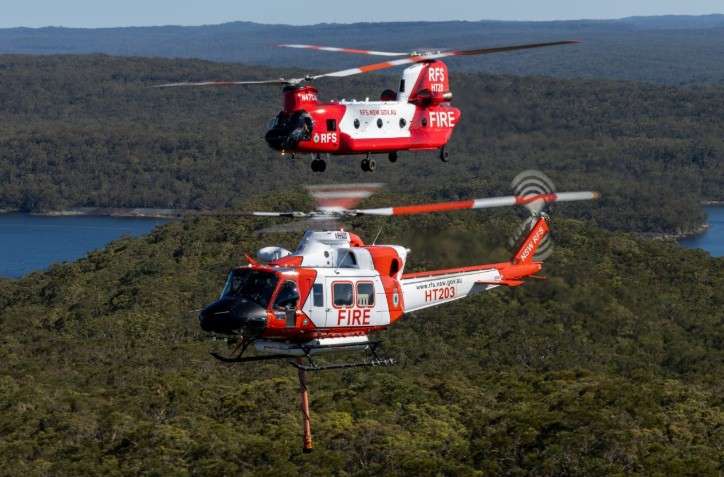
Meanwhile, a New South Wales Rural Fire Service CH-47D Chinook helicopter and a Bell 412 support aircraft deployed this weekend to fight fires in France. This will mark the Service’s first-ever European deployment and is in addition to its crews and its 737 Large Air Tanker already deployed to North America.

A New South Wales Rural Fire Service CH-47D Chinook helicopter and a Bell 412 support aircraft deployed to fight fires in France, August 2026. Photo: NSWRFS

In France, the two aircraft will be accompanied by 24 aerial and ground crew.

The Chinook, equipped with an 11,300-litre belly tank will work with the Bell 412, and is also capable of conducting waterbombing missions at night. Should it be tasked to do so in France, it will be the first time night-time waterbombing has been undertaken in the country.

“This is the first time we have deployed to Europe,” said Ben Millington, Deputy Commissioner at the NSWRFS.

“We have firefighters and incident management teams currently operating and supporting agencies in Canada and the United States with this pending deployment to France that will see our crew across three countries.”

Over 600 Spokane structures destroyed, 6,000 evacuated as Washington wildfires near most destructive in state history

Over 600 structures have been destroyed in Spokane, Washington, as 60,000 residents were evacuated late Saturday into Sunday.

Local officials gave the update on what they’re calling the Spokane Complex Fires at a press conference on Sunday afternoon. Washington Gov. Bob Ferguson issued a statewide wildfire emergency and a statewide burn ban in response to the Complex and 17 others burning throughout the state on Saturday.

The number of destroyed structures rivals the state’s costliest wildfire incident in 2023, when the Oregon and Gray Fires burned down 710 structures.

“This year has already been one of our busiest wildfire years on record, and we just started August,” Commissioner of Public Lands Dave Upthegrove said. “Our firefighters are already stretched thin across the state, and with more heat and wind expected this weekend and for the rest of the summer, any new spark on our tinder-dry landscapes can lead to another devastating wildfire. I’m urging all Washingtonians to not be that spark.”

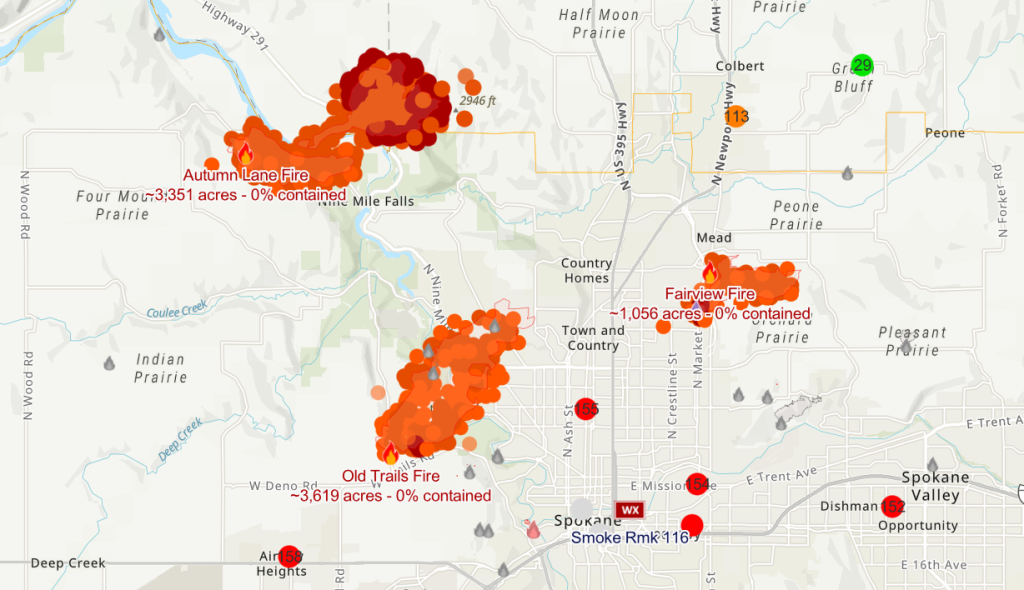
Three separate fires that constitute the Complex have not merged but are burning within miles of each other, triggering a shared response. The fires, all of which are at 0% containment, and burned area totals as of Sunday evening include:

  • The Old Trails Fire has burned 3,619 acres
  • The Autumn Lane Fire has burned 3,351 acres
  • The Fairview Fire has burned 1,056 acres
Credit: National Interagency Fire Center

The extreme fire weather that the region is facing isn’t expected to let up any time soon, according to National Weather Service meteorologists. Dry conditions, winds, and elevated temperatures are expected to continue throughout the upcoming week, with conditions intensifying on Friday as winds strengthen to between 30 and 35 mph.

“Friday is the next day being eyed for elevated fire weather concerns,” the National Weather Service’s Spokane office said in its Sunday evening report. “There is a near-zero chance for any precipitation within the next week for all areas except the Cascade gaps, so expect little to no relief from dry conditions.”

How to help Spokane residents recover

City officials asked the public to support their community using these resources: