Wildfire briefing, March 11, 2015

Lava from Hawaii volcano continues to spread
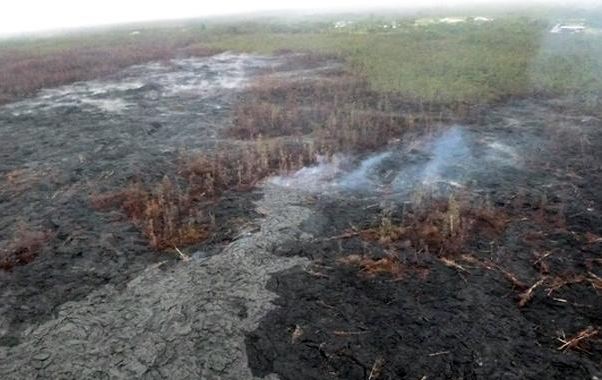
Hawaii volcano
Lava flow from the Kīlauea volcano in Hawaii. Photo by Hawaii County Civil Defense.

Lava from the Kīlauea volcano above Pahoa in Hawaii continues to spread, occasionally igniting the vegetation. The latest breakout is about 0.7 miles upslope of Highway 130, officials from the Hawaii County Civil Defense said after a helicopter flight Tuesday morning. Over the last four days the lava has advanced about 240 yards.

Three additional deceased hotshots to qualify for benefits

Decisions by the City of Prescott, the courts, and the Prescott Public Safety Retirement Board have resulted in the families of three additional members of the Granite Mountain Hotshots being approved to receive public safety survivor benefits. In 2013, 19 members of the crew were killed on the Yarnell Hill Fire south of Prescott, Arizona. Initially only six of the men were classified as full-time, permanent employees and deemed eligible for full benefits. More information is at AZcentral.

Group opposes FEMA’s plan to reduce hazardous fuel near Oakland, California

The Hills Conservation Network has sued several organizations in an attempt to halt a project that would reduce the hazardous fuels over 2,059 acres in the East Bay area. Below is an excerpt from Courthouse News Service:

“(C)lear-cutting and chipping of eucalyptus will not achieve the most effective reduction of fire risks in the project areas and instead increases fire risks by disposing of wood chips in layers up to two-feet deep over extensive areas of the project sites,” the complaint states.

But FEMA’s environmental impact statement, which justifies depositing up to 24 inches of mulch from eucalyptus trees, “fails to acknowledge research that highlights the high potential for spontaneous combustion in deeper accumulations of mulch, the difficulty of fire suppression in such fuels, the severe long-term damage to soils by the intense heating in mulch and wood chip fires, and the documented spotting danger posed by mulch and other forms of masticated fuels,” the group says.

“The net effect is essentially trading one fire hazard for another.”

Eucalyptus trees actually help reduce fire hazard by breaking up strong winds and reducing hazard from flying embers, and the complete removal of the eucalyptus forest would constitute a “catastrophic site disturbance” that would open up the ecosystem to invasive species, according to the lawsuit.

Last year we wrote this about eucalyptus trees:

Wildland firefighters in Australia and in some areas of California are very familiar with eucalyptus trees. They are native and very common in Australia and are planted as ornamentals in the United States. The leaves produce a volatile highly combustible oil, and the ground beneath the trees is covered with large amounts of litter which is high in phenolics, preventing its breakdown by fungi. Wildfires burn rapidly under them and through the tree crowns. It has been estimated that other than the 3,000+ homes that burned in the 1991 Oakland Hills Fire in California, about 70 percent of the energy released was through the combustion of eucalyptus.

Florida wildland firefighters concerned about their pay

Below is an excerpt from NBC 2:

Firefighters with the Florida Forest Service are fired up over small wages. They’re making a plea to state leaders to correct what they describe as being “grossly underpaid.”

[…]

Experience – now one the areas of concern being pointed out by a local union representing some of the firefighters with the Florida Forest Service.

“We do see a fairly high rate of turnover because of that,” said Chris Schmiege, Lee County Forest Area Supervisor.

“That”- being low salaries- in a job wage survey conducted by the union- it states Wildland firefighters receive a starting wage of a little more than twenty-four thousand a year for full-time work.

An amount comparable to a cafeteria worker or plumbers assistant which is considerably less than the average for firefighters at the county and local level, amounts ranging from thirty-nine to sixty thousand a year.

Forest Service officials are now calling on help from state leaders.

“We can definitely use the help, but at the same time we’re doing what we’re doing,” said Schmiege.

Which according to Schmiege also includes going out West to work for other federal fire agencies to stay afloat financially. Right now officials say it’s really almost a labor of love.

Wildfire briefing, January 30, 2015

Fire near Lake Disston, Florida

Fire near Lake Disston FL

Kenny Arnaldi took this photo Wednesday of a wildfire a mile south of Lake Disston, Florida.

Bushfire burns into Waroona in Western Australia

 bushfire threatening Waroona
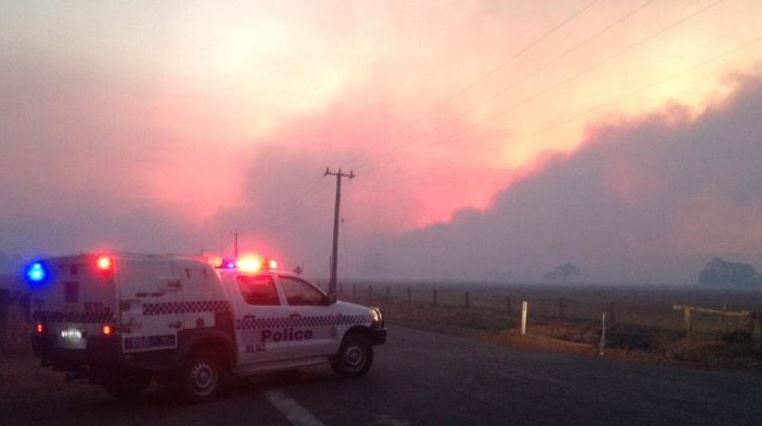
A bushfire threatening Waroona, about 100 kilometers south of Perth.

A large bushfire has burned into the city of Waroona in Western Australia about 100 kilometers south of Perth. (Map)

Below is an excerpt from an article at abc.net.au updated at about 4 p.m. MST, January 30, 2015:

An out-of-control bushfire is threatening lives and homes at Waroona in Western Australia, with up to three properties believed to be damaged so far. The blaze has entered the town, which is about 100 kilometres south of Perth, and the Department of Fire and Emergency Services (DFES) has warned it is moving fast in a north-westerly direction. Embers are likely to be blown around homes, starting spot fires.

DFES duty assistant commissioner Chris Arnol said residents should take their location into consideration when planning how to respond.

“It depends on where they are. We’ve asked some residents to shelter in place which is the best option for them and others to evacuate to [an evacuation centre in the nearby town of Harvey],” he said. “People should have their fire plans ready and know what to do. We’ve got about 150 firefighters. We had 21 appliances on the fire and we’ve sent a further 24 from the metropolitan area.”

Oklahoma grass fires

Firefighters responding to a fire southwest of Tulsa observed a person setting one of eight grass fires that were burning in the area. More information is in the video below.

Update on the Kīlauea volcano lava flow
Kīlauea volcano
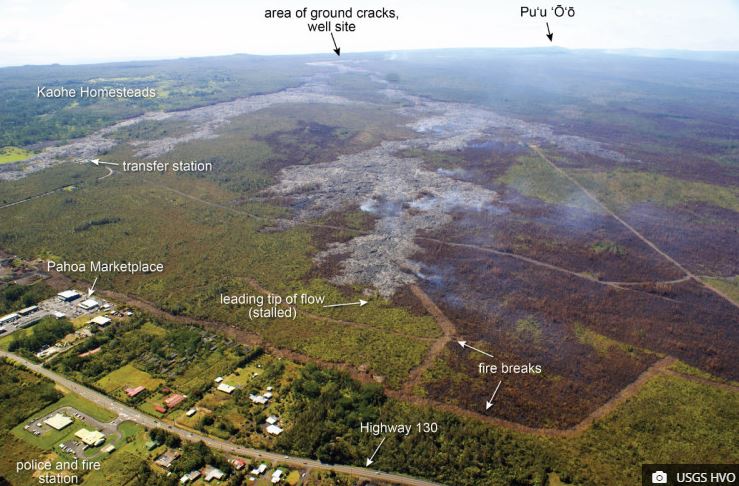
The image above released by US Geological Survey Hawaiian Volcano Observatory on January 29 shows the lava flow front from the Kīlauea volcano a mere 550 yards away from Highway 130 at its closest point. The distal tips are stalled, however “breakouts persist upslope,” writes USGS, “and these areas of activity can be spotted in this photograph by small smoke plumes where the lava is burning vegetation on the flow margins.”

Mississippi wildfire threatens natural gas facilities
A wildfire in Simpson County Mississippi (map) burned over an underground natural gas pipeline and came close to an above ground gas substation.

Below are excerpts from an article at WSMV:

“If it blows up down here, won’t nobody be left in Simpson County,” said resident Gurston McDonald.

McDonald lives just down the road from where a fire ripped through several acres of grass and forest, stopping just a few feet shy of a natural gas substation.

“All these gas lines coming through is a great concern,” added McDonald.

Simpson County EOC Director Glen Jennings said at least three fires broke out Thursday afternoon. However, the one off the highway posed the biggest danger to neighboring residents. Containing it also remained a challenge, because forestry officials can’t dig a fire line when there’s a gas line underneath.

“We don’t push on these gas lines. We just let it go, try to control it by water or some other means,” said Ben Vanderford with the Mississippi Forestry Commission. “We never know how deep those lines are, when we’re out there plowing these fire lines. These lines may be five or six feet under the ground, they might be five or six inches under the ground.”

And as night fell, flames spread again toward the substation, this time from a patch of trees about 200 feet away, with no fire line to stop it.


HID West prescribed fire in Everglades

prescribed fire Everglades National Park
Photo by Aerin Land, NPS

Everglades National Park Fire Management personnel conducted the HID West prescribed fire on January 23. The objectives were to consume dead and decaying vegetation, to release nutrients that promote new growth, and improve habitat.

prescribed fire Everglades National Park
Photo by Cory Dutton, NPS
prescribed fire Everglades National Park
Photo by Aerin Land, NPS

Everglades National Park’s aviation program

n626 bucket
Everglades National Park’s N626, a Bell Long Ranger. Photo by Clayton Camblin.

Many of the 1 million acres in Everglades National Park are inaccessible. The swampy terrain is not very conducive to the establishment of an extensive system of roads so park personnel often rely on helicopters to facilitate the accomplishment of a variety of tasks.

The park has a very active aviation program, occasionally using several helicopters in one day. They have contracted for an exclusive use contracted helicopter plus call when needed aircraft since the mid- to late-70s, but in April, 2014 acquired their own ship, a Bell Long Ranger. For now they are using pilots under contract, but are considering, AFMO Jack Weer said, hiring their own pilot. The aviation program is managed by a crew of five.

plastic spheres
Plastic spheres being used to ignite a prescribed fire. Photo by Clayton Camblin

Approximately 70 to 80 percent of the 450 to 550 hours of aircraft time in the park each year is for research, alligator capture, bird surveys, hydrology, fisheries, vegetation surveys, and python location. About 20 to 30 percent is used for fire management, including recon of wildfires and prescribed fires, aerial ignition, and dropping water with a 108-gallon Bambi Bucket. In 2014, 241 hours were used by call when needed aircraft, and 236 by the NPS-owned ship. Other agencies also use aircraft in the park. Recently the EPA used two float-equipped helicopters for 21 days in order to land at about 120 spots to monitor environmental conditions.

floats helicopter
Occasionally Everglades personnel need to land on water, and use a float-equipped helicopter. Photo by Clayton Camblin.

Since the helicopter is generally used in south Florida which has numerous airports, they do not maintain a fuel or service truck like you would see at most fire-related helicopter operations, but they do have a helitack truck and can mobilize a fuel trailer if needed.

Water ditching training
Aviation personnel put on water ditching training on a regular basis, since many flights are over water. Photo by Vilma Luque.

In the remote terrain aerial ignition is often used for prescribed fires. Recently fire personnel experimented with a technique for when a burn unit boundary is not a natural fire break. They ignite with the helicopter and after the fire gets going, they use a Single Engine Air Tanker (SEAT) to stop the spread near the intended unit boundary by dropping water. They do not use retardant in the Everglades, due to the fact that much of the park covered with or near water.

Tanker 819
Tanker 819, a Single Engine Air Tanker, used by Everglades. Photo by Clayton Camblin.

We have more information about the wildland fire program at Everglades National Park on our sister site, Wildfire Today.

Wildland fire management in the Everglades

everglades sign

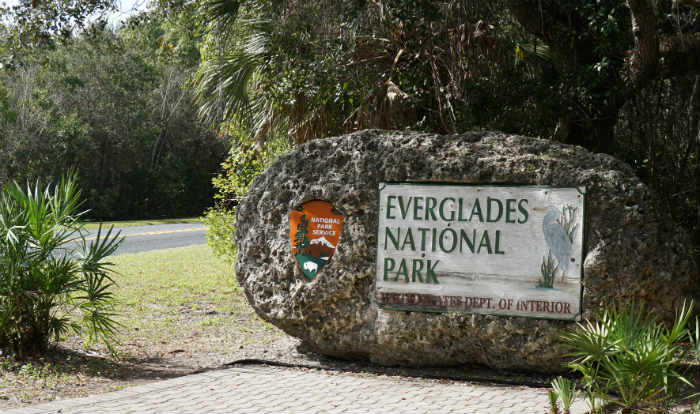
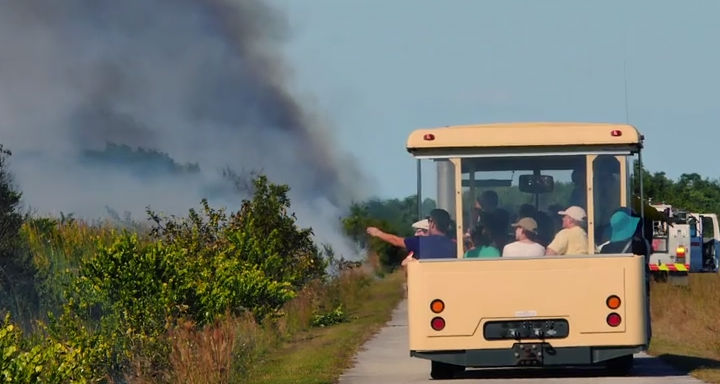
Everglades National Park, at the southern tip of Florida, has been using prescribed fire since 1958 to reintroduce and maintain fire as a part of an ecosystem that has been altered by humans. They have been doing it so long that they apparently feel comfortable having park visitors bicycle or take a tram along a road that is used as a fireline on an active prescribed fire.

Northwest River of Grass prescribed fire
A tram full of park visitors cruises past the Northwest River of Grass prescribed fire in December, 2014. Screen shot from the video below.

In 2014 Everglades prescribed burned about five times as many acres as were blackened in wildfires — 23,162 compared to 4,641 acres. Only about four percent of the acres burned in unplanned fires last year were on fires that were completely suppressed. The rest were managed, or not entirely put out and allowed to accomplish resource management objectives.

Everglades prescribed fire
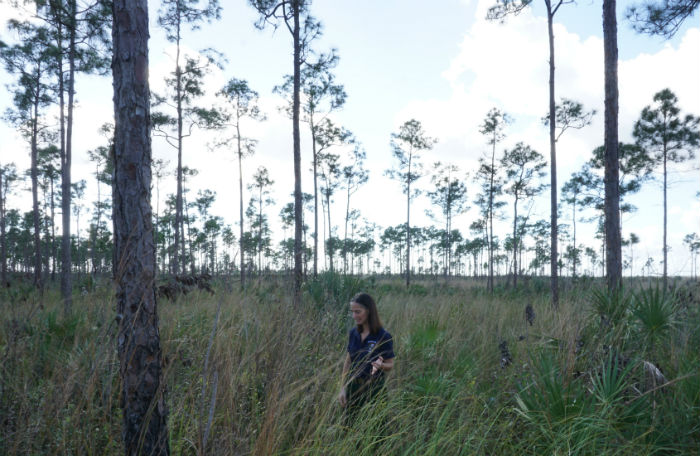
Fire Information Officer Katherine Corrigan standing in a an area that burned in a prescribed fire nine months previously, in April, 2014. Photo by Bill Gabbert.
Like other units in the National Park System, Everglades is experiencing a “workforce realignment”. That’s National Park Service-speak for a major budget reduction. They are still figuring out the details, but it appears that the fire management staff will  be “realigned” from about 35 to around 25 employees. Right now they have two staffed engines, fuels personnel, a fire ecologist, a helitack crew, and two fire effects monitors.  
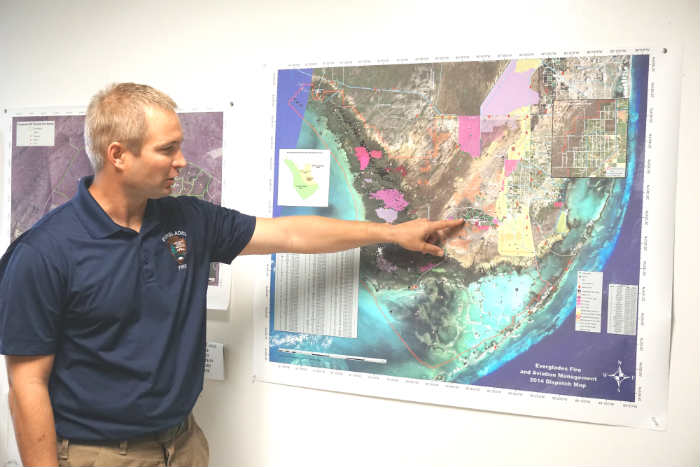
Jack Weer
Jack Weer, Assistant Fire Management Officer, Everglades National Park. Photo by Bill Gabbert.
Jack Weer, the assistant Fire Management Officer, said most of their wildfires occur in the months of January through May, but said they can have fires any month of the year. 
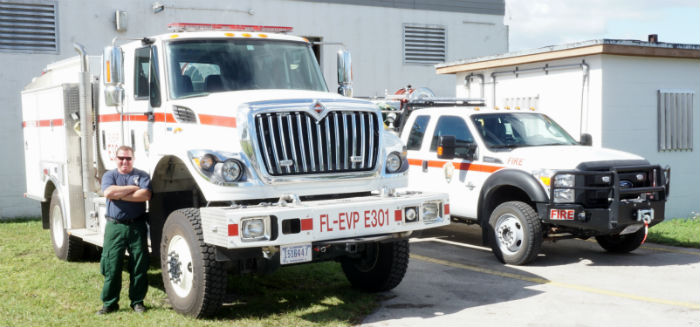
The park’s two engines, a Type 3 and a Type 6, hold 500 and 313 gallons, respectively. The also have two all terrain vehicles and four utility terrain vehicles. The Type 6 engine is on a Ford 550 chassis.
Everglades fire engines Chris Corrigan
Engine Captain Chris Corrigan and two of Everglade’s engines. Photo by Bill Gabbert.

The park also has a very active aviation program, using helicopters extensively, occasionally several in one day. For decades they have used an exclusive use contracted helicopter plus call when needed aircraft, but in April, 2014 acquired their own ship, a Bell Long Ranger. For now they are using pilots under contract, but are considering, AFMO Weer said, hiring their own pilot. We have more information at FireAviation.com regarding the helicopter program.

In 2012 we told you about an excellent film that the park commissioned, titled The River of Fire. It was produced, directed, and edited by Jennifer Brown who at the time was an NPS Interpretation Division employee whose term appointment was about to end. Ms. Brown, now with Into Nature Films, has produced another great film about a 28,000-acre prescribed fire the park conducted in December, 2014. Check it out below:

Miami-Dade’s aviation program

Miami-Dade Fire Rescue helicopter
Miami -Dade Fire Rescue’s helicopter base at Tamiami airport in south Florida. Photo by Bill Gabbert.

The Miami-Dade Fire Rescue (MDFR) Air Rescue Bureau has four Bell 412 EPs that are used for fighting wildland fires in south Florida as well as providing regional aero-medical transport, search and rescue, and tactical support to MDFR operations. Jim Hunter, an Aircraft Commander, said about 80 percent of their responses are for medical aids, with the remainder being rescue and firefighting support.

Miami-Dade Fire Rescue helicopter
Miami-Dade’s Bell 412 on duty at Tamiami. Photo by Bill Gabbert.

The Bureau operates out of two facilities in south Florida, the Tamiami Executive Airport and the Opa-locka Airport. Maintenance, administration, and training is conducted at the Tamiami facility.

There is always an “alert aircraft” helicopter staffed 24/7 at each location, along with two pilots and two paramedics for each. The other two helicopters are used for backup when an aircraft is down for maintenance. The day we were there, a backup ship was ready to be wheeled out on a dolly to the ramp if needed, and the fourth was undergoing heavy maintenance, which included removing the engines, rotors, and many other components.

Miami-Dade Fire Rescue helicopter
The backup helicopter is available if needed. Photo by Bill Gabbert.

During the dry season, January or February through May, the helicopters are equipped with a 350-gallon Simplex belly tank for firefighting, which takes about an hour to install, Mr. Hunter said. The tank has three doors which can be opened independently or all at the same time depending on the need. While the helicopter is hovering, the tank is filled through a snorkle with a 5 gallon per second pump powered by an electric motor.

They also have a 240-gallon Bambi Bucket.

Miami-Dade Fire Rescue helicopter
A Simplex 350-gallon belly tank is usually mounted during the busy part of the fire season. It takes about an hour. Photo by Bill Gabbert.
Miami-Dade Fire Rescue helicopter
They prefer to use the 350-gallon fixed belly tank, but a 240-gallon Bambi Bucket is also available. Photo by Bill Gabbert.

Each aircraft is equipped with the following:

  • Patient loading systems normally configured allow the transport of two critical-care patients, with the option to reconfigure for up to six patients in Mass Casualty Incidents (MCIs).
  • An external hoist for helicopter-borne rescues.
  • An external high-power searchlight, “The Night Sun,” is used for night operations.
  • MCI Command and Control suitable radio suite.
  • Night Vision Goggle compatible lighting.

They are also equipped with weather radar, but Mr. Hunter said the pilots prefer to use an iPad connected to the Internet, since it can show troublesome weather at a longer range than their radar.

(More photos are below.)Continue reading

Throwback Thursday: Time to think

On Throwback Thursday today, we’re reprising an article we wrote on August 9, 2008.


When I walked into Bill Supernaugh’s office one day in 1995 I found him looking out the window with his feet up on his desk. I was the Fire Management Officer and had an appointment with the Assistant Superintendent of Indiana Dunes National Lakeshore to brief him about the prescribed fire we were going to ignite in the park in a few days. I got along well with him and felt comfortable smiling and saying, “Oh sorry, I didn’t know you were busy–I’ll come back later” and half turned to walk away.

He pointed to a chair and told me to sit down. In the banter that we usually engaged in before getting around to business he explained that he was “thinking”, something that he felt was important for a manager in his position, supervising the Operations of a large workforce and a big chunk of public land. Taking time to think gave him the opportunity to mull over the issues of the day and strategize about the direction the park would take. He said a person in his position was more of a thinker than a doer.

I wanted to slink down into my chair and disappear, because what he said made perfect sense and I was giving him a hard time. I was there to brief him about a project I was going to DO, and he was going to take my information and THINK about it, then approve it, ask for more information, or give me advice about how to do it differently, or not at all.

At 5:00 a.m. on August 26, 1992 Hurricane Andrew made landfall, knocking the crap out of south Florida and four national parks including Everglades, Big Cypress, and Biscayne Bay. Early the next morning I was in a rental car south of Miami driving through Homestead trying to navigate on back roads while driving over downed power lines and other debris. The first power line was scary as hell, but then we realized there was no electricity anywhere. Navigation was difficult because all of the road and street signs and many of the usual landmarks were gone. Even someone with us that was familiar with the area was disoriented.

We were a Type 1 All-Hazard Incident Management Team with a mission to rescue park employees and restore the infrastructure. It was a huge job and after a few days as Planning Section Chief I felt a little overwhelmed, with lots to do and not enough time in the day to get it all done. In confessing my situation to our Incident Commander, Rick Gale, he said “Order the personnel you need to get the job done. You are paid to think, not do.”

After that, I made time, like Bill Supernaugh, to think. Occasionally I even put my feet up on a desk.

Until he retired from the day to day operations of Microsoft, Chairman Bill Gates scheduled a twice-yearly “Think Week” ritual, where he would take a helicopter or float plane to his secret lakeside cabin and… think….by himself….barring all outside visitors. He would rarely leave the cabin during the week except for an occasional walk on the beach, having a caretaker slip him two simple meals a day at the cabin. He subsisted on the two meals, Diet Coke, and Orange Crush.

Think Week was legendary in Microsoft. Gates would pore over about 100 papers written by company executives, researchers, managers, and developers, who hoped to obtain approval for their new project, or a new direction for the organization. Comments that Gates wrote on the papers could give the green light to a new technology that millions of people would use, or send Microsoft into new markets. He had to be careful what he wrote, after finding that a casual “Hey, cool, looks good” could result in 20 people being assigned to a project.

Barack Obama appears to understand how important it is to set aside time to think. Here is part of an accidentally-captured conversation between Obama and British Conservative Party Leader, David Cameron. Cameron asks Obama if he will be taking any time off for a vacation this summer:

Mr. Cameron: Do you have a break at all?

Mr. Obama: I have not. I am going to take a week in August. But I agree with you that somebody, somebody who had worked in the White House who — not Clinton himself, but somebody who had been close to the process — said that should we be successful, that actually the most important thing you need to do is to have big chunks of time during the day when all you’re doing is thinking. And the biggest mistake that a lot of these folks make is just feeling as if you have to be …

Mr. Cameron: These guys just chalk your diary up.

Mr. Obama: Right. … In 15 minute increments and …

Mr. Cameron: We call it the dentist waiting room. You have to scrap that because you’ve got to have time.

Yes. You have to have time to think. Those of us in the emergency management business too often see time to think as a luxury we don’t have. True, at times, when split second decisions can have life-long, or even life-dependent outcomes. But when initial attack becomes extended attack morphing into a long duration incident, thinking is not a luxury. It is a necessity.

Report released on swamp buggy fire in Florida

burned swamp buggy
The burned swamp buggy. Photo from the report.

The Wildland Fire Lessons Learned Center has published a report on a swamp buggy that caught fire and was destroyed while working on a prescribed fire in Big Cypress National Preserve in Florida in August.

According to the report:

The exact cause of the swamp buggy fire remains unknown. However, physical examination of a very similar buggy—as well as the first-person accounts from those present during the burn—suggest that the fuel line running from the buggy’s gas tank to the pump failed.

swamp buggy

Florida: prescribed fire escapes at St. Johns National Wildlife Refuge

Saint Johns National Wildlife Refuge, map

A prescribed fire escaped at a national wildlife refuge east of Orlando on Monday. The plan was to burn 660 acres within St. Johns National Wildlife Refuge, but multiple simultaneous spot fires outside the burn unit exceeded the capability of the firefighters from Merritt Island National Wildlife Refuge who were conducting the burn. An additional 72 acres of private land and 200 acres of Brevard County property outside the refuge burned — 600 acres in the original planned unit were completed.

The escape was knocked down by 43 personnel on Monday. Today spokesperson Candice Stevenson of the U.S. Fish and Wildlife Service said the fire is 70 percent contained. Agencies involved in the suppression of the escaped fire included the U.S. Fish and Wildlife Service, Brevard County, Florida Forest Service, the City of Titusville, and the U.S. Forest Service.