Northwest Fires

Map of wildfire in northwest, July 28, 2013

Wildfires in the Northwest
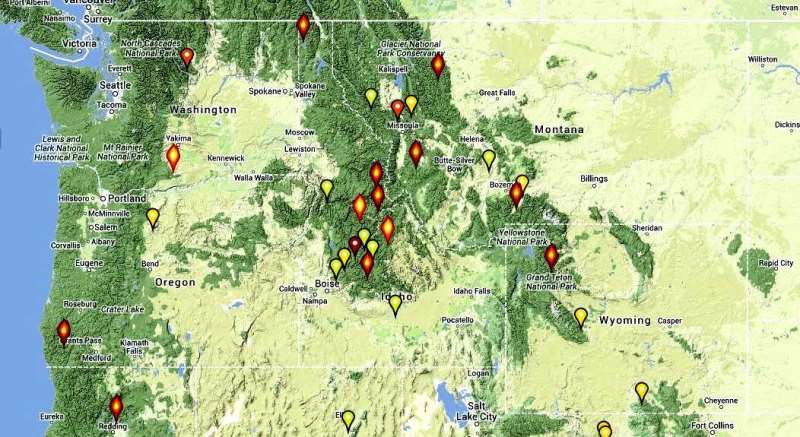
Map of wildfire in northwest, July 28, 2013

There are numerous large uncontained wildfires in the Northwest region today. The map  above (click to enlarge it) is a screen shot of a handy tool developed by the Billings Gazette.

Smoke from the fires in southwest Oregon’s Douglas Complex blew south over Josephine County again today, according to swofire.com — other fires include 24 incidents on the list of the Oregon Dept. of Forestry’s Grants Pass Unit, plus the 400-acre Labrador Fire about 10 miles northwest of Selma on the Rogue River-Siskiyou National Forest.
Douglas Complex
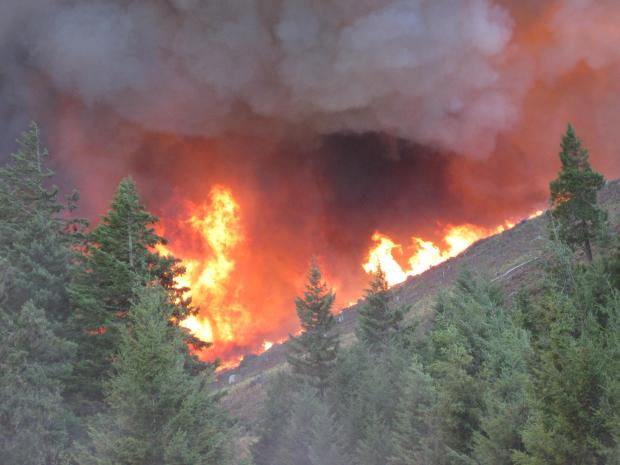
Douglas Complex

The 13,400-acre Douglas Complex north of Glendale was 2 percent contained Sunday; about 4 dozen homes have been evacuated, according to the Oregonian, and another 30 homes were under a secondary evac notice. A Friday lightning storm ignited 54 fires in southwest Oregon. The Douglas Complex was listed as the #1 fire priority in the nation this afternoon.

Gov. John Kitzhaber declared the complex a conflagration yesterday, allowing the state fire marshal to call in crews and equipment from around the state. (Oregon’s conflagration declaration allows dispatch of structural firefighters and equipment by the state fire marshal; more information is online at the OSFM website.) About 300 homes are threatened, and four structural task forces have been activated from Lane County, Linn County, Marion County, and Lincoln County.

About 750 personnel were assigned as of Sunday evening; crews reported extreme fire behavior, with 100-foot flamelengths on the  Dad’s Creek Fire with crown runs, torching, and long-range spotting.

The Oregon Department of Forestry (ODF) mobilized Sifford’s IMT 2 for the complex; it’s burning  in the southern portion of the district east of I-5, mostly on Douglas Forest Protection Association (DFPA) protected lands, which include BLM and private forestlands.

According to ODF reports, residents throughout Josephine County can expect to see ash and burned tree needles falling this evening and overnight. The Brimstone Fire, 5 miles west of Sunny Valley, breached lines this afternoon and grew to approximately 500 acres.

Colorado creates Firefighting Air Corps

On Wednesday Colorado Governor John Hickenlooper signed a bill, Senate Bill 245, that created the Colorado Firefighting Air Corps. The Corps is organized within the Department of Public Safety in the Division of Fire Prevention and Control. There was no money associated with the passage of the bill, so until funds are appropriated, it will apparently exist in name only.

If the state does come up with some funding, according to the legislation:

The Division may purchase, acquire, lease, or contract for the provision of firefighting aircraft, facilities, equipment, and supplies for aerial firefighting; and retrofit, maintain, staff, operate, and support the firefighting aircraft or contract for the provision of those services.

In a related story, on Monday, Nebraska Governor Dave Heineman signed into law LB 634, the Wildfire Control Act of 2013 which authorizes the state to contract for one Single Engine Air Tanker (SEAT).

You may remember that one of the sponsors of the Colorado bill, State Senator Steve King, had an idea to help defray some of the costs of the program:

Can you imagine what advertising value would be if you had a Colorado Rockies sign on the tail of slurry bomber?

So we sponsored a competition for designs showing potential advertising and asked our readers to vote on their preferred choice. The one below by Jerome Laval is the leader in the poll, which is still open.

Jerome Laval P3


Thanks go out to Bean

Nebraska Governor signs bill to contract for an air tanker

On Monday, Nebraska Governor Dave Heineman signed into law LB 634, the Wildfire Control Act of 2013 which authorizes the state to contract for one Single Engine Air Tanker (SEAT). The act also directs that two bases for SEATs be constructed and to acquire one or more mobile SEAT bases. It went into effect immediately after being signed.

The signed bill also directs the Nebraska Forest Service to administer fuel reduction programs and to provide wildfire training for volunteer fire departments and private landowners.

Before the legislation was modified, the original version authorized the state to contract for two SEATS at Chadron and Valentine, but that was eventually cut back to one. Another item removed from the bill was direction to establish a Type 3 Incident Management Team in the state.

In a related story, on Wednesday Colorado Governor John Hickenlooper signed a bill, Senate Bill 245, that created the Colorado Firefighting Air Corps.


2012 was a record fire year in Nebraska

Cottonwood Fire Crawford NE
Cottonwood Fire, west of Crawford, NE, June 18, 2012. Photo by Bill Gabbert

In 2012 Nebraska had the most acres burned in wildfires since records started being kept in 1964. Approximately half a million acres were blackened by fire last year.

Nebraska acres burned wildfires
Acres burned in Nebraska wildfires, 1964-2012. From the Nebraska Forest Service.

Wildlife to help reforest Nebraska Pine Ridge burn areas

Seed blocks
Seed blocks
Nebraska Game and Parks Commission biologist Shelley Steffl places a mixture of seeds, molasses and livestock mineral into a mold for drying. Once dried, the blocks are being fed to wildlife in hopes that the animals will distribute the seeds to remote areas of the Pine Ridge that were burned in wildfires.

If this works it could be a brilliant way to help replant areas burned in wildfires.

Natural resource officials in northwest Nebraska are turning to one of the oldest forms of seed dispersal to replace some of the countless trees and shrubs that were burned in the 2012 Pine Ridge forest fires.

Blocks containing seeds of native trees and shrubs soon will be fed to the region’s wild animals, which are expected to “deposit” the seeds in remote areas of the region’s rugged landscape.

Shelley Steffl of Chadron, the Nebraska Game and Parks Commission wildlife biologist leading the effort, said the project is intended to move seeds to the most remote areas of the Pine Ridge and complement future forest rehabilitation efforts.

She and the crew have created 800 of the blocks and have enough seed for about 300 more. Up to 10 blocks initially will be made available to individual landowners whose timberland was affected by the fires. If blocks remain after the first round of dispersal, each landowner will be able to receive more as needed.

“We’re looking at making these seeds move through wildlife and not livestock,” Steffl said, noting the livestock are more likely to walk on gentle slope areas where thick grass provides too much competition for seeds. “The blocks are small enough that we can put them out so the deer, elk, turkeys and songbirds can help the seed dispersal.”

She’s recommending the blocks be placed a quarter-mile apart about midway up north- and east-facing slopes, where they will be less vulnerable to competition from thick grasses and heat as the seedlings grow.

The blocks contain seeds for 12 native species of trees and shrubs, including Rocky Mountain maple and Ponderosa pine.

Steffl said one of the greatest challenges of the project was developing a recipe that contains the right ratio of molasses and livestock mineral to keep the blocks from falling apart. Most livestock feed blocks are formed using pressure and heat, but that technique could not be used without sterilizing some of the seed.

Steffl said the idea for the project derived from a brainstorming session with Upper Niobrara White Natural Resources District Manager Lyndon Vogt, and Nebraska Forest Service district forester Doak Nickerson.

“The more we thought about it, the more we thought that it just might work,” she said.

A grant from the Nebraska Environmental Trust was used to help with a portion of funding for the project. Thanks to that contribution, these blocks are available to landowners for just $3 per block, which is well below the actual cost of seed and production.

Landowners who want to be placed on a list for the blocks may contact Steffl at 308-432-6190 or visit the Upper Niobrara White NRD, 430 E. Second St., Chadron.

Nebraska legislature considers bill to enhance wildfire response

SEAT at Hot Springs
Single engine air tanker #466 at Hot Springs, SD, March 14, 2012. Photo by Bill Gabbert

UPDATE at 5:34 p.m. MT, April 5, 2013:

State Senator Jerry Johnson said the Governor is in favor of the bill.

****

(Originally published on March 25, 2013)

The Nebraska legislature voted 36 to 0 on Monday to advance a bill to the second round of debate that would appropriate $1.7 million to improve the response to wildfires. LB634 directs that contracted single engine air tankers be stationed at Valentine and Chadron, one at each location, during the fire season. It would also provide for the thinning of forests, make more wildfire training available to volunteer firefighters, and develop a Type 3 incident management team.

The air tankers would be available through mutual aid agreements for fires that occur across the states lines in South Dakota, Colorado, and Wyoming.

Before the vote on Monday the bill was amended, adding the following:

Since an emergency exists, this act takes effect when passed and approved according to law.


Red Flag Warnings, March 18, 2013

Red Flag Warnings


Red Flag Warnings for enhanced wildfire danger have been issued by the National Weather Service for areas in New Mexico, Colorado, Kansas, and Nebraska.

***

The map above was current as of 1:00 p.m. MT on Monday. Red Flag Warnings can change throughout the day as the National Weather Service offices around the country update and revise their forecasts. For the most current data, visit this NWS site.

Nebraska offers cost-share fuel reduction program

Chadron State Park fuels treatment

Chadron State Park fuels treatment

The state of Nebraska is offering to help forest landowners pay for the costs of reducing the fuel loads on their land. Using state and federal funds, the Nebraska Forest Service (NFS) is able to provide eligible forest landowners up to 75 percent cost-share assistance for fuels treatment projects. These programs are currently open to forest landowners in the Pine Ridge and Niobrara Valley areas. Other fuels treatment opportunities exist for Nebraska landowners whose land is adjacent to National Forest land.

In the future fuels treatment assistance programs may spread to communities in other areas if they have completed a Community Wildfire Protection Plan (CWPP).

More information is available in a NFS pamphlet (large 2.7MB file).

Bill introduced in Nebraska to enhance wildfire suppression capability

Cottonwood Fire
Cottonwood Fire
Cottonwood Fire near Crawford, Nebraska, June 18, 2012. Photo by Bill Gabbert

A bill has been introduced in the Nebraska Senate that would enhance wildfire training, preparedness, and suppression capability of firefighters in the State. The proposed legislation would provide two single air tankers in the northwest part of the state and develop a Type 3 incident management team, in addition to other provisions. Senator Al Davis of Hyannis will present the bill, called the Wildfire Control Act of 2013, to the Legislature’s Natural Resources Committee on Friday.

Key provisions of the proposed legislation include:

  1. Contract with private aviation companies to place two single engine air tankers during the fire season at airports near Chadron and Valentine. These planes would provide rapid initial attack across a broad area of western Nebraska on both private and public lands, keeping fires small and less destructive.
  2. Thin forests to reduce fuel loads, substantially reducing wildfire risk, intensity, and rate of the spread, and reduce risks to residents, communities and emergency personnel.
  3. Provide expanded training programs for volunteer firefighters, private landowners and communities in order to increase fire suppression effectiveness and safety.
  4. Develop a Nebraska-based Type 3 incident management team that would serve as a comprehensive resource to augment and help manage large wildfire operations.
  5. Expand the federal excess property programs managed by the Nebraska Forest Service to provide volunteer fire districts with fire suppression equipment.
  6. Rehabilitate forest lands that have been destroyed by wildfires.

The bill was introduced by Senator Davis and has eight co-sponsors.

Here is a link to a fact sheet about the bill with more details.

Prescribed fire training in Nebraska

Nebraska Rx fire academy
Nebraska prescribed fire academy, screen grab from Emily Kreutz video

The Nebraska Public Broadcasting System is reviewing their best stories of 2012, and among that group is their coverage of a prescribed fire academy sponsored by The Nature Conservancy near Gothenburn, Nebraska. The Nebraska PBS site has an interesting article as well as a video describing the training which occurred in March.

Here is an excerpt from the article:

==============================================================

…More and more, field operations for controlled burns are dictated by knowledge gleaned from scientific research. It’s long been known fire behavior is influenced by weather, the amount and type of available fuel and the lay of the land.

Since so much knowledge has been passed from one generation to the next, there’s an unusual tension between new science and the traditional, often effective, methods of harnessing the benefits of fire.

“I think that prescribed burning is more of an art than a science, but you do have to understand fire behavior and use that,” said Doug Wisenhunt of the USDA’s Natural Resource Conservation Service. He admitted to mixed feelings about crews in the field relying too much on computer models and mathematical formulas.

“You can calculate some of that, but in general, it’s just kind of knowing how the fire is going to react when you are burning at that time.”