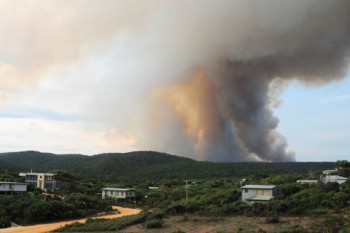
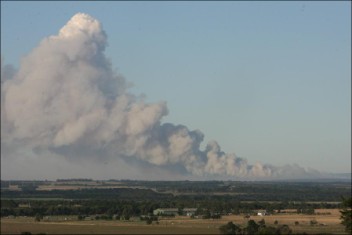
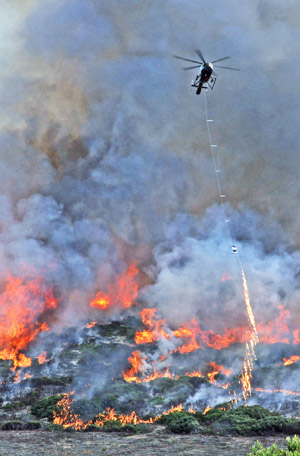
A prescribed fire in Victoria, Australia on Monday got a little larger than expected in Angahook Lorne State Park about 20 miles southeast of Geelong (map). Originally planned to be 1,074ha (2,654 acres), it jumped control lines within a few hours of ignition Monday evening and burned an additional 50ha (124 acres) before it was contained. “Erratic fire behaviour” was blamed for the bonus acres.
Photo: Geelong Advertiser
Firefighters worked through Monday night to corral the fire with the help of aircraft and 92 pieces of fire apparatus.
In 2007 the state of Illinois passed a law, Public Act 95-0108, that established some requirements related to conducting prescribed fires. Some of the key points included in the legislation include:
A “certified burn manager” must be on site.
A written prescription for the project must be approved by a “certified burn manager”.
Prescribed fire is a serious business and needs to be conducted by highly skilled and experienced professionals. But this is the first we have heard of a state passing a law requiring that a person be certified as a “burn manager” under specific requirements written by the state. Are there other states with similar laws?
After the law was passed in 2007 the state’s Department of Natural Resources established the requirements to become certified. They include:
Training: Basic ICS, basic wildland firefighter training (S-130, S-190), and a “specialized Illinois Prescribed Burning Manager Course”.
Participate in five burns.
Complete two burns as an apprentice prescribed burn manager.
Submit a written application with a $50 fee.
These are very minimal training requirements.
And, there is this:
Persons who have received the certification as a Prescribed Fire Burn Boss Type 1 or Type 2, known as RXB1 or RXB2 respectively, under the NIIMS Wildland Fire Qualification System, can receive an Illinois Certified Prescribed Burn Manager Certificate by submitting an Application, proof of the RXB1 or RXB2 certification and the $50 fee.
There is also a grandfather clause that makes it easier for someone to become certified that has been conducting prescribed fires for a while.
I wonder if federal employees conducting burns on federal lands will have to apply and pay the $50 fee.
The Mark Twain National Forest is igniting the 6,971-acre Brush Creek and Clayton Ridge prescribed fire today. The project is in southwest Missouri, about 15 miles southwest of Ava. Much of it will be lit with Redding Air Service‘s helicopter 57Z, a Bell 206 L4.
The Brush Creek and Clayton Ridge project is shown in red. USFS map.
The objectives of the project are to maintain and improve glade and savanna ecosystems by prescribed burning every three to five years. Encroaching eastern red cedars are removed mechanically by USFS personnel.
This is a huge prescribed fire. Does anyone know of any other large prescribed fires recently completed or planned in the near future, say, larger than 3,000 acres?
Fort Stewart, the home of the 3rd Infantry Division in eastern Georgia (map), claims that they burn up to 120,000 acres each year in prescribed fires, almost half of the base’s 280,000 acres. They say it is more than any other organization in the United States. Pretty impressive. Sometimes fire personnel in federal, state, local, or private organizations forget how involved some military bases are in wildland fire.
This video introduces us to the prescribed fire program at Fort Stewart.
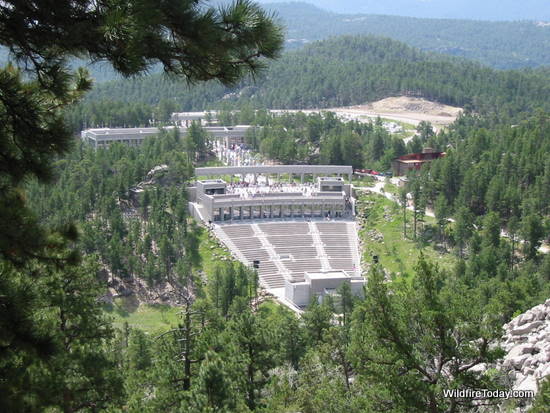
Mount Rushmore administrative site, looking down from just below the sculpture . Photo by Bill Gabbert
Mount Rushmore National Memorial has posted a draft plan on how they intend to manage the mountain pine beetle (MPB) epidemic that is headed their way. The problem is real, with the beetles staged just outside the memorial’s boundary on U.S. Forest Service land. While the critters are native to South Dakota and much of the western US, if they wipe out most of the Ponderosa pines near the sculpture in a epidemic caused by years of drought, it will not be a very pleasing sight for the 2.5 million visitors that trek there every year.
The plan calls for thinning most of the 1,200-acre site, spraying some areas, and treating much of the site with prescribed fire. They are asking for $5,653,150 through FY 2014. That works out to $4,710 per acre. Here is a summary of their treatment recommendations.
Spraying high value trees with insecticide to prevent loss within the developed area
Search, mark, and remove infested trees throughout the Memorial
Thin forests along the Highway 244 corridor to create a fuel and bug break
Thin forests throughout the Memorial to varying density and age class levels
Thin a 300 foot MPB and fire break along the south, west, and east boundary of the Memorial
Introduce prescribed fire throughout the Memorial after thinning
Communicate MPB management issues to the public
The memorial has enough funding to begin implementing the plan if it is approved, but they will be asking for more dollars to work on the list above, plus hiring four employees, including interpreters and a public information officer.
Taken with my Droid cell phone a couple of hours after the piles were first ignited.
The driftwood piles at Pactola lake are being burned on top of the frozen lake surface. The six piles were ignited easily with a propane weed burner. I will post more pictures later.
Below is an update and better photos–taken with an actual camera.
Last week the Secretary of the Department of Sustainability and Environment (DSE) in Victoria, Australia told the Royal Commission that is looking into last year’s Black Saturday fires that he would not support a 4 to 6 percent increase in prescribed burning, partly because the science was still developing.
But a seven-member panel made up of fire ecologists, CSIRO fire researcher Phil Cheney, and Jerry Williams, former Chief of the U. S. Forest Service, said there is plenty of science available to support burning 5 to 10 percent of Victoria’s forests each year.
Cheney said a good prescribed fire will stop a bushfire for one to two years, and after three years will have a “profound effect” in reducing the rate of spread. For as long as 20 years embers and flame height will be reduced.
Jerry Williams said prescribed fire had an effect even in extreme conditions.
A person might say the science of prescribed burning has been developing for many centuries since indigenous people began routinely setting prescribed fires to enhance the habitat for the plants and animals they needed for survival. In 1804 and 1805 Lewis and Clark documented the use of prescribed fire by native Americans (but at least one of them had an unfortunate result). At some point we have to admit that the science has reached a level of maturity.
Abraham Lincoln said:
Things may come to those who wait…but only the things left by those who hustle.
Fire is a natural part of the Australian environment and has been so for millions of years. Natural ignition (lightning) and indigenous burning practices have shaped our ecosystems over tens of thousands of years.
From Bill Gabbert, February 22, 2010:
Prescribed fire, when applied wisely by experienced fire management personnel, is an essential land management tool.
Research scientist Lachlan McCaw led a team that studied the effects that previous planned or unplanned fires had on the spread of the disastrous Black Saturday fires a year ago in Australia. Unsurprisingly, he concluded that the intensity was reduced and the areas provided anchor points for firefighters, but larger prescribed fires were more effective than small ones.
DUH. To many of us this is intuitive, but documenting this data can help to rebut the uninformed rants of those in Australia that are opposed to prescribed fires.
Dr McCaw said that across the areas burned on Black Saturday, there was no evidence that small-area fuel reduction had curbed the fires, but strong evidence of an impact where planned or unplanned burns had occurred within four years and over broad areas of more than 600ha.
Where the Kilmore fire, burning with great intensity about 3pm on Black Saturday, met a relatively small area of four-year-old growth, it was quickly outflanked.
About 6.30pm, when the fire met a 1600ha area burnt by wildfire in January 2006, it burned with low intensity.
Dr McCaw said the severity of the Beechworth fire on Black Saturday was reduced by burns that had been conducted one year, two years and four years previously, that had also provided “anchor points” for fire fighting.
Asked about the effectiveness of small “mosaic” burns that left areas of unburnt vegetation for biodiversity conservation, Dr McCaw said if the primary objective of planned burning was community protection, “you would have to be pursuing fairly high levels of fuel reduction”.
Contractors burn vegetation at Fort Ord in the fall of 2009. Photo: Chris Prescott, U.S. Army Corps of Engineers
Fort Ord, an Army base south of Monterey, California, (map) was closed in 1994. Since then the Army has been restoring portions of the base to a more natural condition. One of their toughest challenges is finding and removing inert and live ordnance in the impact areas which are covered in dense stands of brush, or in this case, “central maritime chaparral”, or CMC.
The ordnance removal teams can’t easily find the unexploded bombs and shells unless the brush is removed. They considered cutting it, but decided that a prescribed fire is the most environmentally friendly method when dealing with one of the last remaining stands of CMC in the state.
Contractors have been doing some of the burning as well as the burn planning. Barry Callenberger, the Principal of Wildland Rx, has been involved in the project. Barry used to work for the U.S. Forest Service on the Cleveland and Eldorado National Forests and in the Regional Office in California, until moving to the private sector in 1997 to work for North Tree Fire before forming his own company.
At least one burn, 500 acres in the fall of 2009, has already been conducted, and the Army plans to continue burning about 800 acres a year on portions of a 6,800-acre area of CMC.
Since 2001, ordnance specialists have removed unexploded ordnance from nearly 2,500 acres, finding over 12,000 unexploded ordnance items and 89,000 pounds of munitions debris.
I wonder if anyone receives hazard pay while working on these prescribed fires?
Who KNEW that the state of Georgia has designated the first full week of February, February 8-14 this year, as Prescribed Fire Awareness Week? Governor Sonny Perdue recognizes “this valuable tool for improving the health of Georgia’s 24 million acres of forest land”.
A little research uncovered other Prescribed Fire Awareness Weeks:
Florida: since 1997 it has been the second week in March.
North Carolina: had their first one, and possibly their last one, February 7-13, 2010. The Governor’s proclamation only designates a one-time event. Damn. And I missed it.
New York: The Nature Conservancy “celebrates Prescribed Fire Awareness MONTH in June” in the state of New York.