Orange County begins trial of night-flying, hover-filling helicopter

night-flying helicopter Australia
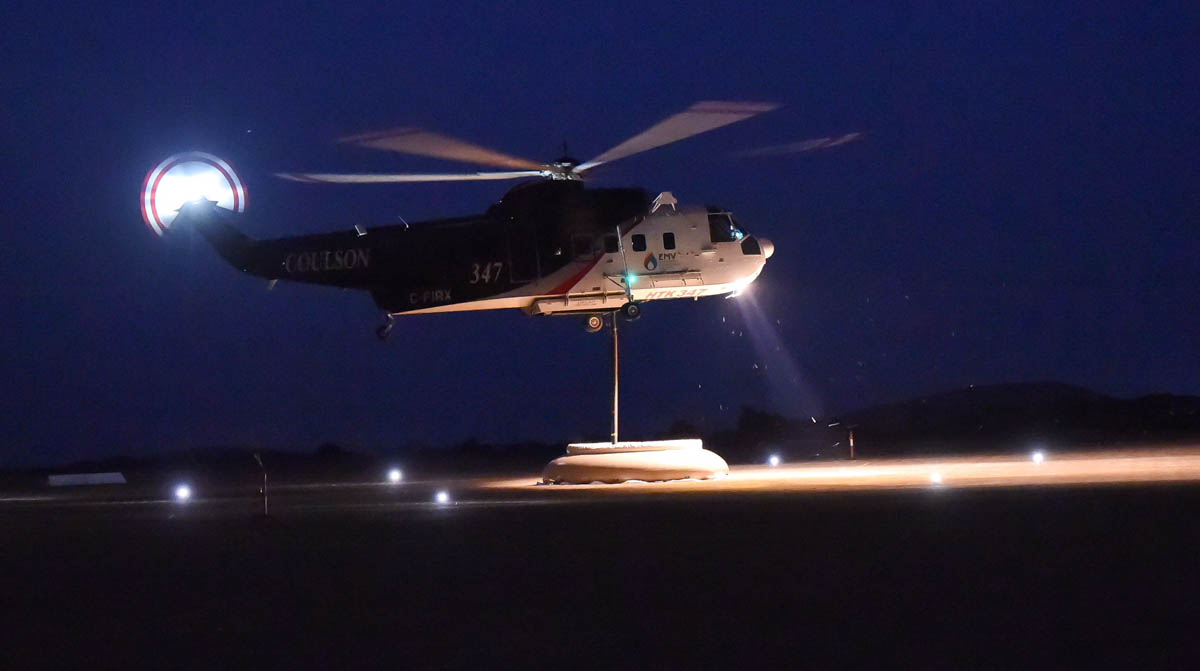
The S-61 snorkels from a dip tank in phase 2 of the night-flying trial in Australia. February, 2018. Coulson photo.

This month the Orange County Fire Authority (OCFA) is beginning a trial of a night-flying firefighting helicopter that can refill its collapsable external water tank while hovering. Thanks to a $4 million grant from Southern California Edison the OCFA has awarded a 150-day contract to Coulson Aviation for two helicopters that will be based at the Fullerton Municipal Airport northwest of Anaheim, California (map).

The one that will be most visible is an S-61 that can carry up to 1,000 gallons of water. As demonstrated during the recent bushfire season in Australia the Coulson helicopter can hover over a water tank at night and use a hose to refill the tank. Night-flying helicopters have been used in the United States since the 1970s to fight fires, but until a few months ago they always had to land to reload, with firefighters on the ground dragging hose, connecting it, pumping water into the tank, disconnecting, and moving out of the way as the helicopter takes off. Hover refilling is more time-efficient.

Firefighting at night can be more effective, since usually winds subside, relative humidity increases, and temperatures decrease, resulting in lower intensity and rates of spread.
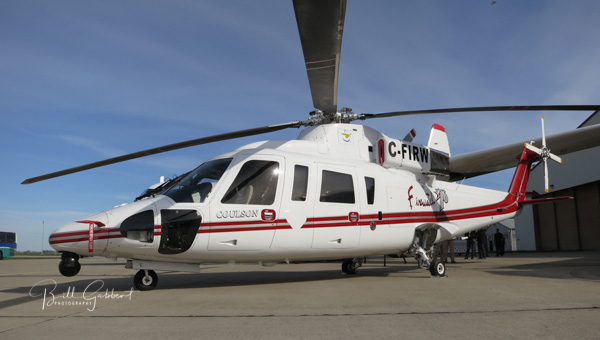
Coulson's Sikorsky S-76
Coulson’s Sikorsky S-76, Helicopter 347, at Sacramento, March 20, 2014. Since then, the livery has changed. Photo by Bill Gabbert.

The second helicopter that is part of the trial is a Sikorsky S-76 that will work with the S-61 to provide intelligence, evaluate effectiveness, and identify targets with a laser designator. In Australia the S-76 orbited approximately 1,000 feet above the S-61 and used a GPS controlled illuminated laser pointer to inform the water dropping helicopter where to drop the loads. The S-61 is fitted with night vision goggles but also has twin adjustable Night Suns on the landing gear along with the helicopter searchlights.

The two helicopters will be staffed 24/7 and will be available to all regions serviced by Southern California Edison including Orange, Los Angeles, Riverside, and San Bernardino counties.

Orange County’s regular helicopter fleet consists of two Super Hueys and two Bell 412ep ships, and has been using night-flying helicopters for years.

The video below shows an Orange County night-flying drill, uploaded to Vimeo July 8, 2019.

Coulson helicopters arrive in Australia, after long ocean voyage

Coulson helicopters firefighting Australia

Two of Coulson’s helicopters have completed their trip on board a ship and have arrived in Australia. The company is in the midst of putting them back together in a hangar in Avalon. The S-61 due to its size had to be broken down more than the S-76, but the mechanics have done this several times before.

The two ships will be used in the Aussie’s night vision goggle firefighting program, with training beginning November 7. The S-61 will be double crewed, providing assistance to firefighters well into the night. It will be capable of filling while hovering, something the North American firefighting agencies have not done.

Photos by Coulson

Coulson helicopters firefighting Australia

Coulson helicopters to participate in Australian night-flying trial


Warning: Trying to access array offset on value of type bool in /home/customer/www/wildfiretoday.com/public_html/wp-content/themes/jupiterx/lib/api/image/functions.php on line 61

Deprecated: ltrim(): Passing null to parameter #1 ($string) of type string is deprecated in /home/customer/www/wildfiretoday.com/public_html/wp-content/themes/jupiterx/lib/api/utilities/functions.php on line 206

Deprecated: preg_replace(): Passing null to parameter #3 ($subject) of type array|string is deprecated in /home/customer/www/wildfiretoday.com/public_html/wp-content/themes/jupiterx/lib/api/image/class-image-editor.php on line 177

Warning: Undefined array key "extension" in /home/customer/www/wildfiretoday.com/public_html/wp-content/themes/jupiterx/lib/api/image/class-image-editor.php on line 179

Deprecated: preg_match(): Passing null to parameter #2 ($subject) of type string is deprecated in /home/customer/www/wildfiretoday.com/public_html/wp-includes/functions.php on line 3089

Deprecated: is_file(): Passing null to parameter #1 ($filename) of type string is deprecated in /home/customer/www/wildfiretoday.com/public_html/wp-includes/class-wp-image-editor-gd.php on line 95

Deprecated: preg_match(): Passing null to parameter #2 ($subject) of type string is deprecated in /home/customer/www/wildfiretoday.com/public_html/wp-includes/class-wp-image-editor-gd.php on line 95

Deprecated: ltrim(): Passing null to parameter #1 ($string) of type string is deprecated in /home/customer/www/wildfiretoday.com/public_html/wp-includes/formatting.php on line 4558

The project will begin February 23 with two Sikorsky helicopters, an S-61 and an S-76.

Continue reading

Helimax prepares for the 2016 fire season

Chinook

Above: One of Helimax’s two CH-47D Chinook Type 1 helicopters they have on exclusive use contract with the U.S. Forest Service.

We stopped by the Helimax Aviation facilities at McClellan Air Field near Sacramento recently and talked with General Manager Josh Beckham and Director of Fire Operations Larry Kelly. Their mechanics were going over their fleet of helicopters preparing them for the upcoming fire season.

HelimaxTwo of their three CH-47D Chinooks are on a Type 1 exclusive use contract. One of them today became the company’s first helicopter to leave the nest this year, beginning work in Sierra Vista, Arizona.

Mr. Beckham told us that they expect to buy “probably two to start with” of the internal 2,800-gallon tanks being built by Jordan Aircraft Services. He said the first one is nearing completion and they hope to begin flight testing in the next couple of months. The water or retardant will be pushed out of the horizontally mounted cylindrical tanks by a 54-inch piston.

Chinook tank
Chinook tank under construction, left side looking forward. Photo provided by Tony Cabler, the Quality Director for Jordan Aircraft Services.

Mr. Beckham said Helimax also has six Type 2 helicopters on exclusive use contracts, five 205A1++’s and one 212HP.

external belly helicopter tank Helimax
An external belly tank for the S-61N.
S-61N Helimax
S-61N and a Chinook
Helimax
Workers in the Helimax hangar get helicopters ready for the 2016 fire season.

On injured reserve is a Super Puma which needs some work — it was hoisted out of the ocean when it became floating debris after the 2011 Tsunami in Japan.

This Super Puma was floating in the ocean after the Tsunami in Japan.

North American firefighting aircraft in Australia beginning to head back home

As the bushfire season winds down in Australia the large and very large air tankers are beginning to migrate back north to North America to prepare for the fire season back home. The DC-10, Tanker 910, arrived at Albuquerque at 8 p.m. Friday night after flying over 8,500 miles from Melbourne, stopping in Pago Pago and Honolulu on the way.

Two of the DC-10s will be on exclusive use contracts with the U.S. Forest Service this summer; one starts in late April and another in early May.

Tanker 910 DC-10 fire
The photo, supplied by 10 Tanker, shows Tanker 910, a DC-10, at Albuquerque Friday night after returning from a deployment in Australia. It could be a little blurry because the crew and aircraft may have been exhausted after flying for over 8,500 miles from Melbourne.

Conair’s Tanker 162 (an RJ85) and Coulson’s two C-130s (T-131 and T-132) are expected to depart around March 1. Britt Coulson said their two S-61 helicopters (photos) have both been extended for another week and a half and may get extensions beyond that if it continues to be hot.

One of our readers alerted us to the photo below that was taken February 28 when Tanker 910 stopped in Hawaii on the way back from Melbourne.

More information about Croman’s S-61A crash

S-61A crash sikorsky helicopter
S-61A crash

It was initially described as a “hard landing”. However, information from the FAA and a photo we received indicate an incident that involved one of Croman’s S-61A Sikorsky helicopters on August 19, 2015 (that we wrote about on August 24) was more than that. We can’t verify with 100 percent certainty that the helicopter in the photo above is Croman’s S-61A, N1043T that crashed that day while working on the Eldorado Fire eight miles southeast of Unity, Oregon. But the person who sent us the photo said it is, and the paint job, the position of the helicopter, and the damage to the tail boom match the NTSB’s description of the crash.

Below is text from the NTSB Preliminary Report, ID# WPR15LA248, that was updated on September 3, 2015:

****

“14 CFR Part 133: Rotorcraft Ext. Load
Accident occurred Wednesday, August 19, 2015 in Ironside, OR
Aircraft: SIKORSKY S 61A, registration: N1043T
Injuries: 1 Minor, 1 Uninjured.

This is preliminary information, subject to change, and may contain errors. Any errors in this report will be corrected when the final report has been completed. NTSB investigators may not have traveled in support of this investigation and used data provided by various sources to prepare this aircraft accident report.

On August 19, 2015, about 1930 Pacific daylight time, a Sikorsky S-61A, N1043T, landed on a mountainside after experiencing a partial loss of engine power about 7 miles west of Ironside, Oregon. The commercial pilot sustained no injuries and the air transport pilot sustained minor injuries. The helicopter sustained substantial damage to the tailboom. The helicopter was registered to, and operated by, Croman Corp under the provisions of 14 Code of Federal Regulations Part 133 as a firefighting flight. Visual meteorological conditions prevailed for the flight, which operated under a company flight plan. The flight originated from Baker City Municipal Airport (BKE), Baker City, Oregon at 1715.

The commercial pilot reported that shortly after picking up a bucket of water from a pond he gained airspeed and initiated a climbing left turn back towards the fire. As the helicopter started to climb, he heard a drop in RPM and the helicopter lost power. He attempted to continue the climb; however, the helicopter was too heavy. He released the water and landed the helicopter on a mountain side; subsequently, the helicopter rolled onto its right side.

The helicopter has been recovered to a secure location for further examination.”

****

UPDATE, September 15, 2015:

Earlier this year a Croman S-61A helicopter’s main rotor hit a tree while dipping water on the Cabin Fire on the Sequoia National Forest in California. Below is an excerpt from the Rapid Lesson Sharing report dated August 4, 2015:

****

“…As the pilots descended into the dipsite, the SIC communicated instructions to the PIC to “stay left” of the trees. While in the dip, the PIC heard what he suspected was a blade strike, called out the strike, jettisoned the water and immediately initiated a climb out to get clear of the area.

The pilots assessed the condition of the blades and saw no noticeable damage while in flight. On the climb out, the SIC noticed a smaller diameter tree (estimated to be about 8 ft. in height) that had been located at the helicopter’s 4 o’clock position, and missing its top. The Air Attack was notified about the potential blade strike and the pilots provided their intentions to land at the first opportunity. During the short flight to the first suitable landing site, the pilots noted no vibrations or abnormalities.

The crew performed a precautionary landing in a field located approximately 10 minutes away from the dip site. The Helicopter Manager was notified of the situation via cell phone. After shut down was complete, the pilots inspected the main rotor blade damage. Maintenance inspectors determined the main rotor blades, rotor-head, transmission and high speed shafts required replacement. The NTSB determined the blade strike as an “Incident”, and it was further classified by the Forest Service as an “Incident with Potential”…”