
Previously it was on contract for four months each year
Continue readingA power company and the county share cost of a Air-Crane
 File photo: A Sikorsky Skycrane drops about 2,600 gallons of water on the Red Canyon Fire 9 miles southwest of Pringle, SD July 9, 2016.
San Diego Gas and Electric is in its ninth year of contracting for an Erickson Skycrane helicopter. It is a unique financial arrangement that shares the cost with the County of San Diego. SDG&E, via its ratepayers, picks up the $1.75 million annual tab for availability each season, July through October, as well as the first two hours of flight time when used on a fire. The county pays for hours three and four. If it is needed for more than four hours it would most likely be on a large fire and the additional cost could be paid by another agency such as the state or federal government, if they needed the aircraft.
The current contract for the Skycrane, which carries up to 2,650 gallons, is in effect through 2022.
Officials investigating the roles of wind and power lines in Northern California wildfires
There is no doubt that after numerous wildfires started Sunday night October 8 north of San Francisco the very strong winds caused them to spread so rapidly that there is no way firefighters could put them out before they grew large. There are reports that the Tubbs Fire between Santa Rosa and Napa burned about 20,000 acres in a few hours.
Many power lines blew down or sparked as electrical conductors brushed together in Sonoma and Napa Counties.
According to the Mercury News:
Emergency dispatchers in Sonoma County received multiple calls of power lines falling down and electrical transformers exploding. In all, according to a review of emergency radio traffic by the Bay Area News Group, Sonoma County dispatchers sent out fire crews to at least 10 different locations across the county over a 90-minute period starting at 9:22 pm to respond to 911 calls and other reports of sparking wires and problems with the county’s electrical system amid high winds.
Officials have not released the causes of most of the fires, but the stock price of Pacific Gas and Electric which supplies electrical power to much of the area dropped 22 percent last week.

On Monday the Cliff Mass Weather and Climate Blog, an excellent source for in-depth analysis of weather events, looked at the conditions that led to the extreme winds when the fires started. Here is an excerpt:
…Although there have been a lot of media reports about windy conditions, few have described the extreme, often unprecedented, nature of the winds on Sunday night and Monday morning (October 8/9th). Some have even mocked PG&Es claims of hurricane-force winds, suggesting wind speeds of 30-40 mph.
Let’s clarify a few things. There was a wide range of winds that night, with the strongest winds on ridge tops and on the upper lee slopes of terrain. Some winds was startling.
For example, at 10:30 PM on 9 Oct 2017 the wind gusted to 96 mph on a 3400 foot peak NE of Geyersville, about 20 miles NNW of downtown Santa Rosa. They reported sustained 74 knots (85 mph). Those are hurricane force winds (sustained of 64 knots or more).
At the Santa Rosa RAWS station (U.S Forest Service and Bureau of Land Management) at 576 ft elevation, the wind accelerated rapidly Sunday night to 68 mph.

San Diego Gas and Electric (SDG&E) is still battling over who will pay for the destruction, the company or their customers, caused by the Witch Creek, Guejito, and Rice Canyon fires in 2007 that started from issues with their power lines. The fires destroyed more than 1,300 homes in southern California, killed two people, and caused massive evacuations. The Witch Creek Fire alone, which started near Santa Ysabel, burned 197,990 acres.
In 2009 SDG&E proposed to implement a system of completely turning off power preemptively to areas where very strong winds are predicted.
San Diego power company wants customers to pay 90% of wildfire costs
San Diego Gas and Electric wants to raise the rates their customers pay in order to cover the costs the utility incurred after the failure of their power lines caused the Witch Creek, Guejito, and Rice Canyon fires in 2007. The fires destroyed more than 1,300 homes in southern California, killed two people, and caused massive evacuations. The Witch Creek Fire which started near Santa Ysabel burned 197,990 acres.
SDG&E still owes $421 million resulting from legal settlements that were not covered by their insurance. The San Diego Union-Tribune reported that on Friday the company asked for permission to have their customers pay 90 percent, or $379 million, of the remaining costs from the fires. The stockholders would pay $42 million.
In the years since the 2007 fires caused by SDG&E’s powerlines, the company has replaced a small percentage of wooden poles with steel poles, stepped up tree trimming programs near power lines, installed over 100 weather monitoring stations, staged private firefighters in areas with extreme fire danger, made a Type 1 helicopter available to firefighters for two years, and initiated a program to proactively shut off power to areas if they feel wind and weather conditions could cause their lines to fail and ignite fires.
The program of turning off power to prevent fires, has been controversial.
From the Times of San Diego in 2014:
San Diego County Supervisor Dianne Jacob, a fierce critic of SDG&E who represents East County communities, asked the utility to shut off electricity only as a last resort.
“I’m deeply concerned about any shutoffs because they pose risks to property and life in an emergency, especially in areas where firefighters need access to well water,” Jacob said. “I urge the utility to cut power only as a last resort and only if there’s an actual system failure that could ignite a wildfire.”
Erickson buys back the Air-Crane it sold to power company
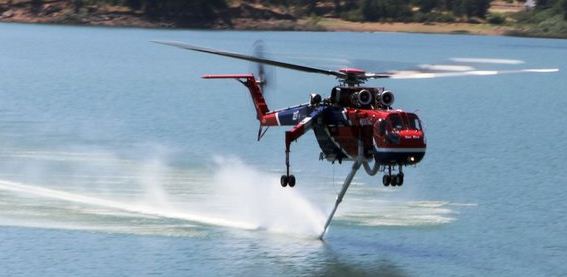
Erickson Air-Crane has bought back an Air-Crane helicopter that it sold two years ago to a power company in California. In 2010 Erickson sold a $30 million S-64F Air-Crane to San Diego Gas and Electric which acquired it to facilitate the construction of a powerline in eastern San Diego County. The company also made it available for fighting wildfires, using the call sign Helicopter 729 when operating on a fire, and “Sunbird” when working on the powerline. The Air-Crane can carry 2,650 gallons of water when suppressing a fire.
Erickson paid SDG&E $21.75 million, according to Portland Business Journal, to purchase the Type 1 helicopter in October.
In conjunction with the aircraft transaction, Erickson entered into an agreement with SDG&E to provide an Air-Crane for fire suppression support in San Diego County this Fall. SDG&E leased the aircraft for a 3-month period from September through November 2012, with an option to renew the lease for the same period each year through 2016.
Erickson added the aircraft to its fleet which now expands to 18 Air-Cranes. The company said it will allow the Company to meet the growing demand for heavy-lift aerial services in the oil-and-gas and powerline construction sectors.
Erickson Air-Crane went public April 11, 20121, selling stock at an initial public offering. Listed as EAC on NASDAC, it sold for about $8 that day, which netted $32 million for the company, about half of what they hoped for a few months earlier. The company used the proceeds to help pay down their debt which as of December 31, 2011 was $130.6 million. Since the IPO the stock price has ranged from $5.35 to $8.50 and closed at $8.03 Friday.
In 2007, ZM Private Equity Fund bought the company, and in 2009 moved the headquarters to Portland. ZM retained 63 percent ownership after it went public with the sale of stock.
Electrical company contractors agree to pay $370 million for San Diego County fires
Two companies that performed work for San Diego Gas and Electric agreed to pay a total of $370 million for their roles in the 2007 Witch Creek and Guejito fires in San Diego County. Davey Tree Expert Company was a contractor doing hazard reduction for SDG&E, trimming trees near power lines. A fallen sycamore branch is believed to have started the Guejito fire near Fallbrook, Californina.
PAR Electrical replaced and modified a power pole that has been linked to the ignition of the 198,000-acre Witch Creek fire which started near Santa Ysabel during 100 mph Santa Ana winds. The fires destroyed more than 1,300 homes, killed two people, and caused massive evacuations.
The $370 will be paid to SDG&E which has already agreed to pay $686 million to insurance companies that paid claims to their customers for the Witch Creek, Guejito and Rice Canyon fires. The company also agreed in a 2010 settlement with the California Public Utilities Commission to pay the state of California $14.8 million for the three fires. The Commission accused SDG&E of obstructing their investigation of the cause of the fires. According to the San Diego Union, in the settlement the company admitted that it didn’t give investigators the information they asked for and nor did it let its workers talk to the investigators, as required by law.
Power company stages contract firefighters during wind event

During a red flag warning last week for predicted strong winds in southern California, San Diego Gas and Electric staged contract wildland firefighters in remote areas of San Diego County to be able to respond quickly if a power line failure caused a fire. Using an automatic system, SDG&E called 11,500 residents in the eastern parts of the county to warn them that the utility could turn off their power if they determined that the fire danger reached a predetermined threshold. The utility has recently installed 130 weather stations in their service area that transmit data via a cell phone network to their headquarters.

Here is an excerpt from an article in the Ramona Sentinel:
…“We used to have only one weather station per circuit, and now some circuits have as many as five, so we can try to pinpoint the potential impact of weather on our system,” [SDG&E spokesman Stephanie] Donovan said. “We also began staging crews in wind-prone areas to hasten response time.”
A typical crew is four SDG&E troubleshooters and two or three firefighters, who are part of a contract wildfire strike team hired by the utility.
“SDG&E had about 90 people staged in the areas where the highest winds were forecast,” Donovan said. “This included our distribution crews, contract firefighters, transmission construction and maintenance crews, and even Telecomm personnel.”
The staging of observers turned out to be “invaluable,” she said.
“Specifically, an electric troubleshooter out of SDG&E’s construction and operations center in Escondido followed fire trucks onto Tribal Road within the Rincon Reservation to find poles and wire down with a half-acre fire. It was determined the line was a 2.4 kilovolt customer-owned equipment,” Donovan said.
“Another troubleshooter patrolling a line came across a leaning pole with secondary wire in the Rincon area, and was able to call it in and get it fixed. Finally, one of SDG&E’s weather stations in the Santa Ysabel area stopped updating in the middle of the event, so one of the stand-by crews was sent to troubleshoot the issue and soon had the weather station back on line communicating via cellular modem.”
More information:
- Raw data from SDG&E weather stations
- Summarized and interpreted data from the weather stations
- SDG&E’s preemptive power shutoff plan
San Diego power company puts data from 101 weather stations online
San Diego Gas and Electric (SDG&E) has installed at least 101 weather stations in their service area in San Diego, Orange, and Riverside counties in southern California. The primary purpose of the stations is to monitor wind speeds so that they can make decisions about when to turn off the power if they think their lines would be in danger of arcing or falling during wind events. The company is beginning to be a little gun shy since their lines have started numerous wildfires, including the 175,000-acre Laguna fire in 1970 and the disastrous Witch, Rice, and Guejito fires in 2007.
Wildfire Today covered this weather station story in August when the company had 94 of them up and running, but now the data from 101 stations is available in near real time on the internet.
Accessing and viewing the data is not very user friendly, but we applaud SDG&E for putting it online, something they did not have to do. Looking at a list of 100+ stations, with names you may not be familiar with, is not the ideal internet user experience, but if you live in the area you will probably recognize the locations near you. It would be great if they had one map that had an icon for each station, and mousing-over or clicking on the icon would bring up the weather data.
There is no single map that shows all of the stations, but if you go to the page with the 101 station list and click on the down arrow below “Regions”, choose an area, then click “Go” to the right, you will see a map of that area which displays the wind speed and direction for those few stations. Or you can select an area under “Communities” and see a text list of the stations in that area along with the wind speed, direction, temperature, and relative humidity.
Clicking on the name of a station brings up a page like this:

Another view of the text data from 22 of the stations can be found here. It includes living and dead fuel moisture information in addition to wind speed, RH, and Red Flag Warnings.
In case SDG&E does implement their very controversial plan to turn off the power during periods of high fire danger, they have provided a web page for the affected residents that will show estimates of when the power will be restored. One of the problems with this is, if a resident has no power, they will most likely have difficulty accessing the internet.
San Diego power company shares helitanker
In June Wildfire Today told you that San Diego Gas and Electric had ordered a Sikorsky S-64F Air-crane helitanker, primarily to install electrical transmission towers on a new power line they are building, but that it would be shared with the local fire agencies if needed for fire suppression. SDG&E has taken delivery of the ship, now designated as helitanker 729 when fighting fire, or “Sunbird” when working on the powerline.
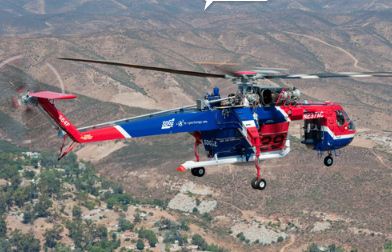
Here is an excerpt from a press release from SDG&E:
This firefighting-capable helicopter will be available to assist in fighting wildfires in the region through two cooperative agreements that will establish protocols for its use during critical fire emergencies. The agreements are similar to the ones prepared last fire season with SDG&E’s leased air crane. The first Memorandum of Understanding (MOU) between SDG&E and the City of San Diego establishes that the San Diego Fire-Rescue Department will be the lead agency that would dispatch the Sun Bird to a wildfire upon request, beginning September 1 or sooner if needed.
“The sheer capacity of water this air tanker is capable of dropping will be paramount to our ability to suppress a wildfire early in the game,” said Chief Javier Mainar, of the San Diego Fire-Rescue Department. “Like last fire season with the leased air crane, we feel more prepared for what Mother Nature may send our way.”
The second MOU between SDG&E and the County of San Diego establishes a $300,000 operating budget for fire season, with SDG&E covering the cost to operate the helicopter during the first two hours of any new fire and the County of San Diego covering the second two hours. The pilots and mechanics, which will be provided by Erickson Air-Crane, are trained to maneuver this type of helicopter for both Sunrise construction and precision water dropping to target wild-land fires. Because of this agreement, San Diego County will not have to lease a helicopter to be on stand-by during fire season.
San Diego power company installs nearly 100 weather stations
We have ranted about San Diego Gas and Electric a number of times for starting numerous wildfires, including the disastrous Witch, Rice, and Guejito fires in eastern San Diego County in 2007. But we have to give them credit for doing two things recently that benefit the wildland fire community.
The first was the purchase of a $30 million Erickson Air-Crane S64F Helitanker that should be delivered later this month. The company has agreed to share it with San Diego County on wildfires for a reasonable cost, but it will be used primarily for constructing and maintaining power lines.
The second thing they have done is to install a boatload of weather stations in the backcountry areas of San Diego County, including Ramona, Alpine, El Cajon, Valley Center and Fallbrook. So far they have have installed 94, yes 94, weather stations on power poles in wind-prone areas. The solar-powered stations contain sensors and data loggers made by RM Young and Campbell Scientific, respectively, and monitor wind speed, wind direction, temperature, and relative humidity.
SDG&E intends to use the data from the stations to determine where it should stage repair crews and whether or not it should shut off power to residents during periods of strong winds.
The meteorologists in the local National Weather Service office are pretty excited about this massive new source of weather conditions. SDG&E has plans to make the data available to the public through a “dashboard”.