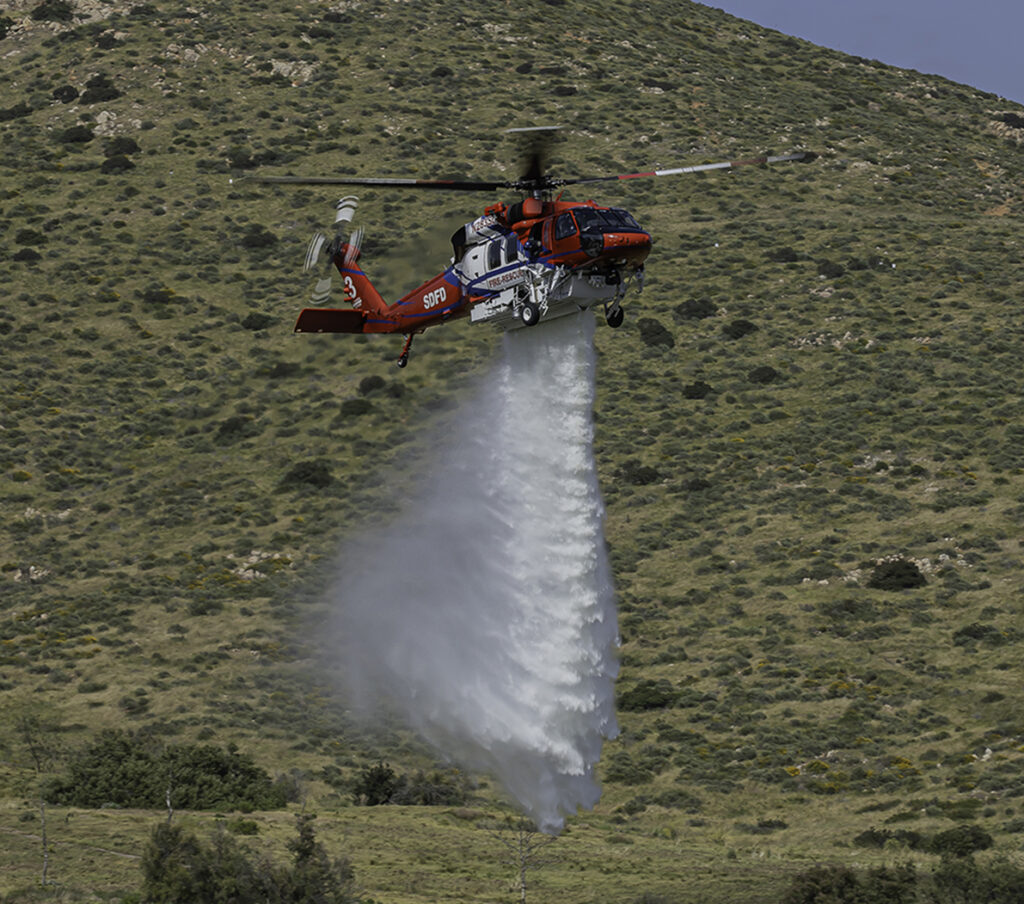
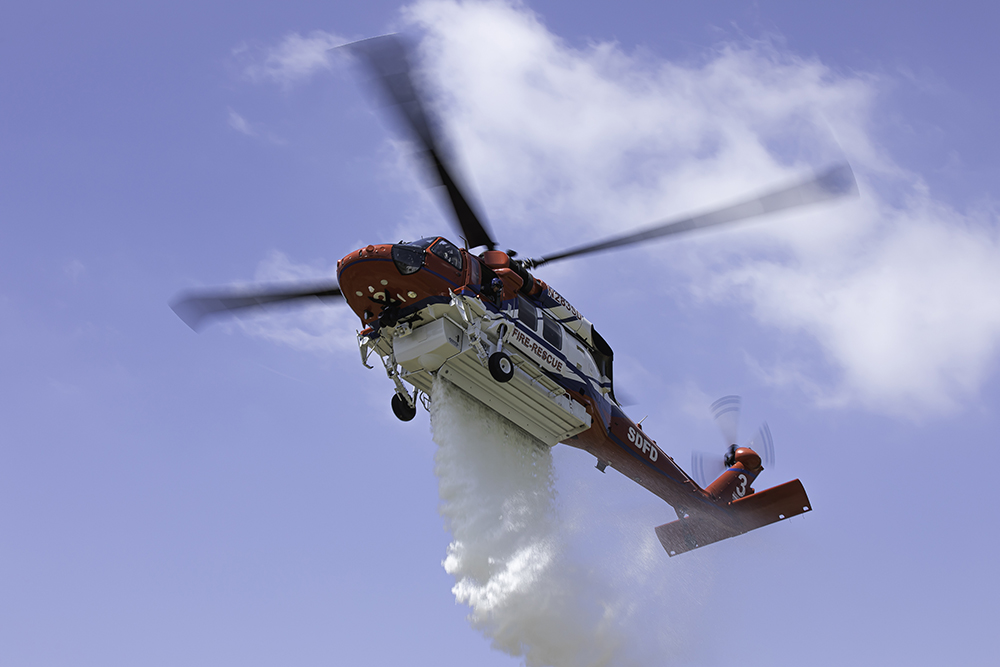
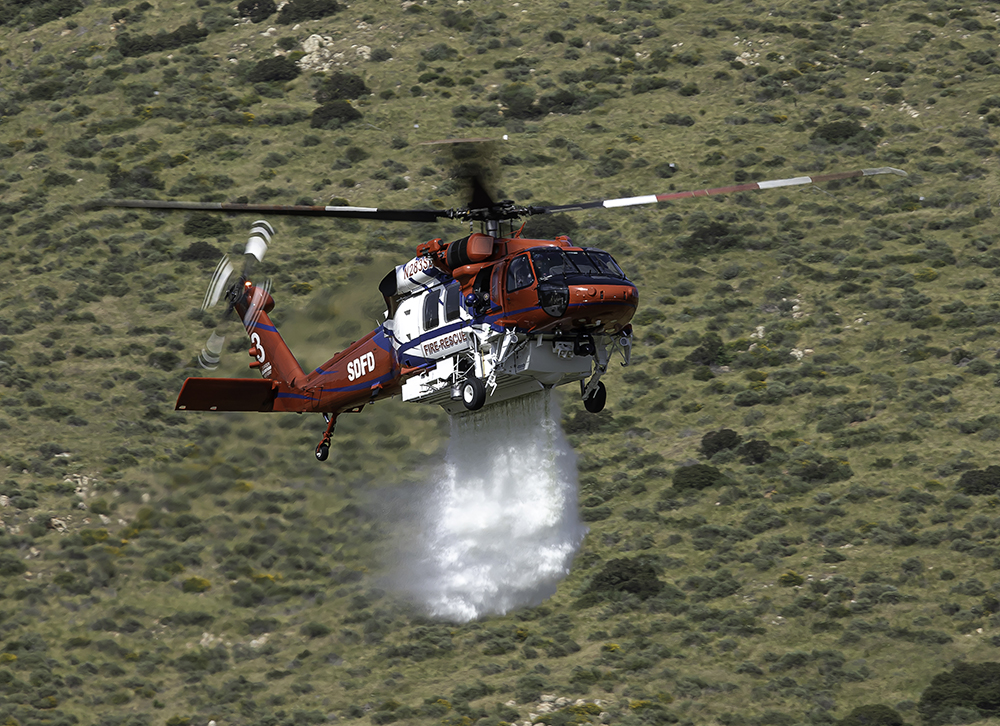
Ryan Grothe captured for us several terrific photos of a San Diego County wildland drill between April 30 and May 2 in Chula Vista. Several fire and law enforcement agencies participated and training included shelter deployments, structure protection, wildland hose lays, and radio communications.
A San Diego Fire-Rescue helicopter made numerous water drops, along with a few simulated hoist rescues.
This event is held annually;. San Diego Fire Rescue operates a Sikorsky 70i Firehawk and they have recently purchased a Bell 412 EPX, expected to be delivered sometime toward the end of this year. Once it arrives, the new Bell will go to Hangar One at Palomar Airport for installation of avionics.
Sikorsky’s “Optionally Piloted” Black Hawk helicopter equipped with MATRIX and Rain autonomy systems during fire localization and targeting demos at Sikorsky HQ in Stratford, Connecticut.
Photo couresy of RAIN.aero
Rain.aero, a developer of aerial “wildfire containment technology” along with Sikorsky, have been for some time now researching wildfire suppression autonomous response possibilities. The companies completed test flights over a year ago with an “autonomous helicopter” that can carry and drop water onto wildfires in early stages of initial attack.
Rain — and Sikorsky — demonstrate early detection and fast response to wildfires, with an autonomous Black Hawk helicopter. The two companies have completed flight tests demonstrating how a helicopter flying with Sikorsky MATRIX and Rain’s “Wildfire Mission Autonomy System” could be quickly launched for initial attack.
The flight demonstration was at Sikorsky headquarters in Stratford, Connecticut, with the “Optionally Piloted Black Hawk helicopter” flying in autonomous mode with Sikorsky safety pilots on board.
Maxwell Brodie
“In 2023, in collaboration with Sikorsky, we set out to prove that we could receive an alert about a possible wildfire, send commands to launch and fly an autonomous helicopter capable of moving a large amount of suppressant to a fire’s location, and then command the helicopter to accurately drop water onto the fire,” said Rain CEO Maxwell Brodie. “We are very pleased with the results that successfully demonstrate autonomous early detection and rapid response.”
What do you think about these developments? Are you a helicopter pilot, or helitack, or hotshot or other ground crew member, or lead plane pilot or ATGS ?
I don’t know enough about the air show environment to have a first-hand opinion on pilot-free helicopters in any role on any fire. I first off can’t imagine where the pilot-free RC helicopters might even be sited (on public land? Large ranches checkerboarded with BLM 40s? Western states private timber holdings? federal or state agency land? Wilderness areas?) and how vandalism possibilities likelihoods (let alone pilot-skill vandals or cyberhacked outside operators) for pre-positioned rotorcraft of any kind (let alone a Sikorsky) might be mitigated or prevented or acted upon …
File photo: A Sikorsky Skycrane drops about 2,600 gallons of water on the Red Canyon Fire 9 miles southwest of Pringle, SD July 9, 2016.
San Diego Gas and Electric is in its ninth year of contracting for an Erickson Skycrane helicopter. It is a unique financial arrangement that shares the cost with the County of San Diego. SDG&E, via its ratepayers, picks up the $1.75 million annual tab for availability each season, July through October, as well as the first two hours of flight time when used on a fire. The county pays for hours three and four. If it is needed for more than four hours it would most likely be on a large fire and the additional cost could be paid by another agency such as the state or federal government, if they needed the aircraft.
The current contract for the Skycrane, which carries up to 2,650 gallons, is in effect through 2022.
CNN put together the above video about Los Angeles County’s Blackhawk helicopters, which they call Firehawks. The footage is impressive, and looks like an advertisement for Sikorsky and the maker of the “souped up” engines, General Electric. Some of the scenes actually did come from a commercial for GE that we had on our site in February.