Over 90,000 evacuate as uncontained Hawk Fire burns outside Reno, Nevada

The Hawk Fire burning northwest of Reno, Nevada, triggered the evacuations of over 90,000 people on Sunday, according to fire crews working the incident.

The wildfire, which ignited on Saturday morning and has since been determined to be human-caused, has burned over 15,000 acres as of Sunday evening. Nevada Gov. Joe Lombardo declared a State of Emergency soon after the fire started on Saturday as the fire spread rapidly.

“This is an active and rapidly evolving situation, and I urge everyone in the affected areas to remain vigilant and follow the direction of local officials,” Lombardo said in a press release regarding the emergency declaration. “The state is fully engaged, and we are working alongside local authorities and first responders to deploy every available resource to protect lives, safeguard communities, and keep Nevadans out of harm’s way.” 

Numerous communities are in GO NOW evacuation zones across the region, with local officials urging community members to check the Perimeter Map website for the latest evacuation updates. Officials have also closed numerous roads in the area, including highways and local streets. Winds up to 20 mph increased fire activity and drove fire movement Sunday afternoon into the evening, crews said.

Credit: Perimeter Map

Firefighters remained fully engaged on Sunday, working to extinguish hotspots and keep the fire south of U.S. 395, according to crews at the scene. Communities north of 396 are sandwiched between pending evacuations from the Hawk Fire to the south and the Bug & Stallion Fires to the north, which have burned over 93,000 acres and are 97% contained as of Sunday night.

The Washoe County School District canceled all school classes, except for Gerlach K-12 school, on Monday due to the ongoing fire. The district had just restarted classes for the new school year on Aug. 10.

“We understand that so many people in our WCSD family—students, families, and staff —are impacted,” the district said in a press release. “Over the next few days, we will continue to update our entire district family with information as it becomes available. We are grateful to our firefighters and first responders as they continue to battle this fire, and we thank our district personnel who are assisting with this effort.”

Credit: Inciweb

Roadless Rule ‘entirely’ removed under new USDA proposal

The United States Department of Agriculture on Tuesday formally began the process of rescinding the Roadless Area Conservation Rule, opening the nation’s protected forests to new development, road construction, and intensive logging.

Agriculture Secretary Brooke Rollins attributed the move to wildfire risk reduction, saying the rule has acted as a barrier to it. Public comment on the rule’s end is now open through Sept. 21. People can click here to submit their comments once the proposed rule is posted on Wednesday, officials said.

“For too long, outdated restrictions have kept tens of millions of forested acres off-limits to the very treatments that improve forest health and reduce wildfire risk to our communities,” Rollins said in a press release. “Today, we filed a proposal to restore authority to local forest managers who know the land best, removing the barriers that have kept them from doing the work the land demands. It’s time to turn the page on the failed roadless rule and return our forests to health and productivity.”

A recent scientific study into roads’ effects on wildfires in forests offers a different view. Members of the Wilderness Society published research in Nature’s Fire Ecology Journal in January that found the highest wildfire-ignition density was in lands within 164 feet of roads at just under 8 fires per 2,471 acres. Wildfire-ignition density was at its lowest in designated wilderness areas without roads, at 1.75 fires per 2,471 acres.

PREVIOUS COVERAGE: End to landmark roadless rule will make wildfires more likely, study finds

President Donald Trump has targeted the 2001 rule since his first term, according to Deputy Secretary Stephen A. Vaden. The Forest Service originally announcing a draft proposal to rescind it in June 2025.

“It is a credit to President Trump that we can begin to put into place a rule that will allow us to properly manage our national forests, because the first step to managing forests is to have access to them,” Vaden said.

Numerous environment-focused organizations previously condemned the plan to end the rule, including Environment America, the National Wildlife Federation, the Sierra Club and the Defenders of Wildlife. The major proponents of the Roadless Rule’s repeal are timber associations, which said the rule is based on false and unscientific premises.

Two pilots confirmed dead after helicopter crash at Utah’s Widemouth 2 Fire

The bodies of the two pilots killed in a helicopter crash helping fight the Widemouth 2 Fire in central Utah have been recovered and returned to their families, according to officials.

Fishlake National Forest officials confirmed the fatalities six hours after reporting crews couldn’t reach the scene of the crash due to a recently ignited fire. They said the Sevier County Sheriff and interagency partners of the Great Basin Geographic Area confirmed the pilots’ deaths after the scene of the crash was deemed safe.

“The victims were pilots with Helicopter Transport Services (HTS), a Forest Service Exclusive Use contract aircraft company,” officials said in a press release on Saturday evening. “The families of the pilots have been notified, and the interagency partners are coordinating closely with the company and families through this difficult time.”

Officials from the National Transportation Safety Board and the Federal Aviation Administration are investigating the cause of the incident.

The wildfire has burned 118,796 acres, destroyed six structures, and is at 27% containment as of Sunday morning, according to the latest release from National Forest personnel. Thunderstorms and lightning rolled over the fire on Saturday, but moisture eluded the area. Erratic winds, dry fuels and hot temperatures continue to fuel the fire’s growth.

“We stand strong in our support of the Fishlake National Forest, HTS, those supporting the Widemouth 2 Fire, and the communities affected directly by this loss,” officials said. “Fatalities such as this land heavily on the minds and hearts of our agencies and the wildland fire community as a whole.”

Credit: Fishlake National Forest

Search for crashed helicopter crew continues as Widemouth 2 Fire crosses 110,000 acres burned

Over 24 hours later, rescue teams are unable to access the site where a firefighting helicopter crashed responding to a wildfire in Utah, according to officials at the Fishlake National Forest.

Ground crews attempted to respond to the area near the ongoing Widemouth 2 Fire in central Utah on Friday, but were unable to access the scene due to an emergent fire caused by vegetation ignited by the crash, U.S. Forest Service officials said in a press release on Saturday afternoon. The responding Incident Management Team decided not to put further lives at risk until the area was deemed safe.

“The site is now inside the fire perimeter itself, with the growth that occurred yesterday on the fire,” officials said in the press release. “Due to the continued large fire growth and unsafe conditions, emergency responders are still unable to access the scene or victims as of this morning.”

There is no confirmation on the health status of the helicopter’s crew, and officials warned against starting or engaging with numerous false reports and rumors that have since spread online, according to the press release. They said any confirmation of the crew’s health status will come directly from the Sevier County Sheriff after Search and Rescue teams can safely access the scene.

“This is an evolving situation, and emergency personnel are on scene where safe to do so,” officials said. “Agency and fire personnel’s top priority is responding to the incident safely.”

The Widemouth 2 Fire has burned 111,306 acres and is 24% contained as of Saturday afternoon, according to the latest update from fire managers. Containment has increased over the past 24 hours, but continual erratic winds, dry fuels and hot temperatures threaten to further the fire’s spread.

“Rainfall is expected early next week, but it is too early for meteorologists to predict how much rainfall will occur and where,” fire crews said.

Click here for the latest evacuation information.

Helicopter crashes while fighting +100K-acre Utah wildfire

A firefighting helicopter responding to the Widemouth 2 Fire in central Utah has crashed, U.S. Forest Service officials confirmed on Friday.

The crash happened in the Fishlake National Forest and emergency personnel were responding to the scene as of 3 p.m. Mountain Time, according to a press release sent out by Forest Service personnel on Friday. Officials said responding to the incident is their top priority.

“Local, state, and federal authorities are assisting in the response,” officials said. “Information will be released as soon as it is available. Please be patient as the response to this incident continues to occur and safety actions are prioritized first.”

The fire, which has burned over 106,000 acres as of Friday morning, was caused by lightning on July 27 and is 19% contained. Erratic winds, dry fuels and hot temperatures have worsened fire spread, but upcoming monsoonal moisture offers hope of lessened fire danger.

“Direct suppression tactics are not feasible, nor safe, in many areas due to terrain, slope alignment, erratic winds, dry fuels and extreme fire behavior,” Fishlake National Forest officials said. “It is too early for meteorologists to predict how much rainfall will occur and where.”

Utah Gov. Spencer Cox and Forest Service Chief Tom Schultz recently visited areas impacted by the Widemouth 2 Fire to sign a formal funding commitment to post-fire flooding mitigation.

This is a developing situation. This article will be updated with the latest information as it is released.

Credit: Fishlake National Forest

Arson spikes possible due to prediction markets’ rise, US senators warn

Nine United States senators have urged financial regulators to crack down on prediction markets’ rise, specifically the ability to bet on wildfires.

The senators recently sent a letter to Commodity Futures Trading Commission Chairman Michael Selig, arguing he needs to “lead the charge” in regulating prediction markets, where people can place money on the outcome of future events. The letter comes after multiple state and local fire officials spoke with the senators, warning that offering such bets would encourage arson to make bets successful.

Polymarket, one of the most popular prediction markets, accepted over $1.2 million in bets related to the Palisades and Eaton fires in California. Another prediction market, called “Wyldfyre,” launched exclusively to accept bets on wildfires in California with the slogan “You can’t predict fire, but you can trade on it.”

The senators warn of the heightened risk that: “…individuals could be tempted to commit arson in order to make sure their bets are successful.”

“By offering contracts on fires, prediction market sites run the risk of encouraging people to influence fires that have already started, creating additional concerns around public safety and insider trading,” the senators’ letter said. “As the United States faces yet another record-breaking fire season this year, the Commodity Futures Trading Commission (CFTC) cannot allow these prediction markets to offer unrestricted betting on wildfires.”

The nine Democratic senators, including Oregon Senators Jeff Merkley and Ron Wyden, California Senators Alex Padilla and Adam Schiff, Minnesota Sen. Amy Klobuchar, Nevada Sen. Jacky Rosen, Nevada Sen. Catherine Cortez Masto, New Mexico Sen. Martin Heinrich, and New Hampshire Sen. Jeanne Shaheen, requested Selig answer the following questions by Aug. 14:

  • Is the CFTC considering prohibiting (Designated Contract Markets) from offering event contracts on wildfires as
    part of the rulemaking process currently underway, given they are against the public’s
    interest?
  • Does the CFTC have any plans to curb bets on wildfires on prediction markets in the
    United States? Does the agency have plans to address these contracts being offered on
    offshore markets?
  • Does the CFTC believe event contracts offered on the following wildfire-related events
    are in the public interest:
    • How long would a wildfire last?
    • How much would a wildfire destroy?
    • How much would a wildfire grow by?
  • Does the Commission have guidance or planned enforcement related to these wildfire
    event contracts?

Click here to read the full letter.

Suspected Old Trails Fire starter arrested by Spokane authorities

Deputies in Spokane County on Monday announced the arrest of a man believed to have started the Old Trails Fire, which has destroyed hundreds of homes and caused the evacuation of thousands of people.

Aaron Farinacci, 37, was arrested and charged with first-degree arson and is being held on a $1 million bond, according to the Spokane County Sheriff’s Office. Authorities said a tip from a citizen led to Farinacci’s arrest.

“The witness…noticed a male standing on the side of the road looking into the trees as he was going to pick somebody up,” Sheriff John Nowels said at a press conference on Monday. “About 10 minutes later, as he was coming back through the area, he noticed the male was bending down near some grass. At that point, the male stood up and looked very nervous, according to our citizen witness…a short time later, they saw smoke coming from what they believed was the area that they had seen the male bending down.”

That tip and subsequent description of the suspect led to Farinacci’s arrest about a mile and a half from where the fire was started, Nowels said. Authorities believe Farinacci started the fire with waterproof matches and a butane lighter, which were found on his person.

Farinacci was temporarily released from custody as deputies continued investigating the crime, but was arrested again once more evidence was obtained.

Click here to watch the full press conference.

The Old Trails Fire, the Fairview Fire and the Autumn Lane Fire have burned over 8,026 acres and have destroyed at least 600 structures as of Monday evening, according to wildfire managers at the scene. Favorable weather conditions have allowed crews to make significant gains on the Old Trails and Fairview fires, but the Autumn Lane Fire continues to be active.

A warming trend, low humidity and increased winds are forecast for the Spokane area starting Wednesday, which is expected to increase fire weather danger.

PREVIOUS COVERAGE: Over 600 Spokane structures destroyed, 6,000 evacuated as Washington wildfires near most destructive in state history

Over 600 Spokane structures destroyed, 6,000 evacuated as Washington wildfires near most destructive in state history

Over 600 structures have been destroyed in Spokane, Washington, as 60,000 residents were evacuated late Saturday into Sunday.

Local officials gave the update on what they’re calling the Spokane Complex Fires at a press conference on Sunday afternoon. Washington Gov. Bob Ferguson issued a statewide wildfire emergency and a statewide burn ban in response to the Complex and 17 others burning throughout the state on Saturday.

The number of destroyed structures rivals the state’s costliest wildfire incident in 2023, when the Oregon and Gray Fires burned down 710 structures.

“This year has already been one of our busiest wildfire years on record, and we just started August,” Commissioner of Public Lands Dave Upthegrove said. “Our firefighters are already stretched thin across the state, and with more heat and wind expected this weekend and for the rest of the summer, any new spark on our tinder-dry landscapes can lead to another devastating wildfire. I’m urging all Washingtonians to not be that spark.”

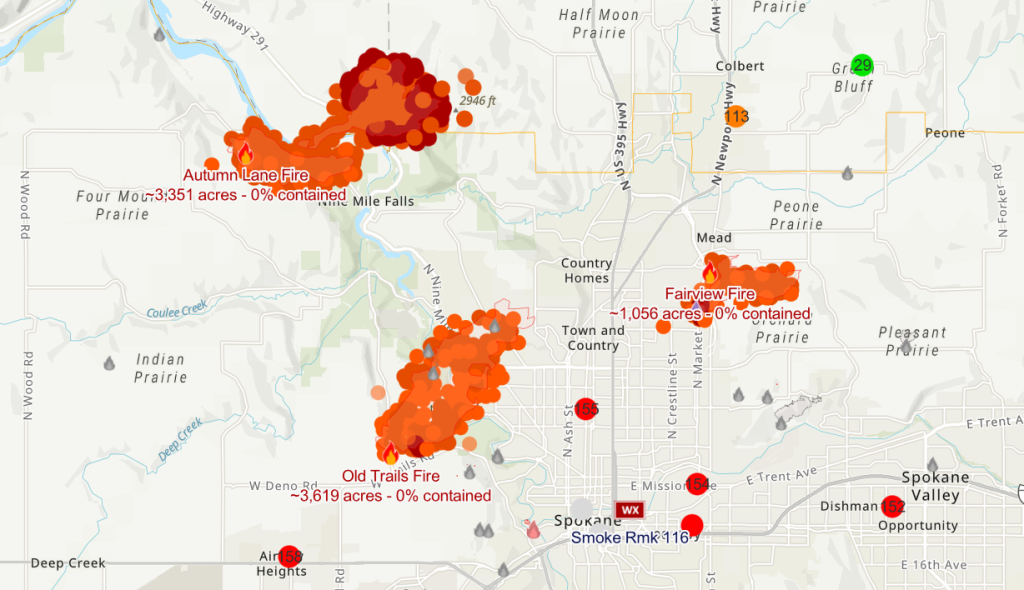
Three separate fires that constitute the Complex have not merged but are burning within miles of each other, triggering a shared response. The fires, all of which are at 0% containment, and burned area totals as of Sunday evening include:

  • The Old Trails Fire has burned 3,619 acres
  • The Autumn Lane Fire has burned 3,351 acres
  • The Fairview Fire has burned 1,056 acres
Credit: National Interagency Fire Center

The extreme fire weather that the region is facing isn’t expected to let up any time soon, according to National Weather Service meteorologists. Dry conditions, winds, and elevated temperatures are expected to continue throughout the upcoming week, with conditions intensifying on Friday as winds strengthen to between 30 and 35 mph.

“Friday is the next day being eyed for elevated fire weather concerns,” the National Weather Service’s Spokane office said in its Sunday evening report. “There is a near-zero chance for any precipitation within the next week for all areas except the Cascade gaps, so expect little to no relief from dry conditions.”

How to help Spokane residents recover

City officials asked the public to support their community using these resources:

Firefighters killed near Colorado-Utah border were waiting for helicopter pickup when burnover overtook them, latest investigation details show

The U.S. Wildland Fire Service on Thursday released preliminary investigation details into the agency’s first fatal incident.

The Knowles Fire, which later merged into the larger Snyder Mesa Fire, caused the deaths of four wildland firefighters on June 27. Emily Barker of Michigan, Nick Hutcherson of Arizona, and Sydney Watson of Alabama died at the scene, while Nathan Matthews of Nebraska died a month later from severe burns. A fifth wildland firefighter was also hospitalized for burns, but officials have not yet released their identity or health status.

The firefighters were waiting for a helicopter pickup when a burnover overtook them, according to the details released by agency officials on Thursday. A new ignition was detected at 12:32 p.m., around three hours after the firefighters arrived on the scene and rapidly began exhibiting extreme fire behavior. Crews originally believed it was a spot fire, but satellite imagery reportedly confirmed it was a lightning ignition.

Strong winds pushed that ignition to merge with the Snyder Fire and kept smoke at ground level, reducing visibility, officials’ report said. A helicopter arrived to pick up the firefighters at around 3:13 p.m., but reported it was unable to land due to the smoke six minutes later. Officials say that’s when the firefighters deployed their fire shelters.

“The (Serious Accident Investigation Team) continues to examine all aspects of the incident,” officials said in the report. “This synopsis provides only verified preliminary facts and does not represent final findings or conclusions. Further details will be shared as appropriate once the full report is complete.”

Click here to read the full report.

PREVIOUS COVERAGE: Fourth wildland firefighter dies from Knowles Fire entrapment near Colorado-Utah border

Canada wildfire smoke will cover more US states soon, forecasts show

Communities within the United States’ Great Lakes region will experience their highest air pollution levels throughout Sunday due to wildfire smoke from Canada, but National Weather Service forecasts show significant relief isn’t coming anytime soon.

Smoke has lowered air quality across the Midwest and Northeast to unhealthy and even hazardous levels over the past week as numerous out-of-control fires burn in Ontario, Manitoba and Saskatchewan. The total area burned surpassed historical highs on Thursday as peak fire season continues into late August.

Forecast models show near-surface smoke remaining throughout the Midwest and Northeast through at least Wednesday. Weather patterns are also expected to push smoke from Canada’s fires down southward into new Midwest and Western states in the coming days, including Colorado, Iowa, Kansas, Missouri, Nebraska and Wyoming.

The National Weather Service issues air quality alerts when levels of fine particulate matter, which are small particles that can penetrate deep inside lungs and are produced in large quantities by wildfire smoke, are elevated enough to pose health risks. Alerts are currently in effect for Illinois, Indiana, Ohio, Michigan and Wisconsin, but more alerts are expected to be issued in other states as the smoke pushes south.

“The heaviest smoke is currently in Wisconsin, where significant portions are at VERY UNHEALTHY levels, while most other areas are seeing UNHEALTHY to USG conditions,” the U.S. Interagency Wildland Fire Air Quality Response Program said in an alert on Sunday. “These conditions are expected to mostly persist today with the exception of northern Ohio and southeast Michigan, where Detroit and Cleveland should see conditions improve to MODERATE levels today.”

Credit: AirNow