Nearly 70,000 people in the United States are expected to die annually from wildfire smoke by 2050, according to newly published research.
Findings of a study were published in Nature on Sept. 18, which prompted public discussion due to the strikingly dire figures. The analysis estimated that smoke from wildfires already contributes to around 40,000 deaths each year in the nation. The additional 30,000 annual deaths by 2050 are primarily attributed to climate change, which is making already fire-prone regions in the U.S. hotter and drier.
The study, however, identifies the location of the forecasted spike in wildfire smoke deaths as eastern US, where historically there are fewer large wildfires compared to the western US. The research team, from a range of universities including Stanford, University of California, Harvard, and the National Oceanic and Atmospheric Administration, said that over half of the 70,000 wildfire smoke deaths will come from eastern states, due to higher population densities and damage from low smoke concentrations.
“Because of the mortality effects we uncover at low annual smoke concentrations, we project large mortality burdens not only in heavy smoke regions but also in populous regions with low smoke concentrations (e.g., the eastern US),” the researchers said. “Similarly, we estimate substantial mortality increases even in the low warming scenario because of projected increases in low-level annual smoke concentration.”
The study’s findings, however, directly contradict separate research published a week beforehand, which found that an overlooked aspect of wildfires overinflates mortality estimates.
This study – published in Science – was conducted by a research team from several Chinese universities with input from colleagues in the US and Canada and funded by the National Natural Science Foundation of China. It found that most predictive wildfire models currently do not include heat-induced weather changes caused by wildfires.
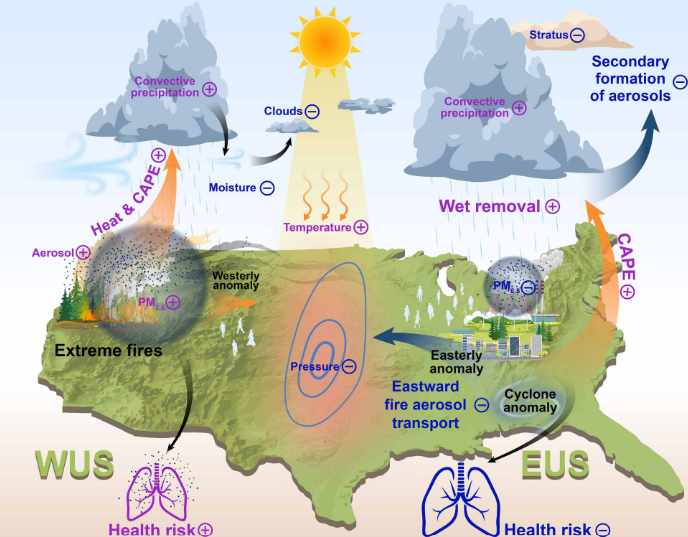
Schematic diagram illustrating how fire heat in the WUS influences PM2.5 air pollution in the EUS. Extreme fires in the WUS release heat that triggers convection, which reduces moisture transport from the WUS to the central US although westerlies are enhanced. The resulting dryer and warmer central US features low-level pressure anomalies, inducing anomalous easterlies and promoting convective precipitation over the EUS. As a result, PM2.5 air pollution and associated health risks in the EUS are alleviated. It should be noted that the PM2.5 air pollution and health consequences in this figure include the contribution of fire aerosols. Source: Science.
The phenomenon, called heat-induced convection, and subsequent meteorological changes actually lower air pollution in eastern states while worsening particulate matter in western states. The researchers said that current models overestimate wildfire smoke deaths by 1,200 and overestimate economic losses by $3.3 billion USD, particularly in eastern states.
“The findings … imply that wildfire-excited jet-stream waves can propagate atmospheric energy eastward, beyond North America, to alter the global air circulation,” according to a commentary in Science that accompanied the main research paper. “This underscores the need to approach wildfire research from a broader, global perspective. Strengthening cross-border and interdisciplinary collaboration is key to improving predictability and driving more effective solutions for wildfire control and recovery.”
The weather data used in the study published in Nature included air temperature, precipitation, relative humidity, soil moisture, vapor pressure deficit, wind speed, and runoff, but there is no indication that the researchers accounted for fire-induced convection.
The phenomenon is one of many uncertainties that fire researchers are continually working to address, including the current limitations of scientific models addressed in the paper, like the difficulty of predicting wildfire impact at local scales and evaluating the repercussions of future unprecedented climate conditions with historical data.
“Addressing these uncertainties could further improve understanding of the climate influences on wildfire pollution and health, and thus inform relevant policies,” the Nature study’s researchers said.
Wildfire Today reached out to both research teams for further insight into the different findings of the two studies, but received no reply.
The U.S. government has shut down after federal funding expired without a continuation decision at 12:01 a.m. on Wednesday.
It is the first time the government has shut down since 2018, which was the longest shutdown in US history at 35 days. That shutdown, however, happened between December and January. This shutdown is happening as wildfires continue to burn across the nation.
The Department of the Interior and the Department of Agriculture both released contingency plans for the lapse in federal funding just days before the shutdown was expected to happen. Both plans state that personnel directly related to wildfire response will largely be exempt from furloughs.
The Department of the Interior’s plan said National Park Service employees involved in fire suppression or fire monitoring activities will not be furloughed. The Department of Agriculture’s plan said that employees who respond to and prepare for wildland fires will not be furloughed.
But multiple wildland firefighters have told Wildfire Today that furloughs will still hit employees who do not have primary fire duties. Employees who are red-carded, or have wildland fire incident qualification certification, have anecdotally been furloughed because wildfire duties were secondary to their official duties. Those individuals provide critical help to wildland firefighters.
The loss of support mirrors the mass firings executed on the Forest Service and National Park Service earlier this year. Around 75% of the 6,000 USFS probationary employees whom the Trump Administration fired had secondary wildland fire duties, Grassroots Wildland Firefighters Vice President Riva Duncan previously told Wildfire Today.
“While ‘primary firefighters’ were exempt, the positions that were cut made some pretty huge contributions to operational wildland fire,” Duncan said. “For example, eastern national forests rely much more heavily on these collateral duty folks to do a lot of prescribed burning and initial attack of wildfires…There were people working the LA fires who, because it was the offseason, weren’t primary fire but were filling in on engines and crews.”
The USDA was eventually ordered to hire back all of the workers it had laid off in March. But, if this shutdown is anything like 2018, firefighters may be without support for some time.
What impacts are you seeing with this shutdown? Tell us in the Comments section.
The U.S. Department of the Interior (DOI) on Monday officially opened up applications for its U.S. Wildland Fire Service Director position.
The department is accepting applications for the position from Sept. 29 through Oct. 13. The position will be based in either Washington, D.C., or Boise, Idaho, and has a salary of $191,900 to $225,700.
The job posting offered insight into the service’s priorities, including:
Lead all wildland fire management activities across the DOI, including workforce development, technology investments, communications, and administrative support, ensuring alignment with departmental mission, priorities, and policies.
Coordinate and oversee structural fire management programs while collaborating with the National Park Service, Bureau of Reclamation, and other stakeholders.
Represent the Department on wildland fire issues before Congress and the president.
Oversee all aspects of the Wildland Fire Management Account, including budget development with other federal partners.
Serve as the Department’s lead for firefighting under the National Response Framework.
The departments also said it will begin shifting away from “outdated systems and fragmented response” that have hindered previous wildfire efforts.
“For too long, outdated and fragmented systems have slowed our ability to fight fires and protect lives. Under President Trump’s leadership, we are cutting through the bureaucracy and building a unified, modern wildfire response system that works as fast and as fearlessly as the men and women on the front lines,” Secretary of the Interior Doug Burgum said in the press release. “By streamlining federal capabilities and strengthening our partnerships with state, tribal and local teams, we will deliver the common-sense reforms needed to safeguard our communities, our lands and our future.”
The United States Department of Agriculture on Tuesday announced that the agency has invested $200 million in 58 wildfire reduction projects across the nation.
The programs span 22 states and two tribes, and include efforts like updating community wildfire protection plans and removing hazardous fuels and overgrown vegetation.
The funding comes from the Congressionally-created Community Wildfire Defense Grant Program. The program is slated to invest $1 billion over five years to assist at-risk communities in preventing wildfires. 2025 is the program’s third year.
“No single organization can address the severe wildfire threats we face today,” Forest Service Chief Tom Schultz said. “It is imperative that we work together to protect our forests and communities. For those communities that already have plans in place, these investments will enable immediate, collaborative action to reduce wildfire risk.”
The state with the most approved grants in round three of the program was Colorado, with eight projects funded. Two projects in the state each received just under $10 million in funding, including:
“Protecting the Gateway to the Rockies” through the Larimer County Office of Emergency Management, which includes defensive space improvements on 900 parcels, wildfire mitigation treatments on 500 acres of open space, and wildfire preparedness education at 75 community events.
Wildfire Risk Mitigation program through the Jefferson County Sheriff’s Office, which will expand the county’s Sustainable Lands and Safer Homes (SLASH) program, hire more staff specifically for wildfire risk education, and help purchase numerous kinds of field equipment and gear.
The project with the largest amount of funding approved was a $10 million program in New Mexico. The “Colfax Wildfire Risk Reduction Project” through the Cimarron Watershed Alliance will “implement high priority wildfire risk reduction treatments including fuels reduction, evacuation route clearing, restoration focused forest thinning, and defensible space work on private lands in and around communities.”
The U.S. House of Representatives passed the Fix Our Forests Act in January and has yet to have any motion in the Senate. The bill has effectively been stonewalled under both the Biden and Trump administration after it also stalled in committee in a Senate committee in 2024.
The Act would create an interagency Fireshed Center focused on wildfire prediction and tracking, establish fireshed management areas in forests with high wildfire risks, and expedite the review of wildfire-related forest management projects under the National Environmental Policy Act.
Critics against the Act claim it would further open up forests to logging and allow a large-scale rollback of the Endangered Species Act, National Historic Preservation Act, and National Environmental Policy Act.
Advocates at Megafire Action, a non-profit organization focused on policies to help avert catastrophic wildfires, recently unveiled the ad campaign, claiming to be the first ever made to support a piece of wildfire legislation, just days after the Trump Administration announced the upcoming creation of the U.S. Wildland Fire Service. Megafire Action CEO Matt Weiner told WildfireToday that the Service wouldn’t be designed to address the same problems that the Act tackles, which means Senators need to take action on the bill now.
“The missing piece in all of this is workforce,” Weiner said. “We’ve been asking our wildland firefighters to do too much with far too little for too long, all while putting their health and safety on the line. My hope is that building a better, more efficient system will help us make the case for workforce reform and funding.”
Weiner addressed the concerns brought up by other members of the Senate, but said the larger issue is lawmakers’ lack of urgency on the matter.
Megafire Action’s ad buy will target Washington and other local news outlets through video and static advertising and run for one week.
The United States Department of the Interior and the Department of Agriculture announced the establishment of the U.S. Wildland Fire Service, a consolidation of all federal wildland fire agencies under the Interior.
Creating a joint federal firefighting aircraft service
Standardizing the Emergency Firefighter Program
Establishing a joint contracting, procurement, and payment center
Building a government-wide Wildfire Enterprise IT System
Developing a unified wildfire risk mapping tool
The departments also said they will begin shifting away from “outdated systems and fragmented response” that have hindered previous wildfire efforts.
“For too long, outdated and fragmented systems have slowed our ability to fight fires and protect lives. Under President Trump’s leadership, we are cutting through the bureaucracy and building a unified, modern wildfire response system that works as fast and as fearlessly as the men and women on the front lines,” Secretary of the Interior Doug Burgum said in the press release. “By streamlining federal capabilities and strengthening our partnerships with state, tribal and local teams, we will deliver the common-sense reforms needed to safeguard our communities, our lands and our future.”
The announcement is a continuation of President Donald Trump’s executive order in June, which directed the departments and all agencies represented by the National Interagency Fire Center to enhance their wildland firefighting capabilities at the state and local levels, including through the use of artificial intelligence, data sharing, and mapping capabilities.
“Time and time again, we have witnessed the devastating consequences of wildfires caused by mismanagement and a lack of preparedness. Under President Trump’s leadership, we are taking bold action to modernize wildfire response systems, streamline federal wildfire capabilities, and strengthen their effectiveness. We started this work in the spring and have continually updated our policies and programs to properly manage our forests through common-sense timber production and management, protecting our national forests and grasslands for generations to come,” Secretary of Agriculture Brooke Rollins said. “Secretary Burgum and I are committed to leading a bold transformation of the federal wildfire system to help our communities, neighbors, and partners better prepare for, respond to, and recover from wildfires.”
The U.S. government has filed two lawsuits against a utility company in California, blaming it for starting two deadly wildfires in the state, including the Eaton Fire in 2025 and the Fairview Fire in 2022.
The Department of Justice sued Southern California Edison (SCE) in Los Angeles federal court on Thursday, alleging the company caused the wildfires through negligence. The department demanded over $77 million in damages for violating California’s public safety laws.
“The lawsuits filed today allege a troubling pattern of negligence resulting in death, destruction, and tens of millions of federal taxpayer dollars spent to clean up one utility company’s mistakes,” Acting United States Attorney Bill Essayli said in a press release. “We hope that today’s filings are the first step in causing the beginnings of a culture change at Southern California Edison, one that will make it a responsible, conscientious company that helps – not harms – our community. Hardworking Californians should not pick up the tab for Edison’s negligence.”
No official cause for the Eaton Fire has been determined, but federal officials alleged that “faulty power infrastructure” owned by the utility ignited the fire. The utility previously reported that it operates transmission towers in the Eaton Canyon area where the fire ignited and admitted that it detected a “fault” on one of its transmission lines around the time the fire started, according to the lawsuit.
“SCE negligently failed to properly maintain its power and transmission lines and infrastructure in the area where the Eaton Fire ignited,” Essayli said. “In a July 31 filing with the U.S. Securities and Exchange Commission, SCE reported that it was ‘not aware of evidence pointing to another possible source of ignition’.”
The lawsuit also blamed the 2022 Fairview Fire on a sagging power line owned by the utility company that came into contact with a communications messenger cable, creating sparks and igniting nearby vegetation. Officials said the utility failed to properly maintain its power and transmission lines in the area where the wildfire ignited and failed to ensure the minimum clearance between the lines.
The supply of chemicals for aerial fire suppression across the US has been locked in with the announcement by US Secretary of Agriculture Brooke Rollins that the nation’s Forest Service and Department of Interior’s aerial wildland firefighting force has entered into a new five-year contract.
The new contract is with Perimeter Solutions, a US-based fire supply company, which supplies a range of firefighting chemicals to governments and agencies around the world.
The company, already a long-time supplier of wildfire products to the USDA, CalFire and others, has secured the dominant position as the supplier of fire-retardant in the US for the next five years
Perimeter, according to its website has manufacturing facilities in US, Canada, France, Spain, Germany and Australia. The new contract, however, states that 100 percent of Perimeter’s retardant for federal use will be manufactured in the US.
In a company statement Perimeter claims a “made in America, for America” commitment. “Combined with an increased commitment to sourcing domestic raw materials, the contract reinforces Perimeter’s support for American manufacturing, supply chain diversification, and national resilience. The USDA will receive the lowest pricing Perimeter offers. Together, the benefits of the contract are a result of operational efficiencies and long-term investment in US-based infrastructure by Perimeter Solutions”
In 2024, US federal agencies dropped 48.6 million gallons of fire retardant to fight wildfires. Rollins, in her announcement, boasted that the new contract would save American taxpayers $153 million over the next five years “…including a negotiated direct price reduction and additional cost savings transitioning to full-service bases and powder retardant by 2030.”
“This contract is a tremendous win for America’s taxpayers, our rural communities, and the brave men and women who fight wildfires every day,” Rollins said. “By locking in historic cost savings and bringing every step of the fire-retardant supply chain back to American soil, we are protecting lives, saving communities from destruction, and keeping America safe, strong, and resilient. This agreement proves that when we put America first, we get the best results for our people and our land.”
WildfireToday reached out to the USDA for specifics on where the $153 million in savings comes from, but the agency has not returned our request for comment as of this article’s publication.
One of the busiest times for the wildland throughout the United States is also among the most frequent times for wildfires.
Labor Day weekend is a time when human-caused wildfires usually spike, according to the National Interagency Fire Center. Numerous Forest Service offices have put out statements sharing tips on how to prevent wildfires during the holiday weekend.
The center’s predictive services have issued fuels and fire danger advisories for parts of the West, underscoring how quickly new ignitions could spread. The majority of the nation’s western coast, along with portions of Tennessee and Kentucky, has very dry fuels heading into the holiday weekend, and much of northern California, northern Montana, and northern North Dakota have moderate fire risk for the next week.
The U.S. has recorded an estimated 46,122 fires since the beginning of the year, the highest year-to-date fire total since 2022 and much higher than the 40,513 fire total average year-to-date. But, the nation’s 4.1 million acres of burned land is under the nation’s 10-year burned acreage average of 5.3 million. Over 18,000 wildland firefighters are deployed nationwide.
“Whether you’re camping, towing a boat, or grilling in the backyard, please remember that most wildfires are human-caused and preventable,” NIFC said. “Make sure campfires are dead out, secure trailer chains so they don’t spark, and never leave barbeques or burn piles unattended. Simple choices like these protect the landscapes we love and help firefighters focus on naturally ignited fires.”
The nation’s worst Labor Day wildfire tragedy occurred in Oregon in 2020, the deadliest wildfire event in state history. Hurricane-force winds triggered warnings from officials of heightened fire danger. An estimated 16 fires claimed 11 lives, destroyed more than 4,000 homes, and burned over 919,000 acres throughout the state.
“The effects of the Labor Day wildfires will be felt for years to come, but – like the forests that burned in those fires – Oregon’s forest sector is resilient,” a report on the fires commissioned by the state said. “Foresters, loggers, tree planters, scientists and other forest professionals have been working ever since the smoke cleared to restore the forests that they pride themselves in stewarding, as well as to better understand how our forests respond to and recover from wildfire.”
There has been a small but growing body of research within the United States on the use and effectiveness of aviation over the past 15 years; much of this focused on large airtankers.
Studies have focused on understanding where and when aviation drops occur, how fire managers prioritize the use of aviation, optimal fleet design, and how risk management concepts can inform where and when to most effectively apply aviation.
The most expansive research effort to date was the Aerial Firefighting Use and Effectiveness (AFUE) study initiated in 2012 to “systematically document the operational utilization and tactical contribution of aerial firefighting resources that have the ability to deliver water and wildland fire chemicals in support of incident objectives.”
As part of the AFUE study, the research team coordinated with incident commanders to collect data on aviation use on 272 wildfires from 2015 to 2018, including more than 5,000 airtanker retardant drops. The research team recorded the primary suppression objective for each retardant drop based on radio communication, operational briefings, and/or post-hoc conversations with incident management. Drops were then categorized into a variety of different outcomes, including no fire interaction, burned through, halted fire spread, and others. The research team then created performance metrics to measure the likelihood of aviation drops interacting with wildfire and their probability of success.
The AFUE study included observations for a variety of aviation platforms dropping water and retardant.
Halting fire spread and delaying fire spread were the two most common objectives for retardant drops, each representing more than 40 per cent of drop objectives with point protection coming in a distant third at 10 per cent. About one-quarter of all large airtanker (LAT) drops did not interact with the final fire perimeter, demonstrating the use of airtankers for indirect suppression tactics and contingency line development. Not surprisingly, for those drops that interacted with wildfire, the probability of successful drops intended to halt fire spread was lower (55 per cent) than the objective of slowing fire spread (75 per cent) and point protection (87 per cent). Although the AFUE study provided a level of detail regarding drop objectives and relative measures of success, there was an important question unanswered: do these mission objectives truly alter wildfire outcomes during extended attack?
Researchers at Colorado State University are engaged in a study to provide formal calculations on the effectiveness of large airtanker retardant drops at altering wildfire growth. The researchers use data provided by units mounted inside LATs that record the exact locations and times of retardant drops, along with information on the daily growth of wildfires from 2017 to 2019, to evaluate fire characteristics before and after the wildfire passes over the retardant line. The researchers evaluate the change in wildfire characteristics as the fire moves through a swath of land that is split by the retardant line. However, a critical piece of information to understand the effectiveness of LAT suppression at the drop level is a comparison with areas unaffected by retardant.
To ensure accurate comparisons, the researchers measure wildfire outcomes in adjacent areas with similar vegetation and topography. The key difference? These areas lack retardant lines, serving as a control, thus creating what is known as a natural experiment. The difference in the change in wildfire outcomes as the fire moves through these two swaths of land provides statistics for the effectiveness of LAT retardant drops.
Aviation drops relative to daily fire progression and populated areas on the Alexander Mountain Fire in Colorado in 2024. Heavy retardant use during the first several days of the event were unsuccessful in stopping the fire, requiring operations to fall back to more favorable locations near populated areas. Graphic by Jim Riddering.An overlay of airtanker drop locations with the Potential Control Locations. Fires have a high likelihood of stopping in areas with cool colors (blue and green) and low likelihood in hotter colors (red and orange). The image shows drops on the Alexander Mountain Fire in the Pike San Isabel National Forest in Colorado in 2024. Graphic by Jim Riddering.
The researchers evaluated the effectiveness of LATs at halting wildfire progression, reducing the intensity, and delaying the spread of wildfire; they found that LATs are effective at altering wildfire outcomes in all three ways.
Wildfire is 8.4 per cent less likely to spread into land that is protected with an LAT drop compared to land that is not buffered by retardant.
Similarly, the intensity of fire (measured by the gridded Monitoring Trends in Burn Severity layer) is 7.5 per cent lower for land protected by a retardant line.
Land protected by retardant takes four to five hours longer to burn than unprotected areas, giving crews crucial time to respond.
These findings reveal the tangible impact of LAT drops on wildfire behavior, offering key insights for suppression strategies.
These statistics aggregate the effectiveness of retardant drops across a variety of landscape and weather conditions. However, the Colorado State researchers have found that LATs are more effective across all three dimensions when dropping on land covered with shrub vegetation, compared to areas dominated by grass or trees. They have also found that air tankers can delay the spread of wildfire by more than 30 hours when used in conjunction with other types of suppression, and that tankers classified as very large airtankers, or VLATs, based on larger tanks for holding retardant, can reduce the likelihood of fire spreading by roughly 12 per cent relative to land not protected by any retardant drops. This research also provides assessment of the influence of topography and general weather conditions on drop line effectiveness.
Understanding the effectiveness of large airtanker drops is a crucial step in refining wildfire suppression strategies, but translating research results into actionable feedback for incident management teams remains a challenge.
Developing processes to review past actions and provide near real-time information to the field is essential for improving future wildfire responses and maximizing the effectiveness of airtanker use.
As such, researchers and fire managers have been using additional telemetry units (ATUs) to track various metrics associated with air tanker drops. ATUs are mounted on all federally contracted airtankers (and some single engine airtankers – SEATs). ATUs are GPS-enabled devices that track parameters such as aircraft location, time, heading, altitude, and most importantly, tanker door open and close events.
ATU data have been used since 2017 to calculate air tanker drop locations and associate various analytics with those drops. These original aviation use summaries (AUS) were manually produced and provided to fire managers through the US Forest Service’s Risk Management Assistance (RMA) dashboard to help inform how fire chemical and water were being applied to the landscape.
Additionally, the AUS process can be used as a powerful after-action review of the effectiveness of aviation drops in supporting suppression actions. Original metrics associated with the AUS reports focused on analyzing time of day, fuel types, and slope classes where the drops were occurring. Subsequent AUS development used the rise of integrated metrics such as suppression difficulty index (SDI) and potential control locations (PCL) within the RMA dashboard to provide additional context for managers to evaluate the use of air tanker drops on incident strategy and tactics.
More recently, US Forest Service personnel have worked to automate the processing of ATU data to expedite the production and distribution of airtanker drop information and associated analytics. Daily processing starts by creating lines from ATU GPS point data for door open and door close events. These derived drop lines are then extended to account for forward momentum of the fire chemical or water. Next, drop lines are buffered and values for SDI, PCL, slope, elevation (of the line), and majority fuel model are extracted for the buffer, and appended back to each drop line feature class (Figure 1). A significant amount of processing time is devoted to quality assurance to remove redundant or bad data points and ensure the creation of logical drop lines. Problematic lines are flagged as possible false positives but retained in the database. Other attributes added include split drop information (where a tanker will split the load and do multiple drops in one flight), the calculation of various time parameters, and incident name association. The final step updates an ArcGIS Online (AGOL) Feature Service. The feature service feeds an AGOL dashboard that is available to credentialed managers and users. Work continues to improve estimation of gallons dropped and tracking costs associated with flights.
Through the automated processing and near-real time distribution, users such as incident management team members, aviation officers, and coordination center managers are better able to monitor drop locations (including areas of misapplication), assess the use of air tanker resources on their incident, and build knowledge using derived analytics to help them evaluate the effectiveness of air tanker resources.
This work highlights the importance of integrating research findings with managerial experience to determine effective resource use. Dan Dallas, an incident commander with the US Forest Service in Colorado and early adopter of the AUS system explained the value.
“The AUS provides us the ability to examine recent drops in near real time on fires we manage giving us the information necessary to identify where and when aviation could best support suppression actions. Using the AUS to examine our management of past events allowed us the opportunity to think more clearly about how aviation can best support our incident strategy. This has allowed us to clearly articulate our strategy in aviation use to the hosting unit and our field-going personnel. We firmly believe the use of AUS has significantly improved the effectiveness and efficiency of our suppression actions and overall fire strategy.”
Aerial drops are probably the most iconic and visible activities in wildfire suppression and often a critical component to initial attack and large fire suppression strategies. The effectiveness and efficiency of wildfire suppression actions writ large is poorly understood, and we largely rely on the experiences of incident management team members and field-going firefighters to determine what resources are needed and where they should engage.
Aviation is but one component of wildfire suppression and the coordination of the broad array of ground and aerial resources is a highly complex process.
The AFUE study provides an indication of the type of objectives and conditions of effectiveness but did not uncover how objectives contribute to overall fire suppression outcomes.
Given the costs of wildfire suppression, exposure of ground and aviation personnel, and the impacts to natural and developed resources, improving the effectiveness and efficiency of wildfire management is essential and understanding aviation’s role will be critical to that effort. Progress will be contingent on the ability for researchers and managers to work together to foster more safe, effective, and efficient solutions.
Dave Calkin is a supervisory research forester with the US Forest Service, Rocky Mountain Research Station in Missoula, Montanna. Calkin’s work is designed to improve risk-informed decision making through innovative science development, application, and delivery incorporating economics with risk and decision sciences. Calkin’s research interests include risk assessment, collaborative wildfire mitigation and response planning, suppression effectiveness, and risk informed decision making. Calkin developed and leads the Wildfire Risk Management Science (WRMS) team within the US Forest Service Rocky Mountain Research Station.
Cal Bryan is a post-doctoral researcher in the Agricultural & Natural Resource Economics department at Colorado State University, interested in researching methods to optimize operational resources for fighting large-scale wildfires. Bryan holds a bachelor’s degree in bioenvironmental sciences from Texas A&M University, a master’s degree in economics from San Diego State University, and a PhD from Colorado State in agricultural and natural resource economics. Bryan’s PhD dissertation, titled Evaluating the Efficiency, Equity, and Effectiveness of Wildfire Suppression Strategy Using the Microeconomic Toolkit, focuses on determining patterns in large airtanker use across wildfires in the United States and their effectiveness at altering wildfire outcomes. Before starting graduate school, Bryan spent several years working seasonally for the U.S. Forest Service in various roles, including trail crew supervisor, interpretive ranger, and type-II wildland firefighter.
Jim Riddering is an aviation analyst with the Strategic Analytics Branch of the U.S. Forest Service Office of Fire and Aviation Management. Riddering’s responsibilities include managing the Additional Telemetry Unit (ATU) program, developing data processing streams, and providing analysis of aircraft use. Riddering holds a PhD in forestry from the University of Montana and has more than 20 years of wildland fire experience, including time on hotshot and engine crews. Riddering is a qualified Aerial Observer (AOBS), holds a private pilot’s license (SEL), and is working on completing his Long-term Analyst (LTAN)