Technology increasingly being used by firefighters in Oregon

camera detect wildfire Oregon
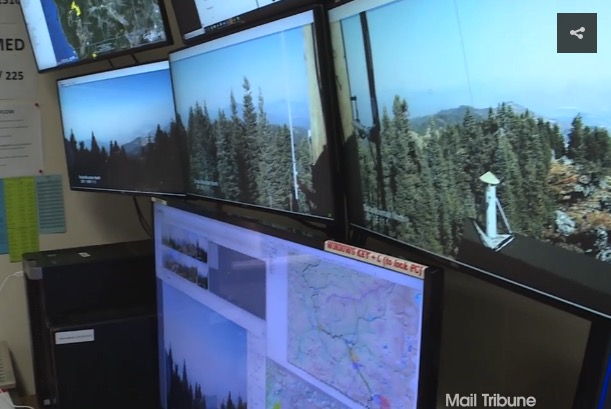
Cameras are used to detect wildland fires in a detection center in Oregon.

(Originally published at 9:51 p.m. PDT October 13, 2018)

Wildland firefighters in Oregon and other locations are increasingly using technology to streamline dispatching, map fires, communicate, detect fires, and enhance situational awareness. An article at the Mail Tribune covers advances in fire detection, drones, mapping, and satellite imagery. Below are two excerpts.

…It’s called the detection center, and ODF employees who man its viewing stations are constantly on the lookout for just-sparked wildfires.

“Typically, what we’re looking for are slight movements,” [Chris] James says while gesturing at a bank of monitors that displays multiple views of the region’s hazy, forested landscape.

Each monitor contains four pictures that rotate through on the screens and are spaced over time, giving ODF workers the ability to see fires.

“We’re looking at those pictures for any sign that we don’t recognize, that we haven’t seen before, and that keys us up on smoke,” says James, a detection center supervisor.

The Bureau of Land Management utilized drone technology for a variety of purposes, including infrared heat detection, mapping, and scouting certain areas of terrain for possible fire lines. Unrelated to surveillance — but no less interesting — the agency utilized some of the unmanned aircraft to haul in supplies. The drones also were used for burnout purposes, dropping ping pong balls … which triggered a chemical reaction that ignited the plastic spheres.

We checked with Gil Dustin who leads the Bureau of Land Management Unmanned Aircraft Systems program. He said the federal land management agencies have not used drones to haul supplies. The aircraft they have been flying can only carry a few pounds at most. One day they may be resupplying firefighters with drinking water, food, fire hose, pumps, and chain saw fuel, but we are not there yet.

Mr. Dustin said years down the road helibases are going to look very different compared to what we are seeing today.

Thanks and a tip of the hat go out to Kelly.
Typos or errors, report them HERE.
It rained in Southern California ahead of Santa Ana wind event

(Originally published at 9:10 a.m. PDT October 13, 2018)

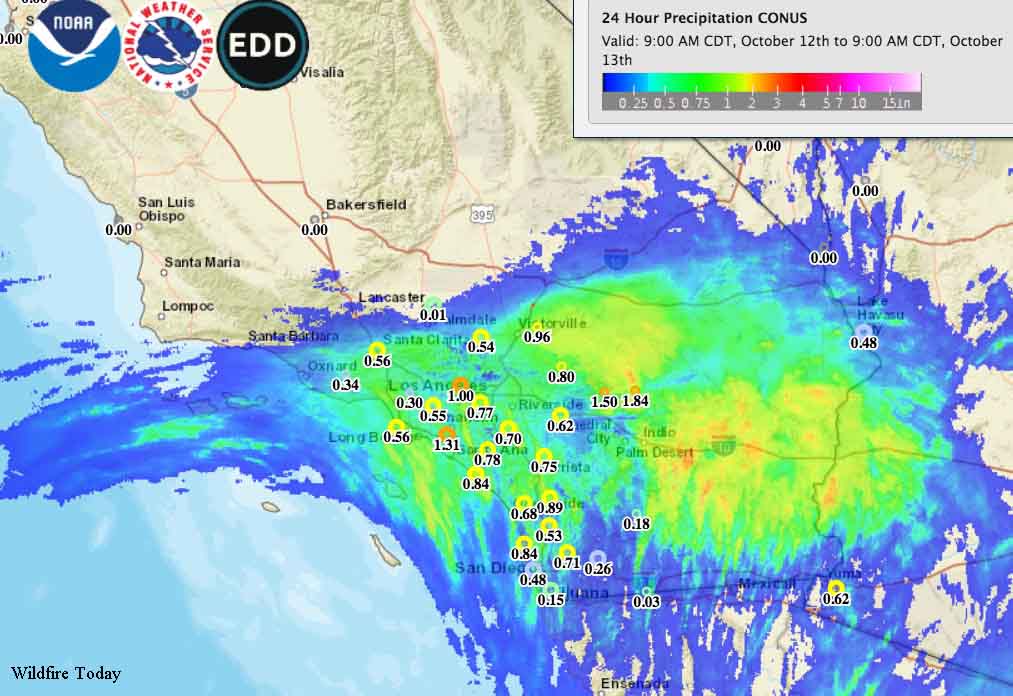
Significant amounts of rain accompanied by copious amounts of lightning fell in Southern California Friday night ahead of a predicted moderate Santa Ana wind event that is expected to begin Sunday afternoon and intensify on Monday and Tuesday.

Many areas from Los Angeles to San Diego received over half an inch and there is a chance it could continue on Saturday. Beneficial rains fell in most areas, but there was too much in some of the desert areas where flooding was reported in the Coachella Valley and Imperial County. Some of the highest totals included 1.54″ at Ocotillo Wells and 1.10″ at Indio.

Accumulated precipitation
Accumulated precipitation during the 24 hours ending at 7 a.m. PDT October 13, 2018. Click to enlarge.

Firefighting agencies have been preparing for the strong, dry Santa Ana winds by prepositioning air tankers in Southern California. They were heavily used Friday to quickly knock down the North Park Fire north of San Bernardino before it could burn more than 50 acres.

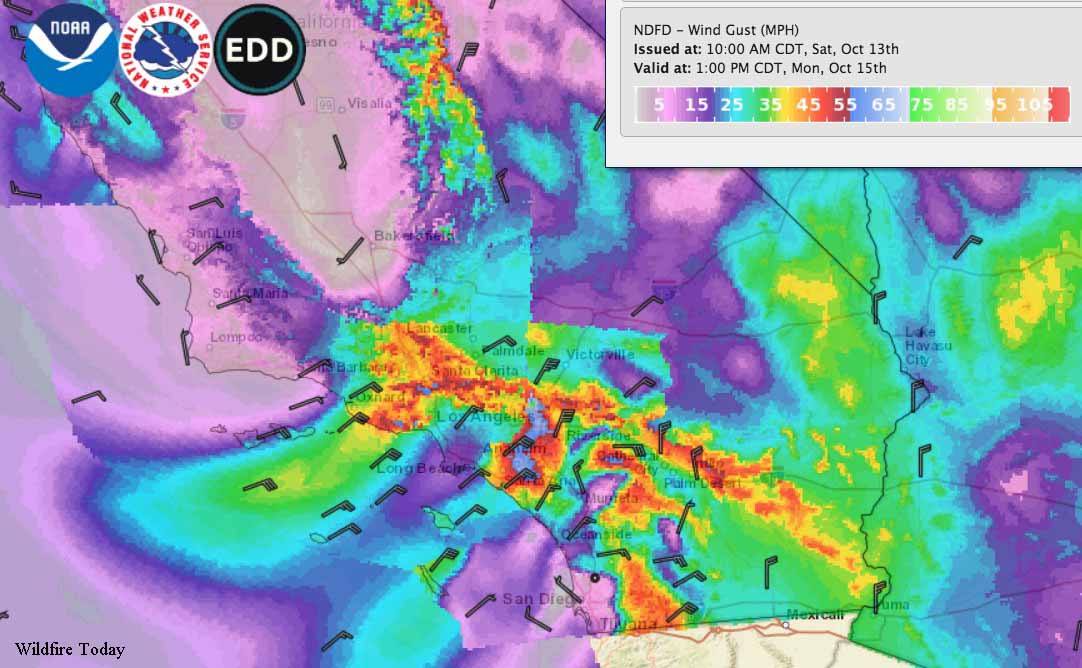
wind forecast southern california october 15
The forecast for wind gusts in Southern California at 11 a.m. PDT Monday October 15, 2018.

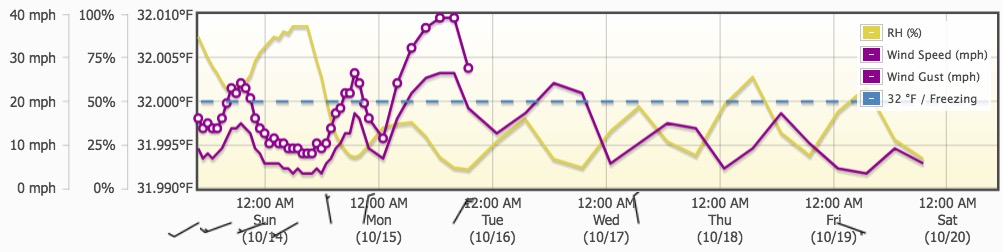
Sunday afternoon the strong winds will surface in the mountains, foothills, inland valleys, and Orange County, and will begin to dry the fuels Monday. Winds in these areas will range from 20 to 40 mph with gusts in the wind prone areas up to 60 mph. The rest of the week should be dry and breezy.

Weather forecast for Riverside, California
Forecast for wind, wind gusts, and relative humidity, Riverside, California. NWS.

High-speed taxi test for China’s new amphibious air tanker

AG600 high-speed taxi test
AG600 high-speed taxi test. Xinhua.

China’s new AG600 amphibious air tanker recently completed a high-speed taxi test. The first flight for the aircraft was December 24, 2017 at Jinwan Civil Aviation Airport in Zhuhai, Guangdong.

The AG600 can carry up to 3,000 gallons of water, and like the CL-215/415 and Air Tractors it can scoop water from a lake and drop it on wildfires. When not fighting fires it holds 50 passengers in a military or civilian role, and has a range of 5,500 km (3,418 miles). It has four turboprop engines, can handle a wave height of two meters, and will have a maximum speed of 354 mph (570 kph, 308 knots).

New book of nighttime fire photography

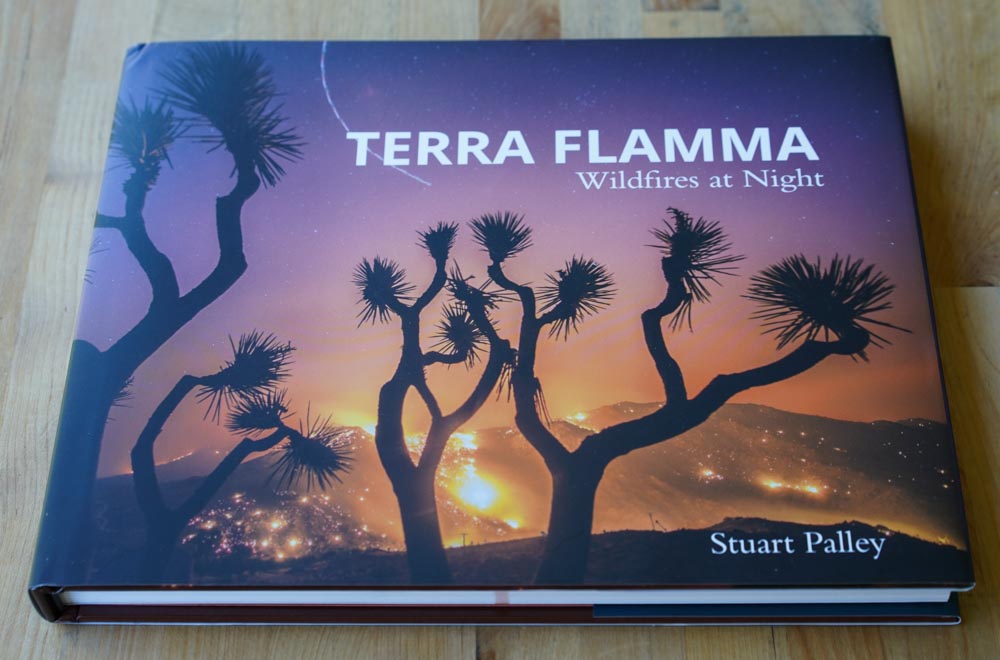
book Terra FlammaTERRA FLAMMA
Wildfires at Night
by Stuart Palley
176 pages, Schiffer Publishing
$25.85 at Amazon

Fires can be deadly, but they can also be beautiful. Most of us have spent time staring at a campfire or fireplace. It can be mesmerizing on a small scale, but when you see hundreds of acres being consumed by flames, it can be hard to turn away.

Television news might cover wildfires even less than they already do if the images were not so fascinating.

Flickering flames on a landscape at night can be captivating. A well-know wildfire photographer has made it an area of special interest during the last five years. After most fire photographers spent hours getting shots of fires during daylight hours and went home to rest, re-hydrate, and edit photos, Stuart Palley would often take advantage of the very special lighting, set up his tripod, and take multi-second exposures keeping the shutter open long enough for the dim light to be captured on the camera’s sensor.

He writes about it in his book that was just released, Terra Flamma; Wildfires at Night:

Soon I found the night shots more interesting than the day. As the painter Vincent Van Gogh said, “I often find that the night is more colorful than the day”.

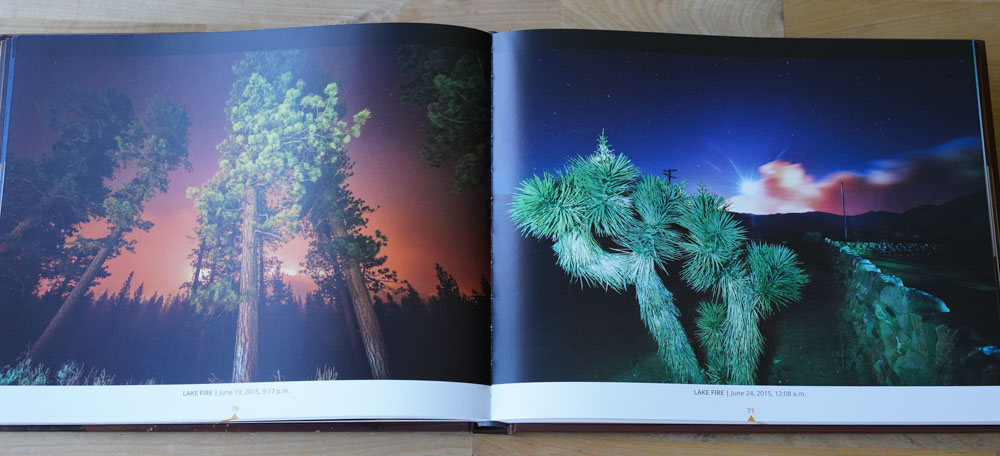
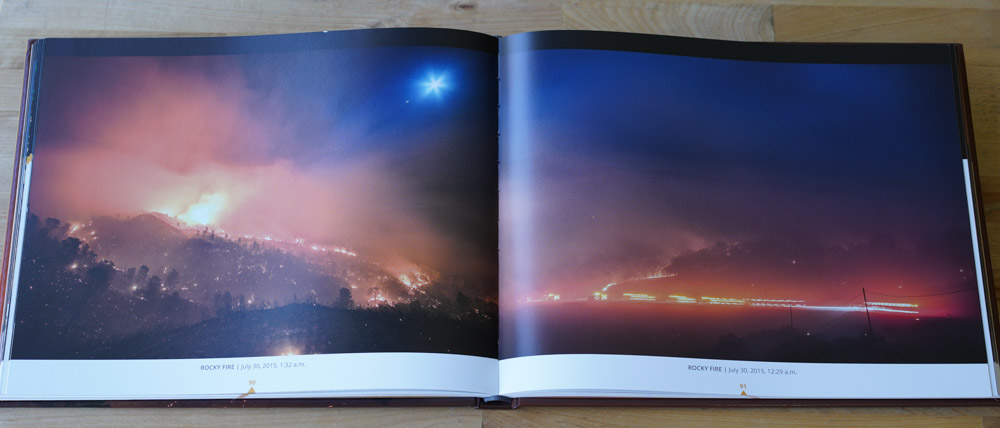
book Terra FlammaThe book is a compilation of 110 color photographs of 39 wildfires shot at night in California over the past 5 fire seasons, including the Rim, Rough, and Thomas Fires. There is also an introductory section about his background, on photographing the fires, and his experience at the incidents in addition to statistics about each wildfire.

Terra Flamma, Mr. Palley explains, is a rough Latin translation for “earth on fire”.  I am not a fan of using words from a foreign language in a motto, company name, or book title. If people reading it don’t speak that language, the words can be meaningless.

I took these three photos of the book cover and some of the pages within, but they do not do justice to the excellent photos and the beautifully printed pages. I didn’t even snap pictures of his best images, not wanting to spoil the pleasure of someone opening the book for the first time.

Too often we see photos that firefighters take at fires that have been tweaked and manipulated within an inch of the pictures’ lives, cranking up the intensity, screwing with the color saturation, adding Instagram filters, or merging three or more photos into one with high dynamic range. Or worse, using the camera’s software to manipulate just one image into what the vendor calls high dynamic range. These can become extremely unrealistic. I have fallen into that trap once or twice, making one very little post production “enhancement” that’s barely noticeable, then one more, and another. Then when done, I have compared the tweaked version to the original and see that they are very dissimilar, and may tell a different story. That’s when I start over.

But Mr. Palley explains that he used “minimal enhancement, with the goal to reproduce what I saw at the fire”.

And it works. His experience as a journalist, news photographer, his masters degree in photojournalism, and years spent chasing wildfires all over California can be seen on the 176 pages.

book Terra Flamma
The cover of Terra Flamma

Gloves produce a strong opinion

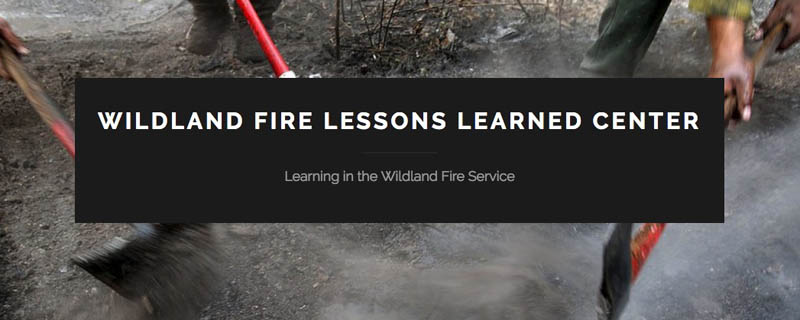
Travis Dotson wrote an article posted on the Wildland Fire Lessons Learned website titled “Gloveless Idiots” expressing his strong opinion about those who point out that firefighters seen in photos sometimes are not wearing gloves. Mr. Dotson used terms like “Glove Nazis” and “Gloveless Idiots”. Maybe the provocative terms were chosen in order to stir up debate, or express his belief that it is OK in certain situations to not wear gloves.


By Travis Dotson

Wildland fire lessons learned center

Some people don’t like the picture at the top of this page. Here is part of an email we received:

“The current Wildland Fire Lessons Learned Center website home screen pictures three wildland firefighters working in the black with hand tools. From my perspective they appear to be less than 10 feet apart and two of them aren’t wearing gloves. Have NWCG standards on Line Construction and PPE changed?  I always speak up on these type issues since this is a pending Condition Yellow 9 Line IWI.”

Here’s another one:

“Just sharing that the header picture strikes me wrong, unless you are trying to show a lesson to be learned….no gloves and using hand tools seems out of place, given that we teach people to use gloves and keep their sleeves rolled down — am I missing something?”

So let’s talk about the picture, or rather the practice the picture captures — wildland firefighters working without gloves on. First of all, let’s do some acceptance around the topic:

  1. It happens. This picture depicts reality. This is how work gets done, whether we want it to be done that way or not.
  2. This is a divisive topic.

Number 1 is self-explanatory. Number 2 seems silly, but it’s true — we like to “Us and Them” the crap out of this hot potato. There is a bright line between the Glove Nazis and the Gloveless Idiots.

Glove Nazi’s have super clean Nomex, no tolerance for nuance, and certainly wouldn’t know which end of what tool is best used to fry grub worms (or why you would fry grub worms).

Gloveless Idiots are a bunch of babbling backwoods booger eaters who have no sense of cause and effect.

Well, we won’t get far if we believe either of those extremes will we? (But I bet you bought one of them anyway.)

OK kiddos, let’s sooth our hurt feelings and come back to the table for a little slice of compromise pie.

Gloves protect our hands. Gloves make some tasks more difficult.

Individuals make personal decisions about risk all day everyday. (Insert your favorite daily risk decision example here. Most people use driving, so don’t use that one.)

When and where to put on gloves is the ultimate “efficiency / thoroughness trade off” dilemma. It’s a pretty tough nut to crack.

What if…

  • Every time you saw a photo of firefighters working without gloves on you thought: “Wow, those folks must have a very compelling reason not to wear gloves…I wonder what it is?”

What if…

  • Every time someone asked why you aren’t wearing gloves you thought: “Wow – this person really cares about my safety, that is so kind.”

More acceptance. Fewer assumptions.

What if.

Vicki Christiansen to be Chief of the U.S. Forest Service

Victoria Christiansen forest service
Victoria Christiansen speaks at the Fire Continuum Conference in Missoula May 21, 2018. Photo by Bill Gabbert.

U.S. Secretary of Agriculture Sonny Perdue announced October 10 that Vicki Christiansen will serve as the 19th Chief of the U.S. Forest Service. Ms. Christiansen has been serving as Interim Chief since March of this year when Tony Tooke resigned after allegations of sexual misconduct were aired on the PBS program NewsHour.

On October 11 Secretary Perdue will swear her in as Chief in the Sidney Yates Building in Washington, D.C. at 9:45 a.m. ET.

Ms. Christiansen has experience in wildland fire suppression. After obtaining a degree in forestry at the University of Washington in 1983 she accrued firefighting experience with the Washington Department of Natural Resources. There is one report that she was qualified to use fireline explosives. Thirteen years after graduating she was the Washington State Forester. Between 2006 and 2012 she served in five different positions with the Washington DNR, Arizona Division of Forestry, and the U.S. Forest Service. Her last job before becoming interim USFS Chief was Deputy Chief, State and Private Forestry with the USFS.


(UPDATE October 12, 2018)