Group files second suit against USFS about retardant

From the Missoulian, an excerpt:

“An environmental watchdog group on Wednesday sued the U.S. Forest Service for a second time over the agency’s use of aerial fire retardants.

The Forest Service Employees for Environmental Ethics, an Oregon-based nonprofit group, filed the lawsuit in U.S. District Court in Missoula.

The lawsuit is part of the group’s campaign to reform the Forest Service’s wildland firefighting mission.

The campaign includes banning retardant airdrops nationwide unless people or homes are threatened, focusing on fire prevention around communities, and allowing more remote wildfires to burn as a natural part of the ecosystem.

The lawsuit accuses the Forest Service, the U.S. Fish and Wildlife Service and the National Marine Fisheries Service of failing to fully evaluate the environmental impact of the aerial retardants.

Studies show the ammonium-based retardants are toxic to fish and other aquatic organisms, and promote the spread of flammable invasive weeds.

FSEEE won an earlier retardant-related lawsuit against the Forest Service when U.S. District Judge Donald Molloy ruled that the agency had violated federal law by failing to properly review the environmental impact of retardants on national forests.

That lawsuit – which was filed in 2003, a year after a retardant airdrop killed 20,000 fish in an Oregon stream – was dismissed in February when the Forest Service complied with Molloy’s order to complete an environmental assessment of aerial retardants.

FSEEE’s latest lawsuit challenges the Forest Service’s assessment, which found that the chemical red slurry has no significant environmental impact.

In their biological opinions, the Fish and Wildlife Service and National Marine Fisheries Service said retardants jeopardize 45 endangered or threatened fish, plant, insect, mussel and amphibian species and their critical habitats.

The lawsuit includes those two agencies because they said the Forest Service could avoid jeopardizing the environment if it followed “reasonable and prudent alternatives” when dropping retardants.

[…]

The new lawsuit challenges the three agencies’ environmental analyses, conclusions and decisions, saying they violate the National Environmental Policy Act, the Endangered Species Act and other federal laws.

FSEEE said the Forest Service should be forced to complete an environmental impact statement, which is more detailed than an environmental assessment, and that the “reasonable and prudent alternatives” do not prevent harm to the protected species and their critical habitat.”

The Flathead Beacon at Kalispell, Montana had this to say, in part:

[…]
“Nuts? Yep, yet FSEEE righteously claims its “mission is to forge a socially responsible value system for the U.S. Forest Service.” They intend to ram their retardant version of social responsibility through the courts, and just might.

Don’t be surprised if FSEEE files their case, and on some trivial technicality, an injunction comes down at the worst possible time. Some poor fire boss will have to announce: “Folks, we need to ground our air fleet and wash out the tanks today. We’re also pulling all our crews, as the bombers were the last chance we had of holding this line without killing someone. Sorry. The judge says a one in 5,000 chance of killing a few minnows overrides any of your trivial concerns. We hope you got your heirlooms and families out in time, have a nice day.”

Retardant justice, indeed.”


Photo courtesy of the Zion Helitack blog

El Cariso Hot Shot Reunion

My old crew, the El Cariso Hot Shots, is having a reunion April 11-12 at Temecula, CA. I won’t be able to attend, but I dug out some of my old photos from 1970-1972. If you click on them, you can see slightly enlarged versions.

Doing PT’s in 1971. We had to wear our boots while we ran. Don’t ask me why.

Dining at fire camp.

Taken in 1972 on the San Bernardino NF after we got chased out of the fire and hung out at a safety zone.

Barry Koncinsky running the chain saw.

A TBM making a drop near our fireline in 1972.

Below are some much more recent photos of El Cariso, from YouTube. Be warned it has some loud music.

Feel free to leave a comment below. You’ll have to register with Google, but it’s painless.

Montana: Legislative panel warns about increasing fire risk

A legislative committee in Montana submitted an interim report on Friday recognizing that fires are getting larger and more difficult to suppress. Here’s an excerpt from the Billings Gazette:

“A draft legislative report warns of the likelihood that towns will burn and people will be injured or killed if Montana does not change how it deals with wildland fires.

The report was released Friday by the Fire Suppression Interim Committee as lawmakers plan a series of meetings across the state to come up with better ways to fight fires.

Last year in Montana, more than 700,000 acres burned in 72 fires tracked by the federal government. Most were sparked by lightning.

The draft report predicted more bad fire seasons because of extended drought across much of the state, rising demand for firefighting resources and more homes built in rural areas prone to fire.

“With limited resources,” the report concludes, “it is likely that communities will burn and firefighters and members of the public will be injured or killed.”


The committee’s chairman, John Cobb, R-Augusta, said the dire warning was a call to action.

“Where we are going now, there are going to be hundreds of homes burned up,” Cobb said. “What can we do differently?”

Mary Sexton, director of the state Department of Natural Resources and Conservation, said agencies such as hers are trying adapt their firefighting strategies. But so far, she said, they have not kept pace with the threat.

“Because of the drought and the buildup of fuels, we just are not able to be as effective as we have been in the past,” Sexton said.”

House burned in fires in 2003 and 2007

The Associated Press has a story about a couple at Cuyamaca, California, east of San Diego, who lost their house in forest fires in 2003 and 2007, in the same spot. They are going to rebuild again. The photo shows the house that burned last October. Here is a small excerpt.

“The Millers lost their house to a wildfire in 2003, then rebuilt it, only to watch the replacement house burn to the ground last October in another wildfire. They were the only family in San Diego to lose a house twice on the same spot. Now they plan to build there a third time — only the house will be mostly underground this time.”

Photo from Associated Press

Robot proposed to put out fires; no need to update your resume yet

robot firefighter

robot firefighterA German industrial design studio, apparently with no expertise in wildland fire, has developed a concept for a robot that would be pre-positioned in the wildland. When it’s sensors detect a fire from up to 1/2 mile away, it would wake up, extend it’s 6 legs, walk to the fire, and put it out using tanks of water and powdered fire-extinguishing agents.

Unless a fire is very small, it can take shit-loads of water to put one out, so unless these robots are going to carry 500-1,000 gallons of water, or unless there are going to be shit-loads of robots, your job is pretty secure. Oh… and the cost of each one is estimated at $125,000-$200,000.

The article at Popsci.com says the weight of the robots will be 150-200 pounds, which means they could hold about 5-15 gallons of water, depending on how much other fire extinguishing agent they carry.

Photo from Popsci.com

BIA cuts hot shot crews

Due to budget reductions within the 2008 Interior Appropriations budget, the Bureau of Indian Affairs is reducing their hot shot crews from nine to seven. Effective immediately, according to a memo dated March 19, the Mescalero Hot Shots of their Southwest Region, and the Bear Paw Hot Shots of their Rocky Mountain Region, are disbanded. A Reduction-in-Force, which means employees may be fired, is to begin within 10 days.

European Union considers rapid reaction force

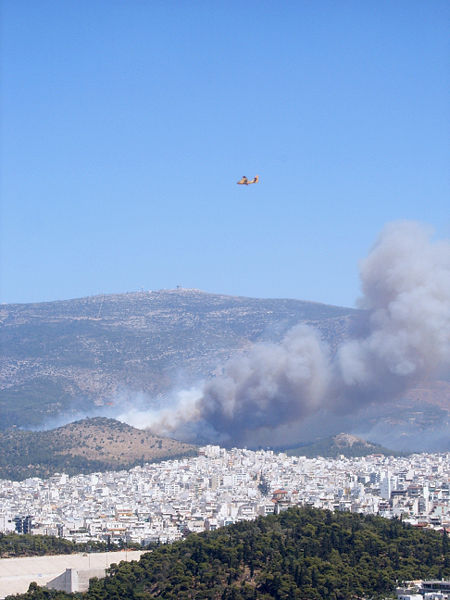
Athens wildfire

Athens wildfireThe European Union (EU), comprised of 27 member states, has been considering since April of 2007 the development of a rapid reaction force that could respond quickly to wildland fires, floods, and other emergencies. The parliament even passed a resolution to that effect, but little has taken place to make it happen.

I recently talked with someone in the UK who told me that in the last 2 weeks, due to last summer’s fires in Greece, the fire on the Greek island a couple of weeks ago, and the recent flooding in the UK, discussions along these lines have accelerated. In addition to other resources, they are considering a fleet of air tankers that could respond quickly to wildland fires in any of the 27 member states. The resources would be funded by the EU and is being advocated by the Directorate for Civil Protection.

Photo: Athens burning, July, 2007

California: Prescribed Fire Blog

The San Bernardino National Forest is conducting a multiple-day prescribed fire near Lytle Creek, California. What makes this one interesting is that they have an ongoing blog describing the actual daily events, along with lots of photos. One photo shows in the background snow on what I assume is a north-facing slope, while someone is running a drip torch in the foreground. It can be a luxury to do a prescribed fire when certain slopes or areas are unburnable due to differences in fuel moisture or snow cover.

Gabe Garcia, the Cajon District Ranger, and Deputy District Ranger Mary Long are providing the updates. This is the first time I have heard of daily blogging about a prescribed fire event, but I think it’s a great idea. It is not on a typical blog site, but is on the Wrightwood, California forum. It is worth a visit.

Firefighters’ distrust of digital radio system grows

Thale Racal radio

When fire agencies began moving to trunked 700-800 MHz radio systems in larger numbers 5-7 years ago, I remember reading a study of similar systems used in

Thale Racal radio
Thale Racal radio

Australia which concluded that these systems have no business being used for emergency services, and that they should only be used, for example, for garbage pickup.

From Mobile Radio Technology (April 1, 2008):

On April 16, 2007, firefighter Kyle Wilson was part of a crew dispatched to fight a residential fire in Woodbridge, Va. He died in the line of duty.

A detailed report on the incident recently released by Prince William County Department of Fire and Rescue concluded that problems associated with the use of the county’s Motorola digital trunked radio system contributed to the tragedy. Issues reported by other firefighters during that incident, which was further complicated by strong winds, ranged from signal distortion and transmission failure to radios displaying “out of range” signals.

Fire safety advocates now are encouraging fire departments across the country to study the incident in hopes that future tragedies could be avoided. Prince William County’s fire department, through further tests, concluded that digital portable radios are “extremely vulnerable to poor environmental conditions and interference of digital noise from ambient sources, which negatively impact the ability of emergency personnel to effectively communicate.”

A handful of fire and police departments, fearing the loss of lives, have opted to continue using analog systems even when the rest of their county’s emergency personnel are using digital trunking systems.

The common complaint, which most affects fire departments, concerns the digital vocoder’s inability to differentiate between a voice transmission and background noise – whether a chain saw, sprayed water or personal alarm. Background noise renders the voice transmission distorted and often unintelligible. Another critical problem is that digital radios lose contact inside buildings. “In most cases, it is a very political and sensitive position to abandon expensive technology and go back to something that is old,” said Daryl Jones, owner and president of Telecommunications Engineering Associates, which manages public safety systems throughout the San Mateo area in California. “But many agencies are finding that complaints from line personnel, both in fire and police, are so significant.”

The Boise (Idaho) Fire Department spent about $1 million two years ago on mobile and portable radio equipment to join a cutting-edge countywide 700 MHz digital trunking system. While training users on the system, the fire department discovered problems with voice intelligibility when a firefighter’s low-air alarm went off. That led the department to investigate the issue further, and it found more instances where alarms interfered with the quality of voice transmissions. Today, the department and other fire departments in the county remain on analog VHF radios while the rest of the county operates on the 700 MHz digital trunking system.

“Right now our dispatch center wants to dump VHF,” said Paul Roberts, a captain with the Boise Fire Department, “[and] we are trying to look at alternatives to at least get on a system that will lessen the load on dispatchers having to patch all of this together. … But until there is a solution to the digital processing of speech when you have competing noises, we have to stay on analog.”

The problems associated with digital systems became known in 2006. Since then, the International Association of Fire Chiefs (IAFC) established a Digital Problem Working Group and appointed Chief Charles Werner of Charlottesville, Va., to serve as its chair. So far, the working group has explored the creation of a best practices solution to work around the problem until a long-term solution can be found. Prince William County’s findings have been forwarded to that group for inclusion in the process.

The National Institute of Standards and Technology (NIST) also is analyzing the problem, as are radio manufacturers such as M/A-COM and Motorola. They are expected to jointly release a formal analysis – in conjunction with the IAFC – that encompasses best practices to help departments to minimize the problems.

“We’re running through this scientifically and hope to distribute a wrap-up summary shortly,” Werner said.

Roberts, who chairs the IAFC testing group, says the testing – conducted by radio engineers – involves taking words that sound alike and requiring the listener to distinguish which word is being said over the background noise of chainsaws and hose sprays.

Motorola declined to comment, saying it was cooperating with the testing and awaiting the conclusions from NIST and the IAFC.

But Chris Lougee, vice president with LMR vendor Icom America, thinks older technology would help solve these background noise problems. “Everyone knew from the beginning that the P25 vocoder was a half-rate vocoder. As you speak into the microphone, you are converting human voice into a data stream that is reassembled at the end,” Lougee said. “TIA … is encouraging a move to a full-rate vocoder, which we are doing. It vastly improves the amount of audio and quality.”

Rapid City Journal: "Keep fire center at airport"

Northern Great Plains Dispatch

Northern Great Plains DispatchThe Rapid City Journal has taken sides in the battle between the Federal Aviation Administration and the wildland fire agencies in the FAA’s efforts to evict the Northern Great Plains Interagency Dispatch Center from the Rapid City Regional Airport.

The FAA wants to evict the dispatch center, tear down the building, and then allow a private company to use the space to build an aircraft hanger.

An editorial in today’s Rapid City Journal calls this “bad fiscal policy and bad firefighting policy”. And:

“…public safety issues of wildfire suppression should take precedence over the needs of the private sector for bigger and better hangar space.”

They are absolutely right. All involved parties agreed to have the dispatch center at the airport. They spent $1.8 million to build it, and to tear it down after just a few years would be an incredible waste of taxpayers’ dollars.