CIA pays full cost of liability insurance for employees

The federal land management agencies pay only 50% of the the cost of professional liability insurance for their fire personnel, but the CIA recently decided to pay 100% in a new policy reported on March 17 by the Associated Press. It’s good to see that a priority in the CIA is taking care of their own.

“WASHINGTON (AP) — The CIA announced Monday that it will now pay the full cost of legal liability insurance for about two-thirds of the agency workforce.

The insurance costs about $300 a year. Until now the CIA has paid just half of the premium annually. Only about 15 percent of eligible employees actually apply for reimbursement.

One shift is already looming: A change in administrations could make it more likely lawsuits will be filed against CIA interrogators for a controversial program approved by the Bush White House — the use of harsh interrogation techniques and the secret movement of prisoners, known as extraordinary rendition.

The insurance comes from private companies to cover legal expenses that arise out of actions undertaken in the course of a CIA officer’s official duties. It is meant to cover potential litigation expenses including damages. It covers legal expenses associated only with those activities undertaken after liability insurance is taken. The reimbursement program began in 2000.

Agency Director Michael Hayden on Monday announced that he had expanded the pool of those eligible to be reimbursed for insurance to include all employees involved in covert activities, not just those involved in counterterrorism and counterproliferation.

Any agency employee who supervises one or more employees is eligible to be reimbursed as will attorneys, grievance officers, equal employment opportunity counselors, auditors, IG inspectors and investigators, polygraph examiners, recruiters or hiring advisers and security officers.

“This benefit will help keep agency employees focused on accomplishing the mission, rather than being concerned about potential litigation costs that might arise as a result of doing their jobs,” said CIA spokesman Mark Mansfield.”

Virginia: St. Mary’s fire

Helitorch

The St. Mary’s fire on the George Washington National Forest has grown to 4,060 acres. (UPDATE March 30; 4,505 acres) It’s interesting the way the media describes the aerial ignition operation.

From The News Virginian, an excerpt:”Instead of rain, a helicopter dropped a hailstorm of ping-pong-ball-sized balls of a chemical that, with a delayed reaction of about 10 seconds, started a potent fire – on the east and west slopes of the ridge leading to Route 56. It’s known as a backfire operation, McPhereson said, and it worked to contain the fire.

Helitorch
Helitorch photo by Bill Gabbert

At the same time that was happening, most of the 121 people involved, from federal and state agencies to local volunteers, were out burning terrain along the road leading away from the bulldozer line, according to Charlie Rudacille, normally with Shenandoah National Park but one of those assisting in controlling the fire.

The helicopter chemical drops, he said, would help prevent big runs with the fires and would lessen their intensity.

In the half-hour it took for the helicopter to drop the many thousands of chemical balls and make its way around both sides of the ridge, visibility was reduced to near-zero as heavy, dark-brown smoke filled the sky and bright orange flames dotted the slopes.

“If it all goes well, in an hour it’ll be boring,” Rudacille said while the helicopter was in the air.

The gusting, 15 to 20 mph winds – blowing the fire northeast, away from the west slope – was a blessing to the firefighters, as were the dry, overcast conditions. But Rudacille was aware of forecasts calling for a chance of thunderstorms later in the day.

“The thunderstorm, and the erratic winds associated with the thunderstorm, would be a problem,” Rudacille said.”

InciWeb has more details.

Fire simulator training in Prescott, AZ

Prescott fire training

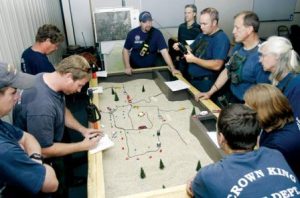
Fire simulators can provide a very valuable opportunity to test and improve your firefighting skills. On the Cleveland National Forest we used to use four overhead projectors to produce images of the landscape, smoke, and fire on a rear projection screen, two 4-track reel-to-reel tape recorders and a mixing board for sound effects, and up to 10 people to run the simulation and act as role players. I have not seen the new computer-based simulator that is being used this year, but I hope it is at least as realistic as the earlier systems.

The Daily Courier in Prescot, AZ has a story about firefighters going through an exercise using a simulator and sand table.

Here is an excerpt:

Well aware that numerous agencies often come together suddenly to battle dangerous wildfires, Prescott-area agencies gather each year to brush up their skills before the traditional wildfire season begins.

Prescott fire training
“Firefighters from a variety of agencies look over a sand table model to plan their next action steps for the 1,200 acre fire they were responding to as part of the annual Basin Drill at the Prescott Fire Center. Photo courtesy of The Daily Courier, Les Stukenberg

“We’re testing ourselves to a level we’ve never tested before,” Prescott Fire Chief Darrel Willis said as he surveyed more than 50 people in the incident command center room alone. “Look at all the agencies here. There’s a comfort level when you see people you know. We know what we can expect from those people.”

Such training can save the lives of firefighters as well as citizens who live in wildfire-prone areas of the Prescott region.

“Communications are always going to be difficult,” Bentley said, so training helps immensely with smoothing out radio compatibility issues. Firefighters also learned some lessons about setting up an incident command system quickly so the span of control is clear, he said.

The sand tables are literally that – wooden tables covered with sand that firefighters mold to mimic the actual fire terrain. They add miniature trees, homes and fire trucks to the scene. They move red strings and cotton balls forward to represent an advancing wall of fire.

The Forest Service started making its computer simulator widely available just this year, Bentley said.

Fire instructors input U.S. Geological Survey computerized topographical maps into the simulator, then add as many as 20 types of homes along with local vegetation, roads, streams and even propane tanks.”


PLI insurance reimbursement available to federal "temporary fire managers"

On December 26, 2007, President Bush signed Public Law 110-161, the Consolidated Appropriation Act, 2008 which expands coverage for reimbursement of professional liability insurance to “temporary fire line managers.” The US Forest Service sent out three memos that provide more information for their firefighters. In part they say:

To qualify, these “temporary fire line managers” must meet one of the following three criteria:

1. Provide temporary supervision or management of personnel engaged in wildland or managed fire activities,
2. Provide analysis or information that affects a supervisor’s or manager’s decision about a wildland or managed fire, or
3. Direct the deployment of equipment for a wildland or managed fire.

I combined the three memos into one document, available HERE. (134 k Word document)

Santiago fire AAR released

Santiago fire AAR

Santiago fire AARThe Orange County Fire Authority has released their after action review on the October, 2007 Santiago fire, southeast of Los Angeles. The document is 138 pages long and 7.3 Mb. The fire burned 28,517 acres and destroyed 42 structures, including 14 homes, 4 commercial buildings, and 24 out buildings.

On a quick review, I did not see any earth-shaking revelations. There were some challenges with communications (i.e. 800 Mh vs. VHF systems) but have you ever seen an AAR for a large incident that did not mention problems with communications?

Some of the recommendations:

  • “…aggressively pursue adoption of Very High, High, and Moderate Fire Severity Zones” on the CalFire maps.
  • Develop a Wildland-Urban Interface Program that includes enforcement provisions, and commit the necessary resources.
  • Accelerate the purchase of new helicopters, and acquire night vision capability.
  • Establish a full-time, year-round hand crew, a 2nd seasonal handcrew, and a seasonal fly crew.
  • Increase staffing on Type 3 wildland engines to include a 4th firefighter.

Take the polls

We have two active polls. One is about the Terry Barton sentence, and the other is about physical fitness programs. Only 2 days remain on the physical fitness poll, and the Barton poll, which we just started, will end in 6 days. Be sure and take them before they end.

Terry Barton re-sentenced today for starting Hayman Fire

hayman fire map
hayman fire map
Scott C. Carter, Digital Data Services, Inc., www.digitaldataservices.com

Terry Barton was a Fire Prevention Technician for the US Forest Service when she started what became the 137,000-acre Hayman fire on the Pike National Forest in 2002.

Unless there are further legal proceedings, it appears that she will be out of prison in June.

From the Colorado Springs Gazette:

“Terry Barton, who set the worst fire in Colorado history, was re-sentenced to 15 years probation and 1,500 hours of community service today by 4th Judicial District Judge Thomas Kennedy.

Her first sentence on a state arson charge – 12 years in prison – was tossed out by the Colorado Court of Appeals in 2004 because of issues with the way the original judge handled her case.

Barton is in a prison in Texas, serving out the remainder of a six-year sentence on federal charges for starting the Hayman fire. She’s scheduled to be released from prison in June, according to her attorney.

Once she’s released, she’ll have to check in with 4th Judicial District probation officials. Her new sentence on the state charge will be retroactive to 2003, meaning she’ll be on the hook for community service hours and probation check-ins until 2018.

In June 2002, Barton – a U.S. Forest Service employee – reported that a fire started in a campground northwest of Lake George. About a week later, she was arrested after admitting she accidentally started the fire by burning a letter from her estranged husband.

The fire burned 137,000 acres in the Pike National Forest and destroyed 133 homes.”
Earlier we covered other developments in this case.

UPDATE: March 28

In yesterdays’ court proceedings, district judge Thomas Kennedy ordered Barton to pay restitution — estimated to be at least $30 million — on top of the $14.6 million in restitution that is part of her six-year federal sentence.

More from the Denver Post today:

Barton, who began serving her federal sentence in 2003, is due to be released in June from prison in Texas. She must report to the El Paso County probation office within a week after leaving federal custody.

Barton’s 12-year state prison sentence was overturned in 2004 by the Colorado Court of Appeals.

The appeals court found the judge failed to disclose that the Hayman fire forced him to evacuate and that he doubled the presumptive range of her sentence inappropriately because only a jury could find aggravating factors.

Prosecutors then argued that Barton’s appeal of her sentence violated the terms of the plea agreement, which allowed them to withdraw it.

In January, the Colorado Supreme Court ruled they could not withdraw from the agreement.

It said Barton would face only one count in one county, would serve any state sentence concurrently with the federal sentence, and she could not appeal any state sentence.

Newsome said the amount of restitution must be determined within 90 days, saying, “It will be at least $30 million.”

While the DAs understand the amount may never be paid, Newsome said state law requires a judge to impose restitution for actual losses and ensures victims’ right to pursue civil judgments.


Farmer dies on a fire in Colorado

From 7 News in Denver, March 26:

ORCHARD, Colo. — A farmer trying to control a fire on his property died Wednesday afternoon when the tractor he was driving flipped into an irrigation ditch.

Morgan County Sheriff Jim Crone said the man was driving his tractor on top of a ditch to get ahead of the fire when the ground shifted or partially collapsed, causing the tractor to flip and roll on top of the farmer. The farmer was killed instantly.

The man, who has not been identified, called for the fire department before his tractor flipped at 2:30 p.m. Deputies believe he was burning brush near the irrigation ditch and it got out of control.

About 100 acres were burned by the brush fire, located northwest of the town of Orchard, Colo.

Recreation Fees Rising in Wake of Fires’ Costs

This was published in the NY Times a couple of weeks ago. Here is an excerpt:

HAMILTON, Mont. — Reeling from the high cost of fighting wildfires, federal land agencies have been imposing new fees and increasing existing ones at recreation sites across the West in an effort to raise tens of millions of dollars.

Additionally, hundreds of marginally profitable campsites and other public facilities on federal lands have been closed, and thousands more, from overlooks to picnic tables, are being considered for removal.

“As fire costs increase, I’ve got less and less money for other programs,” said Dave Bull, superintendent of the Bitterroot National Forest here in Hamilton. The charge for access to Lake Como, a popular boating destination in the national forest, will be increased this year to $5 from $2.

Last year, the Forest Service collected $60 million in fees nationwide, nearly double the $32 million in 2000. The Bureau of Land Management, the country’s biggest landlord, doubled its revenues over the same period, to more than $14 million from $7 million. The agency projects revenues from the fees will grow an additional $1 million this year.

[…]

Sen. Max Baucus, D-Mont., has introduced a bill that would repeal the authority of the Forest Service and other agencies to raise or institute many of the fees.

“The authority given land managers is being abused,” Baucus said. “They are using it to pad their budgets at the expense of the public. I think it’s just wrong.”

Fire in North Carolina allowed to burn

In the western US we call this type of fire a “fire use fire”. But only if a fire management plan allows for this type of fire, and all of the predetermined conditions are met.

From a story in the Charlotte Observer:

A fire has been burning on an island near marker 10 off Stonemarker Point on Lake Norman since Tuesday evening, officials said.

The fire was reported around 7 p.m. Tuesday to the N.C. Division of Forest Resources district office in Mount Holly.

Brian Haines, a spokesman for NCDFR in Raleigh, said rangers from the division have been allowing the fire to burn on the 18-acre uninhabited island because it doesn’t pose a threat to people or properties.

“It’s not going to go anywhere,” Haines said. “It’s surrounded by water so you have a natural fire break there.”

The island is located in Lincoln County off McConnell Road, and can also be seen from southern Iredell County at the end of Brawley School Road peninsula in Mooresville.

This morning, two rangers went to the island that’s about 500 yards off shore to torch the fire to help it burn faster and reduce the amount of smoke.

Haines said most of the smoke in the area is drifting into the Charlotte area from controlled burning occurring South Carolina and not the island.

“The island is not the major factor of smoke coming into Charlotte, “he said.

The cause of the fire hasn’t been determined yet.

“It may have been somebody who camped over the weekend and did not fully extinguished their fire,” Haines said.