Yesterday a federal jury convicted a homeless man, Steven Emory Butcher, of starting the Day Fire, which in 2006 burned over 160,000 acres in the Los Padres National Forest. The charges included willfully setting debris on fire in the forest and allowing a fire to escape from his control. The same jury also found him guilty of causing the 2002 Ellis Fire that burned about 70 acres in the same area.
The 49-year-old man faces up to 11 1/2 years in prison. The fire started in a remote area where Butcher camped for part of the year. It burned for four weeks through 254 square miles of chaparral and scattered pines in and around the Sespe Wilderness, a remote area with steep and rugged terrain. It destroyed 11 structures. The costs for suppression were over $73 million.
Jeanne Pincha-Tulley has been invited back to the town that was threatened when she, as Incident Commander of California Incident Management Team #3, managed the 48,52-acre Castle Rock fire that some feared would burn the homes in the Wood River Valley near Ketchum, Idaho. An article in the Idaho Mountain Express describes her in glowing terms, including calling her the “darling of the Wood River Valley”. With all of the controversy that surrounds much of the wildland fire world these days, it is refreshing to see some good news about our firefighters.
Here are some excerpts from the article:
“Jeanne Pincha-Tulley, darling of the Wood River Valley who oversaw the successful fire-fighting effort last summer that kept the 48,520-acre Castle Rock Fire from overrunning homes, lives and businesses, is returning to the valley for a visit next week.
On Thursday, Feb. 21, Pincha-Tulley will participate in a public conversation at the Presbyterian Church of the Big Wood in Ketchum.”
and:
During the wild time that was the Castle Rock Fire, Pincha-Tulley’s presence became a calming factor in the local community. During successive public meetings, she gave local homeowners, public officials and others frank assessments about where the fire was headed, and what actions firefighters would take to control the fast-moving blaze.
Time after time, Pincha-Tulley achieved the near impossible. Standing in front of crowds that typically numbered well into the hundreds, she managed to restore calm to local homeowners inching toward panic due to the proximity of the flames and the scarcity of information.
Rumors bandied back and forth through the community were quickly dispelled by her fact-based reports.
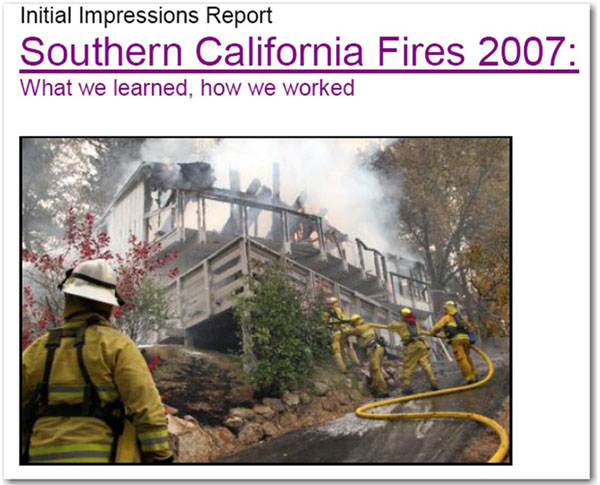
The Lessons Learned Center organized a group of five people to analyze the fires in the fall of 2007 in Southern California to determine the potential for lessons learned. They just released their 44-page report. It is very interesting reading.
The five-person team consisted of Dan Frazee, Phoenix, AZ Fire Department, Dennis Baldridge, U.S. Forest Service, Kevin Pfister, BridgerTeton National Forest, Dave Christenson, Wildland Fire Lessons Learned Center, and Jim Hollingsworth, Cal Fire.
The Associated Press is picking up on the pay and retention issues the U.S. Forest Service and other agencies are facing in California. The USFS is losing a great many experienced firefighters to CalFire and other fire departments in the state who pay much higher salaries than the federal agencies.
From the San Diego Union-Tribune:
“WASHINGTON – A top federal official acknowledged Tuesday that the U.S. Forest Service is losing federal firefighters in California to state and county departments that pay more.
But Agriculture Department Undersecretary Mark Rey, who directs U.S. forest policy, told concerned lawmakers he’s still evaluating how much of a problem that is. “On the one hand you hate to lose trained people. On the other hand they’re still fighting fires under a unified command system,” Rey told a hearing of the House Appropriations Interior subcommittee. “They’re going to be on the fire line along with the federal firefighters.”
Lawmakers convinced there is a problem ordered the Forest Service to come up with a plan by Feb. 1 to increase recruitment and retention for Southern California forests. That deadline has passed but the agency is working on it, officials said.”
“Jimmy Branca doesn’t know exactly what saved his life: his Chevy truck, a safety device on the powerline up above, or maybe God.
But he recalls his first thought after a getting struck by an electric line yesterday: “Thank God I didn’t get killed and I get to go home and see my wife and kids.”
Branca and another firefighter were outside their trucks Monday, assessing a wildfire on northwest Josephine Road. Two poles were on fire, and they were about to make a decision on whether to put them out.
That’s when both utility Glades Electric poles snapped, and the power lines fell.
“One pole landed not far from me,” Branca said. “The wire hit me, and took me to the ground.”
Branca, 47, is a burly Navy ex-corpsman who has been working in emergency services since 1979. He
pointed to an abrasion on his left elbow.
So how is it that Branca is alive today?
The wire, he said, caught in the space between the driver’s side mirror and the door of his white three-quarter ton command vehicle. He thinks that created enough tension to trip the breaker on the power line. In a fraction of a second, the wire de-energized.
On January 18 we wrote about the machine being tested by the U.S. Fish and Wildlife Service that burns a 5-foot wide black line as it is towed behind a tractor. Now their Huron Wetland Management District in South Dakota has approved the use of the equipment. More details are on their web site.
Tom Collins of the North Carolina Department of Emergency Management says that the drought could result in a year-round fire season, according to an article in the News Observer.
“The epidemic of hundreds of wildfires in every corner of the state served as a warning that drought could expand the spring and fall fire seasons into one long year of risk, emergency officials said Monday.
“Right now, we could have a fire season year-round,” said Tom Collins, eastern branch manager for the N.C. Division of Emergency Management.
Normally, the spring season doesn’t begin until March. But in a single weekend, 10,100 acres — more than half the acreage normally torched in an an entire year — were burned.
“We probably had fires in every county in the state,” Collins said. “I’ve seen days in the western part of the state where we just had fires everywhere, but this time it was statewide.
“It just had to be drought-related.”
Propelled by strong winds, more than 300 wildfires flared across the state Sunday. By Monday, the winds had died, but several small fires and three larger blazes were still burning, state fire officials said. The last major fires, each about 2,000 acres, were in Halifax, Tyrrell and Camden counties.”
Senator John Kyl, a Republican from Arizona, in an article on his web site criticizes the President’s proposed budget for 2009 which reduces the funds allocated for fuel treatments.
“With almost 48 percent of the proposed budget going toward fire fighting, the Forest Service might be more appropriately called the “Fire Service.”
I believe funding for fighting fires must be complemented by adequate funding for preventing them. Proactive management of our forests not only is the best tool in combating wildfires, it is critical to restoring forest health and improving habitats for diverse species.
Typically, there are two complimentary methods of treatment: mechanical thinning of brush and smaller diameter trees, and prescribed burning. These treatments open up forests so they are less susceptible to “hot” crown fires. More importantly, reducing competition for soil nutrients, water, and sunlight immediately enhances the health of the trees, allowing them to grow bigger and fend off diseases and deadly insects like bark beetles.”
Lake Carolina in Richland County, VA, from wistv.com
Strong winds up to 50 and 60 mph caused problems for firefighters in Virginia and North Carolina.
Virginia, from Pilotonline.com:
Beyond southeast Virginia, dozens of brush fires burned across the commonwealth and some were still burning Sunday night.
Local authorities declared emergencies in Bedford, Roanoke, Caroline, Orange, Dinwiddie, Lunenburg, Nelson and King George counties.
Shelters were opened in Roanoke and in the counties of Bedford, Hanover and Nelson for evacuees from residential areas threatened by brush fires.
Brush fires and downed power lines have closed parts of several major roads: I-81 north of Roanoke; U.S. 460 in Botetourt County; I-95 in Hanover County; U.S. 60 in New Kent County.
CONWAY, S.C. — Wind-whipped wildfires chased churchgoers from worship, forced hundreds of residents to flee homes and closed highways across the rain-starved Carolinas and Virginia on Sunday.
Twelve small structures, including at least one business and an unknown number of homes and sheds, were damaged by a blaze near the South Carolina coast; no injuries were reported, authorities said.
About 60 homes were briefly evacuated Sunday afternoon as the fire sent smoke billowing above this city of about 11,000 people about 15 miles northwest of Myrtle Beach.
“The flames were at the top of the trees and I could feel the heat,” said Lewis Cooper, 37, who fled the fire.
In North Carolina, winds gusting up to 60 mph in some areas toppled trees and power lines and also fanned brush fires.
One of the companies that provides professional liability insurance for wildland firefighters has now expanded their coverage to include AD (Administratively Determined) employees. This is big news for the AD firefighters out there. The cost is $270 a year, the same as for a regular government firefighter.
“Federal Employee Defense Services (FEDS) has recently determined that personnel hired under the Pay Plan for Emergency Workers (AD Pay Plan) are considered “federal employees” for purposes of eligibility for benefits and membership in the FEDS program.
Through our relationships with such organizations as the Federal Wildland Fire Service Association (FWFSA), AD Firefighters Association, Wildlandfire.com and other groups and individuals involved with federal wildland fire fighting, we learned about a group of individuals called ADs who were hired by federal agencies to support the federal government’s wildland fire fighting mission. We received many inquiries as to whether these individuals would be eligible for liability protection under the FEDs program.
We have determined that individuals who are hired under the Pay Plan for Emergency Workers (AD Pay Plan) are eligible for membership under FEDS. Eligibility for benefits under FEDS, however, is limited to those instances when you are performing a federal function under the direction and control of a federal agency (i.e. within the scope of federal employment and are an employee under 5 U.S.C. 2105(a)). Accordingly, we at FEDS are happy to continue our support of the federal wildland fire fighting community by extending our coverage to ADs in this regard. When signing up on line at www.fedsprotection.com simply select AD Pay Plan when asked to identify the federal agency for which you work.”

 Yesterday a federal jury convicted a homeless man, Steven Emory Butcher, of starting the Day Fire, which in 2006 burned over 160,000 acres in the Los Padres National Forest. The charges included willfully setting debris on fire in the forest and allowing a fire to escape from his control. The same jury also found him guilty of causing the 2002 Ellis Fire that burned about 70 acres in the same area.