Wildfire Today printed on stuff

Have you been wondering when you would be able to get a coffee mug or a shirt with Wildfire Today on it? Just in time for Christmas ordering, here you go.  The shirts and mugs can all be found HERE, as well as sweatshirts, hoodies, women’s shirts, kids clothing, Sigg bottles, men and women’s underwear, and even a dog T-shirt. The shirts start at $9.69 and the mug is $11.89.

WildfireTodayMug_146x146WildfireTodayWomensLightT-shirt_yellow

CalFire’s mobile kitchen units

Fire Department Network News has produced a 3-minute video about the mobile kitchen units that CalFire deploys.

(VIDEO NO LONGER AVAILABLE)

Researchers: "Ethnicity does matter when it comes to prescribed fire"

Researchers from the USDA’s Southern Research Station (SRS) concluded in a study that a person’s ethnicity and culture may affect their perceptions of prescribed fire. Here is an excerpt from a summary of their report:

====================

SRS researchers Mike Bowker, Cassandra Johnson, and Ken Cordell, along with university collaborators Siew Lim, Gary Green, and Sandra Rideout-Hanzak (former SRS scientist) used data from a recent version of the National Survey on Recreation and the Environment to look at how culture affects perceptions and attitudes about fire and fire management in the South. When they analyzed the results, they found definite variations among respondents from the three most prominent ethnic groups in the South—African- Americans, Hispanics, and whites— about prescribed fire and its effects.

“The purpose of the southwide survey was to provide policymakers with a broad picture of public opinion on prescribed fire among major ethnic groups in the Southern United States,” says Bowker, SRS research social scientist based in Athens, GA. “The goal is to enhance agency communications with the public and to gain acceptance of prescribed fire as a fuel control program.”

Though overall most survey respondents agreed that public land managers and forest professionals can be trusted to choose the best methods for dealing with fire, African- American and Hispanic agreement was lower. African-Americans and Hispanics were also less likely to support prescribed fire as a management tool, and were more concerned about fire effects—harm to wildlife, reduced scenic quality, and smoke—than whites. Females across all groups also tended to be more concerned about the effects of prescribed fire than males. In addition, although level of education had no effect on preference for prescribed fire in general, concern over side effects diminished as education increased.

“Though we found that concern over the side effects of prescribed fire diminished as education level increased, it doesn’t mean that more education leads to environmental knowledge,” cautions Bowker. “The whole correlation between education and environmental knowledge needs to be more carefully examined.”

One reason for differences among groups may have to do with ethnic environmental beliefs and backgrounds, an area that social environmental science has only started to explore. Another factor uncovered in the survey was local private forest land coverage. According to the survey data, as the presence of private forest land increases in the area a respondent lives in, so does distrust in the use of fire as a management tool. This result may indicate a lack of confidence in the expertise of private land owners or managers, distrust of state liability laws, or a lack of communication between residents and private land managers.

“Our statistical evidence suggests that ethnicity does matter when it comes to prescribed fire,” says Bowker. “To gain wide public support and trust, land managers and owners should be aware of these differences, and fuel control programs should be tailored with the concerns and preferences of the local community in mind.”


via @fireinfogirl

Plea deal accepted in North Myrtle Beach fire

Attorney Paul Taylor, left, with his client, March Torchi in court on October 27, 2009. The Sun News.

The man whose debris burning has been linked to the Highway 31 fire in North Myrtle Beach, SC pleaded guilty to two charges on Wednesday. Mark Torchi reached an agreement with prosecutors and was fined $262 for not notifying the South Carolina Forestry Commission about the burn, and $470 for allowing a fire to spread to another person’s land.

The Highway 31 fire in Horry County, which started on April 22, 2009 was the largest in the state’s history. It burned 19,000 acres, caused $20 million in damges, destroyed 76 homes, and damaged 96 others.

Mr. Torchi’s attorney said his client takes no responsibility for the ignition of the wildfire. However, the Forestry Commission has said the wildfire was most likely the result of the rekindling of Mr. Torchi’s debris burning.

Horry County Fire Rescue responded twice to Mr. Torchi’s debris burning on April 18 when his burn pile got out of control.

During the suppression of the fire two tractor plow operators were burned over.

Highway 31 fire. CarolinaLive

Firefighters to gather for Howard Rayon

Mark Grow posted a comment in the original article about the passing of Howard Rayon, who worked for the U. S. Forest Service and the Santee Fire Department in California:

The Santee Firefighters are holding an informal gathering at: Hooley’s Irish Pub and Grill, 5500 Grossmont Center Dr., La Mesa, CA,  October 28th between 1700 and 1900 hours.

Below is an excerpt from California Firefighters Memorial:

Howard Rayon firefighter

Airtanker and helicopter in the same air space?

Ashland Daily Tidings, Bob Pennell

The photo above was taken on a fire south of Ashland, Oregon on September 21, 2009. It may have been taken with a long telephoto lens making the helicopter appear closer to the air tanker than it actually was. But even considering that, it is very unusual for a helicopter to be that close to an air tanker when the air tanker is dropping.

The photo is from an article about an air tanker that was finished with its season at Medford, Oregon on September 21 and was warming up its engines preparing to fly home when it got dispatched to a couple of fires.

Smokey Bear, 2009 version

Some new new Smokey Bear fire prevention ads have been produced in the last couple of months. Here is one that was uploaded to You Tube yesterday by the Ad Council, which produces the ads.

(VIDEOS NO LONGER AVAILABLE)

The one below was put on You Tube an hour ago by the Ad Council. It is about a guy outside a diner who throws his cigarette onto the ground and is called out by someone in the diner who, like the previous ad, morphs into Smokey.

The next one was released in 2007. It features Bambi and other cutesy forest creatures. Remember it was Bambi being scared by forest fires decades ago that made the public fear ALL wildland fires and made it very difficult to conduct prescribed fires.

Has anyone else noticed that Smokey no longer calls them “forest fires”? He has switched to “wildfires”. When did that happen? In 2007 or before?

In 2008 Wildfire Today told you about a new Smokey ad featuring ATV riders that produced enough criticism that it was pulled and cancelled. An ATV organization complained that it…

“…incorrectly conveyed to the ATV rider that the best way for them to prevent wildfires was to stay at home. Instead, the ad should have encouraged the use of Forest Service-approved spark arresters and limiting travel to approved routes and areas.”

How fire hose is made

I enjoy how-stuff-works stories. Here is a 5 minute video about how fire hose is made.

(VIDEO NO LONGER AVAILABLE)

CalFire burned brush piles near where 485-acre Loma fire started

While firefighters are mopping up the 485-acre Loma fire near Santa Cruz, California, investigators are looking into the possibility that the fire may have started from brush piles that were burned by inmate crews. CalFire Battalion Chief Darrell Wolf supervised the crews that burned 30 brush piles near the point of origin of the fire as recently as Wednesday, October 21. The fire, which burned one trailer and two outbuildings and caused hundreds to evacuate, was reported Sunday, October 25 at 3:00 am. Full containment is expected today.

According to the Santa Cruz Sentinel, Frank Deto, who lost his fifth-wheel trailer and Chevy pickkup in the fire, said he saw unattended embers where the piles had been burned when he drove to work in the pre-dawn hours on Thursday and Friday, but assumed CalFire crews knew what they were doing. 

Here is an excerpt from an article in the Santa Cruz Sentinel:

After years of building trail – [Deto has] carved 100 miles of paths into public open spaces in the Santa Cruz Mountains – and clearing land, Deto believes in responsible use of fire as a land management tool and is supportive of the state fire agency.

“They were doing a really good job, but they were a little impatient,” Deto said. He even said a little of the fault lies with himself. When he left for work early on Thursday and Friday mornings, Deto saw embers glowing on the hillside where the fire erupted.

He said he assumed Cal Fire crews knew what they were doing, but Monday questioned aloud his own actions.

“Why didn’t I stop and do something about it?” Deto asked. He carries a shovel in his pickup.

[Cal Fire Capt. Gianni] Muschetto said fire investigators have no preconceived ideas about what started the Loma Fire and will consider all options, such as a discarded cigarette or lightning. However, Muschetto also acknowledged they were aware of the inmate crew’s brush-clearing activity.

“This whole stretch,” he said, referring to land edging both sides of Loma Chiquita, a dirt road that winds into Santa Clara County, “they’ve been doing work.”

Along the road, much of the rocky soil is bare and there are fresh cuts on manzanita trees and other bushes where branches have been sawed off. Some of the brush piles – which were 4 feet high – were burned as recently as last Wednesday, he said. And although a Cal Fire engine was there each day, dousing them with water, some embers may not have been extinguished and potentially could have started the wildfire, he said.

“Is that a possibility? Yes,” said Wolf, a 30-year veteran firefighter. “Do I know it happened for a fact? No. They are doing a thorough investigation and we’ll make the results public as soon as we find out.”

Wolf, a Morgan Hill native who began his career at Cal Fire’s Burrell Station on Summit Road, was the incident commander on the Loma Fire when the blaze raged on Sunday morning. “I know for a fact that we are very careful. If it is something we caused, it brings me real concern,” he said.


"Safety" or "risk management" in wildland fire?

The Colorado Fire Camp sent out a message from their Twitter account to their 101 followers on October 21 which said:

#OSHA vs. wildfire agencies: Safety & Health no longer goal of #NWCG structure, new focus on risk management http://bit.ly/4oy38E 2:50 PM Oct 21st from TweetDeck

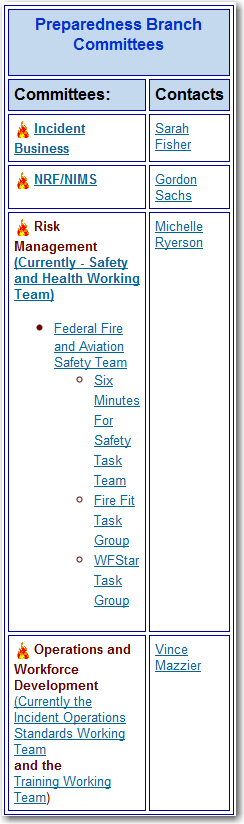
To say that safety and health are no longer goals of the National Wildfire Coordinating Group (NWCG) seemed rather surprising, so I went to the link, which leads to an organization chart showing the Committees of the NWCG.

NWCG_Preparedness_Branch_Committees

A portion of the chart is shown here on the right. As you can see, the organization is changing. The “Safety and Health Working Team” is becoming the “Risk Management” committee, and the “Incident Operations Standards Working Team” is merging with the “Training Working Team” to become the “Operations and Workforce Development” committee.

To say that “safety and health is no longer a goal” of the NWCG is misleading at best. And yes, the term “safety” in the organization chart has been replaced with “risk management”. But that does not mean that “safety and health is no longer a goal”.

Here are some definitions of the term “risk management”.

  • Risk Management is the identification, assessment, and prioritization of risks followed by coordinated and economical application of resources to minimize, monitor, and control the probability and/or impact of unfortunate events. en.wikipedia.org/wiki/Risk_management
  • The process of determining the maximum acceptable level of overall risk to and from a proposed activity, then using risk assessment techniques to determine the initial level of risk and, if this is excessive, developing a strategy to ameliorate appropriate individual risks until the overall level of risk is reduced to an acceptable level. en.wiktionary.org/wiki/risk_management
  • Risk management is the active process of identifying, assessing, communicating and managing the risks facing an organization to ensure that an organization meets its objectives. www.lesrisk.com/glossary.htm
  • The technique or profession of assessing, minimizing, and preventing accidental loss to a business, as through the use of insurance, safety measures, etc. Origin: 1960–65. Dictionary.com

I exchanged some email messages with Michelle Ryerson, the fire safety program manager for the Bureau of Land Management, the current chair of the Safety and Health Working Team, and interim chair for the Risk Management Committee. I asked about the reason for the changes and she said the name change better reflects their approach to safe and effective fireline operations. The reorganization of the NWCG gave the groups an opportunity to change the names, encompassing a more comprehensive programmatic approach.

“We are in the process of converting over”, she said, “but have not been officially chartered under the new title of ‘Risk Management Committee’ (mission will remain the same) — plan to have conversion happen early spring of 2010 and will make note of it on our website”.

I asked what the effect of the change would be on firefighters. She responded:Continue reading