Aerial Firefighters Association to promote safety, standards, innovation

The launch of the United Aerial Firefighters Association adds a unified industry voice to help shape changes in fire aviation practices, policies and funding.

As noted in their launch release on February 16, the UAFA was founded in “an effort to respond to the ever-growing wildfire challenge” and unites “leading aerial firefighting companies … to form a powerful industry association that will serve to foster safety and standardization in the aerial firefighting community.”

United Aerial Firefighters Association

The UAFA identifies as “the only association dedicated to aerial firefighting and is a unified voice advocating for safety and standardization on the local, state, and federal levels.” Membership is open to those who own, operate or lease wildland firefighting aviation assets, and companies supporting the aerial firefighting industry. Additionally, free memberships will be available to nonprofits and state and national agencies engaged in the wildfire community.

“We’ve seen tremendous change occur in wildland fire aviation over the last twenty years,” says John Gould, President and CEO of 10 Tanker Air Carrier, who is one of the founding members as well as the UAFA’s first president. “As we look ahead, these challenges will only become more significant. While individual organizations within the industry will always be competitive, we believe the collective expertise represented within UAFA membership will help to ensure our industry continues to grow with the innovation, safety, and standardization necessary to deliver the best service possible to our customers.”

The UAFA’s entry into policy and planning occurs at an opportune moment. With the initial report on fire aviation released this week by the Wildland Fire Mitigation and Management Commission, the need and value of a focused industry-expert voice becomes more apparent. Though the phrase “private aviation” only occurred three times in the commission’s report, some variation of “contract,” “contracting” or “contractor” appeared 132 times, including in the second recommendation: “Efforts should be made to include contractor perspectives in any future strategy development given that, at this time, the majority of aviation resources in the federal fleet are owned and operated by contractors.”

And in the third recommendation: ”A national strategy should consider all ownership models, including contracting and government ownership of aviation resources.”

Recommendations 5, 6 and 7 focus specifically on the contracting and financing of fire aviation, all seeking to resolve an interconnected set of concerns summarized in Finding 4: “Agencies’ current budget structures and contracting constraints have incentivized the use of contracts that are seasonal, shorter term, and, while incorporating best value considerations, ultimately favor short-term budget expediency over long-term value.”

(For more on the Commission, see “First Wildland Fire Commission report focuses on aviation” in Wildfire Today.)

As Gould observed in an interview with Wildfire Today/Fire Aviation, the initiative for founding the UAFA preceded the Wildland Fire Commission – so board members were able to meet with the commission and “were gratified to see that some of the points we discussed made it in to the report,” even though the UAFA was still in its founding phase.

“It’s the right time, right place” for the industry to come together, Gould said. While many of the members have met individually in the past with members of Congress and the US Forest Service and related agencies to share their perspectives, they were often asked “what does the industry think? We see the advantages of speaking as a single voice, a unified voice. We realized that within our individual companies we have an expertise and experience yet there’s nobody that really speaks for our industry, to get the messages to our customers and to the Hill.”

UAFA has opened an office in Washington, D.C., and is planning to hire an executive director this spring. One of their first charges will be “to discuss what our organization can do. The breadth of experience you find in UAFA reaches back into into 20, 30 years of experience and innovation. And innovation comes in a lot of forms, so the challenge is how do you integrate it into fire … with the association, we bring experience across all aspects of innovation, safety and standards.”

Founding UAFA board members include:

  • President: John Gould, 10Tanker
  • Vice President: Bart Brainerd, Firehawk Helicopters
  • Secretary/Treasurer: Brett L’Esperance, Dauntless Air
  • Director: Tim Sheehy, Bridger Aerospace
  • Director: Jennifer Draughon, Neptune Aviation Services

For more information about the UAFA, visit UAFA.org or email membership@uafa.org.

A jumper to remember

William Dinwiddie Tucker, a smokejumper in the early decades of the program, died on January 18, 2023, in Arlington, Virginia, at the age of 94.

William Dinwiddie Tucker

His obituary included stories of fires he jumped and his commitment to his smokejumper colleagues.

“One such fire was immortalized in the article ‘I Jump into Hell,’ published in the October 1955 issue of Cavalier magazine, where he was part of a team struggling to get their wounded colleague out of the forest.”

Stills of smokejumpers and Richard Widmark from "Red Skies of Montana."
Stills of smokejumpers and Richard Widmark from “Red Skies of Montana.”

“Bill can also be seen in the 1952 film Red Skies of Montana, working alongside Richard Widmark and Jeffrey Hunter. Until recently, Bill would return periodically to Montana for smokejumper reunions where he would work on clearing trails and reminisce over cold bottles of Moose Drool beer with his friends.”

After three seasons as a smokejumper, Tucker “joined the USAF Reserves, transitioning to active duty in 1961. He served as a USAF Military Pilot and Aircraft Commander with the 53rd Weather Reconnaissance Squadron (Hurricane Hunters) at Ramey AFB in Puerto Rico. In Vietnam, Bill served as a pilot and instructor flying C-123s and C-130s on transport and defoliation missions. After the war ended, Bill went back into the USAF Reserves, working at Andrews AFB with the 459th Congressional Wing until he retired as a Lieutenant Colonel in 1979.”

His citation for the Distinguished Flying Cross noted “how Bill successfully completed a high priority mission despite his aircraft sustaining significant damage.”

The family requests that donations be made to the National Smokejumper Association, https://smokejumpers.com.

Flying smarter to manage wildfires

2023 begins as a year of fire aviation innovations.

Wildfire-focused aviation innovations for the first few weeks of 2023 hold promise for a year of improved aviation tools and techniques. Some of the more recent examples range from financial innovation to foam delivery.

FINANCING: The special purpose acquisition company (SPAC) of Jack Creek Investment Corp. collaborated with the long-time aerial firefighting delivery company, Bridger Aerospace Group Holdings, LLC (BAER/BAERW), moving onto Wall Street via the Nasdaq Global Market. Shares began trading on January 25 and dropped by a third on day three, with the company’s market capitalization at a robust $760.64 million. More on process and goals of this business combination at https://ir.bridgeraerospace.com/news-events/press-releases/detail/16/bridger-aerospace-and-jack-creek-announce-closing-of.

Eight scooping air tankers at Santa Fe airport
Eight scooping air tankers at Santa Fe airport, May 6, 2022, operated by Bridger Aerospace and Aero-Flite. The Calf Canyon and Hermit Peak Fires were nearby. Photo by Jerry Messinger.

Bridger provides a “fleet of firefighting aircraft, which includes ‘Super Scoopers’ (CL-415EAF), air attack and logistical support aircraft .. and UAVs (Unmanned Aerial Vehicles). Bridger also offers FireTRAC (https://firetrac.com), an innovative, proprietary data gathering, aerial surveillance and reporting platform that complements its fleet of firefighting assets.”

AERIAL FOAM: Aerial X Equipment continues to develop and deploy a range of aerial foam engines. As described on their website, “Aerial X Equipment’s Striker Airborne Fire Engine™ is the first airborne platform that produces homogeneous high expansion class A foam. This enables it to become the first aerial wildland fire suppression force multiplier with unique capabilities and a range of capacities.” This foam engine floating in the sky beneath a range of helicopter platforms is claimed to have longer-residency foam due to the use of compressed air (CAFS) – with Aerial X stating residency of 30-90 minutes compared to 1-10 minutes for traditional low-expansion foam. More at https://aerialxequipment.com.

TELEOPERATED FLIGHT: Our prior coverage of Rotor Technologies will continue to be updated, and Fire Aviation articles on other innovations are in progress.

But not all the updates hold such promise or good news.

CRASH SETTLEMENT. A family of a helicopter pilot, Heath Coleman, who died while fighting wildfires in Alberta, Canada, in 2021 due to a faulty rotor pin, has received a $10 million settlement, per a report in AviationPros. At the time, the fatality inspection report led to temporary grounding and rotor-pin inspections of more than 500 Bell 212 helicopters.

K-MAX, GOODBYE. The venerable twin-rotored K-Max will cease production. Over 60 rolled off Kaman’s production lines over 30 years, but limited demand and low profitability led to Kaman’s decision.

K-MAX Comet Fire
A K-MAX helicopter (N314) drops water on the Comet Fire north of Salmon, Idaho July 28, 2016.

The company has committed to support those helicopters already in service. https://www.ainonline.com/aviation-news/business-aviation/2023-01-19/kaman-ending-production-k-max-heavy-lift-helicopter.

PRODUCTION NOTE: Lest we take the pace and utility of tech innovation for granted — the research, writing and posting of today’s article was thanks to satellite connectivity on a cross-country flight which also featured some monitoring of prescribed burns in Louisiana and surveying the snowpack in New Mexico, Arizona and southern California.

Surveying the snowpack en route to LAX. Photo: Ron Steffens.


Bill Gabbert’s death announced by his family

We are saddened to share that Bill Gabbert, founder of Wildfire Today/Fire Aviation and a friend and colleague to so many in our profession, passed away last night. His family shared that Bill  died peacefully in his sleep yesterday evening in Senatobia, Miss.

Our thoughts are with Bill’s family. We will share more on Bill’s life in the days ahead.

Writing on fire, from the air … top FireAviation articles of 2022

The voice we’re missing here – that of Bill Gabbert – is here in the archive of Bill’s articles. Join us as we begin the new year with a return to a few of the most-viewed posts from 2022.

Of those in the top 10 from last year’s FireAviation.com archives, one stands out, demonstrating Bill’s key ability to listen, reflect and make context from the work of those in the field. This was published January 14, 2022, but recounted fire events from September 2021.

The headline: “Air tanker pilot dropped retardant on his own neighborhood.”

DC-10 dropping Almeda Fire Oregon September 8 2020
DC-10 dropping on the Almeda Fire in southern Oregon. Screenshot from video by Helga Descloux September 8, 2020.

And it begins …

In lining up the DC-7 air tanker for his first retardant drop on the Almeda Drive Fire southeast of Medford, Oregon on September 8, 2020, Pilot Scot Douglas looked out of the window of Tanker 60 and saw his wife and daughter hosing down their yard. The fire was spreading north toward his neighborhood pushed by 40 to 45 mph winds out of the southeast. The wind aligned with the Interstate 5 corridor as it burned through communities like a blowtorch for 8 miles, starting north of Ashland and tearing through the cities of Talent and Phoenix.

For the rest of the article, visit https://fireaviation.com/2022/01/14/air-tanker-pilot-dropped-retardant-on-his-own-neighborhood/.

Needless to say, it became a tragic day — as we witness too often when fire burns into communities — but as you read (or re-read) this post we celebrate (again) some good news for the pilot’s family and home.

Drones are playing an increasingly important role in fighting wildfires

drone wildland fire firefighter
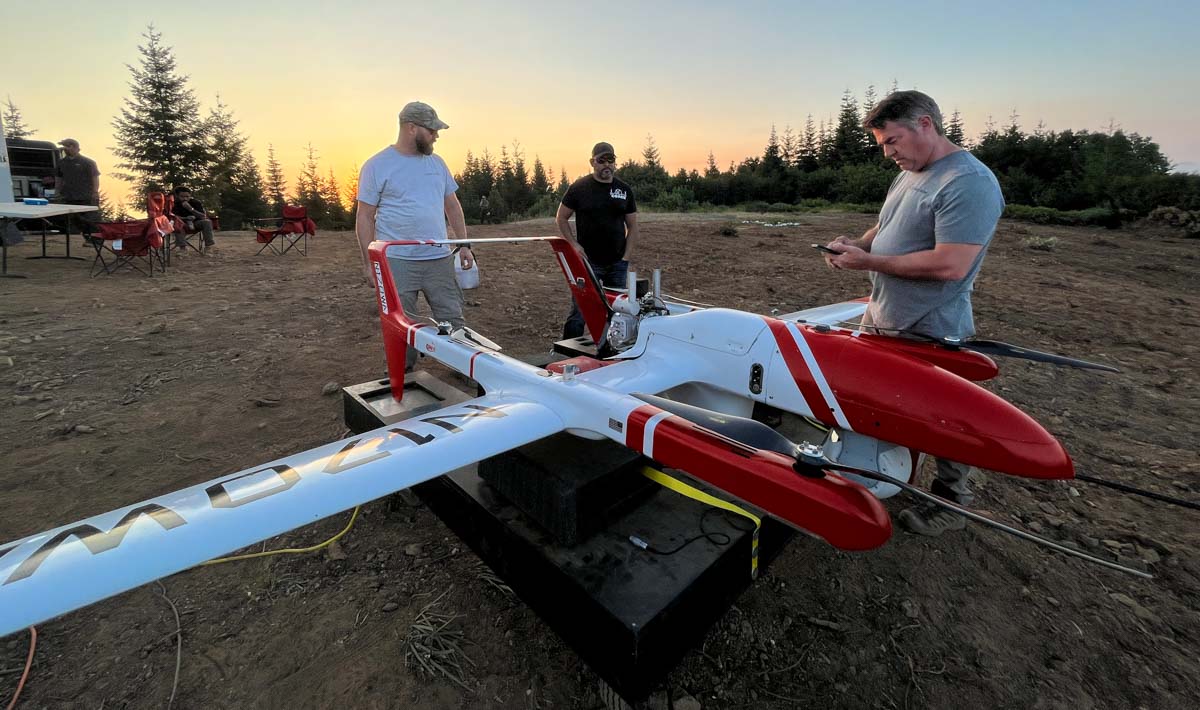
A contracted UAS crew with Precision Integrated Programs / Overwatch Aero — Tyler Kock, Daniel Rodriguez, and Cliff Savage — on the Lighting Complex of fires. US Forest Service photo by Andrew Avitt. FVR-90, N170WA.

By Andrew Avitt, US Forest Service, Pacific Southwest Region

Drones – also called UAS or unmanned aerial systems – are playing an increasingly important role in fighting wildfires by supporting operations with aerial ignition and gathering intelligence for firefighters. The greatest benefit drones provide is they can take to the sky when manned aircraft are grounded for pilot safety.

Take, for example the FVR-90, a fixed-wing drone with a 14-foot wingspan capable of traveling at speeds up to 46 mph with a flight time of 8 hours. They are sent airborne just at dusk when other manned flights are grounded. The sky is theirs, and the overhead view they have of the fire is detailed and in real time.

“The way we use UAS now is very much a supplement,” said Justin Baxter, the Forest Service National UAS Operations Specialist. “There are certain times that it’s just not safe for us to utilize manned helicopters or fixed-wing aircraft, like nighttime operations or in thick smoke or high winds.”

drone wildland fire firefighter
USFS photo by Andrew Avitt.

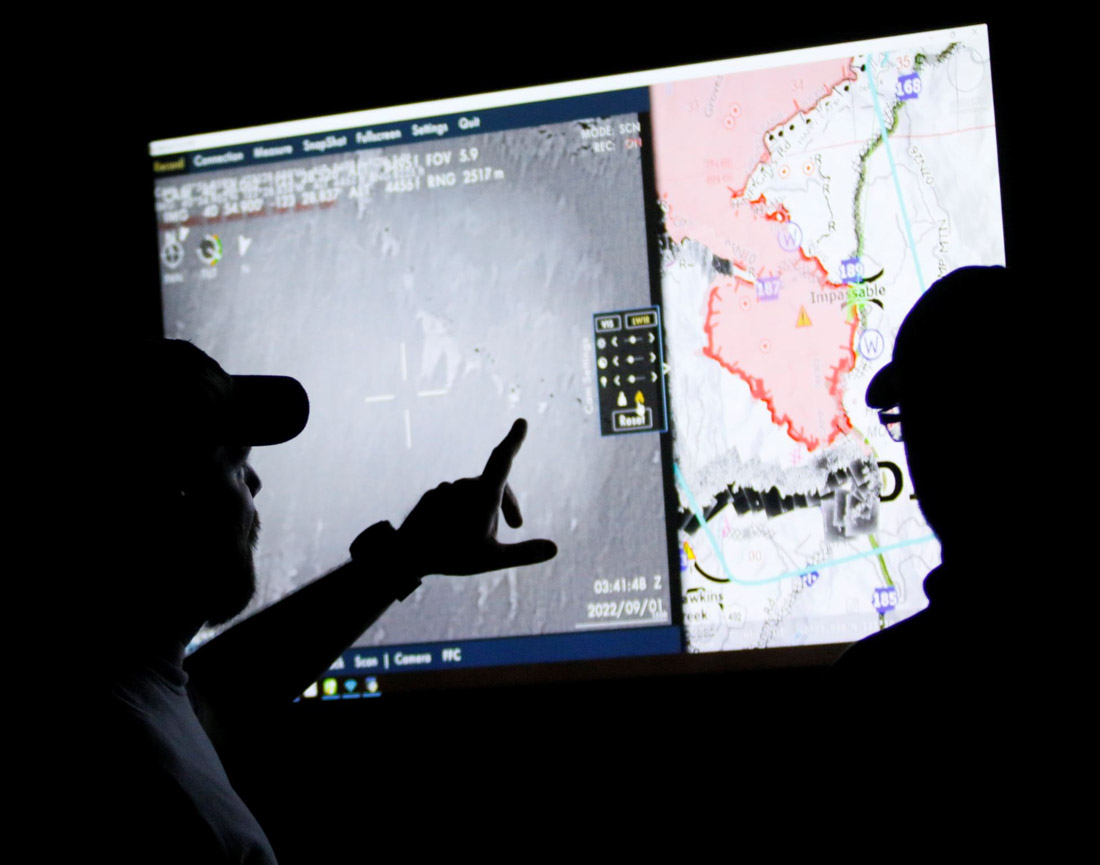
The drones that Baxter and his team fly are equipped with cameras that are not your normal cameras. They have multiple types of sensors, including infrared, that allow the team to see through smoke and, at night, see heat signatures, or thermal-based imaging. This allows the identification of areas where fire is still active and new areas where flames have advanced, such as spot fires.

Spot fires occur when embers from the main fire are thrown into the air and pushed by wind until they fall to the ground, starting a new fire. They are notoriously hard to identify because they are small at first and visibility is diminished by smoke. They may occur in hard-to-reach places difficult for firefighters to patrol, like on steep slopes or down in drainages.

“Drones are changing that labor-intensive process to identify these spot fires, especially when an operational area can span hundreds of thousands of acres,” Baxter said. With drones, fire managers and incident management teams can scan large areas quickly and easily identify spot fires that may be a mile from the main fire. That enables firefighters to get in and suppress those new starts before they grow.

“To give you an idea, this drone can detect a 2-inch by 2-inch spot fire from a half-mile away,” said Baxter as he gestured to the imposing drone just to his left minutes before takeoff to fly around the perimeter of the Six Rivers Lightning Complex Fire near Willow Creek, California.

Baxter said that much has changed since 2015 when the agency began the UAS program.  With each passing year, incident management teams have increasingly incorporated the capability into their strategies.

The communication between the UAS crew and firefighters on the ground flows in both directions. The drone may be flying over and see heat in an area and transmit the information to a hotshot crew. Conversely, the hotshot crew can ask the UAS crew for assistance in exploring an area that they suspect might be active, and then view a feed from the drone of the area in question.

John Crotty served as the air operations branch director with California Interagency Incident Management Team 15 that responded to the Lightning Complex Fire on the Six Rivers National Forest.

drone wildland fire firefighter
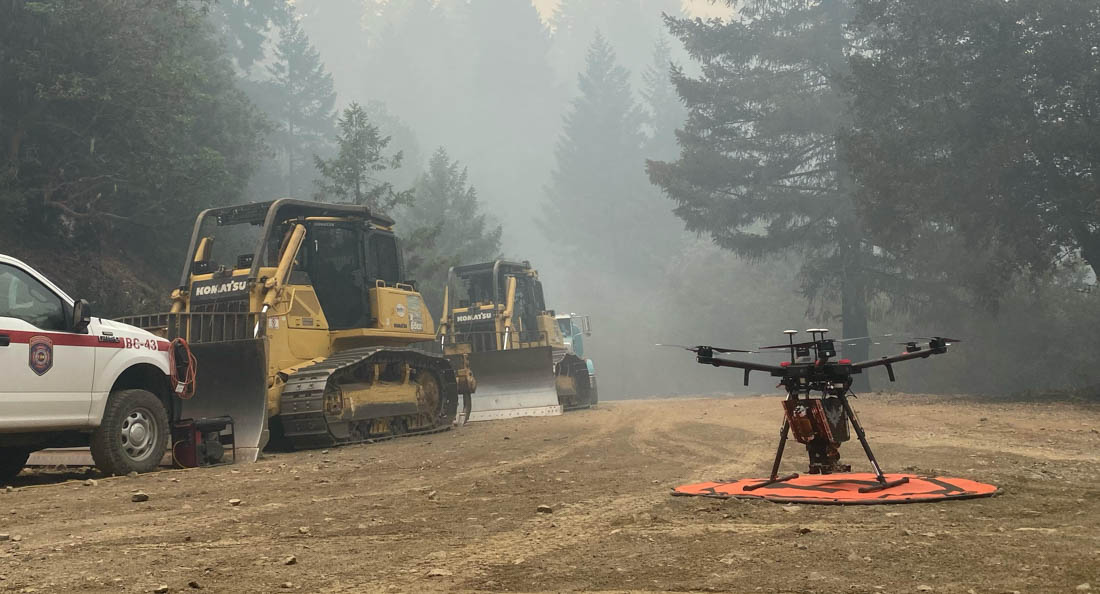
A drone equipped for aerial ignition. USFS photo by Mike Yearwood.

Aerial intelligence isn’t new in wildland firefighting, said Crotty referring to the recently retired Cobra helicopter and its Firewatch capabilities. But the implications of unmanned flight— that opens up new possibilities.

“With the Cobra aircraft, we needed a pilot and an interpreter up there to run the camera and talk to the folks on the ground. So, we expose two individuals plus a flight [to risk],” said Crotty, “But what we really needed was the visibility to fly.”

Thick smoke on the fires like the Lightning Complex can ground manned aircraft. That’s where drones come into play and the images it captures can inform firefighters working across a large area.

“The other day I heard from one of the hotshot crews out there. They were in heavy smoke conditions, at night. With the low visibility they couldn’t see if they had a spot fire across the line,” Crotty said. “This tool being up in the air, looking down at that exact area, the UAS crew was able to pinpoint the spot and provide precise coordinates to the firefighters who were able to check it out and put it out. That kind of information we would never have without these unmanned aircraft and that capability. Drones are the future of aviation for not only fire but for aviation in general. It’s a win-win for the agencies to operate under an umbrella of this type of aircraft that can provide precise and timely info to firefighters and incident management teams. And most importantly, we can do it safely.”

26-year old is the youngest and first-ever female Fire Boss pilot

Mikaela Young Fire Boss
Mikaela Young in Fairbanks, AK with Fire Boss. (Alaska Fire PIOS photo)

By Public Information Officer Kelsey Griffee,
Alaska Wildland Fire Information Center

Aerial firefighting is a dangerous job and few make the cut in this fast-paced adrenaline-fueled world. Water-scooping Single Engine Airtanker (SEAT) pilot Mikaela Young, a born and raised Alaskan, fits right in with her desire to do anything that, “gets the heart rate up.”

At the age of 26, *she is considered the first female and the youngest person to ever pilot a Fire Boss. She is praised for her impressive flying and instincts beyond her years, according to officials at Dauntless Air, the company that owns the contracted firefighting airplanes.

Young grew up homeschooled along with four siblings on an off grid, 320-acre homestead near Talkeetna, Alaska. Her family lived in tents for three years while building their house. When she turned 15, she started logging seven days a week to pay for her first truck. Young credits her work ethic to her parents.

Mikaela Young Fire Boss
Mikaela Young (Alaska Fire PIOS photo)

Young was inspired to get into the aviation world after participating in Build A Plane, a nonprofit that gives Talkeetna youth the chance to rebuild an airplane. After rebuilding a Cherokee 6, Young decided to pursue a career turning wrenches as an airplane mechanic.

Young had “wicked” motion sickness growing up and never thought she would be a pilot. But her need to “try everything” and learn more about the planes she worked on changed her mind.

She convinced a coworker to instruct her and within a year she had earned all her pilot ratings, including private, commercial, and multi-engine. She got her start in commercial aviation as a flight engineer and then moved up to piloting World War II DC-6 and C-46 planes, the giant cargo planes that transport fuel and food to remote Alaskan villages.

“I like the flying world more than the wrenching world because there is always something new. Different weather, scenery, and emergencies,” Young said. “Wrenching was a lot of the same tasks every day.”

She saw the Fire Bosses, the water-scooping airplanes that look much like crop dusters with floats, for the first time while flying cargo across Alaska. These floats give them the Fire Boss name and separate them from the SEATs flown in the Lower 48 with a wheeled configuration.

Mikaela Young flying a Fire Boss
Mikaela Young flying a Fire Boss. Photo by first year Fire Boss pilot Scott Palmer.

Then, a year ago, she met Mindy Lane, a SEAT base manager with the BLM Alaska Fire, and Sonny Amboni, Dauntless pilot, who explained the requirements to become an aerial firefighter. At the beginning of the fire season, the BLM AFS contracts four Fire Bosses to respond to wildfires throughout the state and orders additional when fire activity increases.

“I thought (Fire Bosses) were pretty cool and convinced (Dauntless Chief Pilot and Director of Operations) Jesse Weaver to hire me,” Young said. “Flying a Fire Boss is awesome! I love being the only one in the cockpit.”

A Fire Boss is an AT-802F aircraft equipped to scoop and drop 800-gallons of water on wildfires. Two postcard-sized scoops on the bottom of each float pylon fill the tank as the plane skims over water as little as 4-feet deep in a matter of 15-seconds. Their ability to scoop from a body of water near a wildfire make them a valuable firefighting resource, especially in Alaska, where fires are remote and there is an abundance of water.

“Flying a Fire Boss is challenging. Scooping is the most difficult thing I have ever done in an airplane,” Young said. “You are flying across water at 60 knots when you put the probes out to scoop water. Initially it dips the nose and you have to correct for that. As the hopper fills with water the plane starts to porpoise from sloshing water and you are eating the wake of the plane in front of you. You’re heavy and slow and the plane doesn’t want to fly.”

This year, Young flew her first fire in her home state of Alaska. It was small smokey spot fires, but her second fire was “big flames.”

“It was cool,” Young said. “I can’t believe I get paid to do this.”

When asked what she thinks about being the first female Fire Boss pilot, “It’s pretty cool to be given the chance. I don’t see it as a big difference. I have always worked in a male dominated field. I do like being the youngest working with all these grandpas. It looks like bring your grandpa to work day.”

Fire Boss 209 - Caroline
Nose art on the Dauntless Air Fire Boss “Caroline.” Dauntless photo.

Look for Young in smokey skies, flying her favorite Fire Boss – named “Caroline” with a painting of a woman firefighter holding a Pulaski much like Rosie the Riveter – as she fights fire across the country.

Dauntless Air Fire Boss Caroline
Dauntless Air Fire Boss “Caroline” is in the foreground. Behind her is Dauntless FB 211 “Head Hunter”, and behind that one is Dauntless FB 214 “Christine.” Dauntless photo.

*Note from Fire Aviation editor: Dauntless Air says, “Dauntless can confirm that Mikaela Young is the first-ever woman Fire Boss pilot and was the youngest ever, to the best of our knowledge, at the time of her training. These claims apply to the Fire Boss; we can’t be sure if they apply to all Single Engine Air Tankers as well.”

There are many makes and models of SEATs. The Fire Boss is an amphibious Air Tractor 802F which can refill the tank by skimming along the surface of a body of water.

Interview with Lead Plane pilot Lisa Allen

BLM Lead Plane Pilot Lisa Allen
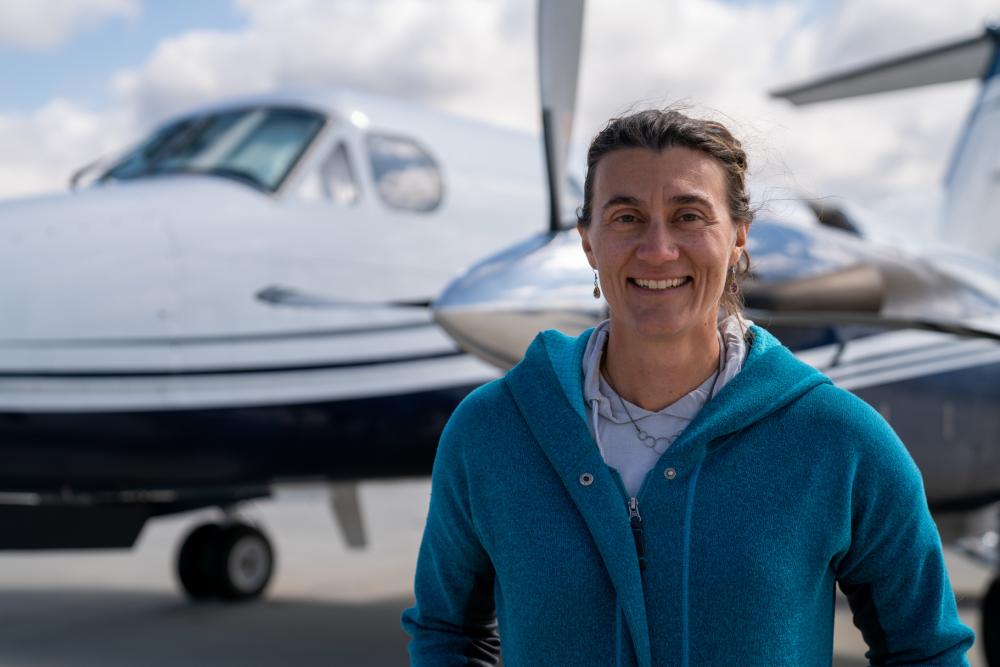
BLM Lead Plane Pilot Lisa Allen at the flightline of the National Interagency Fire Center during MAFFS spring training in Boise, Idaho April 29, 2022. Photo by Air National Guard Senior Airman Michelle Brooks.

By Air National Guard Senior Airman Michelle Brooks

I had the opportunity to interview Lisa Allen, a lead plane pilot with the Bureau of Land Management’s National Aviation Office, about the role of a lead plane pilot during wildland fire suppression missions.

Q. What is the role of a lead plane pilot?
A: The role of a lead plane pilot is to increase the safety margin for the air tankers and helicopters fighting the fires. We do that through flying a more nimble aircraft and being on-scene throughout the mission, so that we can observe the conditions as they change. We find the firelines, we search out all the hazards, we scout the exit routes and we coordinate the air space. Safety is our main goal. Our secondary goal is efficiency and effectiveness. We help the tankers get on to the line and coordinate the resources so we’re using them efficiently and effectively.

Q. How long have you been a lead plane pilot?
A: I was signed off in 2019. I started officially training as a lead plane pilot in 2018. This will be my fourth season.

Q. As far as the training aspect, are you giving feedback to the air tankers on their drops?
A: Yes. I try to always make a left-hand turn so that I can see the drop point easier. Once I come off the run I watch the retardant fall. We evaluate the start point, if we’re trying to tie into something, or the end point, if we’re trying to roll up to something. Also, we evaluate the direction of the line—how much it drifted one way or the other if we had a crosswind—the angles of the line. We try to give them honest feedback. The pilots are using all their knowledge, their previous experience, and all that culminates to them pushing the button. They’re always judging and trying to figure out, “Did I push that button in the right place?” or, “Did I put my airplane in the right place?” If we sugar coat the drop, we’re not helping. We’ll say things like, “that was a half a load late,” or, “a wingspan to the left,” or, “you were off on the heading by ten degrees.” Things like that.

Q. What risks are involved in this type of low-level flying with an air tanker?
A: One of the principles we learn is to always have an exit and never take a loaded aircraft where you can’t get it out of. Sometimes we can’t drop retardant because there’s just not a good exit—it isn’t safe. The exit is probably the most important part of the drop and the easiest to forget about. A big part of my job is scouting the exit. I also have to be constantly looking for wires, towers, and where there is lower terrain. If, for some reason, either I lose an engine or if the tankers lose an engine and they can’t get rid of a load, where are the hazards they’ll need to avoid?

Q. What is the role of the lead plane when helicopters are being used?
A: We sequence the helicopters in between the tanker drops. So, we find out where they’re going to be dropping and where they’re getting their water from – or, if it’s a recon helicopter, for logistics, we find out where they’re coming from and where they’re going to. Then, we create checkpoints and routes to clear the flight paths of different aircraft away from one another.

Q. What is the most unique aspect of your job?
A: To me, it’s super unique, in that one second you’re sitting here in Boise, like today, and dispatch could call and say, “Hey, we’re sending over a resource order.” We print out a piece of paper and it’s got the name of the fire, its coordinates, and frequencies—and we get in the plane and go. It could be from here to SoCal. It could be all the way to Florida. I go all over the place. I also get to fly a King Air, which was not designed to fly in the environment we fly in, it was made as a commuter jet, so that’s interesting. I get to go work with DC-10s, MD-87s, air tractors, C-130s, all kinds of different helicopters, in a very tight airspace—it’s all in a different changing environment–and I get to use my airplane to help.

Lisa Allen, a lead plane pilot with the Bureau of Land Management’s National Aviation Office, provided training and support for U.S. Air National Guard and Reserve MAFFS-equipped C-130 Hercules H- and J-models during annual spring training and certification held at Gowen Field, Idaho April 25-30, 2022. Military flight crews spent the week training with their civilian counterparts in preparation for the upcoming wildland firefighting season. All MAFFS units are requested through the commander of U.S. Northern Command (USNORTHCOM) to provide support to the National Interagency Fire Center (NIFC) in conducting wildland fire fighting operations within the United States. First Air Force (Air Forces Northern), USNORTHCOM’s Air Component Command, is the DoD’s operational lead for the aerial military efforts.


For another article about a lead plane pilot, check out Bill Gabbert’s interview with Jamie Tackman in Chile when Mr. Tackman was leading the 747 Supertanker.