The open wounds of Pedrógão Grande

This article first appeared in Wildfire magazine.

The Pedrógão Grande mega fire of June 2017 shaped a region by tragedy, causing profound human consequences that have left people battling their own memories, questioning their safety and working through trauma.

Lily Mayers writes on how the lives of those touched by Portugal’s worst mega fire have changed since the smoke cleared.

The fire storm’s intensity melted skin off hands and feet, liquified glass windows and reduced standing signs to puddles of metal. The ferocious wind whipped heat up from the burning forests, thrusting flames forward before crashing them down on the small towns dotted across Portugal’s central region, suffocating the area in thick black smoke.

On the afternoon of Saturday, June 17, 2017, a complex of at least five wildfires ignited, spread and merged across 11 small towns surrounding the municipality of Pedrógão Grande in Central Portugal creating an unstoppable and catastrophic fire event. Sixty-four people died and 250 were injured. Over five days more than 46,000 hectares of land were destroyed. The fire struck territory carpeted by highly flammable, abandoned pine and eucalyptus plantations at a time of prolonged drought and enduring heat waves. The major triggers were found to be contact between vegetation and a 25 kV electrical line as well as lightning strikes.

Aerial view of a forest area between the villages of Pobrais and Nodeirinho, in the municipality of Pedrógão Grande, in the central region of Portugal.

Volunteer firefighter Rui Rosinha, 46, was called in as reinforcement. He was driving to one of the emerging spot fires when his team’s truck collided with a car on the N-236 highway near Pobrais, southeast of Coimbra. The crash stranded them on the side of the road and trapped the three unconscious passengers of the car. As the firefighters struggled unsuccessfully to free the passengers from the wreckage, the wind, radiation and heat from the approaching fire became unbearable. They were forced to save themselves and leave the passengers behind. Huddled together on a small island junction of raised concrete in the middle of the highway, Rui and his four colleagues then endured an hour of exposure to flames, heat, cyclonic winds and the thrashing of airborne debris.

“We experienced temperatures that seemed impossible,” Rui said “The radiation came in waves. I felt it as if it were extreme waves of heat, I remember not just once, but many times the impact and pain, as it hit my body.”

Though severely burned, the group was able to successfully shelter three adults and a child on the same junction. When help finally arrived Rui and the others were driven to medical centers before being airlifted to hospital and that’s the last thing he remembers.

“If ever there was a hell on earth, for me it was there.”

The fire moved at unbelievable ferocity, with more than 4400 hectares burned in a single hour, violently accelerated by intense wind gusts, emitting enough energy to propel itself and exceed the capacity to be extinguished within four hours of igniting. The severe speed of the fire, which by nightfall was advancing at 15 kilometers an hour, outpaced evacuation orders and knocked out communication networks, trapping hundreds and killing dozens in their cars as they fled on the N-236 highway.

It was the worst mega fire in Portugal’s history. As a result of the disaster, family members of those who died and others who were seriously injured were compensated from a 2.5-million-euro support fund. A complete reform of land management legislation was also prompted including the introduction of a new 10-meter clearing rule between roads and vegetation, the banning of new eucalyptus plantings and a shift away from purely reactive firefighting to prevention investment. The reach of the Pedrógão Grande mega fire has left physical, psychological and generational scars, altering the social fabric of the small communities forever.

How have the lives of those touched by Portugal’s worst mega fire changed since the smoke cleared?
RUI

Almost three months after the fire, Rui awoke from a coma to a new reality. He had suffered debilitating burns to his hands, back and feet, respiratory problems as well as partial paralysis to his left side due to injuries in a nerve plexus making him wheelchair dependent.

“Those first nights, when I began to realize what had happened and when I began to understand my body and what was happening to me, those first nights were horrible.” He pleaded for psychological help as he grappled with suicidal thoughts, “I saw that I didn’t have the capacity to deal with it [alone].”

Thrust into this new reality beside him was his family.

Rui’s distraught but resilient wife, Marina, 45, had anguished through the months he was in a coma with daily drives to the hospital two hours away and when he woke she became his full-time caregiver. His two young sons, Antonio and Francisco, 12 and nine at the time, were confronted by a jarring role reversal in prematurely being the able men and joint caregivers of the house. Among these harrowing realizations for Rui was that his close childhood friend and colleague with him in the fire, Gonçalo Conceição, hadn’t survived. Rui says the guilt of surviving when his friend didn’t and not being able to save the passengers of the car, are two of the most complex psychological hurdles he is working on overcoming.

“I’m managing to approach and exorcize some ghosts and it is an almost permanent mourning to face traumas and talk about certain subjects that were taboo for me or at least I couldn’t face it.” Over the years, Rui has been able to reconcile and overcome parts of the trauma in a process that he says will never end, just forever evolve.

“These are the steps I am taking, that I am achieving to feel more at peace with myself and be at peace with others too.”

Rui comes from a family of firefighters. With reduced mobility however he has been transferred away from active duties after 28 years of service and now the Castanheira de Pêra fire brigade, once a second home to his family, is a place he feels uncomfortable and alien within. Despite everything his family has been through, both his sons dream of pursuing the family tradition. For now, it’s a dream Rui and his wife are conflicted in supporting.

ANA

Some see daily reminders of the fire written on their bodies, while others face stubborn mental barriers in evolving past June 17. Ana Luisa Bernardo, 51, lost both her mother and father, Maria, 71, and Manuel, 80 in the fire. Their car crashed on the shoulder of a road as they fled the town of Sarzedas de São Pedro.

“The descriptions from people were that the sky suddenly turned dark and they couldn’t see anything. So, I believe he didn’t realize that the turn was right there on a steep slope,” said Ana. Having worked as a diagnostic and therapeutic technician in hospitals for 25 years, she says not being able to save her parents brings immense pain, “Every day I still think about the subject. I can’t dissociate.”

For two years Ana was so paralyzed by the pain of losing her parents she was unable to enter their family home. She would visit it every weekend and clean the lower patio but not cross the threshold. Even now, Ana is still gradually sorting her parent’s belongings, a journey her daughter Sátia, 16, is helping her through. “What I’m trying to do is triage only what brings back good memories, what’s bad is not worth keeping. It’s very delicate.”

From what was already a network of small towns where most people are known to one another, now exists a new subcommunity forged by their shared grief and loss after the fire. This web of survivors refer to each other as a family who speak the same language of experience. “We share the same pain, some in one way, others in another,” Ana said of one of the tragic event’s rare silver linings.

But from the community the fire created, it also took away. Many of the towns affected haven’t been able to return to the bustling places they once were. Ana says in Sarzedas de São Pedro, the change is palpable.

DEOLINDA AND ANTONIO

Deolinda Henriques Simões and Antonio Dias Gonçalves work on their property in Nodeirnho. The manual labor involves pulling weeds, clearing gutters and cutting back the forest’s understory, to reduce the chances of another fire. Photo: Paulo Nunes dos Santos for Sonda Internacional.

Retired couple Deolinda Henriques Simões, 55, and Antonio Dias Gonçalves, 80, spend their weekends in the tiny town of Nodeirnho. The day before the fire struck, the renovations of their weekend home were finished. They escaped just in time but “in the blink of an eye” their new home was destroyed before they could enjoy it.

Once it was safe to return to the smoldering town, they drove back and found the remains of their home and all their life savings destroyed beyond repair. “All the windows and doors were wooden in the old-fashioned way. I remember getting there, I only saw the walls and that’s what happened. So much so that the beams that I had placed in aluminum were all crammed together like snails,” said Deolinda.

It is estimated more than 1,000 buildings were damaged or destroyed in the fire resulting in damages of up to 200 million euros. The Portuguese government committed to providing 30 million euros for the reconstruction of first homes. But for Deolinda and Antonio their old home had been registered as dilapidated by the previous owner, unbeknown to them, so it wasn’t eligible for insurance cover or government aid. The couple were left with nothing and had to wait three years before investing again. They have now bought around the corner from their old destroyed home but their new view frames their past struggles.

“Unfortunately, we can see the skeleton of the old house, which is just the torn walls, there’s nothing left.” Antonio says their new home has the best insurance they could get.

The couple, now acutely aware of what fuels a mega fire, use their weekends to clear the land around their new home. The manual labor involves pulling weeds, clearing gutters and cutting back the forest’s understory. It’s back-breaking work for the couple who are noticing the difficulty their age brings to the task but are limited by the cost of outsourcing it.

CÉU

Their town of Nodeirnho was once described as a lively place filled with young families and weekenders. But when the June 17 fire came through it killed 11 of the town’s 50 residents. Those who remain still live among burned houses, hauntingly permanent reminders of the night their neighbors died.

Maria do Céu Silva, 52, is one of them. Céu (as she’s known) survived the fire by sheltering in the water tank beside her home with a dozen others. She is lucky to have lived, but it was at a cost. She and the others with her had to endure the sounds of their neighbors dying within earshot. “We heard screams and cars crashing, and then we realized there were a lot of people in the village who were already dead. We never thought there would be so many. It was horrible but we couldn’t do anything. We didn’t have the means to help.”

The fire and the evidence of its destruction across the town mean residents like Céu are trapped in a time capsule, unable to move forward. “I used to actually be a very fun person, and I think that since that happened, I’m not. Because we leave the house, I speak for myself and go to my work and pass by several places where victims died. It marks us every day no matter how much we go through and forget, we remember every day.”

Among the town’s victims were two children aged three and four, and several people in their 30s. Céu says much like in Sarzedas de São Pedro, they had filled the town with activity and dynamism. Now the chemistry of the tiny village has changed dramatically. Deathly quiet and still ash-stained, it feels ghostly with virtually no passing foot or car traffic. Céu says many of the remaining population are elderly and mostly stay inside their homes. In summer, when the wind picks up Céu fears fire will return to the town.

GONÇALO

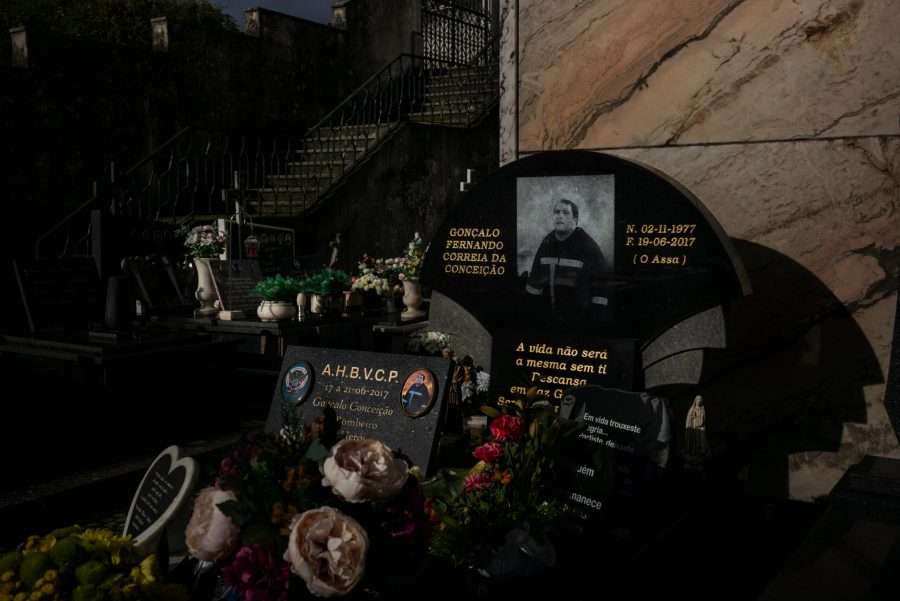
Monuments dedicated to the victims of the Pedrógão Grande fire are scattered across the region. Written on all of them is the name of the only firefighter who died, Gonçalo Fernando Correia Conceição. The charismatic and well-loved firefighter was known as “Assa” or “Dr. Assa” (from the Portuguese assar, meaning to grill) due to his renowned barbequing skills and restaurant of the same name.

The 39-year-old is missed by many within the community he was so involved in, but none feel the loss more than his family. Years on from the fire, his parents strain to speak through the grief. They, and Assa’s 17-year-old son David, live with the consequences of his selfless decision to routinely run into danger to help others, “It’s the life he chose, that’s it. It was his way to help others.” said his father, Joaquim Domingos da Conceição, 69.

Maria da Conceição, 63, grips a portrait of her son, Gonçalo Fernando Correia da Conceição, the only firefighter to die during Portugal’s Pedrógão Grande mega fire of 2017. Gonçalo was severely injured after he and his team became trapped in the flames during the extinction operation. Six years after the fire, Maria remains grief stricken by the loss of her son who was well-loved by the Castanheira de Pêra community. Photo: Paulo Nunes dos Santos for Sonda Internacional.

The 39-year-old is missed by many within the community he was so involved in, but none feel the loss more than his family. Years on from the fire, his parents strain to speak through the grief. They, and Assa’s 17-year-old son David, live with the consequences of his selfless decision to routinely run into danger to help others, “It’s the life he chose, that’s it. It was his way to help others.” said his father, Joaquim Domingos da Conceição, 69.

Hotelier Joaquim and his wife, Maria da Conceição, 63, have kept their son’s house in pristine condition in the hopes their grandson, who had to move away after Assa’s death, will someday return to the town and take over his father’s restaurant. Like many families, they experienced a double desolation when the death of a loved one prompted other family members to move away.

Inside Joaquim and Maria’s lakeside hotel in Castanheira de Pêra a huge quote has been painted on the wall of the dining hall, it reads, ‘May my presence never be forgotten in my absence! Thank you friends. – Dr. Assa.’ His parents say they have no fear their son will ever be forgotten.

THE PEDROGAO GRANDE MEGA FIRE

The Pedrógão Grande mega fire shaped a region by tragedy, causing profound human consequences that have left scores of people battling their own memories, questioning their safety and working through trauma. For those, the fire is unfathomable to forget. But in the wider community others are eager to leave it in the past and focus on the future.

While these communities oscillate between the two outlooks, the vegetation surrounding them has been quietly regrowing. Now the build-up has reached levels higher than before the fire and many fear history could repeat when the region almost inevitably faces future weather extremes.

Government forestry workers are attentively cutting back trees close to roads and houses while homeowners like Deolinda and Antonio race tirelessly against the growth of the pines closing in around them. Looking at the dense forests threaded throughout his town Joaquim Conceição says the work doesn’t go far enough, “Another similar tragedy could happen tomorrow,” he said. Meanwhile, the graves of Ana Bernardo’s parents lay claustrophobically encircled by the same thick vegetation that accelerated the fire that caused their deaths.

Lily Mayers is a freelance journalist from Sydney, Australia, based in Madrid, Spain. Mayers’ career began in television and radio news for Australia’s national broadcaster, the ABC. Since moving to Spain in 2020, Mayers’ work has focused on the long-form coverage of world news and current affairs.

This report was developed with the support of Journalism fund Europe.


New strategy needed for extreme wildfires

This article first appeared in Wildfire magazine.

The author, Rick McRae, argues that the impacts of climate change must be better included in wildfire management strategies. McRae is an adjunct professor with the Bushfire Research Group at UNSW Canberra.

After a career as an ecologist, senior emergency manager, and bushfire scientist I have a particular view of where climate change is taking us; it is fundamentally based on Australian conditions, but I have an international perspective that is both operational and scientific. A lot of people say a lot about this problem, but too many are saying different things. Who does one listen to, especially if you enjoy your comfort zone? You may disagree with my views, but rather than dismiss them, start a conversation with your colleagues and think about how what I am saying might affect both them and your collective goals. My career and my research has all been aimed at reducing wildfire risks. Here I simplify some topics, and omit a lot of necessary technical detail, but I completely support the outline that I present.

The global collective of fire management wisdom is clearly focused on a fuel-oriented path forward in the face of climate change. The Landscape Fire Governance Framework that arose from the 8th International Wildland Fire Conference in Oporto in May 2023 is the latest element of a global framework. The framework states that fires are getting worse due to a combination of too much wildfire suppression, a lack of investment in fire management, and changes to how communities handle fire on the landscape. A common theme in discussions is the need for more fuel management, either through more fuel reduction burning or a switch to Indigenous practices.

To this end, planning typically includes a focus on risk reduction through hazard reduction via fuel management. Training, equipment, and systems are focused on this system, matched by budget allocations. Satellites show that certain countries produce a lot of smoke from this risk-reduction effort. For normal wildfires, fire services and their communities do a very good job mitigating the risk. (Can this ever be enough?) Climate change is increasing fire danger as the world warms up, and fire services and land managers are correctly adapting to the heightened risks.

At the same time, the world is being severely affected by what are called extreme wildfires, which dangerously couple with the atmosphere above.

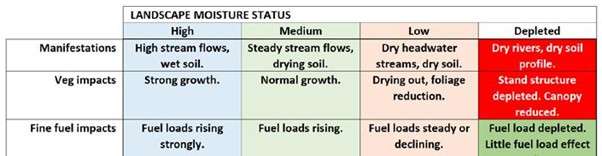
It is critical to correctly use the terms normal and extreme: normal fires spread by quasi steady state fire behaviour – if you know the fuel and the terrain, then you largely know what the fire will do; extreme wildfires have one or more blow-up fire events (BUFEs), where the fire couples with the atmosphere and exhibits dynamic fire behaviour, which often involves feedback loops and so the details are largely unpredictable. Figure 1 shows their relationship.

For BUFEs, there is no explicit role for fuel load (beyond the need for a prior fire), indicating that fuel management – central to the framework – is unlikely to be an effective preventative action. We do, however, need to explore how fuel management can be targeted to prevent future dynamic fire escalation. Extreme wildfires do not occur in flashy fuels such as most grasslands: they are mainly a problem in forests and woodlands and they have, in recent years, occurred in new ecosystems (discussed below). (See figure 2.)

When an extreme wildfire couples with the atmosphere after being triggered by dynamic fire behaviour, a BUFE occurs, lasting up to three hours, and typically burning 50 to 100 square kilometres (20 to 40 square miles). With little opportunity for fire suppression the only real incident objective is to save lives. Saving structures may put fire crews at risk for little return. This minority of fires cause the majority of damage.

Figure 1. The relationship between the fire drivers for normal wildfires with quasi-steady state behaviour and the fire drivers for extreme wildfires with dynamic behaviour. The left is quasi-deterministic while the right involves unpredictable feedback loops.

The incident action plan for affected sectors and divisions during a BUFE looks very different to that for a normal fire. Locally appropriate strategies and tactics need to be formulated to help save lives.

There is an archive of decades of high-quality satellite data that is informing many aspects of the challenges associated with extreme fires; it will become increasingly important that we get the full leverage off the datasets involved. The complexity of the changes already underway can be overwhelming. It will be important for end users to make clear what their needs are, and for them to accept the answers produced.

While many authors have used forward-looking climate models to anticipate how climate change will impact fire risks, observations are now showing a far more alarming picture overall.

Fire thunderstorms, called pyroCbs, are the most obvious manifestation of extreme wildfires. A recent study found that there has been no recent global trend in the frequency of pyroCbs. Global pyroCb activity has always been dominated by fires in and around Boreal forests. However, areas such as Australia, South Africa, South America, and the Mediterranean have only recently started having problems with extreme wildfire. Canada, in 2023, experienced the most protracted ever season for extreme wildfires, globally. Australia’s Black Summer was just as prominent with record breaking intensities.

Figure 2. The drivers of fire risk. The “depleted” column is where dynamic fires usually occur.

An important step must follow on from recognition of the wildfire-type dichotomy: operational doctrine must be revisited. As an example, in Australia, the national doctrine for operations in the urban interface lacks any dynamic fire behaviour elements. This document is founded on decades or experience during fire fighting and is state of the art – for normal fires only. What is different? When a BUFE arrives at the urban interface, it is characterised by: (1) a lack of a headfire, with a switch to dense spotting, and a high chance of loss of overall situational awareness; (2) an ember storm (a sea of flowing pea-sized embers flowing over the ground), which is very different to typical ember attack (which is more like a mortar attack); (3) strong turbulence; (4) a darkened sky; and (5) much deeper penetration of the urban edge. Air ops are likely to be impeded.

Also, standard doctrine is often founded on past damaging fires, but key lessons from previous events may need revisiting if, as is often the case, those fires were driven by processes subsequently discovered, such as the key elements of dynamic fire behaviour.

Several past landmark fires have featured descriptions of the fire spreading sideways on the lee face of a ridge. We have seen this in news footage, with chief officers waving their hands sideways during media briefings, or even in official post incident reports. After being identified in 2003 in the Canberra fires, a scientifically validated concept called Vorticity-driven Lateral Spread (VLS) is now known to be the cause. VLS is by far the main cause of forest fire damage in rugged landscapes, globally. Fire service operations based on key lessons learned need to adapt to this. A lookout at a fire where VLS might occur has to be trained to look to the rear at certain landform elements, as opposed to the prior practice of focusing on the headfire. To avoid VLS-driven BUFEs, it may sometimes be an option to burn-out VLS prone areas ahead of the main fire when fuels are too damp to support spotting. Another key instance of the need to rethink is that dynamic fire behaviour is often associated with large air tanker accidents. Climate change is leading to large aircraft flying out of aviation weather into fire weather while climate change is turbo-charging weather close to the ground.

It used to be that different countries had different types of fire, and therefore different operational approaches. Climate change is reducing these differences. I identified a fire near Canberra in 2004 as being foehn-wind driven. Some time after that my collaborators and I wrote a paper on this, introducing Australian firefighters to an idea that has long been a mainstay of training in North America and the Mediterranean Basin. Over the following decade we found only a few good cases of local foehn-wind driven fires. Then during Black Summer, with hundreds of BUFEs, perhaps 50 per cent of those were of this type. That is a massive escalation.

These changes clearly suggest that the world needs a multi-pronged adaptation strategy to climate change’s impacts on wildfire risk. The strategy for normal fire is well understood and must be implemented and continually improved upon. The strategy works better than is acknowledged, because the metrics for success were developed using data from both types of fire. The inclusion of dynamic events with bad outcomes biases the outlook.

In passing, a serious issue arising from lumping all fires together is the mis-training of artificial intelligence and machine learning systems being developed to help mitigate bushfire risks. Just because a fire was attributed as something in a database 25 years ago does not mean that that is correct in today’s thinking. Climate change will not be forgiving to field crews using poor intelligence.

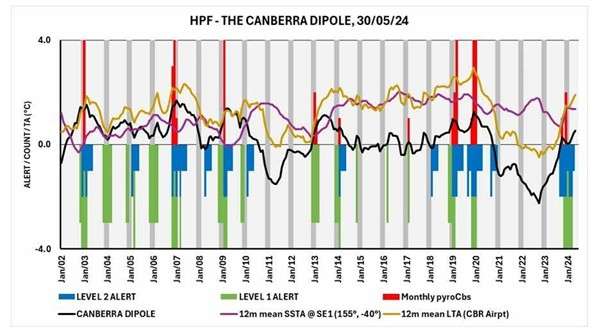
A new strategy is required for rapid adaptation to extreme wildfires. The ongoing escalation suggests a need for the multi-pronged approach to be created as quickly as possible. I have developed a framework for predicting dynamic fire events in the forests of south-east Australia, which aims to show the potential for new thinking (Figure 3). The framework seeks to predict BUFE events using hydrology, remote sensing, and fire ground data in a multi-scaled way.

For the adaptation strategy to work it is necessary to define the following: ownership (by a global body); working membership; protocols; data and accounting needs; professional development protocols; and dissemination channels.

The mandate for climate change adaptation for wildfires might include:

  • Focussing on extreme wildfires (to complement on-going collaboration on normal wildfires);
  • Defining, owning, and disseminating research goals;
  • Providing a hub for research outcomes;
  • Providing a forum for international exchange of relevant operational lessons;
  • Maintaining a global overview of wildfire problems and tracking the overview’s evolution;
  • Rapidly disseminating new information or certified lessons from major fire events.

Figure 3. Two decades of predictive analysis on the potential for pyroCbs in the forests of southeast Australia. PyroCbs (red bars) occur when alerts are generated by the system, either due to temperature anomolies (green bars) or landscape hydrology (blue bars). The orange line clearly shows the impacts of climate change on air temperatures in Canberra, while the purple line shows a more worrying trend for offshore sea-surface temperatures. The difference between the two sets of 12-month average anomalies – the Canberra Dipole (black line) – is critical for BUFE potential. At the peak of Black Summer, Canberra had an extraordinary 12-month average temperature anomaly of 3C. Similar frameworks could work elsewhere.

Students of the evolution of wildfire can look at the references cited in many new wildfire papers and see – from the references alone – where the paper was written and what technical specialty it is from (for both the authors and the journal). However, this Fire Tower of Babel situation is not good enough. In a similar vein, if we are to collaborate on these problems, we must standardise the terminology. The use of alternative terms, and the widespread misuse of others does nothing to aid adaptation –foundation terms such as pyroCb or megafire are key examples – and surely reinforces the previously mentioned issue with the training of machine learning systems.

The wildland fire sector needs to stop being overly distracted by fuel loads, otherwise we will all be affected by extreme wildfires and their impacts on ecosystems, communities, soils, hydrology, biodiversity, traditional practices, and the upper atmosphere – including the ozone layer.

Rick McRae served as a headquarters technical specialist in what evolved to become the ACT Emergency Services Agency in Canberra from 1989 until his recent retirement. He worked in business planning, arson investigation, multi-hazard risk assessment, as planning officer for major incidents, weather specialist, and as a research scientist focusing on extreme wildfires, and especially pyroCbs. McRae has conducted case studies, described new phenomena, and developed predictive tools. He maintains a website that aims to present operationally useful material on extreme wildfires: https://www.highfirerisk.com.au/.

McRae is an adjunct professor with the Bushfire Research Group at University of New South Wales Canberra.

LAHAINA FIRE: The failure of fire, law enforcement, and other agencies at the 2023 Maui fires

 ~ By Chuck Sheley, retired smokejumper (Cave Junction 1959)
and current NSA Smokejumper Magazine editor

As part of our family drove along the Lahaina Bypass Road on July 5, 2023, I mentioned to my son that I had never seen things so dry in the 20+ years that we have been going to Maui. The bypass road ran by Lahaina a quarter mile or so up the hill from that historic town. The area between the town and the bypass was solid grass a couple of feet tall. With the continual downhill winds, I mentioned that this was a disaster waiting to happen. On August 8, it happened. Lahaina was a historic town and a major tourist attraction. Years of history there.

I’ve always wondered about the Hawaiian “Hang Loose” attitude, but their house, their attitude. You can substitute incompetence for Hang Loose in this fire. Let’s look at what happened at Lahaina, where over 100 people died. Could it have been prevented? Were fire and law enforcement caught off guard? Definitely not! They just ignored the inevitable.

Chuck Sheley
Chuck Sheley

The Warning: In 2021 a Maui County commissioned report, County of Maui Report on Wildfire Prevention, was released. A summary: Wild/brush/ forest fires appear to be increasing; wild/brush/ forest fires present a growing threat to Maui County citizens; there are ongoing fire threats to Maui Island: grasses and combustible materials along road rights-of-way; low-hanging, failure, or shorting of above-ground powerlines.

The report included comments on Maui County’s Fire and Safety Response: “Prevention is given short shrift. There is no stated goal of fire prevention or any metric to assess success or improvement in prevention. There is much space devoted to preventing injuries and illness of employees and to preventing equipment failure, but nothing about what can and should be done to prevent fires.”

They were told wildfire is coming. However, they respond with employee concerns. How about the citizens? Sounds like an employee union response.

2014: Michael Walker, Hawaii’s Fire Protection Forester, urged state lawmakers to make a relatively meager financial commitment to boost wildfire preparedness: about $1.5 million. That money would have funded new firebreaks, livestock grazing, and water infrastructure for firefighting. The bill died in committee.

National Weather Service data shows that in the last 17 years, the NWS  issued 65 red flag warnings or fire weather watches for the area, including Lahaina.

When the predicted happened: The New York Times published an excellent report, with video, on this disaster from start to finish. “A cascade of failures by officials left thousands trapped and largely fending for themselves.”

Conditions: The NWS forecasted hurricane-force gusts up to 76 mph, with winds accelerating down the slopes leading into Lahaina. Using the NYTimes as a source, we have the following timeline: Shortly after sunrise on August 8, a powerline snapped and started a fire. Firefighters responded and contained the fire. Crew left site at 2:18 p.m. and returned to station. A 911 call at 2:52 p.m. as fire started again. (Fire Dept. did not leave anyone on the fire and did not make sure it was out.) At 3:22 p.m. fire jumped Lahaina Bypass and at 3:51 p.m., a Lahaina resident texted, “We are trapped.” At 4:13 p.m. fire spread across total area. Emergency managers chose not to activate the siren system, fearing people would evacuate TOWARD the fire. (Evacuate uphill toward a fire pushed by 70 mph winds?) 4:16 p.m. officials issued an evacuation alert via cellphones. But by then, the fire had already burned through the evacuation zone — 20 minutes earlier.

By 4:19 p.m. the fire had crossed Front Street. Roads were blocked. At 4:35 p.m. a caller to 911 said, “The roads are closed, I can’t turn out.” Roads blocked by downed powerlines, but Hawaii Electric said that the powerlines had been de-energized for hours. No one told the police who were blocking the escape routes. (No coordination between agencies.) 4:45 p.m. gridlock. Front Street blocked. Firefighters said they were losing water pressure. (Water and hoses against a wildfire pushed by 70 mph winds?) 6:00 p.m. Maui County mayor said he was “happy to report” the opening of the roads that had been blocked.

Honolulu Civil Beat: Maui County has known the town of Lahaina and its neighboring communities were the island’s most at risk for wildfires for years, with alarms being raised at least as far back as 2018. According to the county’s hazard mitigation plan developed in 2020, West Maui had a 90 percent chance of annual wildfires. Lahaina and the area around Maalaea were identified as being of highest concern.

Hawaii News Now: HNN obtained the report as part of an ongoing investigation of the county’s actions before, during, and after the wildfire that leveled Lahaina. Two months after the disaster, which claimed at least 99 lives with six others still unaccounted for, it’s clear that the wildfire threat was well-documented — the result of poor land management, inadequate planning, and drought. Escape routes blocked: As a reader, you can go to youtube and see videos taken by residents trying to escape Lahaina. Cars are backed up on Front Street, side by side and not moving. If the north end of Front Street had not been blocked by law enforcement, cars could have easily moved to safety in the large parking lots at Safeway — or driven farther north to safety. Some people drove around the blockage, but that didn’t help those trapped in line a mile back.

Associated Press (8/23/23): As flames tore through a West Maui neighborhood, car after car of fleeing residents headed for the only paved road out of town in a desperate race for safety. And car after car was turned back toward the rapidly spreading wildfire by a barricade blocking access to Highway 30. During a news conference on Tuesday, Maui Police Chief John Pelletier said, “So the police were blocking roads, the exit, some of the exit roads out. And I’m assuming it’s because there’s been some downed powerlines or some downed trees.”

In another news report: This week, Maui’s police chief explained why barricades were set up. “Downed powerlines, which would kill you if you drove over them,” said MPD Chief John Pelletier. Danger from downed powerlines: We know or should know that downed powerlines present a danger. The rule: Do not exit the vehicle, stay inside. Other references: A powerline is the source (electricity), so the only place it will want to flow is to ground. A vehicle sits atop rubber tires which provide an insulator, so the occupant would be insulated. Since the vehicle does not provide a path to ground, driving over a powerline would not pose a risk for the insulated occupant. (Trained officers and the Fire Chief should know this.)

Common sense is uncommon: We have a situation where a town is engulfed by a 70 mph wind-driven fire. Exit roads are blocked, and cars are jammed and not moving. Even as a law enforcement official, if you did not know that a vehicle could drive safely over downed powerlines, could you see the alternative — being burned to death by a wildfire? People with off-road vehicles ignored the barriers and drove around them to safety. Was there any power in those lines?

“By 6:40 a.m., there was no power to Lahaina or West Maui, according to Darren Pai, a spokesman for Hawaiian Electric.” (Honolulu Civil Beat)

Bottom line: There was plenty of advance warning, some back as far as 2014, that this wildfire would happen. Whoever was at the top of the food chain should have put fire, law enforcement, medical, and Hawaiian Electric into a room and devised a plan to coordinate all these agencies.

After the Camp Fire in Paradise, California, which destroyed a town of 26,000 people in a matter of hours, all of Maui should have been aware of the need to shut down powerlines during high-wind events. Coordination between fire and law enforcement is also at the top of the list. Each seemed to be operating independently of the other in Lahaina. I still cannot understand how law enforcement officers could block escape routes. That is like locking people inside a burning building.

Maui should have had trained wildland firefighters. Anyone thinking that the loss of water pressure was a factor here does not have much knowledge of wildfire. You don’t face down an advancing wildfire pushed by 70 mph winds with a hose. Time spent spraying water on a burning house, surrounded by 30 other burning houses, is a waste of time. Forget the houses and concentrate on evacuating people.

How many eventual victims could have been saved if those roadblocks were removed? After the Camp Fire in Paradise, I’ve championed the establishment of “safe zones” rather than road evacuation. It didn’t work in Paradise, and it didn’t work in Maui. There is a concrete parking garage at the north end of Lahaina. I would bet that 500-600 people could have sheltered in place there. Athletic and play fields at the schools were other possible safe zones. There are many experts in planning and coordinating wildfire efforts. Because the local officials on Maui, with years of advance warning, couldn’t properly prepare for a disaster, bring in some experts from the mainland.

Best description of the Maui wildfire — fiasco!

smokejumpers.com
National Smokejumper Association — smokejumpers.com

Chuck Sheley (Cave Junction ’59) graduated from Chico State University in 1960. He taught Physical Education for 36 years and coached track and cross country in Chico for 53 years. After two seasons on an engine crew on the  Lassen National Forest, he jumped at Cave Junction 1959-66, then out of  Fairbanks 1967-1970. Sheley was the organized crew coordinator for the Mendocino National Forest for 19 years, where he recruited and trained 300 new firefighters each year. He finished his fire career with 34 seasons in wildland firefighting, and he’s still coaching and officiating Track & Field and has served as editor of Smokejumper magazine since 1999 — he’s also the vice president of the National Smokejumper Association.


Spanish scoopers: a major defense against European wildfire

An article by Spanish journalist Miguel Hernández Fernández

First published by A21 — the first two images
were approved for Miguel’s final project
in his university communications degree.

The 43rd Air Force Group in Spain is one of the main weapons in the fight against forest fires there, and the Canadian-built amphibious aircraft are one of the main reasons.

It has been over 50 years since the incorporation of the first two seaplanes, a major force in the fight from the air against forest fires in Spain and the region. The 43rd Air Force Group has accumulated a brilliant history and is one of the most successful and admired units of the Spanish Armed Forces.

Its history in Spain begins in 1969 when, after the results achieved in France, Canadair, the designer and builder of the seaplane (today Viking), deployed an aircraft in Galicia at the request of the Spanish government. The results were so impressive that the Ministry of Agriculture decided to purchase two aircraft to be operated and maintained by the Air Force. The government assigned them to the 803 Squadron of the Getafe Air Base, and personnel were trained in Canada late in 1970.

Spanish scoopers
These dams are near the43 Group military base in Torrejón de Ardoz (Madrid). Photo ©2024 Miguel Hernández Fernández

Crew training and aircraft delivery were overseen by the Canadian company and delivery flights made by the Spanish crews, who accepted the planes in  February of 1971. The scoopers arrived at their base after crossing the Atlantic with stopovers in Newfoundland and the Azores. The aircraft carried out their first detachment at the Santiago de Compostela Aerodrome that same summer.

Because of the increase in forest fires and the achievements of the aircraft in the first two campaigns, in 1973 the purchase of eight more seaplanes was decided. The 404 Squadron was created, a unit dedicated exclusively to fighting forest fires and based in Torrejón de Ardoz. In 1974, the new planes arrived with some improvements – such as exploration and meteorological radar and bubble windows, which equipped the aircraft for their secondary task of search and rescue.

Spanish scoopers
Robledo de Chavela is a village in the mountains west of Madrid. This fire in 2020 was ignited by a motorcycle crash and spread very fast; it burned a great area that included three villages. The fire affected many animals, because the area is an important protected species zone, where still can be seen the fire effects. Photo ©2024 Miguel Hernández Fernández

The C-215 were seaplanes with Pratt and Whitney piston engines with a power of 2,100 hp each, as well as water tanks with a capacity of 5,400 liters. Its crew consisted of a pilot, co-pilot, and maintenance specialist who also assists the crew when necessary.

In 1978 the 404 Squadron reached 10,000 flight hours and received several decorations and recognitions for its already impressive career. In 1980, the 404 became the 43rd Air Force Group, which it maintains to this day – as well as its summer deployments in Torrejón de Ardoz, Albacete, Palma de Mallorca, Santiago de Compostela, and Zaragoza.

Spanish scoopers
Las peñotas is a dam near the city of Ávila. This 2021 fire started in the town of Navalacruz, about 20 miles to Ávila. This fire was devastating but generated a movement of solidarity throughout the country with the ranchers and farmers affected by the fire. The initial forces had to be increased, with many resources in Spain (Castilla León, Madrid, Castilla La Mancha, Galicia) and the UME (Military Emergency Unit) was deployed with many resources, including the Group’s 43 aircraft, that flew with many other planes and helicopters. Photo ©2024 Miguel Hernández Fernández

In 1989, flight hours reached 55,000 and some aircraft were modified to the CL-215T version. This variant, developed by Canadair, was enhanced when the company was purchased by Bombardier. Among other improvements, the conversion replaces the piston engines with turboprop, resulting in greater performance and power (2,380 hp), four-blade propellers, larger capacity in the water tanks, and structural reforms such as winglets at the ends of the wings and improvements in controls and flight systems.

Not all the planes were converted, but ten seaplanes of the new version were purchased, and the unconverted primitive engines were sold or operated by civil companies, which have kept some in flight to this day.

Spanish scoopers
This set was taken during a season presentation day for the media, at Valmayor dam, where two planes of 43 Group made a demonstration for fire suppression. This image is the final flight and marked the return to base. Photo ©2024 Miguel Hernández Fernández

The maintenance of the fleet has been carried out, since 1971, at the Albacete Air Master and the approvals are also conducted in Spain, a sign of the capacity of our aeronautical industry and the competence of the personnel.

In 1995, the 43 Group began operating with only the new CL-215T, reaching 100,000 flight hours in 1999 and counting thousands of hours during each season from June to September. With the passage of time and the acquisition of aircraft, the detachments have expanded: in addition to Torrejón de Ardoz, Albacete, Palma de Mallorca, Santiago de Compostela, and Zaragoza, they now also include Málaga and Badajoz, with full capacity to deploy in the Canary Islands.

In 2002, in response to the Prestige oil tanker disaster on the Galician coast, the 43rd Group collaborated with other units of the Air Force in the detection and monitoring of spills. The flights were intense and long in the harsh Atlantic winter, demonstrating the preparation and commitment of the crews and maintenance teams to help mitigate the disaster. Between December 25, 2002 and January 9, 2003, nine sorties were carried out, with some missions during that crisis lasting more than six hours with aircraft flying from sunrise to sunset.

A CL-215T carries around a 300 lb. lower payload than the CL-415 and does not have an electronic flight instrument system (EFIS) flight deck. The major visual difference is CL-215T’s two-door bomb bay; the CL-415 has a four-door bomb bay, and which aircraft is better is continuously debated by the worldwide operator base.

In 2006 the first of the four new CL-415s – an improved CL-215T – was received, and in 2012 the 43 Group reached 150,000 flight hours.

Spanish scoopers
Beginning of the 2019 season at Valmayor Dam. Photo ©2024 Miguel Hernández Fernández

The Unidad Militar de Emergencias (UME) is a branch of the Spanish Armed Forces providing disaster relief throughout Spain, and abroad if required, and it relies on the 43 Group – with more than 150 people and 18 seaplanes (fourteen CL-215T and four CL-415, with fuselage numbers 43-31, 32, 33 and 34) that, year after year, fight forest fires not only in Spain but also other countries including Israel, Portugal, France, and Morocco. All these over the years have counted on Group 43 to fight fires in their territories.

The responsibility of the 43 Group is subject to the intensity of challenging launches, over very hot areas, landing on water surfaces that are not always clear of obstacles, along with other factors that could easily trigger disaster. Fifteen crew members over the years have lost their lives fighting wildfire. Their memory and sacrifice have a permanent tribute at the Group Headquarters, as a testimony to the enormous difficulty of the job that demands the maximum from its members.

Spanish scoopers
Torrejón de Ardoz air base. The pilot is a veteran who carries proudly a patch that means he has flown in ten fire seasons. Photo ©2024 Miguel Hernández Fernández

The official motto of the 43 Group contains both the greatness and the humility with which its members fulfill their duty:  Apaga … y vamanos.  Literally translated, that is “Turn off and let’s go.” What it means is “Put this fire out and let’s go home” — or it’s all in a day’s work, not heroic, just part of the job.

In memoriam
08-09-1976

Alférez D. José Luis Herráez Soria
Brigada D. José Cachofeiro Ramón
Sargento 1º D. José Pérez Belmonte
12-10-1980
Comandante D. Óscar Sáez de Santamaría Alegría
Sargento 1º D. Luis Vélez Tarano
02-03-1981
Teniente D. Fernando Esteban Baturone
Teniente D. Aurelio Gil Laso
Alférez D. Eduardo Javier Moreno Jiménez
Sargento 1º D. Santiago García García
09-09-1988
Capitán D. Pedro Álvarez de Sotomayor Seoane
Capitán D. Jesús Cembranos Díaz
Teniente D. Carlos Ramírez de Esparza Figuerola-Ferreti
Sargento D. Juan Carlos Muyo Romero
25-03-2003
Sargento D. Manuel Fábrega Salas
Sargento D. Manuel Fernández Carrascosa


Miguel Hernández Fernández: “Since I can remember, I have been passionate about aviation. From building plastic kit airplanes I went on to photograph them and from there, when I had my first SLR camera in 1991, I became a spotter photographing real airplanes. At the same time I took the ultralight pilot course and, although I flew little, I enjoyed it to the fullest. With a journalistic vocation, I started with the magazine VOLAR, and the TV program ‘Caminos en el Aire,’ reporting on military and civil aviation with video. I obtained my university degree in communication and I maintain my passion for aviation and photography. And the best: when I hear a propeller or a jet engine, at home or outside, I always look at the sky.”

Cal Fire C-130s

Here’s more from Ryan Grothe:


Last week I was up in Sacramento attending the Aerial Firefighting Conference, and I took a tour of Cal Fire aviation headquarters at McClellan Airtanker Base. The main topic of discussion was the C-130 tankers, and here is an update.

According to Cal Fire officials, One of the C-130s should be ready to go sometime this year, and the first one will be based at McClellan. The other six C-130s will be tanked soon. Fresno and Ramona have been confirmed for C-130s.

Cal Fire’s new C-130s at McClellan — photo ©2024 Ryan Grothe
Cal Fire C-130s
Cal Fire’s new C-130s at McClellan — photo ©2024 Ryan Grothe

And here’s a note Bill Gabbert wrote two years ago:

C-130s Bill Gabbert
AND the editorial Gabbert wrote a year before that:  Congress should hold hearing on C-130s 


Aerial Firefighting Conference at McClellan

We weren’t able to attend the Aerial Firefighting Conference at Sacramento last week, but Ryan Grothe was there, and he sent us some notes and photos.


Britt Coulson
This photo of Britt Coulson with one of the company’s Black Hawks was taken five years ago by Bill Gabbert when the two of them met up at HAI Heli-Expo in 2019.

Coulson Aviation president Britt Coulson spoke at the event; he said this summer Coulson plans to take delivery of a 737-700 series aircraft from Southwest Airlines.

The 737 will have multiple cabin configurations, including head of state, business class, and standard seating. Leveraging off the already successful 737-300 platform, the prototype 737-700 will begin its modification this summer  with an expected certification date by the end of 2025.

This will be the first 5000-gallon Large Air Tanker ( LAT ) to enter service. It will be equipped with the RADS-XXL tanking system.

The RADS – XXL systems have also been selected for the tanking of the CAL FIRE C-130s. Coulson has also added more C-130s to its fleet, along with two Citation 500 aircraft for intel and lead operations and a Bombardier Challenger.

The California National Guard operates aerial firefighting helicopters that can be activated from 5 bases:

      • Los Alamitos: UH-60 Black Hawks
      • Fresno: CH-47 Chinooks / UH-60M Black Hawks.
      • Stockton: Uh-60M Black Hawks / UH72A Lakotas
      • Mather: UH-60M Black Hawks
      • Moffett: HH-60G Pave Hawks

 ~ Ryan Grothe

Aerial Fire Conference McClellan. Photo ©2024 Ryan Grothe

Just Put It Out

Book Review by Brian Ballou

Running Out of Time: Wildfires and Our Imperiled Forests
David L. Auchterlonie and Jeffrey A. Lehman

RUNNING OUT OF TIMEWhen I was asked to review a new book, Running Out of Time, by David Auchterlonie and Jeffrey Lehman, I was underwhelmed. First, I had to set aside the book I was already reading, The Complete Works of P.G. Wodehouse, and then dive into something that looked like it was penned by the Government Accounting Office, something Congress orders when it wants to give one of the federal government’s agencies a good spanking.

Instead, it turned out to be a surprisingly thorough and readable book written by two high-level business troubleshooters who are genuinely concerned about climate change and the role of wildfires in making the planet considerably hotter than it used to be.

Wildfires have come to dominate the news in the past 30 or more years since they have become larger and harder to stop, and the destruction caused by them has reached epic proportions. And this is not just a Western United States problem. Wildfires have plagued the planet — in the U.S. from Alaska to Florida, in Australia and South Africa, southern Europe, and the northernmost forests of Canada and Russia. (If I’ve left anyone out, just wait; your turn is coming.)

Efforts have been made to stop the Big Wildfire problem by a number of agencies in the U.S. However, in the authors’ analysis, the money spent on the cure is way, way short of what is needed.

“A put-the-fire-out-first strategy should be fundamental.”

“[T]he DOI, USDA, Homeland Security, Defense/Energy and others will spend approximately $16.8 billion [in FY2021-22] on forest maintenance and wildfire management. This figure represents only 0.28 percent of the total federal budget. Despite $8.5 billion of increased allocations since 2000, the number of burned acres of forestland also increased by more than 75 percent during the same period. Even with the most recent ten-year funding from the 2021 Infrastructure Investment and Jobs Act, the federal funding commitment is not keeping pace. It is, quite frankly, an embarrassment, considering the stated priorities of preserving our forests. Americans impacted by wildfires each year (212 million or nearly 65 percent of the country’s population) deserve better.”

Call me old-fashioned, but $22.6 billion sounds like a lot of money. But so does 65 percent of the United States’ population being affected by wildfire.

Scarier yet is the number of homes, subdivisions, even whole towns burned to cinders by wildfires. In the past 30-plus years, that number has skyrocketed. And it’s expected to get worse.

“Under current federal agencies’ practices,” say Auchterlonie and Lehman, “wildfires now place 46 million residences in 70,000 communities at risk. Two-thirds of the country face the threat of large, long-duration wildfires. As the wildland-urban interface (WUI) expands due to expected population growth in the next twenty-five years, some experts predict a 50 percent increase in wildfire acreage consumed by 2050.”

To which they add: “[T]he last update to federal interagency wildfire fighting was in 2009. It excludes any mention of prioritizing early wildfire extinguishment.” Instead it focuses on thinning and prescribed burning. The authors say, “A put-the-fire-out-first strategy should be fundamental.”

“Annual devastation from wildfires requires an immediate, laser-focused, and warlike response. Study after study shows aggressive wildfire initial response within the first few hours of ignition minimizes the likelihood of more devastating and intensive wildfires.”

Then there’s the smoke problem. Wildfires in the United States produce approximately 10 percent of the global wildfire greenhouse gas emissions each year, say the authors. “Wildfires across the globe produce twice the CO2 as all commercial airline flights in the world in 2019, and about 60 percent of emissions from automobiles. While the economic cost to the environment caused by wildfires has not been ‘quantified,’ it is substantial and ‘one more reason to expeditiously extinguish them.'”

Therein lies a very old problem: How to quickly and completely extinguish a wildfire after it has escaped initial attack and burned thousands, or tens of thousands, or even hundreds of thousands of acres of wildland. It soon emerges in Running Out of Time that the answer is to have more airtankers. A lot more. “[T]he government should purchase a fleet of 200 SEATs, 75 to 125 large airtankers (LATs), and 30 to 50 very large airtankers (VLATs).” And more helicopters and bulldozers, too.

Oh, and another thing: “Fight wildfire twenty-four hours a day.” While this poke in the eye is primarily for the U.S. Forest Service, the authors also note that quite a few state and municipal firefighting agencies engage fires quickly and work as productively as possible around the clock. Some even own night-flying helicopters — but they also have trouble with a small number of their fires, which too often become landscape-gobbling, home-wrecking wildfires.

RUNNING OUT OF TIME

While their airtanker buying recommendation is an alarming, blow-your-hair-back shopping list, Messrs. Auchterlonie and Lehman go into considerable detail to illustrate their position on how to pull this off. They propose a top-to-bottom reconfiguration of many (perhaps all) federal agencies to make them more efficient. The authors are, after all, business consultants who have helped large corporations with turnarounds and mergers, and were consultants to the likes of Boeing and McDonnell Douglas. They have 80 years of combined experience in the private sector and government. They know how to strip large corporations down to the bone and build them back better.

An admirable amount of research went into this book, and it is notable that the focus is on finding a better way for keeping that small percentage of wildfires that escape initial attack from becoming destructive megafires. Granted, working firefighters and managers may not be the target audience — although many could benefit from reading the book. I suspect city planners, homebuilders, elected officials, and members of the news media could learn a great deal from Running out of Time. It’s also a good book for the public — the people who know or suspect that they live in a wildfire-prone area.

Wildfire remains a dizzying, frightening mystery to millions of people. This book may not assuage their fears, but at least they’ll understand considerably better what they’re up against — and maybe take away some small hope that two guys who have never dug an inch of fireline do know how to fix it.

Published by Amplify Publishing Group
Copyright ©2023 by the authors and Crowbar Research Insights LLC
Edition reviewed: Hardcover (publisher-supplied) 403 pages. $34.95
The book is also available in paperback and kindle editions.

Bill Gabbert’s roots in fire and route into fire journalism

by Chuck Bushey

Meriwether William “Bill” Gabbert II of Senatobia, Mississippi died peacefully on January 14, 2023 at age 75 from cancer.

Nobody that I know ever called him Meriwether. He shared that name with Meriwether Lewis, half of the renowned Lewis & Clark Expedition, and Meriwether is the name of the canyon mouth adjacent to Mann Gulch above the Gates of the Mountain Wilderness on Montana’s Missouri River.

Bill and his siblings grew up in the same small rural town south of Memphis where he was born in 1947. After high school he went on to Mississippi State University for Agriculture and Applied Science (commonly called Mississippi State University) in the central Mississippi community of Starkville. I can imagine that the change from Senatobia, population about 3200 persons, to the much larger community of Starkville (about 11,400 people at the time) and entering into studies at the university must have been a major eye-opening change for Bill.

After navigating university life, Bill graduated with his B.S. degree in Forestry. As we all do upon graduating, it was time for him to make decisions on which direction to head next with a budding career. Bill decided to join up with the U.S. Forest Service to further his forestry interests and education, so he headed West to California and soon added wildland fire to his forestry toolbox. In actuality he probably didn’t have much of a choice about entering into wildland fire; at that time during the 1970s all USFS employees were “firefighters” in some capacity. It was a requirement that everyone understood; this was an organization that had been born into fire. Bill obviously took quickly to the challenge, joining up with his first fire crew, the El Cariso Hotshots, in California. This crew was one of the very first hotshot crews, established just after World War II on the Trabuco District of the Cleveland National Forest.

Bill truly enjoyed his seasons with the hotshots and he frequently mentioned in later years his memories from these days. Those memories weren’t all fun – they included the fatalities the crew suffered during the 1959 Decker Fire and the 1966 Loop Fire – the latter was still a fresh and sore memory when Bill joined the crew.

Fire crews of all types are wonderful places to develop lifelong friendships as people move through the fire seasons. This was also a time during which Bill quickly learned the ins and outs of the structure and politics within the wildland fire community, knowledge that would serve him well later in life. He ended up with 20 years of service in the U.S. Forest Service, and then transferred to the National Park Service (NPS) for another 13 years. He eventually retired as the Fire Management Officer for the Black Hills National Forest in South Dakota; he was responsible for fire management on seven National Parks in South Dakota, Wyoming, and Nebraska. But he wasn’t even close to being finished with his fire career — he was just changing direction.

It was while Bill was with the NPS that I first got to know him. Bill was the Planning Section Chief on Rick Gale’s Type 1 Team based out of West Yellowstone, Montana during the 1988 Yellowstone Campaign. Our paths crossed whenever I would visit the fire camp there where I had established a USFS Northern Region (R1) satellite “Fire Behavior Service Center.” Yellowstone for that fire season was part of the R1 fire suppression responsibilities – what we all thought would be a “once-in-a-career” fire season.

Bill was obviously a very detail-oriented individual, a necessary and valued trait in that key position.

He and I met up again when he joined the IAWF as a new Board Member in 2004. He remained in that position for a year before assuming responsibilities as the IAWF’s brand new Executive Director (ED). Bill was a firm believer in the mission of IAWF– to promote communication within the global wildland fire community. He was the ideal detail-focused person to take on the director role, quickly organizing all of the disparate directions the association was growing into. Bill made it clear from the beginning that the ED role was not going to be a long-term job for him, and after a year under my term as IAWF President in 2008 he submitted his resignation.

At this time social media and blogging for many of us were still relatively new internet experiences. Bill had the idea of using these newish technologies in communication to further his ideas (and ours) regarding wildland fire communications. He quickly had Wildfire Today up and running – an online news site of wildland fire – with news stories spanning the globe but definitely U.S.-centric. His news updates and features and images and opinion pieces spread, and in 2012 he spun off a companion website which he called Fire Aviation, because this was a topic in wildland fire news that was growing in breadth and importance.

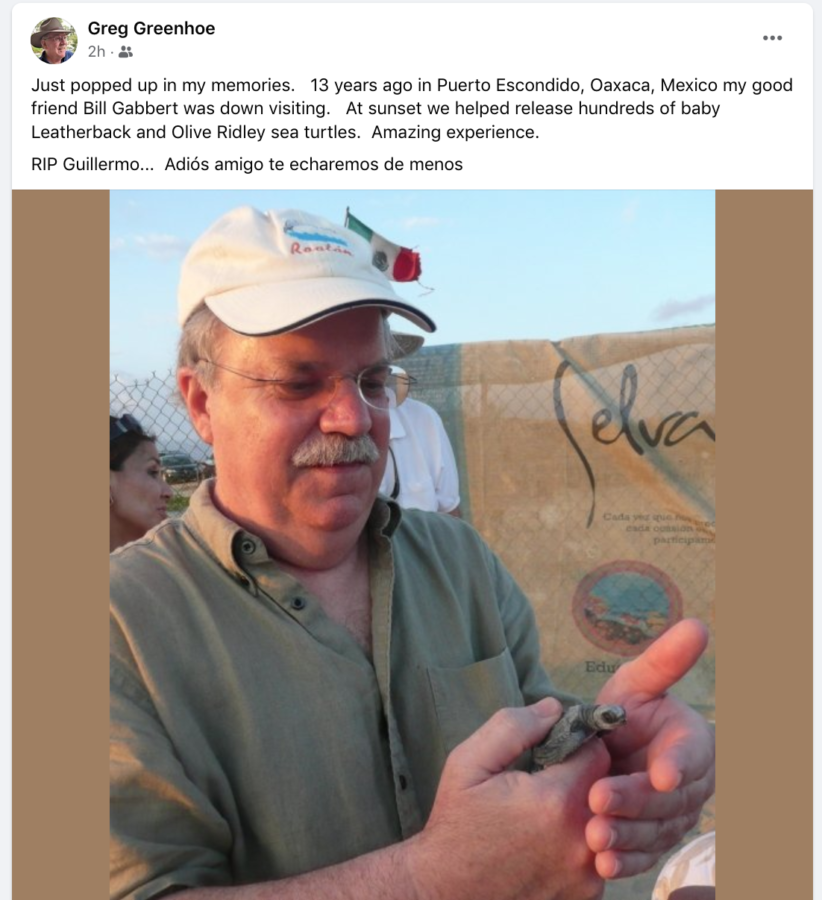
Bill Gabbert visiting Oaxaca and helping out with hatchling sea turtles

From the beginning these sites were a labor of love for Bill Gabbert, and a few of his passions quickly came to the forefront in his journalism, including what he called “students of fire.” He also focused on smoke impacts on firefighter health, political considerations of the jobs in fire, and perhaps most important, firefighter safety. He developed a wide-ranging global audience relatively quickly, and now and then he’d add on other expert authors and editors to round out and support both sites. He befriended and kept up with fire photographers and writers and editors — and agency leaders — not only in our relatively close wildland fire community, but internationally. He also made many friends in the fire-interested peripheral “public” – the tens of thousands out there who are interested in and connected with fire, such as family members, media, researchers, international fire personnel, and the large group of people who are just curious about the topic and how it influences our lives.

Bill Gabbert wrote on these topics almost daily, in a style that was easily understandable for readers who commonly get lost in or don’t care to digest the typical U.S. bureaucratic fire news.

Bill knew where to go and who to talk with to find the details he wanted, the core of the issue no matter the issue – he understood what was being said and could interpret or translate (without pulling any punches) for his readers. He had no qualms about writing on controversial fire topics, such as when Donald Trump and other politicians wanted to launch 4th of July fireworks from the heads of the Presidential sculptures at Mount Rushmore. This was just one of the Parks that had been Bill’s responsibility, and it’s a location with loads of highly flammable vegetation, at risk for trash and debris from fireworks with a history of both.

BILL GABBERT
Bill Gabbert and the poster for ONLY THE BRAVE.

I wouldn’t call these efforts “work” for Bill. He loved doing it and being busy and involved “in the thick” of the wildland fire business, long after his official career retirement. These pursuits and activities of his also afforded him the opportunity to indulge in some of his other passions – including photography, motorcycle riding, and meeting up now and then with fire friends, which occasionally included a dark beer or two. His knowledge and networking skills also opened doors for him as a “retired” fire guy to occasionally work on short teams for hurricanes and other disaster response assignments, as well as traveling to international wildland fire events.

A few years after he had his sites up and running he and I had a discussion about the future of the successful work he had accomplished. It was a light conversation on succession, a topic that all organizations must have. I thought Wildfire Today would eventually be an excellent addition to the collection of communication organs that IAWF had developed. Bill had all sorts of new ideas he wanted to try out with the site, so he wasn’t at that point yet really interested, and truthfully IAWF wasn’t really ready yet either.

But the idea stuck in the back of our minds over the years. When Bill learned last year that he was terminally ill, he and IAWF began some talks about how a merger might be managed. I’m pleased to say Bill was happy that the IAWF Board agreed to take on the responsibility of moving Wildfire Today and Fire Aviation into the future — and it is an honor for IAWF to serve in this role. I’m sure he will be whispering in our ears as we advance the work he began and passionately served, as wildland fire news and communications become more vital around the world.

Bill Gabbert’s introduction to firefighting – and motorcycles

by Wade Ward

I first met Bill Gabbert in a forestry economics class in 1968 at Mississippi State where we were both forestry majors. The professor of the class coordinated summer jobs with the students and the Forest Service. The previous summer I had taken one of those jobs: a hotshot position with the Chilao Hotshots in southern California. I told Bill about the experience and he decided he wanted to go the next summer. 

We went to see the professor who advised us, but he said he currently had only fire tower lookout positions and some timber stand improvement positions. Bill and I took the timber stand improvement positions, and we ended up in northern California at the Log Springs Ranger Station on the Mendocino National Forest, where we spent the summer running chainsaws and thinning trees. Twice our crew was sent to fires, where I assume someone thought chainsaws were needed. Both times we were not put on the fireline. Bill was disappointed. 

Haight & Ashbury
Wade Ward (left) and Bill Gabbert (right) on an early trip to California.

We returned to Mississippi State and rented an off-campus duplex where we lived the following year. I graduated and was immediately drafted into the Army – as I won the 1969 draft lottery. Bill dropped out of school lacking only a one-hour credit to graduate; he returned to California as a member of an engine crew in southern California, where he could actually fight fires. He did not have to worry about the draft as he’d got a high number. He also eventually took another course and received his degree.

When I finished my Army stint I traveled by motorcycle to Lake Elsinore, California to visit with Bill. He was in love with his job, and he stayed with the Forest Service until transitioning to the Department of the Interior. I never visited him while he was in Indiana, but did so several times while he was in Hot Springs, South Dakota. I rode my motorcycle out there.

On one trip we made Bill decided to buy a bike, and he did that immediately. He and I made numerous bike trips together through the years, and I think perhaps the only thing he liked better than the bike trips was his career and his associates in the wildfire community. So it’s quite fitting that his ashes will be spread in National Parks … Paul Mims and I, along with another friend, will be taking some of Bill Gabbert’s ashes by bike to Rocky Mountain and Wind Cave National Parks. Family members and other friends will help spread his ashes in Yellowstone and the Grand Tetons.

Bill Gabbert (center) with Paul Mims (left) and Wade Ward (right) on one of their bike trips. Bill completed an Iron Butt Association ride – to qualify you need to ride 100 national parks within a year.

Florida burning, from an air attack’s perspective

As Florida fires were peaking in early April I was texting a colleague, Jon Freeman, for updates. I first got to know Jon when he was a fire effects monitor and wildland fire module member and lead. Now his work has taken him to air tactical group supervisor (ATGS), or simply Air Attack – and his recent assignments took him to south Florida. A few texts and shared photos later, it became clear that Florida is a landscape, like so many, where the stories of unwanted hazardous flames burn along side (and sometimes into) the good work of planned fire.

As Jon texted, “It was pretty amazing to watch the head of a large wildfire roll right into this recent Rx fire and basically go out. It threw spots into it that smoldered and put themselves out quickly. So cool.”

He’d preceded his observations with a few photo stories … with these photographs by Michael Gue, prescribed fire manager with the South Florida National Parks and Preserve, as seen at work with a camera and in his photos, documenting his team’s artful fire work. The photos are of the head of the Cypress Camp Trail Fire, stopped by the Perocchi prescribed burn which, as Jon said, demonstrates “the power of Rx treatments.”

The story is amazing, as are the photos … and the story and photos continue from Jon’s perspective, including a few of his images taken while doing the work of the day, with a smart phone.

And what’s a photo story without an end of shift sunset.

Oasis Helibase in February 2022, when Jon was in Big Cypress NP, doing the same sort of work as this year. Photo: Jon Freeman.

Even though we’re filled with such a range of social sharing, it’s not always the case that we can scan the breadth and depth of fire experience at once …  to see and reflect on a month of fire, planned and unplanned, and what happens where they join. Thanks for sharing to Michael and Jon.
For more on this, see the story map, “Prescribed Fire: The Best Defense Is a Good Offense,” which explains the work on the Cypress Camp Trail Fire and the benefits of the Perocchi prescribed fire.
*

While fire activity moderated with mid-April precipitation, fire season does continue in Florida. In Big Cypress National Preserve, the Sandy Fire has grown to 10,000 acres since its discovery on May 1.