Kruger Fire (in red) 3-D map, approximate location. Looking north.
(Note from Bill: Bean Barrett, a frequent contributor to Fire Aviation, spent a career in U.S. Naval Aviation as a fighter pilot and served on the Navy Staff as a program sponsor responsible for planning, programming, and budgeting. He was also a Naval Aviation Safety Officer trained in mishap investigation. Here are some of his thoughts about the fatal crash of the AT-802 single engine air tanker on the Kruger Fire July 25, 2021.)
A blinding flash of the obvious to an old Naval aviator.
Having been in the business of personally flying and ordering flights in marginal conditions over my flying career, I offer the following observation derived from thinking about the mishap involving the SEAT at the Kruger Fire: This mission represented a near first for fire aviation in a very difficult environment. There is little community experience to bolster command and operational decisions by IC’s and pilots operating in this environment.
From personal experience, flying in extraordinarily bad conditions at night at sea is only possible to undertake and successfully accomplish because there are thousands of hours and sorties worth of community experience that helps those responsible know when and where to draw the line.
In this case, regardless of the NTSB/FAA mishap findings, without a significant background of fire aviation community experience to draw on for a particular situation or environment, it is always best to operate conservatively and approach any new environment in steps, never do the hardest one first if at all possible.
I would hope that the mishap SEAT flight was the culmination of a “work up” from simple to complex tasking and flying over hundreds of hours of use of night vision goggles and night drops with the aircraft.
This underscores the requirement for the fire aviation community to develop/ expand standard training and operations procedures both for general ops and by specific aircraft type and mission. If everyone trains and operates to the same standards, community experience is more relevant, experience can be accumulated and shared, procedures modified and improved, and training requirements adjusted resulting in improved flight safety and operations.
—
How many folks in the IMT/ IC business are aware of the AT-802 flight safety record when they order a SEAT?
Over four mishaps a year since May, 1997. This should have set off alarm bells a very long time ago except there isn’t any agency “keeping score” for type aircraft mishap rate and mishap cause that then ties the information and “lessons learned” back to mandated changes in training, maintenance, and ops procedures. It is very apparent from looking over the reference that the mishap rate is unacceptable and it isn’t getting any better.
Absent mandated standardized training, maintenance, and operations procedures for the AT-802 (and all other fire aviation aircraft), unacceptable mishap rates will continue. Since the US government is the largest contracting organization, it would seem logical to mandate a comprehensive Federal standardization program for AT-802 SEAT’s and other fire aviation aircraft that will operate under government contract.
To expect a loose confederacy of contract aviation companies to cooperatively develop a program is wishful thinking.
Some may say that such a Federal program already exists but my reply would be “where is the dash 1 or NATOPS flight manual for each type of aircraft, how is it revised, and what single agency is responsible for the manuals, standardized training, standardized operations, and standardized maintenance?” It is obvious that today’s chop suey of regulatory agencies, regulations, requirements, and instructions is not working for fire aviation.
There will be complaints about the additional cost to institute a consolidated comprehensive standardization program that will save fire aviation lives, aircraft, and improve effectiveness but my answer would be … the option of continuing with business as usual is obviously unacceptable.
Until fire aviation has a comprehensive aviation program as good as the US military aviation programs, we can expect little change in the fire fviation mishap rates or in operational effectiveness.
Joe Milligan and William Bowman of the National Park Service Type 3 UAS Module.
Background
Fire Season 2021 has forced Incident Management Teams to be creative in how they engage with fires. One of the ways teams have been successful is with the use of Unmanned Aircraft Systems (UAS), informally known as drones.
Unmanned Aircraft Systems are now used regularly for commercial, military, public and private applications. Experts suggest that while this technology is already impressive, it is still in its infancy. Some have described the state of UAS technology like being in the pager stage before cell phones. Many government agencies, even those regulating UAS, are struggling to keep up with the pace of development and spread of UAS use in the national airspace.
Previous reports have been published regarding the utility of UAS on wildfires. The intent of this post is to use the Schneider Springs Fire to frame current and potential UAS applications for wildland firefighting operations.
The Schneider Springs Fire
Operational Picture
The Schneider Springs Fire on the Okanogan-Wenatchee National Forest started when a lightning storm blanketed the northern Cascade Mountain Range on the evening of August 3, 2021. During the next several days, the fire grew quickly in record hot and dry conditions. It was burning in heavy timber, standing dead trees, and very steep terrain that was difficult for ground resources to access.
“The UAS program will pay for itself by reducing the mental and physical wear and tear on our people.”
THOM TAYLOR, NIGHT OPERATIONS BRANCH, SCHNEIDER SPRINGS FIRE
The Schneider Springs Fire is being managed under a full suppression strategy. However, due to the large number of fires in the region and nationally, as indicated above, there are a limited number of available firefighting resources. When PNW Team 2, a Type 1 Incident Management Team, took over the fire it was at only three percent containment after another IMT had been managing the fire for two weeks.
Type 3 UAS with Ignis PSD.
How UAS Were Used on Schneider Springs Fire
Swing Shifts
Swing shifts allowed both day and night operations to benefit from the UAS. Swing shifts are often used as an opportunity to make the most of burning conditions. This approach was noted to synergize UAS opportunities by making the most of both day and night fire behavior.
Burning at Night
The Type 3 UAS was used extensively at night for Plastic Sphere Dispenser (PSD) burning operations.
Intel Gathering
The UAS were able to access portions of the fire that were inaccessible to other aircraft, as well as areas that had limited visibility due to smoke.
Providing Real-Time Data
The Type 1 UAS on night shift was used to fly Infrared (IR) over the entire fire.
The Type 1’s data interpreter was especially useful when the U.S. Forest Service’s National Infrared Operations (NIROPS) orders were Unable to Be Filled (UTF).
After the Type 3 was used for PSD burning operations, it was then able to get back up in the air to grid for spots in the burn area—providing IR immediately after burning or gridding deep in the green through thick smoke.
Both the Type 1 and Type 3 UAS were used concurrently during burning operations. The Type 3 burned and the Type 1 looked for spots. Once they located a spot fire, these UAS could “walk” suppression crew members on the ground to a spot’s lat/long—always being within a few feet of the spot fire’s location.
Kelly Lewis, BLM Alaska Fire Service, with a Type 1 UAS.
What Are We Learning?
Benefits
Better intel leads to better decisions. UAS can now improve how we manage risk by limiting exposure when scouting, patrolling, and firing.
UAS can identify spot fires. They also increase confidence that spots are being found—that you wouldn’t otherwise know about.
The UAS can support patrol operations with high effectiveness and less people, ultimately reducing exposure.
Smoke was not a limiting factor during UAS PSD or recon operations. Utilizing the UAS provided precision PSD operations, related to both timing and geography.
UAS can reduce the human exposure involved in helicopter PSD operations.
UAS can fly in smoky or foggy conditions not ideal for manned aircraft.
A UAS can cover more ground than a person on foot over various terrain conditions.
Night operations means no conflict with other aircraft.
Challenges
More aircraft increases the coordination workload – including between manned and unmanned aircraft.
Air Operations and ground operations must coordinate on priorities for the entire incident.
With few UAS modules available, the existing ones are often required to drive back and forth trying to cover more than one fire incident.
The learning curve of not having previously worked with UAS.
Not knowing what products the UAS can provide, having no set standards.
For the Type 1 UAS it can take 24-48 hours to get it running on an incident—due to FAA approvals, Temporary Flight Restrictions, Landing and Recovery Zones (LRZs), Land Use Agreements, Mission Aviation Safety Plans, etc.
There will always be a need for manned aircraft. In terms of situational awareness, drones can’t see what a person looking out of an aircraft can see.
Current UAS availability is a limitation. There are not enough pilots, aircraft, or modules to meet the demand. Regional UAS Coordinators work with incidents and the Geographic Area Coordination Centers (GACC) to set priorities for the modules and equipment. In doing so, they try their best to meet the needs of the fire and the region. There are a lot of pressure points: A high demand for the equipment; the pressure of “use it or lose it”; and the pressure to burn even if conditions aren’t right.
A UAS connected to a suppression module, such as a hotshot crew, means that you’re pulling one to three hotshots off the crew for UAS operations which may limit the crew’s capabilities.
UAS modules are not standardized. Currently, there is no established configuration. Equipment is often shared, including: big TVs, batteries, staffing (most modules are interagency), trailers vs trucks.
UAS have limited flight times. The Type 3 drone has anywhere from a 15-25 minute flight time, depending on payload (PSD operations vs IR).
UAS pilots need to have more than just UAS experience. They need to know what they’re seeing and how to talk on the radio. Having Firing Boss experience is very valuable.
Line of sight is still a limitation for the Type 3 UAS, which, due to terrain and vegetation, is about two miles.
Type 1 and Type 2 UAS are only available as Call When Needed (CWN) contracted aircraft.
UAS Possibilities for the Future?
A UAS—or multiple UAS—being assigned to every incident. Having dedicated federal UAS modules rather than taking from other modules.
Integrating UAS with incident Air Operations.
Development of UAS leadership positions.
Full time “eyes in the sky”—that could replace recon and patrol.
Eliminate the use of a light helicopter for PSD operations. Aerial ignition modules.
Better battery life for longer flight times.
Higher payloads and flight times for operations such as bucket drops.
Fireline explosives.
Search and Rescue on a fire.
More structure and standardization.
For More Information About How UAS can Benefit the Wildland Fire Community:
Calwood Fire northwest of Boulder, Colorado, Oct. 17, 2020. Photo by Ben Nelson, Envision Studio, Boulder, Colorado.
(Note from Bill: I asked Bean Barrett, a former Naval Aviator and frequent contributing writer on Fire Aviation, for his thoughts about the Aerial Firefighting Use and Effectiveness study that was conducted by the U.S. Forest Service during a nine-year period at an annual cost of $1.3 million. The AFUE had very ambitious goals initially when Tom Harbour was the Director of Fire and Aviation for the U.S. Forest Service. “AFUE was initially intended to eventually help answer questions about the size and composition of aviation assets needed by the USFS,” Mr. Harbour told Fire Aviation recently. Bean’s comments are below. It begins with the Government Accountability Office’s request to the USFS to justify spending about half a billion dollars a year for aerial firefighting programs. That was one of the reasons for conducting the study.)
What the Government Accountability Office recommended :
Expand efforts to collect information on aircraft performance and effectiveness to include all types of firefighting aircraft in the federal fleet.
Enhance collaboration between the agencies and with stakeholders in the fire aviation community to help ensure that Agency efforts to identify the number and type of firefighting aircraft they need reflect the input of all stakeholders in the fire aviation community.
Subsequent to the completion of the first two recommendations, update the agency’s strategy documents for providing a national firefighting aircraft fleet to include analysis based on information on aircraft performance and effectiveness and to reflect input from stakeholders throughout the fire aviation community.
The AFUE study says it provide “…empirical information addressing the three GAO recommendations…”
From a program management perspective, enough information is required to inform decisions on inventory objectives, inventory types, and to allow costing out various aircraft and contract options.
At a higher level, when dealing at the programmatic and budget levels, it is necessary to first clearly demonstrate the value of aircraft vs ground crews and equipment or the appropriate mix of aircraft, ground crews, and equipment. One departmental budget buys all. When the value of aircraft can be demonstrated empirically, the desired mix of air and ground capability can be decided. Then, aircraft inventory objectives by type can be determined. AFUE picks up at this point and I’m not sure the larger case for air has been made. We cannot answer the question … In general, how much more efficient are our firefighting efforts when ground crews are augmented with air tanker support?
With respect to GAQ tasking, AFUE has only taken a partial first step in addressing and providing the necessary information for GAO recommendation #1. There is not enough information to determine desired inventory objective, type and mix of types, and cost. I’m not sure it is presented in a form to allow conclusions to be made. As the information was collected across the various LMA’s it does comply with #2. Without fully accomplishing task #1, updating strategy documents is not possible #3.
The Performance definition utilizes two metrics. Interaction percentage [IP] and probability of success [POS]. The definition of those two performance measurements and how they relate to GAO’s recommendation to collect information on “Performance” and Effectiveness” is not clear. I’m not sure Performance and Effectiveness by type aircraft can be adequately determined.
This study is perhaps being too clever by half when it introduces new terms to analyze.
What constitutes satisfactory interaction in Interaction Percentage [IP]? Probability of Success [POS] seems to be conflated with “effectiveness”. What constitutes success? What constitutes “effective”?
Some questions:
If “Each drop was analyzed on the basis of objective and outcome” with respect to use statistics, was the air asset chosen by the IMT or was it used because it was all that was available? If it was a beggars can’t be choosers tasking situation, some of the aircraft-mission paring data might be questioned.
We may have a better idea of what groups of aircraft are tasked for which missions but not why a particular group is being chosen/used. The statistics clearly show helos flying over 80% of the missions. Is that a reflection of IMT choice, the practicality of using what was available, the preponderance of water as a payload, or perhaps it is related to the ratio of small fires to large fires? There is insufficient information to determine why helos flew over 80% of the sorties.
How much of IP and POS was a function of drop accuracy? Which aircraft were the most accurate? What missions are more accuracy dependent?
How much of the IP and POS statistics are more dependent on payload than aircraft type?
Fire is the target. It is why aircraft are flying. Is classification of fire into IA, EA, and Large as defined in the study sufficient to sort aircraft assignment and results by type? EA appears to be a small gap filler between IA and Large Fire.
Why are there no time dependent metrics? From a program analysis perspective, many aircraft distinguishing characteristics are time related. Speed, range, endurance, reload-return, and IA response come to mind.
If this were a commercial airline study, I would expect to see some “bottom line” characteristic similar to Revenue/Seat-Mile. Why isn’t there something like cost/payload gallon-mile/hr for air tankers?
From a commercial and military perspective, it is more about payload delivered and what it takes to get it there. Aircraft are mission dependent variables. Why wasn’t the AFUE study based on mission requirements? What payload needed to be delivered, what quantity, what coverage level, how fast, how accurately, and for how long? Given something like these parameters, the number and type of aircraft can be determined.
A problem?
Figure 10. With LAT’s approximately 45% of drops have a positive outcome. For VLAT’s 50%.
Figure 10, Drop Outcomes, AFUE.
Figure 13. LATs have a 67-68% Probability of Success. VLATs have a 70% Probability of Success.
Figure 13, Probability of Success, AFUE
Someone smarter than me needs to explain this discrepancy. Evidently a positive outcome is not necessary to qualify as a success.
Conclusion:
The original GAO requirement was for information on “performance” and “effectiveness” to support determination of what constituted an adequate aircraft firefighting fleet. From a program manager’s standpoint, this study does not provide the necessary information to determine aircraft inventory objectives or mix of types.
AFUE made an assumption — they assumed that what we are doing today with aircraft is mostly correct. This going-in assumption resulted in missing an examination of “Are we doing it the right way? Are we using the right assets? Or, are we just doing the best we can and getting by with what we have?” The answers to these questions are necessary to inform the data collection process and objectives. It is highly likely that the AFUE data more closely reflects firefighting that is making do with what it has, as opposed to selecting the best aircraft for the job.
Australia has done a far better job at justifying use of firefighting aircraft and examining aircraft effectiveness and performance.
Going to your e-mail questions.
Is it useful? Aircraft types are grouped so nothing can be determined about specific aircraft except in a most general nature based on Tanker Type Categories.
Adequate comparison? Data is insufficient or entirely missing.
Future program decision support? Not useful in determining aircraft inventory and types for a national air firefighting fleet. Also not adequate to support program decisions because it never answered the “why” various types were chosen for various missions.
Cost metric. As mentioned in my missive, it’s about payloads required/delivered. That is a better sorting function than Tanker Type. Aircraft Type and #’s are dependent variables of payload and payload related requirements.
Aircraft Mix going forward…
My familiarity is somewhat limited. I would like to think I understand some of aviation based on my 31 years of military and some commercial experience but since I’m on the board of directors of a 98 square mile fire protection district in Colorado (the district with the community at highest assessed risk of loss to wildfire in the whole state of Colorado) my immediate day-to-day scope is much more focused on things like IA, what it takes for our department to keep small fires small, and our citizens safe.
In Colorado it is the small fire protection districts that are primarily responsible for IA.
If something like 95-96% of our wildfires fires are contained then the approximately 95-96 % containment was probably due to effective IA. Taking a couple more percent off of the escaped fire percentage is far cheaper than fighting a large fire.
Maybe more unique to Colorado, but almost every district could use more staff for IA (primarily volunteer departments) and larger budgets for equipment. Neither one is in the cards. We need close air support to overcome the obstacles of marginally accessible terrain and shortage of staff. Small, accurate, and timely air support comes to mind.
Like a Marine gunny I knew once observed — when I need close air support I don’t want a B-52, I usually want something like an A-10 with a gun.
We are short of big lakes around here so scoopers are out. Dipping/snorkeling helos come to mind to directly support the small crews that are responsible for getting the initial attack going. SEAT’s reload-return times are too long.
Somewhere in the bean counting world there is a very good reason a LAT or VLAT cannot be made available for every 12-20 man module/ crew working an IA. Locally, we need more helos. Who owns the helos isn’t important. It is the response time and cycle time that counts.
We need the bigger tankers for the 4 or 5% of the fires that do escape.
If I had to do a rough guess on the aviation mix, I’d start on the ground floor with what might be considered “first principles” and look at the targets list… (how many fires, how big, where, how often), then figure out what needs to be dropped on the various targets and generally, where the targets are and if the missions are direct support or indirect support. Determine payload type, quantity, and necessary accuracy. Then, look at the best aviation mix to deliver the required payloads.
Bean Barrett
31 years as a Naval Aviator flying tactical jets, some heavy time, and a little prop time.
Flew for Continental Airlines for two years.
Aviation Safety Officer and mishap investigator.
Staff time at the Navy Strike Warfare Center/ included work on close air support training.
Navy sponsor on Navy Staff for some air and space programs. Total annual obligation authority $1B.
Presently on our local Colorado fire protection district board of directors. Have worked with our fire department for over 10 years.
Lived in Colorado’s front range tinderbox since 1979. Have seen several of our front range big fires up close and personal. Evacuated for one.
A Coulson Chinook and Blackhawk, at Talca, Chile. Coulson photo.
(From Coulson Aviation)
Coulson team members work all over the world supporting communities and firefighters which means adapting to different systems, operations and firefighting partners.
In Chile, it’s also meant adapting to operating in a different language. While some of the team members speak Spanish, each of the 4 Chinooks and a Blackhawk fly with a pilot translator whose job it is to translate the instructions from the aerial supervisor or ground crews.
Pilot Andy Thomas is currently flying a tanked Chinook in Chile and said it was a lot of fun working with the translators, some of whom have fire experience.
“A lot of the translators are highly experienced airline pilots who are a great help on the radios navigating the flight paths and fire operations,” he said.
Coulson pilot Colin Morgan, who has been operating a Chinook with a Bambi bucket, said the pilot translators did an amazing job in dynamic circumstances. Colin worked in Chile last year for Coulson, also flying a Chinook.
“The CH47 is, in my own opinion, the best helicopter operating today. It was designed for the military to be versatile, technologically advanced, yet forgiving and simple to operate. It’s also simply a pleasure to fly,” he said.
Andy, who has decades of experience operating heavy helicopters, said the Chinooks were designed to lift a tremendous amount of weight.
“With us that’s water, and it’s really good at it,” he said. “It’s a lot of fun to fly and it makes us pilots look good!”
Coulson photo.
Coulson has four Chinooks and one Blackhawk working on fire contracts in Chile.
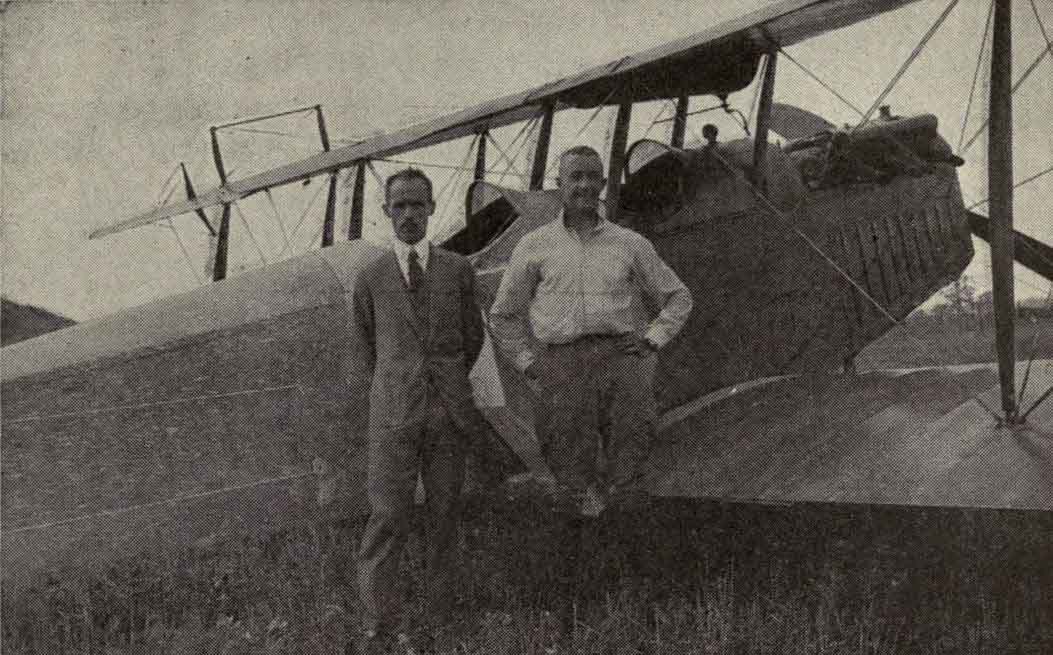
World first crop dusting experiment (August 3rd 1921, Troy, Ohio) using an aircraft – Left: McCook Field engineer Etienne Dormoy (left) who designed the hopper and operated it during the flight ; Right: Lieut. J.A. Macready who piloted the plane (Curtiss JN-6). Photo: Houser, J. S. “The Airplane in Catalpa Sphinx Control.” Ohio Agricultural Experiment Station, Monthly Bulletin 7 (1922)
By Richard L. Hilderbrand
EARLY SPRAY EQUIPMENT
Military aircraft have long been used to apply insecticides and herbicides. An entomologist from Cleveland, C. R. Neillie, believing that airplanes could be used to dust a stand of trees, worked with the Army Air Service at McCook Field in Dayton to test the idea. On August 3, 1921, Lt. John A. Macready assisted in the successful treatment of catalpa trees using insecticide dropped from a Curtiss JN-6 airplane to kill sphinx caterpillars.
World’s first crop dusting experiment, Aug. 3, 1921
In 1933 a study summarized the military use of chemicals dispersed by aircraft and included the possibility of using chemicals to deny the opposition the use of rear areas and lines of communication. This basic idea was applied in Vietnam to deny cover and limit food crops.
An engineering study completed in 1952 laid the groundwork for the development of the MC-I “Hourglass” system which was first used for defoliation in Vietnam. Built by the Hayes Aircraft Corporation of Birmingham, AL, the MC-1 system included a 1,000-gallon tank and equipment to support six spray nozzles.
The MC-1 was used on many occasions but was not satisfactory to spray jungle foliage in Vietnam in “Operation Ranch Hand” due to the requirement for two passes over the treatment area. Knowing a second pass was coming for adequate treatment allowed the enemy on the ground to prepare a “return” welcome party. On February 2, 1962, Ranch Hand lost an aircraft and the crew became the first Air Force fatalities in Vietnam.
The need for a three gallon/acre spray capability in one pass resulted in the development in 1966 of the A/A45Y-1 sprayer which incorporated spray booms under each wing and under the tail and a larger pump to increase pressure from 38 to 60 psi. The A/A45Y-1 Internal Defoliant Dispenser, also designed and manufactured by Hayes, was a complete dispensing system with a 1000 gallon tank, jettison capability, and rapid installation into and from a C-123.
AIRCRAFT
In the spring of 1953, Douglas Aircraft Company was flying a DC-7 prototype out of Palm Springs Airport using water in a tank as a ballast to represent a load. At the end of flight-testing, the four-engine DC-7 made a low pass over the Palm Springs runway and dumped its ballast through three six-inch valves in the airplane’s belly. The result was a wide, mile-long swath of water that caught the attention of the DC-7’s pilots as well as observers, thus starting the concept of aerial attack on fires. The first application of aerial attack adapted a 1939 Stearman biplane that had been converted into a cropduster. In 1955 Willows Flying Service, a California agriculture chemical applicator, cut a hole in the airplane’s belly fabric and fitted the chemicals hopper with a flapper hatch that opened when the pilot pulled a rope to release 170 gallons of water. In August of that year the Willows Stearman made several runs on a fire burning in Mendocino National Forest, dropping 170 gallons on each run and assisting in “knocking down hotspots.” This was the first time that a real forest fire had been attacked using water dropped from the air.
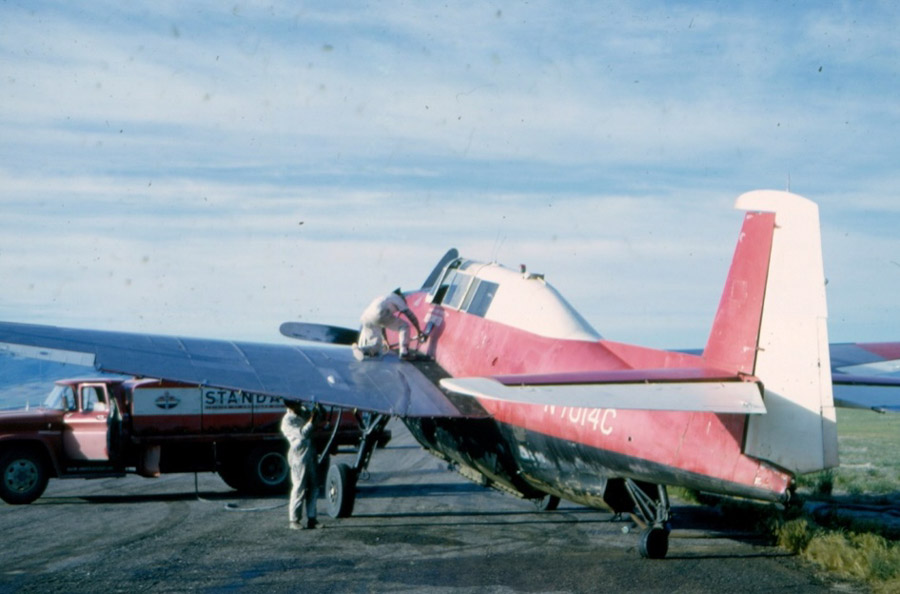
TBM air tanker being refueled by truck in 1966 in the Beaverhead National Forest, Montana. The TBM payload was 800 gallons of retardant. Photograph provided by Mr. Dave Stack courtesy of National Museum of Forest Service History, Missoula, Montana.
In 1958 a single engine TBM Avenger (Grumman TBF manufactured by General Motors) dropped retardant on a fire at Lake Elsinore, California and started the use of the TBM as a retardant tanker. Continuing through the 1960s, the tankers were usually modifications of WWII bombers, such as the TBM, that carried a several hundred gallons of retardant and dropped the load using the bomb bay. These drops were bulk drops and frequently a mass of retardant would break the trunks of trees. The military bombers were designed to withstand the “negative g” wing-loads of rapid cargo (e.g., bombs) deployment but were not necessarily adapted to the low-level drops in mountain terrain. Other aircraft used were the PB4Y, B-26, B-17, and P2V Neptune. Other military aircraft were used such as the Grumman AF with a payload of 800 gallons and the C-123. They were usually single purpose aircraft owned and operated by private contractors with much time parked on the ramp. These early pilots flew on the edge and would occasionally return to the retardant base with pieces of tree-top in their wings. C-119 “Flying Boxcars” were used through about 1987 and a few even had 3,400-pound-thrust Westinghouse J34 turbojet atop the fuselage.