Senators finally on board with firefighter pay

In his ongoing efforts to support wildland firefighters, U.S. Senator Jon Tester yesterday backed the bipartisan Wildland Firefighter Paycheck Protection Act to preserve competitive pay for wildland firefighters.

As part of his 2021 Infrastructure Investment and Jobs Act (IIJA), Tester championed $600 million in temporary pay boosts for wildland firefighters, but these pay increases — for more than 10,000 Forest Service and DOI firefighters — will expire at the end of this fiscal year. The temporary raise boosted firefighter pay by $20,000 — or 50 percent of annual base salary, whichever was lower — and that funding runs out at the end of September. The IIJA, known as the Bipartisan Infrastructure Bill, was signed into law by President Joe Biden on November 15, 2021. About 16,000 federal firefighters received the temporary raises, according to Fed Manager.

“This is a welcome down payment on a sorely needed continuous investment in our federal wildland fire workforce. Wildfires will continue to impact millions of people across the U.S., and we need to ensure we have wildland firefighters to respond whenever the call is made.” 
 ~ Riva Duncan, vice president, Grassroots Wildland Firefighters

Tester and other members of Congress plan to extend those pay raises and improve recruitment and retention. The new pay scale is more than the GS pay scale under which federal employees are paid. This not only creates a new hourly pay rate and overtime pay rate for wildland firefighters, but it will also be used for their retirement calculations. Currently applicable pay premiums (such as hazard pay and Sunday differential) would still apply.

The new bill requires the Forest Service and the DOI agencies to distribute daily pay supplements to employees when they are working on long-duration wildfires, working on prescribed fires, or deployed away from their duty station for pre-positioning. The daily pay supplement is determined by multiplying one hour of an employee’s basic pay by 4.5 and payments are capped at approximately $160 per day and $9,000 per year.

A bipartisan group led by Senator Michael Bennet of Colorado has now written to the Senate Homeland Security and Governmental Affairs Committee urging swift consideration of the bill.

“Firefighters deserve fair pay, support for their mental and physical health, and time to recover from their dangerous work. In a future with increasingly catastrophic wildfires, Congress cannot wait to ensure that the federal government has the necessary workforce to protect communities,” they wrote.

“Montana’s wildland firefighters put their lives on the line to protect our communities and public lands, and the least we can do is ensure fair and competitive pay for the work they do,” said Tester. He added that firefighters should be fairly compensated for the dangerous work they do. “This bipartisan bill will make that compensation permanent, and I’ll be fighting to get it across the finish line in Congress.” Tester chairs the Congressional Fire Services Caucus.

This new bill would make the temporary pay raise permanent. The Wildland Firefighter Paycheck Protection Act that was introduced yesterday would codify a base pay raise for those frontline responders. According to the Federal News Network, this new bill came after months of calls from advocacy groups. Though it’s not as comprehensive as Tim’s Act, it’s a good start. “Well, to say we aren’t disappointed that more reforms weren’t included in this bill wouldn’t be truthful,” said Riva Duncan. “But we have to remind ourselves how far we’ve come to get to where we are today. Now the ball is in the legislators’ hands for the WFPPA, and we will continue to remind them to do the right thing for the federal fire management workforce.”

“As climate change brings longer fire seasons and more extreme fire behavior across the West, we must remain steadfast in our commitment to wildland fire preparedness and response,” said Deputy Secretary of the Interior Tommy Beaudreau during a visit to Montana. “Through President Biden’s Investing in America agenda, we are strengthening our wildfire response efforts, providing increased certainty to allow land managers to better prepare for future needs, and ensuring our wildland firefighting workforce is given the respect, compensation, and training support they deserve.”

“It is critical that Congress passes this legislation as soon as possible,” said NFFE National President Randy Erwin. “If the provisions within this law do not pass by September 30, federal wildland firefighters will endure a pay cliff of a 50 percent cut to their base pay up to $20,000. If this happens, a mass exodus will begin that may be impossible to stop. Thankfully, there is a tremendous amount of bipartisan support for the Wildland Firefighter Paycheck Protection Act. In addition to continuing existing practices on pay, the bill recognizes the 24/7 working life of wildland firefighters while on assignment, and it calls attention to the burnout and exhaustion that these firefighters experience throughout the year.”

The full text of the bill is [HERE].

Are we ignoring the smokejumpers?

Recent facebook post by Murry, re-posted with permission and slightly edited; he spent 26 years as a smokejumper followed by 22 seasons on a Cal Fire lookout, and he theorizes that much of the public land in the West has burned because we’re under-utilizing smokejumpers.


Guest post by MURRY TAYLOR

Since 2020 smokejumpers have averaged only 4.5 fire jumps each season. That’s a terrible under-utilization of an important firefighting resource. In the past we easily jumped twice that many, and some years four times as many. I’ve seen it many times while on the Duzel Rock lookout southeast of Happy Camp, California — fires were not staffed for a day or two and then went big and cost tens or even hundreds of millions while the jumpers sat unused.

There seems to be a lack of understanding among fire managers in the Forest Service about the capability of these jumpers. Dispatchers have said they didn’t put jumpers on a fire because the “trees were too tall,” or the “winds were too strong.” Clearly they didn’t understand that jumpers carry 150-foot let-down ropes, and they have a spotter in the plane throwing streamers, so they know EXACTLY what the wind is like over the fire.

The good news is that things seem to be changing for the better. Allowing jumpers to get back to 10-plus fire jumps per season would save big money and lots of acres. For those who think we need to get more fire back on the land, all I can say is, Don’t worry, there’s going to be plenty of that given the way fires burn now. The policy of putting ALL these early season fires out while small would be a big help. That way, when August — the toughest part of fire season — arrives, the handcrews wouldn’t be exhausted and scattered all over hell, and the skies wouldn’t be filled with smoke so that Air Ops are critically limited.

Jumpers and hotshots tell me that Yes, sometimes the fuels and new fire weather are factors in making fires harder to catch. But MOSTLY, they say, there’s always something that can be done to catch these fires if they are hit while small.

The Rogue River–Siskiyou National Forest in southern Oregon has taken a more aggressive approach to putting fires out when small. In the last three seasons they’ve had 192 fires and burned only 50 acres. This was achieved by pre-positioning jumpers during lightning storms, better utilization of rappellers, and contract fire resources.

I wrote a post on this topic a couple years ago. Over and over, while on the Duzel Rock lookout, I’ve heard that certain fires weren’t attacked early because the country was “too steep and too rough.”

Santa Maria ready for the season

It’s summer in California, and the Santa Maria Tanker Base is ready for the 2023 fire season. “We’ve got six personnel staffed with the base, and that’s parking tenders, ramp coordinator, tanker base manager, and timekeeper,” said Alex Ihle, air tactical group supervisor with the Los Padres. “Then between the primary mix plant here with Perimeter Solutions and the annex, there’s six or seven personnel ready to load tankers.” The air attack platform includes Ihle and his trainee, plus a contract pilot, and Tanker 101 has two pilots and a crew chief, he explained to News Channel 3-12.

The airtanker base, at the south end of the Santa Maria Airport a bit north of Lompoc, covers more than 3.6 million acres of response area, including San Luis Obispo, Santa Barbara, and Ventura counties, as well as the Los Padres National Forest. The base opened for the season nearly two months ago, but significant rainfall over the winter and into spring has meant a late start to operations. Ihle said they delivered their first retardant in early June.

“That’s just a result of more rainfall than normal,” he said. “We are in essence about two months behind where we normally would be. Our fuel moistures now are right about 96-to-97 percent, and we typically see that fuel moisture percentage in early May, so we’re a couple of months behind.” Since opening in mid-May, the base has responded to just eight wildland fires, including the Villanova Fire near Ojai last week. While the tanker crew from the base flew out, they did not drop any retardant on the fire, which was limited to just 20 acres.

Erickson’s MD-87 aircraft, which can land loaded, were recently granted permission to make gear-up drops; Bill Gabbert wrote about this back in 2017.

Erickson's T-101 and T-105
Two of Erickson’s MD-87 airtankers

This year Tanker 101, a 3000-gallon MD-87 owned by Erickson Aero Tanker, has been stationed at the base since June 5, and Capt. Brent Conner has been flying wildland fires for a few years — about 30 years as a tanker pilot and about 30 years as a cropduster pilot. He said T-101 will remain stationed at Santa Maria as long as they’re needed there.

Bill Gabbert caught this photo of the MD-87 aircraft at Madras, Oregon June 13, 2016.

MD-87 airtankers at Madras Oregon
MD-87 tankerss at Madras, Oregon before they were converted to airtankers. Photo by Bill Gabbert.

“I saw five of Erickson’s MD-87s at Madras,” he wrote in 2018. “They were parked in single file and my 24mm lens was not wide enough to get them all. The one missing in the photo also had Spanair on the side. Erickson bought at least seven of the MD-87s. They began flying two of them as airtankers in 2014.”

Erickson currently has seven MD-87 airtankers, five now on contract and two more headed out this week, in addition to its three DC-7 tankers.

Five years ago in Colorado

From Wikipedia:

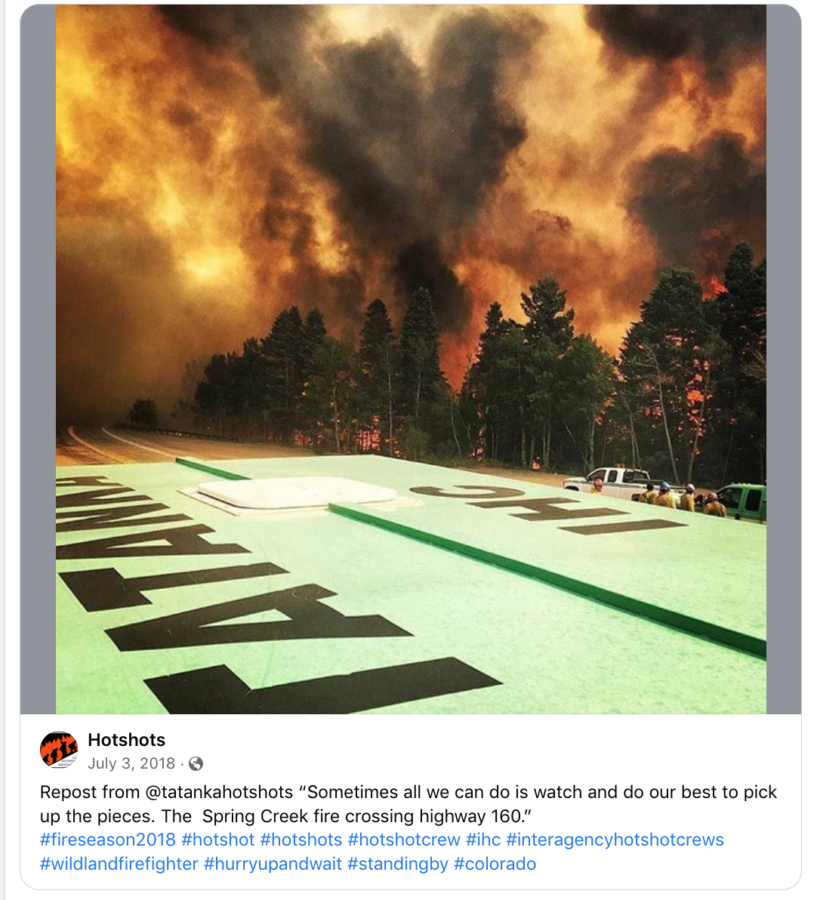
The Spring Creek Fire was a wildfire near Fort Garland and La Veta, Colorado in Costilla and Huerfano counties in southern Colorado. The fire burned 108,045 acres (43,724 ha) and was at the time the third-largest wildfire in Colorado history.

Spring Creek Fire, Colorado 2018

Origin and trial:

The Spring Creek Fire was started on Wednesday, June 27, 2018 near Fort Garland, Colorado and southwest of Parachute. Jesper Jørgensen, 52, a citizen of Denmark who was in the U.S. illegally (he had overstayed his visa), was arrested and charged with arson. He was camping in his truck and using a fire pit to grill food. Jørgensen claimed he was unaware of the open fire ban; he assumed the fire was fully extinguished, but was woken from a nap by the smell of smoke a few hours later. He initially attempted to extinguish it himself, and when he couldn’t stop it he called 911. The fire burned the western flank of the Sangre de Cristo foothills, on the south side of La Veta Pass. It was finally contained almost three months later on September 10 — after more than 140 structures were destroyed.

Jørgensen
Jesper Jørgensen

Shortly after his arrest in June 2018, Jørgensen was declared mentally incompetent, which delayed his case; he was facing 349 counts of arson. According to the Colorado Sun, in the spring of 2022 after more than 2½ years, a judge dismissed criminal charges because Jørgensen was repeatedly assessed as unable to stand trial. He was diagnosed with delusional disorder.

Senior Judge Gregory Lyman had hoped that Jørgensen would be deported if the charges were dropped. However, he said U.S. Immigration and Customs Enforcement had no intention of doing that; after an unsuccessful attempt to have Jørgensen involuntarily medicated, Lyman said he believed the law required him to dismiss the case.

 ~ Thanks and a tip of the hardhat to Tatanka Hotshots (on facebook).

Staging Area … July 4, 2023

Today we are continuing an occasional off-topic feature that Bill Gabbert deployed a couple years ago — had been meaning to revive this and JK reminded me. This post can serve as the beginning of an open thread in which readers can talk about issues that we have, or have not, yet gotten into. This is a literally off-topic thread. You have the floor.

The usual rules about commenting do apply, though. And remember, no personal attacks or politics, please. If you haven’t read the rules lately, they are posted HERE.


Annual Poll: Preparedness Level 5 this year?

I don’t know which year Bill Gabbert started this PL5 poll but I always enjoyed it and I’m reviving it.
When do YOU think we will move to PL5 this year? And, will there be a “Moses Letter” this year?

Preparedness Level

PL2In 2018 on this date, Bill wrote that the National MAC Group had just moved the national fire level up to PL4 “due to increased significant wildland fire activity from central TX to WA state, the commitment of IMTs, and the potential for new wildland fires across multiple GACCs.”

The highest level is 5. Today on July 2 at the NICC in Boise, we’re at PL2.

NIFC has more information about Preparedness Levels, but here are the criteria for PL5:

This is the highest level of wildland fire activity. Several geographic areas are experiencing large, complex, wildland fire incidents, which have the potential to exhaust national wildland resources. At least 80 percent of the country’s IMTs and wildland firefighting personnel are committed to wildland incidents. At this level, all fire-qualified federal employees become available for wildfire response.

Please tell us what you think in our poll. Last day to vote is August 19.
[poll id=”19″]

Sometimes when we’re in PL4 or 5 the honchos in Washington will distribute what’s called a “Moses Letter,” telling regional and local units to Let My People Go so they can go fight fire and save lives.

Exodus 8:1 — Then the Lord said to Moses, Go in to Pharaoh and say to him, “Thus says the Lord, ‘Let my people go, that they may serve me.'”

Of course they don’t officially actually call it a Moses Letter and probably won’t quote the Bible if they do send one, but you never know — this country’s in a new norm now, for many reasons. For bonus points, let us know in the comments if you think the folks in the head shed will send a Moses Letter this year.

PL5


CAL FIRE adds aircraft

For the second year in a row, CAL FIRE is boosting its seasonal fleet across California — with more than $72 million provided by Gov. Gavin Newsom’s administration. The funding secures an additional 24 firefighting aircraft (19 helicopters and 5 planes) for a contracted period of 90-120 days. The Fullerton Observer reported that these aircraft are located in communities across the state and will be pre-positioned as needed.

“The deployment of more aircraft dedicated to the people of California marks a historic milestone, with the highest number of firefighting aircraft ever available for initial attack in the state for the second consecutive year,” said Director and Fire Chief Joe Tyler. He said rainfall this year has resulted in increased fuels; last week alone, CAL FIRE responded to over 300 wildfires.

Cal Fire Hawk

NEW HELICOPTERS:  Nevada-Yuba-Placer Unit Chief Brian Estes said that CAL FIRE’s new Fire Hawk is faster, with greater capacity, than the state’s aging 12 Super Huey helicopters, and the Hawks can also conduct night flight operations. According to a report by YubaNet.com in FY2022-2023 additional funding was approved to purchase four more S70i Fire Hawks to increase surge capacity and to maintain operational capabilities during mandatory maintenance cycles. The Fire Hawk can deliver up to 1000 gallons — or a 9-person helitack crew.

California’s aircraft are initially prepositioned in the following counties: Butte, Tuolumne, San Diego, Tulare, Humboldt, Mariposa, Nevada, Siskiyou, Sacramento, Fresno, Shasta, San Luis Obispo, Napa, Placer, Lassen, Riverside, and Sonoma.

C-130H tankersThe fixed-wing aircraft in the California fleet include three large airtankers that can carry up to 4,000 gallons. FireAviation reported last year that the U.S. Air Force was directed by Congress in December 2013 to perform maintenance on seven C-130H aircraft and convert them to airtankers. At that time the USAF was given $130 million for the project. Five years later in 2018 Congress appropriated an additional $20 million, bringing the total cost to $150 million. No recent estimates of totals were readily available.

The statewide fleet has grown to more than 60 fixed-wing and rotary-wing aircraft, according to the Chico Enterprise-Record, making CAL FIRE’s the largest civil aerial firefighting fleet in the world, including Grumman S-2T airtankers, Bell UH-1H Super Huey helicopters, Sikorsky S70i helicopters, and North American OV-10A (plus one D Model) Bronco Air Tactical aircraft. The aircraft are located at 14 airtanker bases, 10 helitack bases, and one CAL FIRE/San Diego County Sheriff helitack base.


On this holiday weekend, CAL FIRE reminds the public that the law strictly prohibits the use of drones in areas with fire activity. Drone operation can shut down aerial firefighting, endangers pilots and crew and firefighters, and poses major risks to lives, property and natural resources.

 ~ THANKS and a tip of the hat to Johnny.

TELL CONGRESS we need to pay firefighters!

Did you know federal firefighters are up for a big pay cut at the end of September? They are. You agree with that? We don’t either.

firefighter fiscal cliffThe federal government’s fiscal year runs from October 1 of one calendar year through September 30 of the next, and if Congress doesn’t act to pass legislation, then the current temporary funding to retain firefighters runs out! This puts federal firefighters and their families in a helluva bind — they will be forced to choose between staying in a job they love with dramatically less pay, or finding better-paying work to get by. The Forest Service itself has testified before Congress that without a permanent pay solution, somewhere between 30 percent and 50 percent of its firefighters will leave the ranks — triggering unsafe work environments for remaining fire crews and leaving many fires unstaffed.

Join with us and the GRASSROOTS WILDLAND FIREFIGHTERS and sign this petition to make sure Congress knows what’s at stake here. “We will give the signed petition to each member of Congress,” says Riva Duncan, the organization’s vice president, “and we’ll urge them to avoid the Firefighter Fiscal Cliff. Please share this petition with your family, friends, colleagues — and anyone else who cares about this nation’s beloved public lands.”

SIGN THE PETITIONLearn more about the Grassroots Wildland Firefighters and how you can help here:

grassrootswildlandfirefighters.com