Train-the-Trainer courses in ICS announced

The Emergency Management Institute at FEMA has released its National Incident Management System (NIMS) Incident Command System (ICS) position-specific Train-the-Trainer virtual “K” course schedule.

ICS Train-the-Trainer courses
FEMA National Emergency Training Center

These courses prepare students to instruct NIMS ICS courses, which are position-specific. These courses are virtual, but graduated instructors will teach in the field to students who are first responders — and other professionals from federal, state, and local agencies and organizations. Emphasis is placed on classroom-based deliveries, including compliance with the NIMS Training Program, adult education methodologies, deployment of course activities, pre- and post-testing, and training program management.

Course goals include preparing instructors to teach NIMS ICS courses. The target audience is emergency responder personnel who are or may be members of an Incident Management Team (IMT). To participate in the Train-the-Trainer course, candidates must be already fully qualified in the position, with a minimum of 3 years’ credentialed IMT experience, and with a significant teaching background.

Selection Criteria:
All applicants for admission into the Train-the-Trainer Program must:

      • Provide documentation of their completion of the baseline course they plan to teach prior to applying
      • Provide documentation of their quals in the position (completed task book and credentials in the position)
      • Provide documentation of experience as a member of an IMT

Documents must be in the form of credential, ICS 225, copies of IAP sections showing assignment, deployment records, or other appropriate citations.

Prerequisites:
The most current version of these courses is required:

      • IS-100 – Introduction to the Incident Command System, (IS-100c)
      • IS-200 – Basic Incident Command System for Initial Response, (IS-200c)
      • E/L/K/G0300 – Intermediate ICS for Expanding Incidents, ICS-300 (May 2019 or more recent)
      • E/L/K/G0400 – Advanced Incident Command System for Complex Incidents, ICS-400 (May 2019 or more recent)
      • IS-700 – An Introduction to the National Incident Management System, (IS-700b)
      • IS-800 – National Response Framework, An Introduction (IS-800d)

* Special Note: Air Group Supervisor Train-the-Trainer candidates must have completed both the E/L/K0987 Introduction to Air Operations and the E/L0986 Air Support Group Supervisor courses.

Other important details about qualifications and applying for the program are online at tinyurl.com/n98c7svz

Additional questions should be directed to NETC Admissions by email at netcadmissions@fema.dhs.gov or you can view the National Emergency Training Center online admissions application (training.fema.gov/netc_online_admissions). The course manager, Robert Patrick, can be reached at robert.patrick@fema.dhs.gov or at (301)447-1297.
Canadian wildfire smoke moves into Northeast U.S.

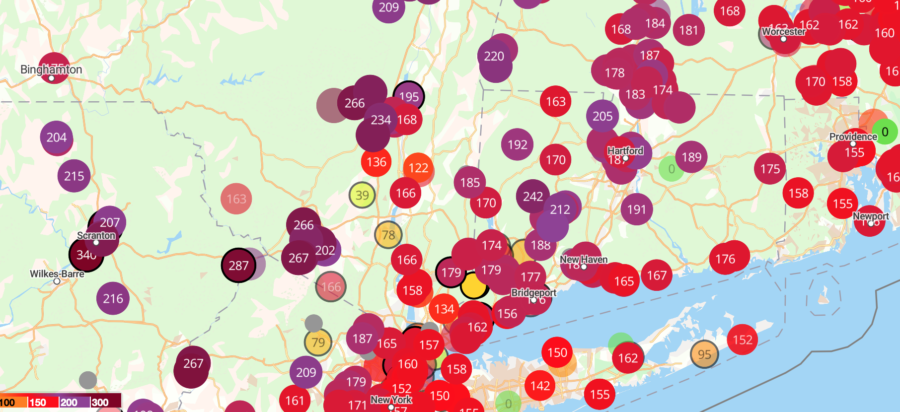
New York City has some of the worst air quality in the country this week because of smoke that’s drifted south from wildfires in Canada. The city had an orange glow Tuesday morning, with the sun obscured by a smoky haze, reported by CNBC. The New York Department of Environmental Conservation issued an air quality health advisory Tuesday for several counties and surrounding suburbs. Ratings for air quality reached into the 150s on Tuesday, according to AirNow. Those levels are considered unhealthy for all people and significantly above exposure recommendations from the World Health Organization.

Fire and Smoke map, AirNow.gov

The sky over the city had an orange glow on Tuesday morning and the sun was largely obscured. Officials warned residents to limit time outdoors and emphasized that people with respiratory illnesses or heart disease are especially vulnerable to the dangerous air quality conditions. The New York Times reported that smoke brought hazy skies to parts of New York State and also Vermont on Tuesday, and air quality alerts were also issued across large swaths of Minnesota. Hundreds of wildfires burned across Canada, exacerbating an active wildfire season that is expected to worsen, and sending smoke into much of the U.S.

Haze blanketed much of Ottawa and Toronto, while all of New York City was under an air quality alert; by the afternoon, the Manhattan skyline was obscured.

The Oregonian reported that smoke is also causing unhealthy air quality across Oregon, but just two sentences of the report by Gosia Wozniacka were available to non-subscribers. The Seattle Times, however, reported that Canada’s intense wildfires now spread from the western provinces to Quebec, with hundreds of active fires. On Tuesday, the U.S. Environmental Protection Agency issued a poor air quality alert for New England, a day after parts of Illinois, Wisconsin, and Minnesota received similar advisories. Last week, U.S. officials as far south as Maryland, Virginia, and Pennsylvania reported being affected by the wildfires.

The EPA said the smoke will linger for a few days in New England.

“It’s not unusual for us to get fire smoke in our area. It’s very typical in terms of northwest Canada,” said Darren Austin, a meteorologist and senior air quality specialist with the Rhode Island Department of Environmental Management. But the smoke usually has remained aloft and doesn’t affect people’s health, he said.

The Quebec-area fires are both large and relatively close, about 500 to 600 miles (roughly 800 to 970 kilometers) away from Rhode Island. And they followed wildfires in Nova Scotia, which caused a brief air quality alert on May 30, Austin said.

In Connecticut, smoke from Canadian wildfires lingered overnight on Monday and covered the entire state by Tuesday morning. WTNH-TV News reported that the smoke boosted fine particulate levels starting Monday evening, pushing them into the “unhealthy for sensitive groups” category, according to the Connecticut Department of Energy and Environmental Protection.

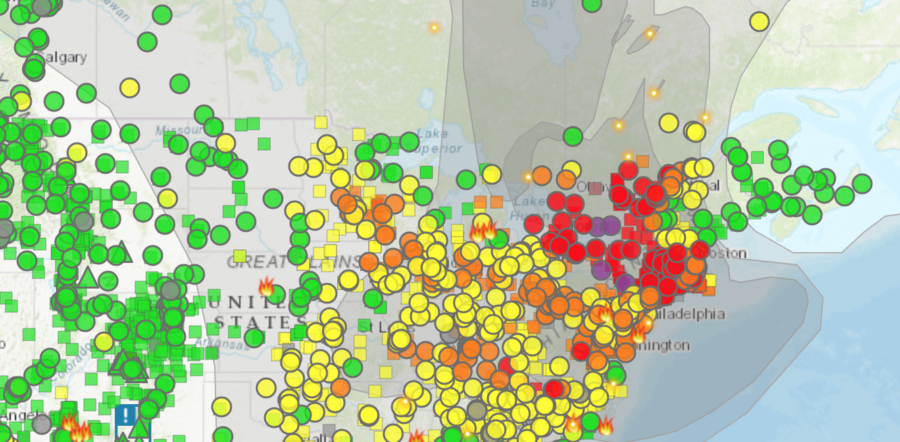
Smoke map, Northeast U.S., by fire.airnow.gov

The Northeast smoke is the result of more than 150 fires in Canada; it has drifted toward Connecticut and stalled in the Northeast U.S. by an upper-level, low-pressure system, according to Connecticut’s DEEP.

map.purpleair.com
map.purpleair.com

Those with asthma or lung disease, and/or the elderly are at risk if they spend a long time outside. Last week, the American Lung Association issued an air quality alert for increased fine particulate matter levels. Check the Fire and Smoke Map at fire.airnow.gov for detailed information about your area, and map.purpleair.com is another excellent source for air quality warnings.

Fires in Germany burn near Königsberg and Wernigerode

In Germany, the Harz Mountain Fire has forced tourist evacuations; the fire reportedly started at the Königsberg peak in northern Germany on Sundayl Another fire was ignited in the eastern state of Brandenburg on Wednesday and it is still growing. Deutsche Welle (DW) reported that near the town of Wernigerode in the state of Saxony-Anhalt, a fire in the Harz mountains had been contained. About 100 people were evacuated from the Brocken peak, the highest point in northern Germany and a popular attraction famed for its literary connections.

A Canadair CL-215 water bomber plane dropping a load of water on a forest fire.  Wikipedia Commons photo
A Canadair CL-215 waterbomber dropping a load on a fire.  Wikipedia Commons photo

ABC News reported that the wildfire on the German military training site is “contaminated” with ammunition. Officials say strong winds have fanned flames at the fire near Jueterbog, south of Berlin, and because the area contains large amounts of ammunition, the fire has doubled in size. Firefighters are working to contain the fire but are avoiding the training grounds where explosions were heard Monday, according to ABC News.

Weeks of dry weather have increased the risk of wildfires in eastern Germany, with some regions on the second-highest alert level. A fire near Jueterbog, south of Berlin, was burning for days as authorities scrambled to keep it from reaching surrounding villages.

Meteorologists say that rain predicted for the coming days may lower the threat of wildfires. CTIF, the Internation Association for Fire and Rescue Services, reported that Europe is expecting that 2023 will be extremely hot, with droughts and record forest fires. 2022 was a year of weather records in Europe; the summer was record-hot, with temperatures above 45°C (113°F) with numerous heat-related deaths, along with the drought and fires.

European Environment AgencyThe 2022 annual report from the EU’s environmental monitoring program Copernicus shows that scientists believe the extreme heat will get even worse in southern Europe. Britain recorded summer temperatures exceeding 40°C for the first time ever in July 2022. Britain’s heatwave was only one of many; the highest temperature measured was in Portugal at 47°C.

The Copernicus program collects and transforms data from multiple sources (e.g. satellites and in-situ or non-space measurements) into operational services to provide information about the earth’s land, oceans, and atmosphere, and to monitor climate change, support European emergency management, and safeguard civil security.

Airtankers ON

The table below released by NIFC is dated May 30, 2023 — but all of these airtankers have been activated, some as early as March. No big surprises on the contract awards — most of who you hoped would be on contract, including two Aero-Flite scoopers, are on the list.

T-262 -- a 1600-gal. CL-415. Aero-Flite photo
T-262 — a 1600-gal. CL-415. Aero-Flite photo

The other airtanker contract awards include Neptune (T-40 and T-15 and T-16 and T-12), Aero-Flite with T-12 and T-162, 10 Tanker with its T-914 DC-10, Coulson’s T-137 (a 737), Aero-Flite (T-167 and T-164) and Aero Air with T-102 and T-101. The CWN activations include 10 Tanker’s T-910 (a DC-10), and the CWN Scooper activations include Aero-Flite’s S261 and S262 (both CL-415 aircraft).

2023 Airtankers
2023 Contract Airtankers

High fives to all you pilots, personnel, and contract companies — we’re glad you’re on board!

*NOTE: No one at NIFC has responded to a couple requests
for details on this, but if they do we’ll update this post.

Nova Scotia battles its largest fire in history

Canadian firefighters are fighting the biggest wildfire in the history of the Atlantic province. The fire on the southern tip of the province has burned over 17,000 hectares (42,000+ acres), with flamelengths reaching nearly 100m (328 feet). And another fire near Halifax has forced the evacuation of thousands of residents. Smoke has drifted south, triggering air quality warnings in the U.S., according to BBC News reports.

Smoke over Nova Scotia firesNova Scotia officials said the fire’s burning in Shelburne County and about 50 homes have been destroyed. Dave Rockwood with the Nova Scotia Department of Natural Resources told reporters that the fire’s very fast-moving. He said about 5,000 people were evacuated, according to reports from the Royal Canadian Mounted Police (RCMP). A smaller fire near Halifax earlier burned about 200 homes and evacuated over 16,000 people.

According to an ALJAZEERA report, the fires were causing poor air quality hundreds of kilometers away, but federal help was coming — along with about 100 firefighters from the U.S. — after local authorities appealed for outside assistance. Canada’s federal government had already provided airlifts, aerial surveillance, crew comfort trailers, and food at the emergency shelters, said Sean Fraser, a cabinet minister and parliament member from Nova Scotia.

Firefighters in Nova Scotia

“We’re in a crisis in the province and we want and we need and we will take all the support we can get,” Nova Scotia Premier Tim Houston told a news conference on Wednesday. “Unprecedented resources are being used because these fires are unprecedented.” Additional resources have been shipped in from Ontario, and a dozen water bombers from neighboring regions and the Coast Guard have been engaged. Houston said he has also asked for military assistance.

Prime Minister Justin Trudeau called the wildfires “heartbreaking” and promised unlimited support.


On Wednesday, Nova Scotia officials increased the fine for breaking the provincewide burn ban — a restriction on outdoor fires — to $25,000 CAD (almost $19,000 USD). Officials said rain is not forecasted for the region until Friday, and they remain unsure on when residents can return to their homes.

Collapsed bridge between Clyde River and Port Clyde in Nova Scotia.

Canada’s federal government announced today that it will be sending more resources to help Nova Scotia. This includes military personnel, as well as additional firefighters to help relieve those who have been working on the ground for days. More than 300 firefighters from the U.S. and South Africa are en route to Canada in the coming days. Some will be sent to Nova Scotia, while others are headed for Alberta.

An amazing firefighter GoFundMe: Casey Budlong

UPDATE: CASEY IS HOME and is doing well, considering.
Still not out of the woods, more details from James and Katy pending …
His GoFundMe page has a bunch more photos!

  • June 2 MESSAGE FROM KATY,
    Casey has been released from the hospital and is home on the farm! We are still waiting on the final pathology results, but we know he will have to undergo chemotherapy and radiation again. We are so thankful for the love and support that we have received, and we will continue to keep everyone updated.
Casey Budlong
Casey Budlong

Hey everyone my name is James Snell with the La Grande Airtanker Base. Unfortunately, as many of us already know, Casey’s brain cancer has returned and as I’m typing this message Casey is undergoing open brain surgery. Casey has over 20 years working in wildland fire for the US Forest Service, with the last 5 years working at the La Grande Airtanker Base. He began his service as a wildland firefighter in his hometown of Detroit Lake, Oregon and went on to serve at various locations in eastern Oregon, including 8 years with La Grande Hotshots. Katy Budlong, his wife, has said expenses for medical bills not covered by insurance will be at least $30,000.

Casey Budlong family

For this reason, we here at the La Grande Airtanker Base have decided to start up a GoFundMe to assist the Budlongs with their out-of-pocket costs.

https://www.gofundme.com/f/casey-budlong-and-his-family

The length of Casey’s post-surgery recovery is unknown at this point. Your donations will help cover medical expenses, hotel stays, and gas money for travel between La Grande and Portland, among other expenses that will arise during his rehabilitation. Please consider donating, a gift of any amount would mean the world for the Budlongs.

MESSAGE FROM KATY:
Casey Budlong was diagnosed with brain cancer in August 2018 and underwent two brain surgeries, six weeks of radiation and chemotherapy, and then another five months of intensive chemotherapy. Casey recovered remarkably well and faced the challenge with positivity and humor. Unfortunately, in April 2023, he developed a bad headache and lost peripheral vision in his left eye. A trip to the ER and a CAT scan revealed a new tumor located right-rear; the first tumor was right-front. The ER doctors immediately referred Casey back to Oregon Health Sciences University (OHSU) in Portland, and he has gotten further tests and is working on getting surgery scheduled. So, surrounded by an amazing support system of family and friends and an exceptional medical team, Casey will once again face this challenge.

UPDATE FROM KATY:
Casey is doing great! They removed the drain tube this afternoon and are keeping his pain level down. After the last surgeries, he developed a blood clot in his leg, so they did a scan today and unfortunately found a clot in the same spot, so they will be placing an IVC filter tomorrow morning for that. He is still in ICU, but with orders to be transferred to general as soon as they have a room ready, but it might not be till tomorrow. He has definitely become the favorite patient and has kept the staff laughing, and they all love him! His nurse last night was briefing some of the medical team outside his room, describing his history and how well he is doing, and told them, “You have Captain America in there!” He is a superhero, although Chris said he is more like the Hulk. He is also eating in true Casey fashion and loving the hospital food. He may go home tomorrow, but that will depend on how he does. As always, thank you for your thoughts and prayers! ❤️

https://www.gofundme.com/f/casey-budlong-and-his-family

Oregon Rx fire gets away east of Eugene

Firefighters are working on a wildfire that took off when sudden wind gusts fanned a prescribed burn that was considered contained, the U.S. Forest Service reported late Tuesday night. KEZI-TV reported that a prescribed burn was under way near the community of McKenzie Bridge, upstream from Eugene, Oregon, on the McKenzie River, on May 30. Though the prescribed burn was started when weather was within planned parameters, gusty winds started two spot fires near the 65-acre burn area.

The USFS officially declared the escaped burn a wildfire — called the W-470 Fire — and said that as of the morning of May 31 the total burn area was about 120 acres.

Fire crews went out on the night of May 30 to try to contain the fire. The USFS said 34 firefighters worked overnight according to pre-existing contingency plans, and more resources were on the way.

KLCC radio reported that unexpected gusty winds pushed the burn outside the prescribed area. The fire is about two miles northeast of the McKenzie River ranger station in eastern Lane County.

The Willamette National Forest reported that the burn was planned to reduce fuels in a thinned stand, but the escaped fire burned onto National Forest land outside of the burn unit’s perimeter. The burn area is north of Highway 126 where FS Roads 26-204 and 26-206 split near Frissell Trail.

Cooler temperatures are moderating fire activity. “Our highest priority is to suppress fire in the area adjacent to the burn unit,” said Dave Warnack, Willamette Forest Supervisor. Residents of the area who remember the 2020 Holiday Farm Fire are expressing frustration with the USFS for allowing the prescribed burn to escape.

OREGON: keep an eye out for contents from this trailer

Firefighters in Oregon are on the lookout for thieves who stole  investigation gear and evidence from a Lebanon Fire District trailer parked at a fire station about 90 miles north in Fairview, Oregon.

Lebanon, Oregon fire equipment trailer

KOIN-TV reported that thieves broke into the trailer and stole thousands of dollars’ worth of investigative equipment.

Firefighters said they discovered the break-in on Monday at Station 33 in Fairview; thieves had cut through a new security fence on the back of the property, cut the locks on the Lebanon Fire Investigation Team trailer, and stolen fire investigation tools including lights and cameras.

“Thefts such as these are extremely frustrating,” said Fire Marshal Ken Foster. “Having to replace all our investigation equipment may delay any pending or future fire investigations and has a direct effect on our community.” The Lebanon Fire District is asking for help; anyone with information should contact the Linn County Sheriff’s Office at 541-967-3950 and refer to case number 23-02101.

Burning Hot: 50 Years of U.S. Fire Weather

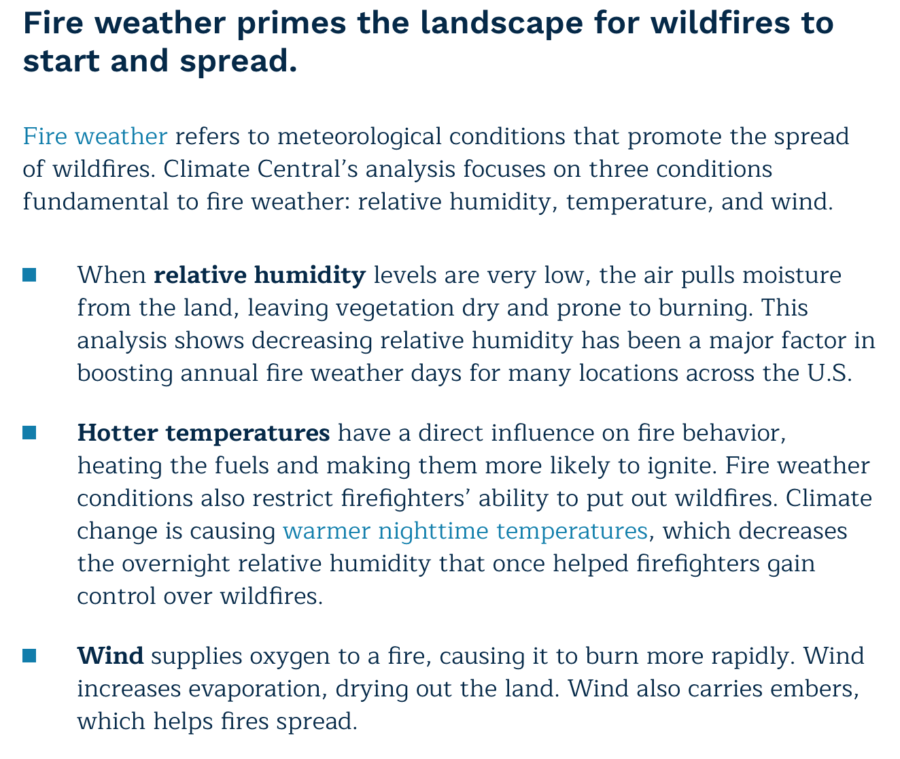
Climate Central has examined historical trends in fire weather — a combination of low humidity, high heat, and strong winds — across the U.S., using data from 476 weather stations to assess trends in 245 climate divisions spanning all 48 contiguous states over a 50-year period from 1973 to 2022.

Wildfire seasons have become longer and more intense, especially across the West, and the research also found that many parts of the East have experienced smaller but important increases in fire weather. Even small increases in the East — with almost 28 million homes in fire-prone areas — puts millions more people at increased risk. As the research intro points out, the same weather variables that influence fire weather and wildfire are factors that determine the safe use of prescribed fire, critical to reducing fuels and thus fire risk. More fire weather days means fewer windows for prescribed burning.

fire weather

The reports include both summaries and in-depth comparisons of Fifty Years of Fire Weather in the West (example: Some places, including parts of Texas, California, Oregon, and Washington, are experiencing fire weather more than twice as often now as in the early 1970s) and Fifty Years of Fire Weather in the East (example: New England has experienced a decrease in annual fire weather days, driven largely by fewer days in which the wind speed variable hit the analytical threshold). Reduced wind speeds could be partially attributed to a decrease in the temperature gradient between land and sea along the Gulf of Maine, as sea surface temperatures have warmed drastically due to climate change.

Climate Central’s new report, Wildfire Weather: Analyzing the 50-year shift across America, expands on wildfire risks and adaptation across the country. The full report discusses other key factors that influence wildfire, including fuels, other weather conditions, and human activity.

Durango opens for the season

Last Wednesday at the Durango Airtanker Base in Colorado, firefighters from a long list of agencies got familiar with one another’s aerial firefighting resources at Durango-La Plata County Airport. The base opened for the season on May 15, and will remain open through the end of September. San Juan National Forest staff showed up, along with firefighters from the Durango, Los Pinos, and Upper Pine Fire Protection Districts, plus the BLM, the Colorado Division of Fire Prevention and Control, Flight For Life, Durango-La Plata County Airport, BIA Ute Mountain Ute fire agency, and Mesa Verde Interagency Helitack.

The Durango Herald reported that the fly-in allowed firefighters to circulate briefing stations at each agency’s aircraft and vehicles around the base. The San Juan National Forest’s Lorena Williams said two SEAT airtankers will arrive at the base next week, and the state has a large airtanker on contract if needed.

Assistant Airtanker Base Manager Dave Hautamaki said the base can host five or six large airtankers. They sent us a nice video a couple years ago. Rick Freimuth also sent us photos and a description of the Safety Fly-In that occurred four years ago at Durango:

 Durango Tanker Base, 2019 photo by Rick Freimuth.
Durango Tanker Base, 2019 photo by Rick Freimuth.