UPDATE 06/02/2023 — Allstate and Farmers join State Farm in denying new homeowner policies in California. State Farm quit selling new homeowner policies on Saturday, and now a second major carrier, Allstate Insurance, has confirmed it ended new homeowners’ policies in the state last year. On top of that, ABC-7 News reported that Farmers Insurance is now limiting policies for new customers. All three companies are still serving existing customers, and more than 100 other companies are still issuing new homeowners’ policies, but homeowners across the state will have a tougher time buying coverage.
State Farm will no longer provide home insurance to new California customers because of wildfire risks and increased construction costs. The company quit accepting new applications for business and personal lines and casualty insurance in California, USA TODAY reported.
Estimation QS Building Cost Estimating, Construction, Outdoor Projects and Activities
State Farm said it will still work with the California Department of Insurance and lawmakers and will still serve existing customers.
The Oregonian reported that last year, California became the first state to require insurance premium discounts for those with wildfire protection safeguards at homes or businesses. That change was in response to soaring insurance costs for customers in high-risk areas.
“State Farm General Insurance Company made this decision due to historic increases in construction costs outpacing inflation, rapidly growing catastrophe exposure, and a challenging reinsurance market,” the company said in a statement.
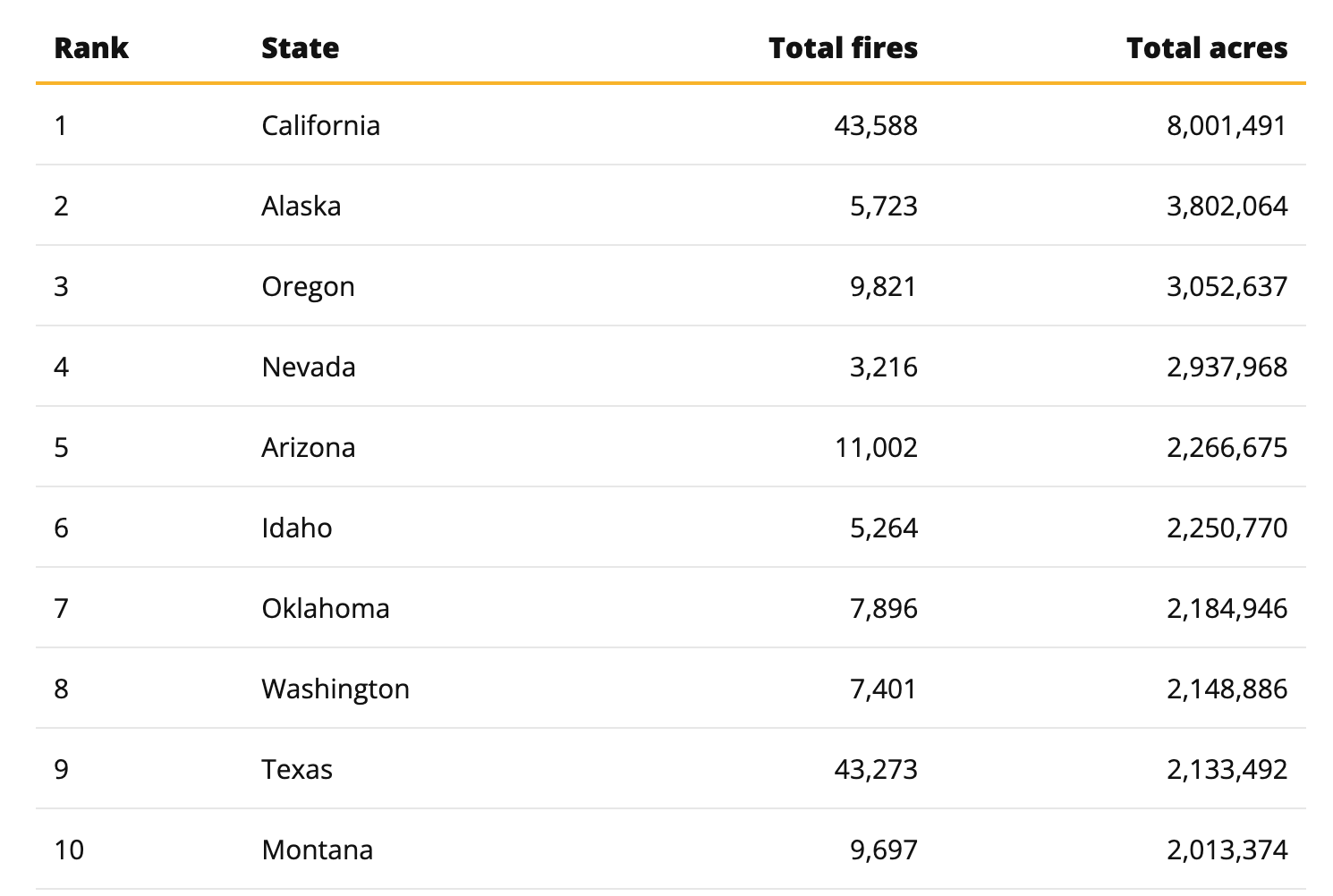
Top ten states by acres burned, 2016-2020.
CNN reported that scientists and California officials blame the climate crisis for the intensity of fire seasons. About 25 percent of the state’s forestland burned in the last 10 years — more than triple the previous decade.
The factors behind Illinois-based State Farm’s move are beyond the agency’s control, Michael Soller with the California Department of Insurance said. State Farm, with its affiliates, is the largest provider of auto and home insurance in the U.S.
A federal judge ruled Friday that the U.S. government can continue using retardant to fight wildfires, despite his finding that it does pollute streams in violation of federal law. Banning retardant could cause greater environmental damage from wildland fires, said U.S. District Judge Dana Christensen in court in Missoula, Montana.
The judge agreed with U.S. Forest Service officials who testified that dropping retardant from aircraft into areas near waterways was sometimes necessary to protect lives and property, according to an AP report posted by KEZI-TV.
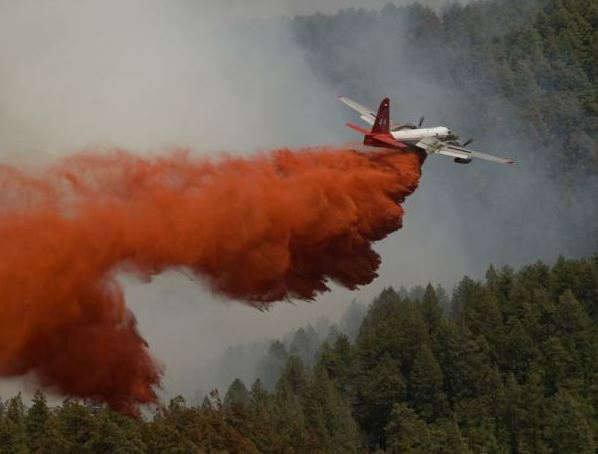
2019 retardant drop, photo by Kari Greer
Christensen’s ruling resulted from yet another lawsuit filed last year by an environmentalist group trying to protect fish over people when they learned that the Forest Service had dropped retardant into waterways — what they claim was hundreds of times over the last decade.
Retardant is often crucial in slowing the progression of wildfires, which have grown larger and more destructive and more frequent as climate change and a burgeoning wildland/urban interface advance the danger of fires across the West — and other parts of the world.
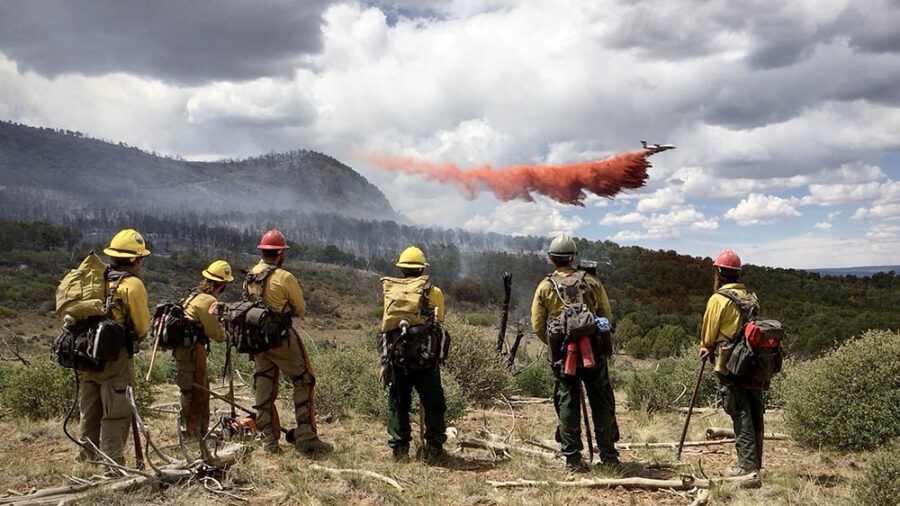
Firefighters observe a retardant drop by an RJ85 airtanker. DOI photo.
Though environmental groups claim fire suppression efforts allowed incursions of retardant more than 200 times over the last 10 years, fire officials reply that such situations happened accidentally — and in less than 1 percent of the thousands of retardant drops ordered each year.
During this case — yet another in the decades-long battle by environmental groups against the use of retardant — a coalition including Paradise, California said stopping the use of retardant would risk lives, homes, and forests. (The 2018 Camp Fire killed 85 people and destroyed the town of Paradise.) There’s a good story online about this coalition by AerialFire Magazine.
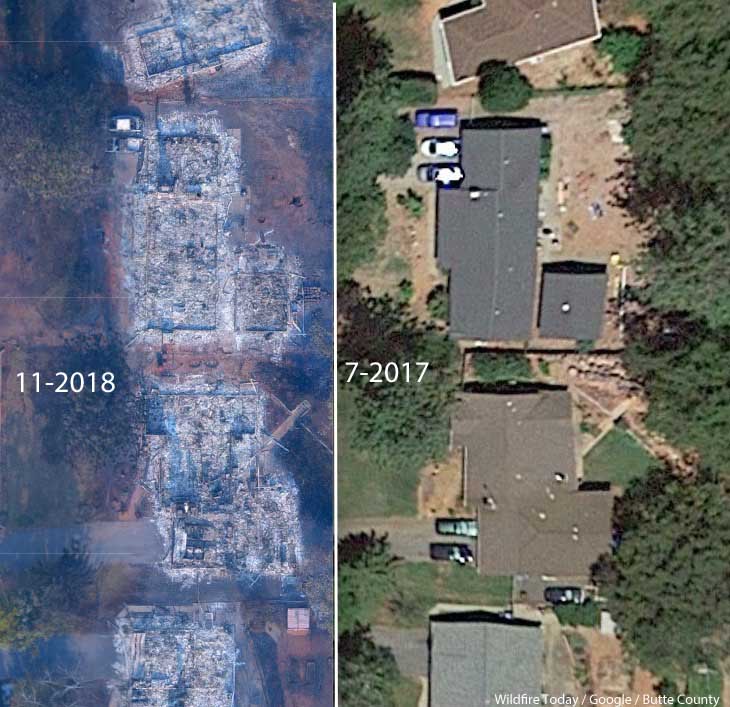
A neighborhood on Debbie Lane in Paradise, California, before and after the Camp Fire that started November 8, 2018. The homes were 14 to 18 feet apart.
“This case was very personal for us,” said Paradise Mayor Greg Bolin on Friday. “Our brave firefighters need every tool in the toolbox to protect human lives and property against wildfires, and today’s ruling ensures we have a fighting chance this fire season.”
“Retardant lasts and even works if it’s dry,” said Scott Upton, a former region chief and air attack group supervisor for CAL FIRE. “Water is only so good because it dries out. It does very well to suppress fires, but it won’t last.”
KDVR-TV reported that the Oregon-based group Forest Service Employees for Environmental Ethics (FSEEE) argued in its most recent lawsuit that the Forest Service was disregarding the Clean Water Act by continuing to use retardant without taking adequate precautions to protect streams and rivers. Launched by Jeff DeBonis in 1989 in Eugene, Oregon, the group (nationalforestadvocates.org) says it has about 10,000 members; it publishes a quarterly called Forest Magazine and pays its director Andy Stahl over $91K annually. The organization receives a substantial part of its support from a governmental unit and/or the general public.
Andy Stahl
FireRescue1 reported that FSEEE claims wildfire retardant drops are expensive, ineffective, and a growing source of pollution for rivers and streams. “There’s no scientific evidence that it makes any difference in wildfire outcomes,” said Andy Stahl. “This is like dumping cash out of airplanes, except that it’s toxic and you can’t buy anything with it because it doesn’t work.”
The case has been followed closely by officials in California, where an extremely wet winter is likely to stoke the growth of early-season light fuels. “This is going to destroy towns and many communities in California, if they allow this to go through,” said Paradise Mayor Greg Bolin, whose town was razed by the Camp Fire five years ago. “To maybe save a few fish, really?”
The Smokey Wire is a Forest Service and public lands policy blog administered by Sharon Friedman, Ph.D., forest geneticist, Forest Service retiree, and former Chair of both the Forest Policy Committee and Forest Science and Technology Board at the Society of American Foresters. In a recent post about this retardant case, she commented on a piece in the San Joaquin Valley Sun published about a month ago in April, which noted that if the court sided with FSEEE, the USFS would have to obtain a special permit under the Clean Water Act to use retardant from aircraft — a lengthy process that would span multiple years. During the lawsuit, the USFS initiated the process of receiving such a permit from the EPA with the current 300-foot buffer zone for retardant drops from affected waterways.
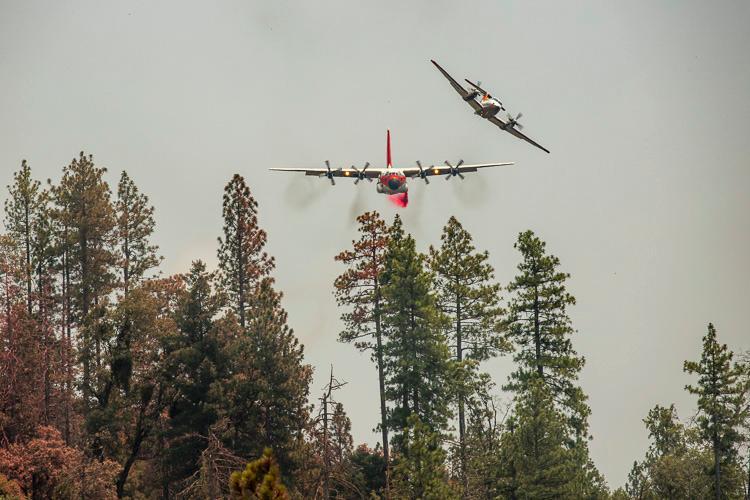
While following a lead plane, Tanker 118, an HC-130H, begins a retardant drop on the 2018 Ferguson Fire — photo by Kari Greer
In response, FSEEE argued that 300 feet was an arbitrary number. Despite its argument that the USFS had originally created the 300-foot buffer proposal out of thin air, FSEEE then asked the Court for a 600-foot buffer zone.
U.S. District Judge Dana Christensen
Judge Christensen noted then that a ruling was pending, because fire season in the West is pending. He expressed skepticism at the nationwide impact of siding with FSEEE and rejected its push for an extended buffer zone. “The last thing I want to do is start imposing magic numbers in terms of buffer zones,” he said. “I mean, that’s way out of my wheelhouse. But I don’t know what the Forest Service did to come up with a 300-feet buffer, and you’re describing it as being essentially nothing. It’s a magic number. And I will tell you, if this Court imposes a 600-foot buffer, that is truly a magic number. So that’s probably not going to happen.”
USFS attorney Alan Greenberg said the Forest Service uses retardant on about 5 percent of wildfires — and less than 1 percent of those drops end up in contact with water.
Christensen said that stopping the use of retardant could result in greater harm from wildfires — including to human life and property and to the environment. (Note that his ruling was not nationwide — it’s limited to the 10 western states where FSEEE alleged harm from pollution into waterways.)
In the lawsuit (online HERE), FSEEE specifies that “the chemical retardants used by wildland firefighting agencies are tested and approved by the United States Department of Agriculture’s Missoula Technology and Development Center, located in this Division. The Forest Service also has a Fire Sciences Lab and Smokejumper Base in this Division. Plaintiff has members who reside in this Division, and who have been injured by the Forest Service actions and activities complained of in this Complaint. Moreover, the Forest Service has discharged aerial fire retardant into navigable waters in this Division without a National Pollution Discharge Elimination System (NPDES) permit.”
Airtanker drops retardant
After the lawsuit was filed the Forest Service applied to the EPA for a permit that would allow it to continue using retardant without breaking the law. That process could take years. Christensen ordered federal officials to report every six months on their progress; no word yet on whether the USFS will still pursue that EPA permit or whether they have to continue reporting to Christensen about it.
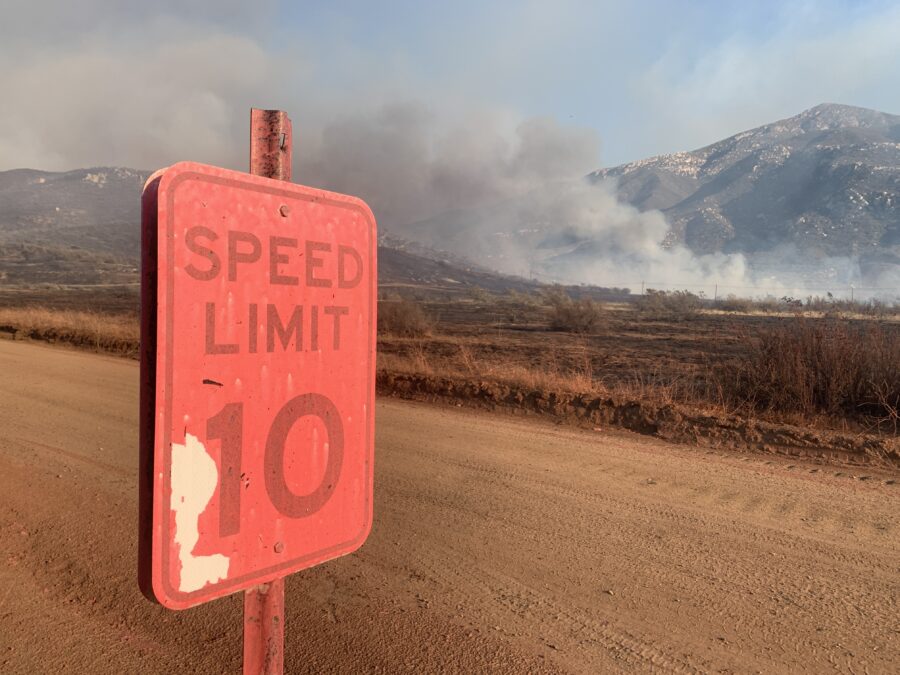
Fire retardant covers a road sign on Barrett Lake Road in the eastern San Diego town of Dulzura, California, site of the Border 32 Fire that burned 4,456 acres between August 31 and Sept 8, 2022. Photo Credit: Josh Stotler
Health risks to firefighters or other people who come into contact with fire retardant are considered low, according to a 2021 risk assessment. But the chemicals can be harmful to some fish, frogs, crustaceans, and other aquatic species. One government study found misapplied retardant could adversely affect dozens of species including crawfish, spotted owls, and threatened fish such as shiners and suckers. To prevent risk, officials and pilots have avoided drops within 300 feet (92 meters) of waterways. Retardant may be applied inside those zones only when if life or public safety is threatened. Of 213 documented instances of fire retardant contacting water between 2012 and 2019, 190 were accidental and the remainder were necessary to protect lives or property, officials said.
Trina Moyles is the author of Lookout: Love, Solitude, and Searching for Wildfire in the Boreal Forest, and the Globe and Mail published this excellent opinion piece by Moyles last week, titled Alberta had one of the best wildfire programs in the world. Budget cuts have left the province at risk.
“I worked for Alberta Wildfire for seven years as a lookout observer,” she writes, “climbing a 100-foot tower and watching for smoke from April to September. In 2016, my first season, on my fourth day on the job, I witnessed a grassfire take off in the scorching hot, bone-dry conditions of early May. Within minutes, not one, but four giant columns of smoke exploded. The fires were caused by sparks cast from the friction of a train braking along the tracks and catching in the cured grass.”
Her detailed op-ed explains, from her perspective, what happened to a stellar fire detection and suppression system, and how Alberta now finds itself understaffed, underfunded, and underequipped. “In the world of wildfire management, experience matters,” she says. “Experience is what keeps communities safe from wildfires and firefighters safe on the fireline. Experience results in a faster, more efficient delivery of wildfire detection, assessment, and management. Experience can be achieved only in a system where people feel valued and fairly compensated, and have the opportunity to learn and grow within the organization.”
Her descriptions of Alberta fire crews sound nearly identical to descriptions of fire crews in the western U.S. — up to and including budget woes.
“A series of government cutbacks and defunding, however, has seriously damaged Alberta Wildfire’s ability to prevent and respond to wildfires,” she writes. “The NDP cut $15 million from the budget in 2016. Three years later, the United Conservative Party (UCP), despite the severity of the 2019 fire season in Alberta, with multiple northern and Indigenous communities affected by the Chuckegg Creek and McMillan wildfire complexes, subsequently deepened those cuts. In November 2019, they slashed the Rappel Attack Program (RAP), a 40-year-old program that trained firefighters to rappel from helicopters into remote areas. They also decommissioned 26 fire towers, one-fifth of the province’s lookout detection program. Then-agriculture and forestry minister, Devin Dreeshen, told the CBC, ‘We don’t want politics getting in the way of how we fight fires. We want experts in the actual field to actually say how we should actually fight fires.’ But the UCP have done anything but listen to wildfire experts.”
For weeks, Alberta Wildfire officials have begged people to stay away from evacuation zones, and now the Royal Canadian Mounted Police (RCMP) will charge a man who ignored those warnings and had to be rescued when he became trapped by flames. RCMP said that Friday afternoon in the Fox Creek area, a 72,830-hectare fire that’s part of the Eagle Complex trapped a man who became stranded northwest of Fox Creek. GlobalNews.ca reported that police were called at 2:45 p.m. about a man stranded, where he had attempted to use a gravel road to get around an evacuation zone checkpoint. Because of active fire in the area, police said it was not safe for first responders to go in and rescue the man — so a forestry helicopter flew in and airlifted him to safety.
On Sunday, RCMP said they are seeking to lay common nuisance charges against the man for diverting firefighting resources.
“Alberta RCMP continue to be deployed with specialized units to assist with public safety and crime reduction efforts during these fires,” said district advisory NCO Staff Sgt. Neal Fraser in a statement. The man’s name was not yet released; RCMP expected details to come later this week. On Monday, Alberta Wildfire said the fire near Fox Creek is still burning out of control but hasn’t grown toward the community in the past day.
Rain was expected late Monday. The province said firefighters are taking advantage of the quieter fire behavior to reinforce a fire guard west of Fox Creek and to build a new line along the southern edge of an excursion that crossed Highway 43 north of Fox Creek. Heavy equipment is also working on fire guards, to remove hazardous rotten trees that pose a risk to both firefighters and area residents. As of Monday, there were 164 provincial wildland firefighters and support personnel working the fire, along with a structural protection unit and the Fox Creek Fire Department.
Also helping were firefighters from Colorado and New Brunswick, and about 100 soldiers from 1 Combat Engineer Regiment out of CFB Edmonton.
There were also 17 helicopters working on the Eagle Complex, including two heavy helicopters dedicated to dropping water with buckets.
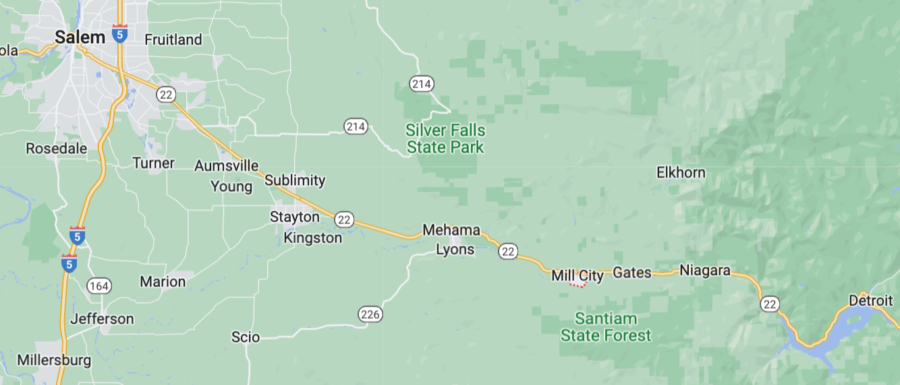
Over the Labor Day holiday in 2020, with east winds picking up toward the end of a long, hot and dry summer, Leland Ohrt was dispatched to a home not far from his own, where a tree branch had fallen on a powerline and started a small brush fire. Ohrt was Mill City Fire Chief, a VFD chief in a small town in western Oregon’s Cascades; he hosed down the fire, then drove over to Schroeder Road, where another tree branch had fallen over another powerline and was still arcing sparks into the dry fuels below. Ohrt couldn’t stop the sparking, so he hosed the utility lines with water until they exploded and de-energized themselves.
Those two incidents initiated a frenzied 48 hours for Ohrt, acccording to an OPB report today, and he was later recognized for his efforts to save Mill City as the fires destroyed thousands of homes down the Santiam Canyon and across other parts of western Oregon.
Chief Ohrt saw Pacific Power’s utility lines start those fires, but he took the stand last week to defend the utility company in a class action trial against Pacific Power. He told a jury in Multnomah County Circuit Court that he immediately blew off attorneys who’d sent him paperwork in the weeks following the fires — lawyers who were trying to contact fire victims.
“I threw all that paperwork away,” Ohrt said. “You could tell right off the bat they were going to go after Pacific Power for this.”
Ohrt’s testimony highlighted a key aspect of the defense Pacific Power’s corporate owners, PacifiCorp, expect to lay out in the coming weeks of the trial: Most of the wildfires in the Santiam Canyon started not from their powerlines, but from embers of the Beachie Creek Fire. Even in places where powerlines did start fires, PacifiCorp’s attorneys contend that people fighting those fires quickly got them under control.
Mill City, Oregon map
The defense follows what has been several weeks of plaintiffs’ attorneys alleging that PacifiCorp acted negligently by keeping its lines energized during the Labor Day fires, even though they had plenty of warning from weather officials and state government about fire danger. The decision to keep the power on contributed to fires spreading out of control, according to the plaintiffs and their attorneys.
Ohrt though, under questioning from PaficiCorp’s lawyers, pointed to another culprit: the U.S. Forest Service. Ohrt has more than 45 years’ experience with Mill City’s volunteer fire department, but he does not have any experience fighting wildfires.
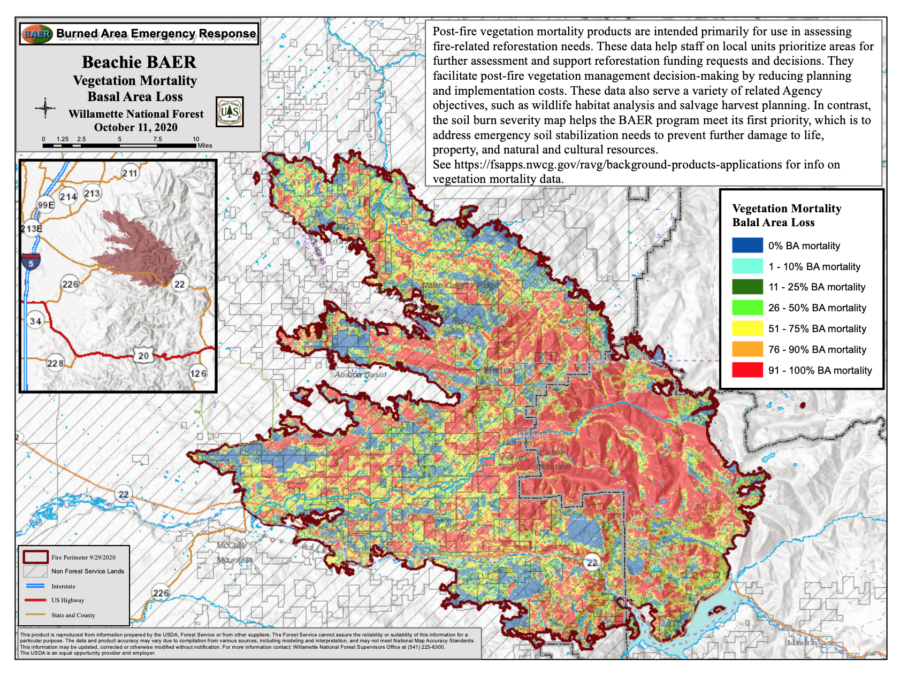
Beachie Creek BAER team map The inciweb images and maps and pages have been retired from the internet, but a few files remain on the Willamette NF site.
Weeks before the Santiam Canyon fires, a lightning strike started the Beachie Creek Fire — northeast of Gates in the Opal Creek Wilderness. Forest Service officials said then that steep terrain made it difficult to get crews to the site to contain the slowly growing fire. According to Ohrt, though, letting the Beachie Creek Fire smolder allowed it to throw embers into the Santiam Canyon when winds picked up on Labor Day.
Beachie Creek Fire August 27, 2020, just 11 days after it started, before it grew very large on September 8. USFS photo.
An excellent “storymap” about the Beachie Creek Fire is [HERE].
“The U.S. Forest Service was supposed to be fighting that fire,” Ohrt said in his testimony.
The Type 3 IC at the time knew that air support was critical, according to a USFS review of the fire, but he also recognized that the fire was burning in an old growth stand, meaning there was a multistory canopy with abundant down logs, duff, moss, and fuels. He knew that getting firefighters on the ground to dig deep for hotspots was the only way to successfully contain the fire.
“Everyone assumes that if you hammer a fire with aerial resources, it will go out, but that’s not the case. There needs to be boots on the ground working in tandem with aircraft. There are hidden hotspots, sheltered from aerial attack, under big logs and deep roots that have to be dug out.” ~ unnamed Type 3 Incident Commander
Whether jurors in the case find PacifiCorp responsible for the wildfires in the Santiam Canyon will likely be influenced by which attorneys’ experts they find more believable. Oregon State University professor John Bailey, for example, testified that there was no way the Beachie Creek Fire could have thrown embers far enough before midnight on Labor Day 2020 to start fires near the town of Gates. Bailey, who teaches fire management and has been studying forestry since the 1980s, said he used topography data, recorded weather conditions, and fuels analysis to estimate where the Beachie Creek Fire could have thrown embers ahead of its front to start new fires. He said strong east winds that night would have — at most — lit spot fires north of Gates and other residential areas in the canyon.
PacifiCorp’s attorneys, on the other hand, had atmospheric sciences professor Neil Lareau of the University of Nevada testify, and he said the extreme weather conditions that night did indeed throw firebrands miles ahead of the Beachie Creek Fire. Lareau explained to jurors how he used satellite data from the fire to determine when plumes of debris burst from the fire and cast embers thousands of feet aloft. He said those plumes matched up with on-the-ground reports of spot fires in the Santiam Canyon. Bailey, by contrast, said embers thrown by fires can rarely travel more than a mile — a far shorter distance than needed to start the fires Lareau claimed originated from the Beachie Creek Fire.
Several regions in the U.S. are suffering from poor air quality as smoke from wildfires in Canada drifts south. Much of the of the U.S. has experienced smoky skies for days, creating unhealthy conditions for residents with heart or lung conditions. ABC News reports that the National Weather Service issued an air quality alert for all of Montana, along with parts of Idaho, Colorado, and Arizona. In Utah, the Department of Environmental Quality urged residents on Friday to avoid outdoor activities in places with visible smoke and haze. Heavy smoke began to pour into northeastern Colorado on Friday.
Alberta Wildfire
Reuters reported that Alberta authorities hope cooler temperatures and showers forecast for the coming week will help firefighters in the oil-rich Canadian province, although storms could complicate efforts. Forecasters are tracking a front likely to move into Alberta on Sunday that could bring cooler weather. Christie Tucker, information unit manager at Alberta Wildfire, said Saturday the front could mean increased humidity or even rain.
“What we’d like to see is a long steady rain that will soak into the forest and into the ground,” Tucker said. “That will help us more than a short burst that would bring lightning and could spark a new wildfire.”
airnow.gov fire and smoke map
Alberta has endured energy production cuts, residential evacuations, and poor air quality after an intense start to the wildfire season. This year, Alberta Wildfire has responded to 496 wildfires burning more than 842,000 hectares, compared with just 459 hectares in 2022.
“This year’s total is nearly 2,000 times last year,” Tucker said. Over 2,800 firefighters from Canada and the United States were fighting 91 active fires on Saturday.
Canada’s wildfires have sent smoke to U.S. states including Minnesota, Nebraska, Illinois, Wisconsin, Wyoming, Utah, Washington, and Colorado, triggering air quality alerts in several places.
The air quality index on the Front Range in Colorado reached 168 on Friday, according to the state’s Department of Public Health and Environment. A reading between 151 and 200 indicates unhealthy conditions that affect sensitive groups as well as the general public, health officials say. Idaho also saw widespread haze earlier in the week, according to the state’s Department of Environmental Quality.
Fire season is already under way in Oregon, with some small fires burning in the southwest part of the state, and state and federal officials are talking about options for funding firefighting efforts.
On May 17, Governor Tina Kotek announced she was adding over $200 million in funding for the state’s wildfire protection system to her budget request to the state legislature. “We need to continue to support things that have worked,” Kotek said in a press conference covered by KEZI-TV. “We need another $207 million to continue our advancements in wildfire protection, in both resilience and protection and response, and I would hope legislators would support that.”
Oregon Dept. Forestry
In Washington, D.C., Oregon Senators Jeff Merkley and Ron Wyden are working on legislation to create national recreation areas across the state. That distinction would require wildfire prevention strategies in the region. “The bill requires the Bureau of Land Management to take preemptive steps to reduce wildfire risks in the new recreation areas,” Wyden said at a Senate committee hearing, “including the construction of new roads to implement fire risk reduction plans and for public safety.”
Fire departments and districts have also received additional funding for firefighters, engines, and risk reduction programs. Much of that funding comes from 2021’s Senate Bill 762.
“Senate Bill 762 was a major investment in in fighting wildfire in Oregon, and it was a huge help for not only the Oregon Department of Forestry but other wildfire agencies in the state,” said Jessica Prakke, PAO with the Oregon Department of Forestry. The legislation provided $220 million to agencies to modernize and improve wildfire preparedness, response, and resiliency. “It was a huge investment in protecting Oregon from wildfire and it has done an immense amount of good across the state,” she said.
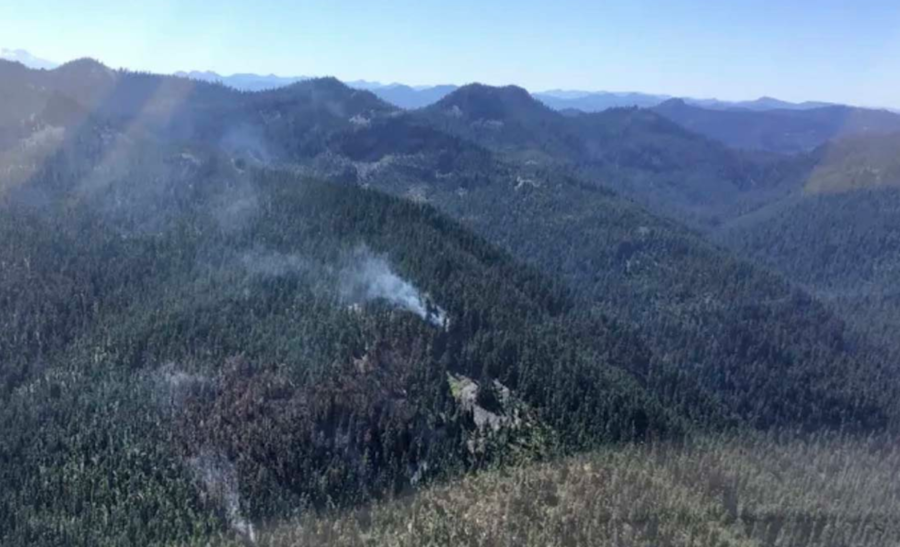
She said the funding also expanded the state’s network of wildfire detection cameras. One such camera caught a fire caused by a lightning strike in Lane County. On the night of May 15 a camera alerted ODF staff to smoke in between Sharps Creek and Mosby. A staffer monitoring the cameras dispatched fire crews to the site, and they had the fire under control within three hours. Prakke said there are now nearly 100 cameras at 60 sites across the state. The system also uses a mapping system to help pinpoint smokes for dispatchers and first responders.
Prevention is the key for a successful season, said Prakke. “The best way to stop wildfire is for people to keep wildfire prevention at the top of their mind,” she said. “About 70 percent of all wildfire in Oregon is human-caused, and so the less that we can contribute to wildfire on our parts, the less our resources are strained to fight other causes of wildfire.”
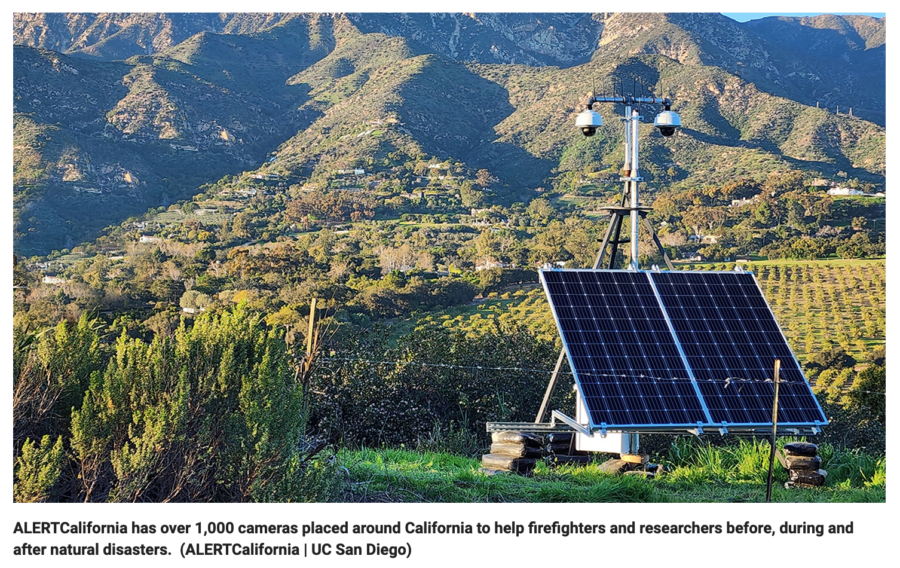
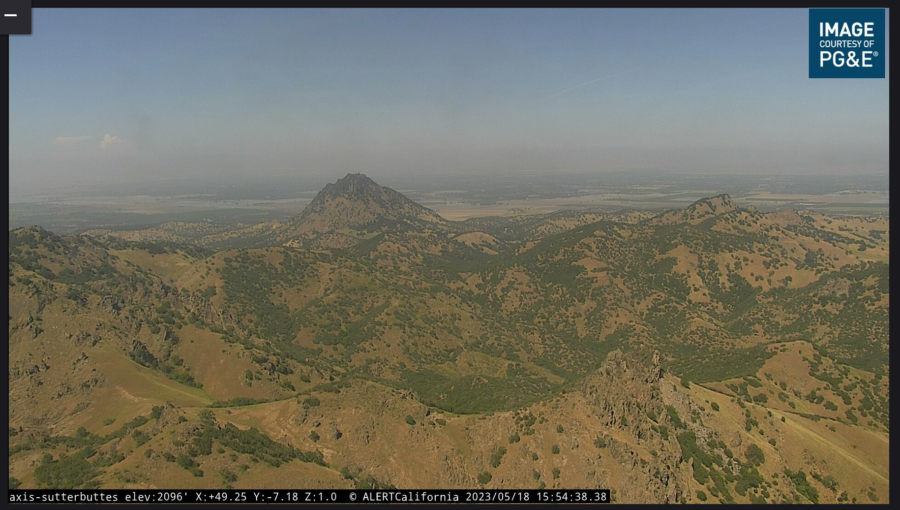
Cal Fire and other agencies are using a network of over 1,000 cameras across California to track wildfires — and now the public can access the network, too. FOX News reports that the University of California San Diego and state fire agencies have partnered to launch a public website for people to view live camera feeds from across the state.
ALERTCalifornia uses a network of more than 1,000 live cameras to track fires. “We’re trying to understand the impacts, the cascading disasters after these events,” said Dr. Neal Driscoll, a professor of geology and geophysics at the UC San Diego Scripps Institution of Oceanography in La Jolla, California. “I’m a professor. I study earthquakes, I make sensors, and here these sensors lend themselves to other events, such as atmospheric rivers and wildfires.”
As the ALERTCalifornia camera network grows in size and sophistication, UC San Diego researchers are using new technology to study natural disaster patterns in the West. ALERTCalifornia provides state-of-the-art technology supporting data-driven decisions to prepare for, respond to, and recover from natural disasters. Based at the University of California San Diego, ALERTCalifornia is a public safety program focused on fires and other natural disasters featuring a world-class camera network.
“These cameras are on mountaintops that we can access, and so if we get a 911 call from someone reporting smoke, we can — one click away — just get on the computer and see if there is actually any smoke in the area,” said Capt. Brent Pascua, PIO with Cal Fire. “We can use multiple cameras to pinpoint the location and get a better location as well.”
“Five or six years ago they had to send a battalion out or an aircraft to confirm ignition,” says Driscoll. “Now they can turn to our cameras. They can immediately move the camera, and image that area, and confirm ignition.” The high-definition cameras can pan, tilt and zoom, with a view as far as 60 miles on a clear day and 120 miles on a clear night, according to Scripps Institution of Oceanography. New cameras were recently installed in Los Angeles, Santa Barbara, and Madera counties since the new year.
Sutter Buttes camera today
Only fire agencies can control the movement of the cameras, which are placed on tripod platforms that can be removed seasonally with little to no impact on sensitive habitats or tribal lands. The camera network started 20+ years ago in 2000, with numerous improvements to the technology over time. The network was originally created to study earthquakes. Since then, it’s expanded to monitor fires and other natural disasters. Public access to the camera feed was launched last week.
Neptune Aviation and the National Museum of Forest Service History in Missoula have announced a partnership to provide Tanker 12 a new permanent home. Neptune Aviation retired its Lockheed P2V airtankers in September of 2017, closing the final chapter on the world’s last active fleet of former maritime patrol aircraft, dating back to the Cold War era, which served for years as national aerial firefighting assets.
Tanker 12 drop, Neptune Aviation photo
“The Museum is a perfect home for Neptune’s T-12,” said Jennifer Draughon, president of Neptune Aviation Services. “The Forest Service has a long history of aerial firefighting operations and Neptune’s T12 will help the museum tell the story of how aircraft play a role in protecting our communities.”
Before Tanker 12 began its history as an aerial firefighting aircraft, the P2V served the U.S. Navy in anti-submarine warfare missions.
NewsTalk KGVO reported that from 1993 Neptune operated a fleet of Lockheed Martin P2V aircraft, and its ships put in about 47,000 firefighting missions, dropping a total of 97 million gallons of retardant.
Neptune’s Tanker 12 during her days as a firefighter — Neptune Aviation photo
Moving Tanker 12 from Neptune’s ops base at the Missoula airport to the museum facilities is a project that’s been in the works for some time. “Our mechanics have been hard at work getting the aircraft ready for display,” said Draughon.
While T-12’s final “flight” will be just under a couple of miles, the work behind the scenes has been intense, according to Lisa Tate, the museum’s executive director. She said the P2V will be parked along the museum’s Forest Discovery Trail near the planned National Conservation Legacy Center, a new interactive and participatory part of the museum. She said the cooperation of the Missoula International Airport will help in moving T-12 to the museum.
“Moving the aircraft is no simple task,” she said. “We need to remove fences, shore up bridges, and make sure the soil is dry enough to handle the weight of a 49,500-pound plane.” She said the airport team is making sure that the historic airtanker’s journey is safe. Tate added that Knife River and Morrison- Maierle have also helped in preparations for this project.
The National Museum of Forest Service History is a 501(c)(3) nonprofit organization with a mission of sharing the history of America’s conservation legacy. Neptune Aviation Services is based in Missoula, Montana.
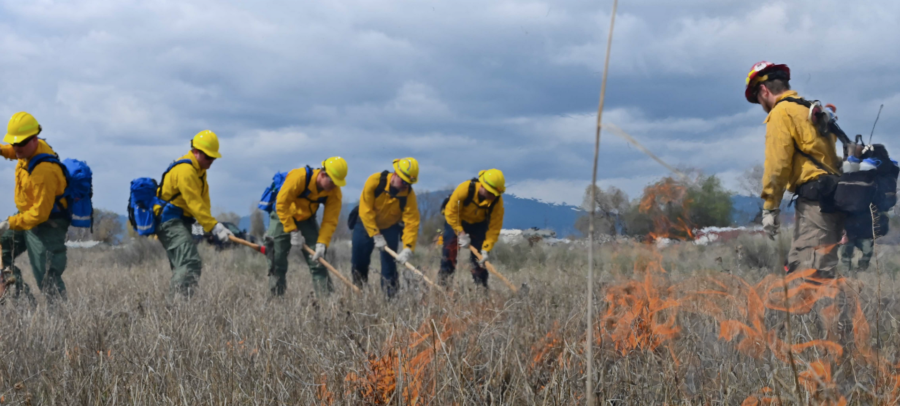
Airmen from the 173rd Fighter Wing recently spent five days of wildland fire training with the Oregon Department of Forestry in preparation for their role in assisting with the 2023 fire season.
Air National Guard Magazine featured a story about ODF firefighters lighting a controlled blaze during training for the 173rd Fighter Wing Airmen at Kingsley Field in Klamath Falls, Oregon.
(U.S. Air National Guard photo by Airman 1st Class Adriana Scott)
“We are tasked with training Guardsmen on Operations Plan Smokey,” said Jake Barnett, protection supervisor for ODF. He said this initial training consists of 32 hours of in-class and hands-on instruction. Airmen are ready to assist the state of Oregon if called up during emergencies and natural disasters. Operation Plan Smokey provides extra resources to the state from the National Guard via an interagency agreement between the Oregon Military Department and the ODF. Training covered fire behavior, tool use, and communications. The last day included a burn in sagebrush and tall grass. Oregon red-carded 20 new firefighters for the state, and Col. Lee Bouma, 173rd FW commander, said they trained an extra three crews this year.