Wildfire potential shifts to the south-central states

wildfire potential map

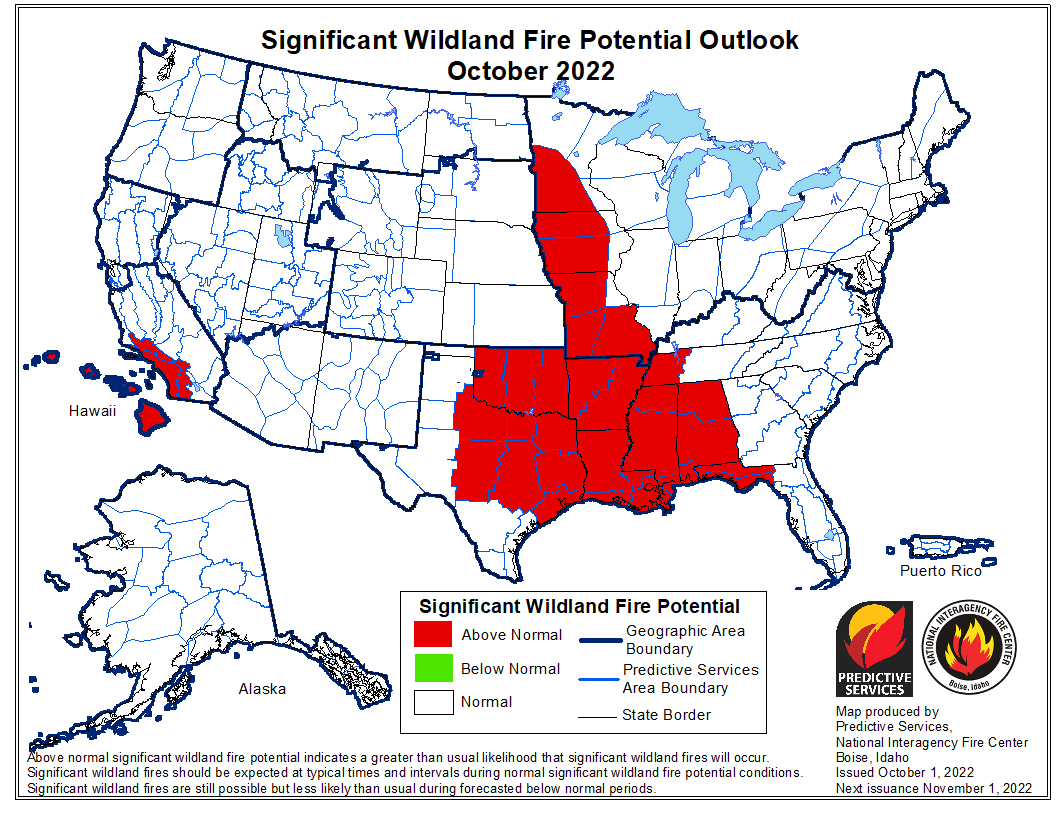
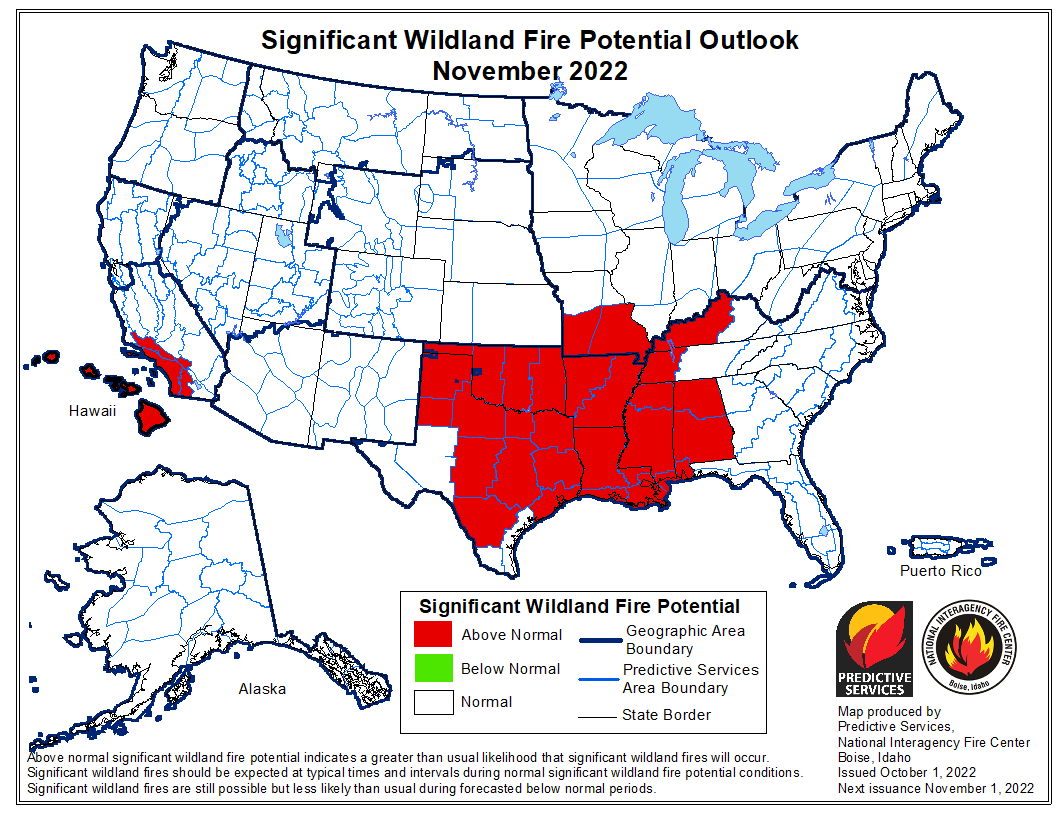
The forecast for wildland fire potential issued October 1 by the National Interagency Fire Center predicts that the wildfire potential shifts to the south-central United States over the next several months. Most of California has received more than the average amount of rain recently.

However some of the Southern California mountain areas have not received much wetting rain, therefore the prediction there is for above normal fire potential in October and November, possibly into December. The first widespread wetting rain this fall will likely follow two to three offshore wind events in Southern California.

NIFC’s monthly forecasts are for the next four months, but in the shorter term, by the end of this week temperatures in the western US and Canada are expected to be 5C to 10C degrees above average for the date.
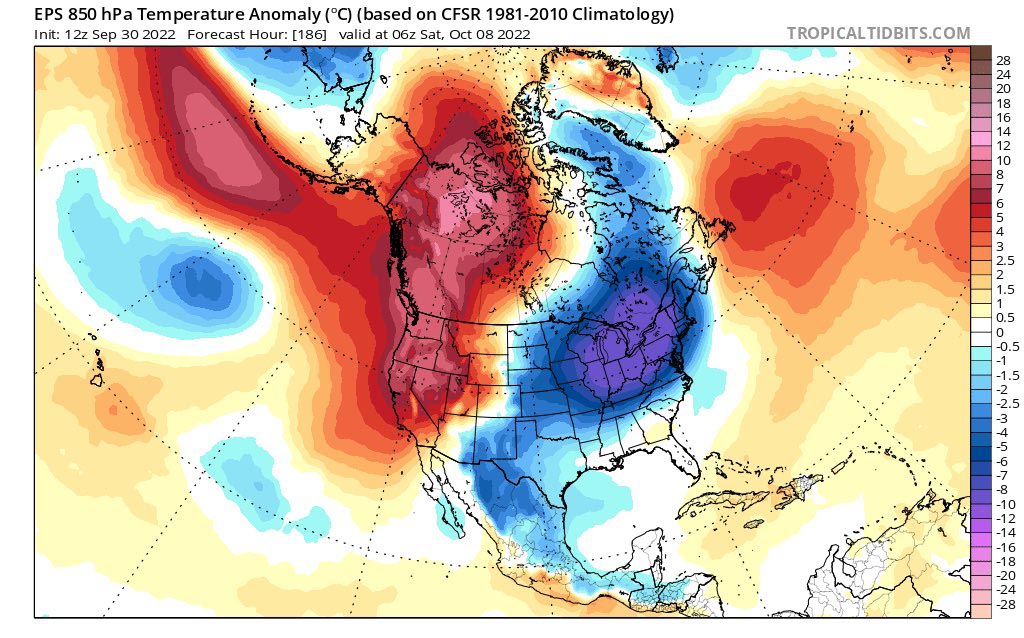
Temperatures week of Oct 2, 2022
Temperature anomaly October 9, 2022.

The fire potential text and maps from NIFC shown here represent the cumulative forecasts of the ten Geographic Area Predictive Services Units and the National Predictive Services Unit. Additional graphics are included from other sources.

Below:

  • Excerpts from the NIFC narrative report for the next four months;
  • Additional NIFC monthly graphical outlooks;
  • NOAA’s temperature and precipitation forecasts;
  • Drought Monitor;
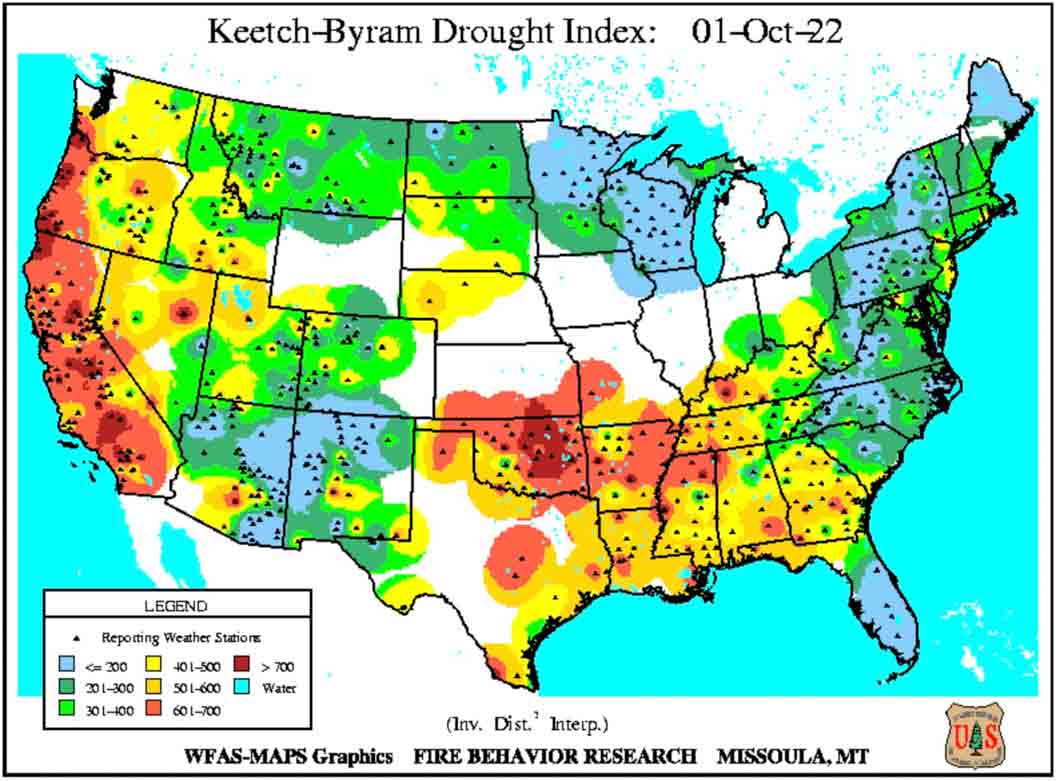
  • Keetch-Byram Drought Index;
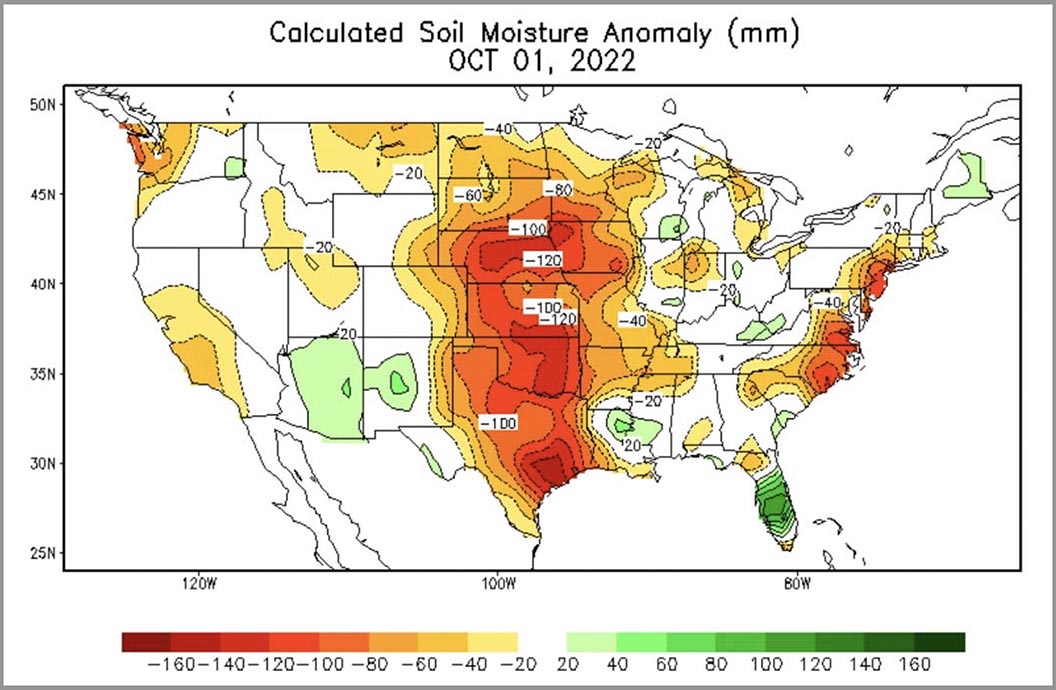
  • Soil moisture.

“Drought continues in much of the West, with expanding and intensifying drought in portions of the Northwest, Idaho, and Montana due to warmer and drier than normal conditions in September. Most of California received well above normal rainfall for the month and much of the Northeast did as well, helping to reduce drought in New England. Warmer and drier than normal conditions also occurred in much of the southern and northern Plains into parts of the Southeast, Texas, and Midwest.

“Near normal temperatures and near to above normal precipitation are likely for portions of the Pacific Northwest and northern Rockies into early winter. Near to below normal precipitation is forecast for the rest of the West through the southern and central Plains into the Gulf Coast and Southeast, barring any landfalling tropical cyclones on the Gulf and Atlantic Coasts. Near to above normal temperatures and near normal precipitation are forecast for the Midwest through the Mid-Atlantic and Northeast.

“Above normal significant potential is forecast for much of Oklahoma, Texas, the Lower Mississippi Valley, and central Gulf Coast into December. Above normal potential is likely for much of the Mississippi Valley in October and the western Ohio Valley through the Ozarks into November. Southern Area is forecast to return to near normal significant fire potential during January.

“The Transverse and Peninsular Ranges of southern California to the coast, areas prone to Santa Ana winds, will have above normal significant potential October through November, before returning to normal potential in December. The Hawai’ian Islands will continue to have above normal potential, especially lee sides, through November before returning to normal potential in December. All the US is forecast to have near normal significant fire potential during January.”
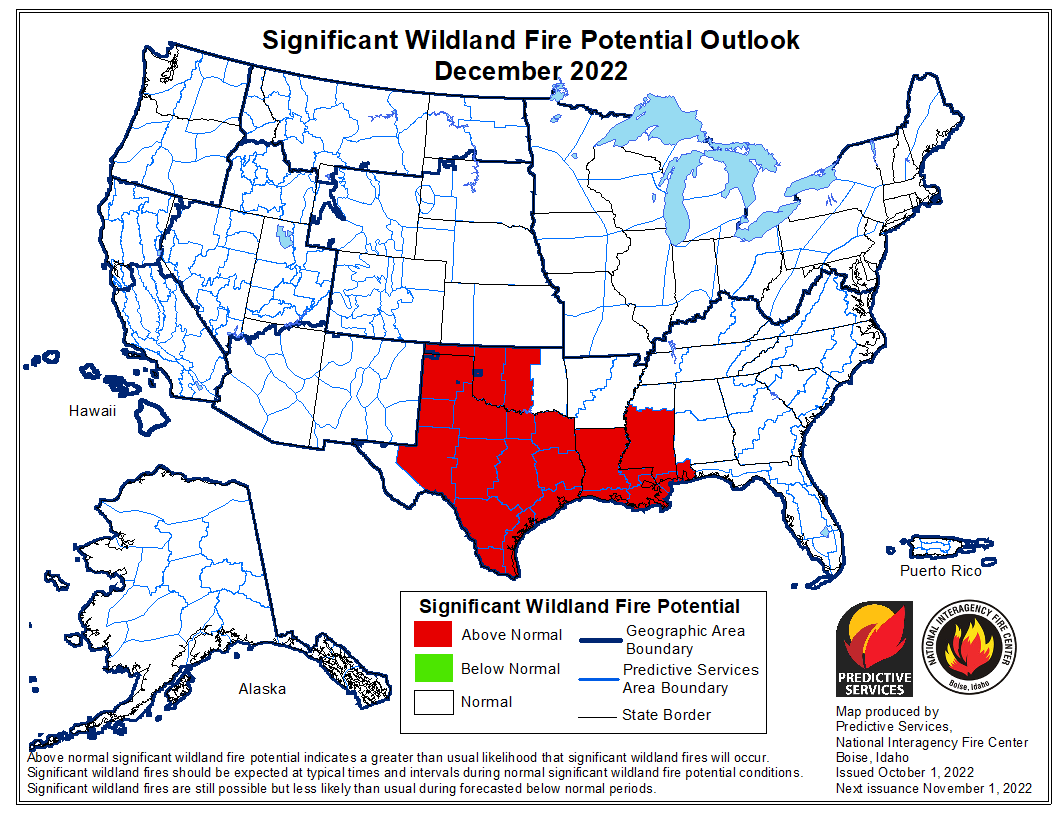
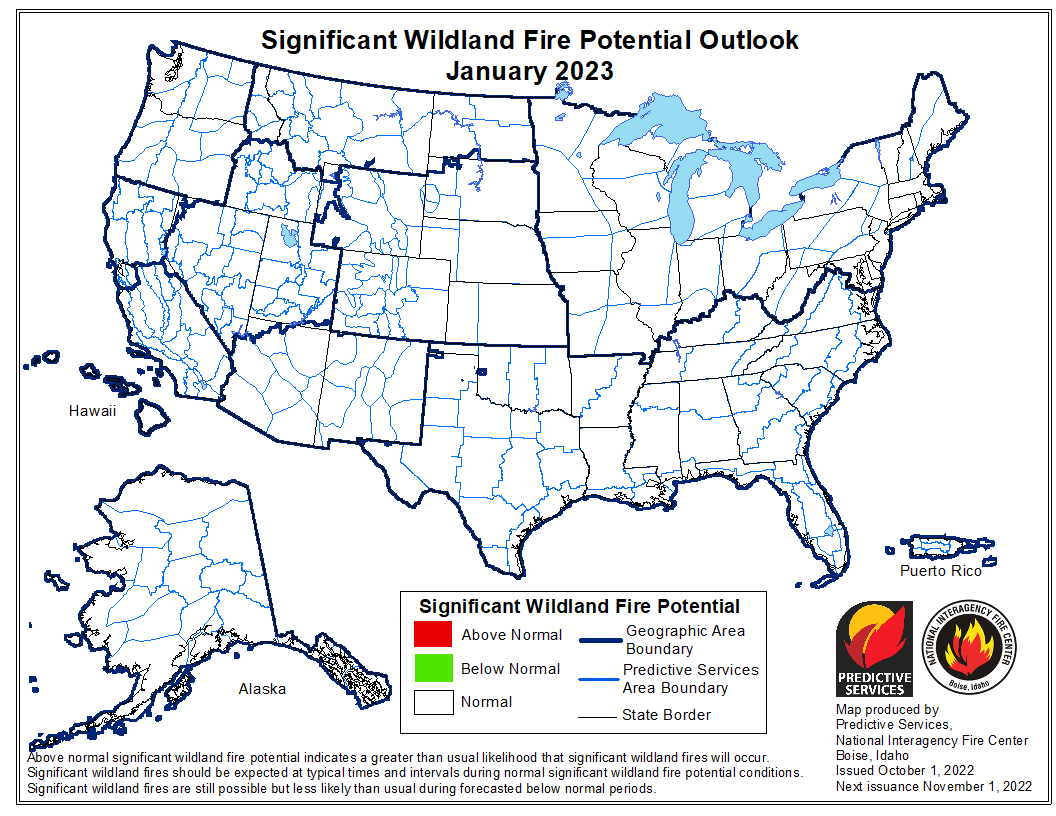
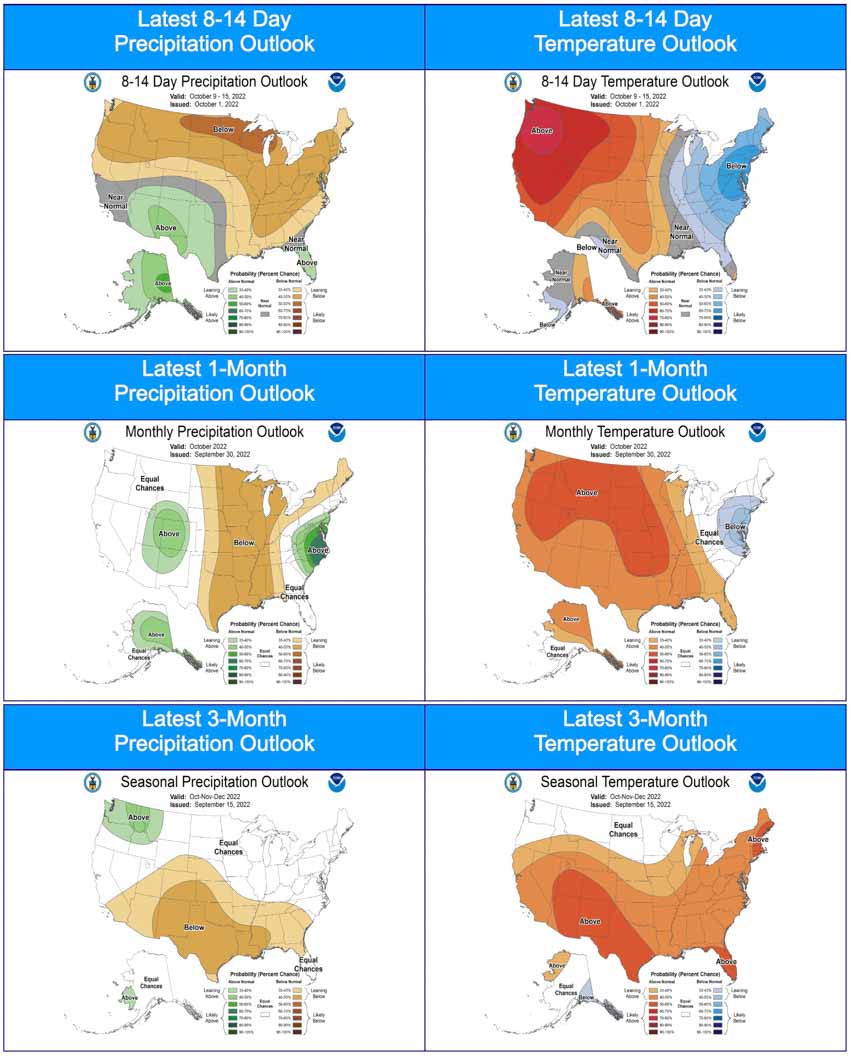
wildfire potential map wildfire potential map wildfire potential map

NOAA temperature and precipitation outlooks Drought Monitor, Sept. 27, 2022 KBDI October 1, 2022

Soil Moisture, October 1, 2022

Presumptive disease program for wildland firefighters effective this month in Victoria, Australia

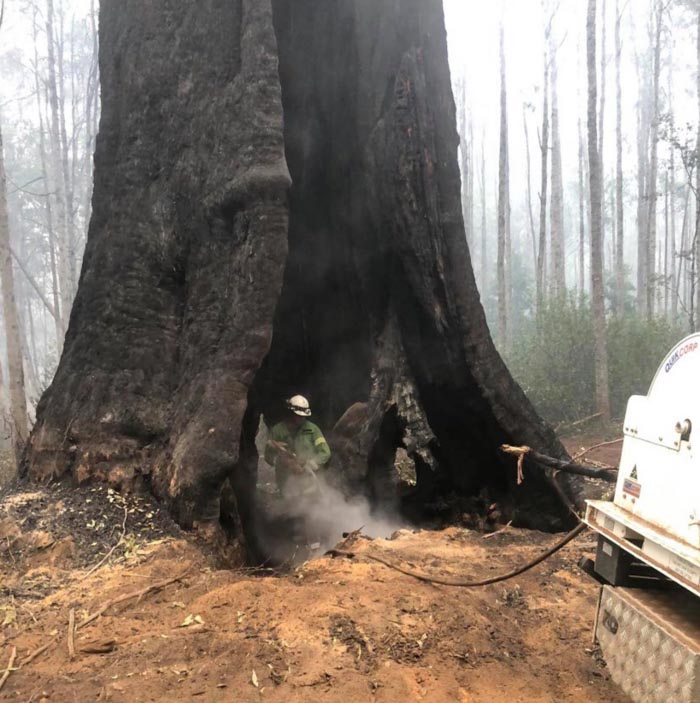
firefighters save Messmate tree Victoria Australia
Firefighters work to save a Messmate in Victoria, Australia. Photo by Forest Fire Management Victoria.

The presumptive disease program passed last year by Victoria’s Parliament went into effect September 14, 2022.

It extends the program to wildland firefighters and includes “surge firefighters” who are government employees normally in other roles, but who perform firefighting duties during the fire season as part of their agency’s surge capacity as needed.

The presumptive disease program ensures that if a firefighter is diagnosed with any of the 12 listed cancers, they will not have to prove that it was caused by their employment, and it will be considered an on the job injury.

The cancers covered are brain, bladder, kidney, non-Hodgkins lymphoma, leukemia, breast, testicular, multiple myeloma, prostate, ureter, colorectal, and esophageal.

The compensation applies to forest firefighters who:

  • have been diagnosed since 1 June 2016 with one of the 12 specified types of cancer;
  • have served in active firefighting roles for a specified number of years, depending on the cancer type;
  • are diagnosed during their service or within 10 years after they’ve finished their service.

A partial year of service is counted as a full year of service to recognize seasonal workers. Previous service as a volunteer or career firefighter and equivalent interstate service count toward the qualifying period.

More information.

Several issues important to wildland firefighters discussed during Senate Hearing Thursday

Senate Energy and Natural Resources Committee
Senate Energy and Natural Resources Committee. Sept. 29, 2022.

During a hearing today before the Senate Energy and Natural Resources Committee a number of issues important to federal wildland firefighters were discussed. The two witnesses from the agencies were John Crockett, Associate Deputy Chief, State and Private Forestry, Forest Service, and Jeff Rupert, Director of the Office of Wildland Fire for the Department of the Interior.

We don’t have time to get into the details, but here are the points at which some key topics were covered in the video above, which shows the entire hearing:

  • 45:19. Three-day break in service which can result in a firefighter (FF) losing eligibility for FF retirement.
  • 49:50. Forest Service counting the same acres of fuel treatments multiple times.
  • 54:47. FF mental health.
  • 1:00:00. Protecting Giant Sequoias from fire during their 3,000-year life span.
  • 1:06:30. How many firefighting aircraft do the agencies have?
  • 1:22:20. FF pay, and a long term solution.
  • 1:27:50 and again at 1:37:30. A possible new requirement for air tankers to have pressurized cabins.
  • 1:33:45. Why have the agencies not accomplished more acres of fuel treatments?

The Grassroots Wildland Firefighters clipped portions of the hearing, as you’ll see in the short videos below.

Senator Murkowski asks the USFS and DOI about long-term pay for Federal Wildland Firefighters:

Senator Heinrich asks the DOI what they are doing for Firefighter Mental Health:

Forest Service and DOI Respond to Three-Day Break In Service Issue for Wildland Firefighters:

Senate unanimously passes bill to improve FEMA’s response to wildfires

The Camp Fire, November 8, 2018
The Camp Fire, November 8, 2018. NASA (Joshua Stevens) – NASA Landsat 8.

When most people think of the Federal Emergency Management Agency (FEMA) what comes to mind is the assistance the agency provides before and after hurricanes, tornadoes, and floods. Part of their mission and the ways in which the assistance is supplied has been specified by the 1988 Stafford Act and before that, the Disaster Relief Act of 1974.

FEMA’s current procedures and requirements don’t always work for post-wildfire recovery needs, and a bill passed unanimously by the Senate Wednesday will help close some of those gaps. The FEMA Improvement, Reform, and Efficiency (FIRE) Act, S.3092, would help ensure that FEMA’s disaster preparedness and response efforts fully address the unique nature of wildfires and their impacts on communities.

If the bill is passed by the House of Representatives and signed by the President, FEMA would be able to pre-deploy resources during red flag warnings – periods of high fire danger, when catastrophic wildfires are most likely to start – just like they already do in advance of hurricane warnings.

The bill would also help ensure relocation assistance is accessible for public infrastructure in fire prone areas. It would improve FEMA’s response to wildfire-specific damage, such as repairing and mitigating contamination from damaged infrastructure.

If passed, it would have FEMA provide culturally-competent crisis counselors and case managers to ensure that underserved and disadvantaged communities receive equitable treatment when accessing federal disaster assistance. Tribal governments would be able to access financial assistance to upgrade their emergency operation centers, putting them on an equal standing with state and local governments.

Winners announced for student air tanker design competition

air tanker design competition
First place: Fireflighter

The American Institute of Aeronautics and Astronautics (AIAA) Foundation has announced the winners of a Team Aircraft Design Competition open to undergraduate AIAA branches or at-large Student Members.  The task was to design from the ground up a purpose-built large air tanker.

Specifications for the aircraft included 4,000 to 8,000 gallon retardant capacity, 2,000 to 3,000 nm ferry range, it would use existing available engines, and have a dash speed of 300 to 400 knots. Other criteria included a drop speed of 125 to 150 knots and takeoff from a Balanced Field Length of 5,000 to 8,000 ft. with an assumption of +35°F standard atmosphere at an altitude of 5,000 ft. above mean sea-level.

The design teams awarded first, second, and third places all chose 8,000-gallon gravity-powered retardant tanks. The estimated prices of the aircraft are based on a manufacturing run of dozens of each aircraft. The teams’ complete proposals are at the links below.

First Place

The “Fireflighter” designed by a team from Nanyang Technological University in Singapore took first place. (See image above). It is powered by four turboprop engines and has a dash speed of 410 knots. The students estimate it would cost $75 million.

air tanker design competition retardant tank
Fireflighter retardant tank

Second Place

air tanker design competition
Second place, Valkyrie, by team Njord.

Team Njord, from the University of Illinois at Urbana-Champaign designed the “Valkyrie,” powered by two jet engines. Its dash speed is 300 knots and would use two removable RADS-XXL retardant tanks, enabling it to carry 20,000 pounds of cargo at the aircraft’s ferry range of 3,000 nm. It would sell for approximately $186 million.

air tanker design competition retardant tank
Falkyrie retardant tank

Third Place

air tanker design competition
Third place, Firehawk, by team Albatross.

The Albatross team, also from the University of Illinois at Urbana-Champaign, designed the “Firehawk” powered by two jet engines. It would have a dash speed of 380 knots and sell for about $91 million.

air tanker design competition retardant tank
Firehawk retardant tank

Hurricane Ian pushes north winds and low humidity into much of the Southeast

Fire weather outlook Sept. 28, 2022
Fire weather outlook Sept. 28, 2022. NOAA Storm Prediction Center.

The counter-clockwise rotation of winds around Hurricane Ian has brought north winds and low humidity to portions of Louisiana, Mississippi, Alabama, Georgia, and the panhandle of Florida. The combination of a strong surface high to the north and the strong pressure gradient around the hurricane will drive moderately strong northerly winds across much of the Southeast on Wednesday.

The forecast is for humidity in the teens and 20s with wind gusts of 20 to 35 mph Wednesday afternoon.

Wind forecast for 2 p.m. CDT Sept. 28, 2022
Wind forecast for 2 p.m. CDT Sept. 28, 2022. Windy.com. The colors represent wind speed in knots. See legend at lower-right. 

In the wind forecast above for 2 p.m. CDT Wednesday, Hurricane Ian is predicted to make landfall near Cape Coral, Florida.

The National Weather Service’s Red Flag Warning map was a little more conservative than the Storm Prediction Center’s designations of elevated and critical fire weather.

Red Flag Warnings
Red Flag Warnings at 8:45 a.m. Sept. 28, 2022. NWS.

The Storm Prediction Center’s forecast for Thursday is for elevated fire weather only in southern Alabama and the Florida panhandle.

NPR interviews locals and Forest Service employees about fuels treatments and the Caldor and Radford Fires

Caldor Fire map
Caldor Fire map showing the location of Grizzly Flats. The white line was the perimeter at 8:20 p.m. August 18, 2021. The red areas represent heat detected by an aircraft at 6:44 p.m. PDT Aug. 19, 2021. The fire continued spreading east, coming very close to South Lake Tahoe.

National Public Radio is publishing a series of at least two short audio stories about treating fuels to reduce the chance of large fires spreading into populated areas.

The first episode, only four minutes long, examined what the US Forest Service promised the residents of Grizzly Flats the agency would do to treat the fuels close to the community. But last year the Caldor Fire destroyed about two-thirds of the town’s structures as it burned to the edge of South Lake Tahoe.

Randy Moore, Chief of the US Forest Service, was asked in the episode if the Forest Service had any responsibility for the outcome in Grizzly Flats.

“Well, I mean, I don’t know what kind of question that is,” he replied. “I mean, you know, do anybody bear any responsibility for not having the budget to do the work that we need to do?”

Episode 1, Sept. 26, 2022. Four minutes.

Transcript of Episode 1.


In the next episode, a local Southern California Burn Boss explains some of the challenges she faces in scheduling a prescribed fire.

The reporter says the San Bernardino National Forest refused to disclose its budget after months of “multiple asks and a Freedom of Information Act request.” The Burn Boss, however, gives a hint.

They also talked with a local resident who evacuated from the Radford Fire near Big Bear earlier this month.

Episode 2, Sept. 27, 2022.

Transcript of Episode 2.


Update Sept. 28, 2022. Cap Radio, which may have collaborated with NPR on the above segments, has a detailed article published August 16 about the proposed fuel reduction project the US Forest Service proposed to lessen the risk to the Grizzly Flats community. It walks us through the ambitious project from conception to completing only 14 percent of the planned work before the Caldor Fire wiped out the town. One of many stumbling blocks were complaints from Chad Hanson, co-founder of the John Muir Project, a nonprofit that aims to protect biodiversity in national forests and fiercely opposes tree removal. One of Hanson’s primary concerns was the California spotted owl, which is designated as a “sensitive species” by the Forest Service.

Our take.

We’re not sure how often this has occurred in Washington over the last 20 years, but Chief Moore’s predecessor in April 2021 squandered a softball opportunity to tell the House Appropriations Subcommittee on Interior, Environment, and Related Agencies that the Forest Service needed more funding in two very important inadequately budgeted areas, fuels treatment and aerial firefighting. In a June 9, 2022 Congressional hearing Chief Moore squandered a similar opportunity, giving an incoherent response when basically asked, “Do you have enough firefighting aircraft?”