$11 million contest for innovation in fighting fire

Best-selling author and futurist Peter Diamandis became frustrated in recent years with the “craziness” of constant wildfire alerts he’d received. But unlike most people, Diamandis has a Rolodex full of wealthy benefactors and politicians, along with experience with a solution he had used before: Create a contest.

On April 21 his group XPRIZE launched its latest contest: finding new ideas to detect and suppress wildfires.

Pacific Gas & Electric (PG&E) said the prize threshold includes detecting and suppressing a high-risk wildfire in 10 minutes or less, and pinpointing from space all fire ignitions across multiple states or countries — in 60 seconds. These are the challenges for innovators in XPRIZE Wildfire, a four-year, $11 million competition to develop and demonstrate fully autonomous capabilities to find and fight wildfires.
XPRIZE Wildfire

The United Nations, the White House, and Congress recently have prioritized destructive wildfires as a major economic, environmental, and safety threat. Patti Poppe, CEO of PG&E, said they are co-sponsoring the project. “Today’s launch of XPRIZE Wildfire is a call-to-action to entrepreneurs, roboticists, artificial-intelligence experts, scientists, and innovators from across the globe to revolutionize wildfire detection and suppression,” she said.

XPRIZE Wildfire encourages teams from around the world to innovate across firefighting technologies in two different tracks designed to transform how fires are detected and suppressed.

    • In the Autonomous Wildfire Response track, teams will need to monitor at least 1,000 square kilometers (386 square miles), and autonomously suppress a wildfire within 10 minutes of detection.
    • In the Space-Based Wildfire Detection & Intelligence track, teams will have one minute to accurately detect all fires across a landscape larger than entire states or countries, and 10 minutes to precisely characterize and report data (with the fewest false positives) to two ground stations.

The day before something is a breakthrough, it's a crazy idea.

The Los Angeles Times reported that Palmer Luckey, a 30-year-old founder of Oculus, a virtual reality company that sold for $2 billion, announced that he was forming the first team to compete for the prize. He said he cares more about solving the problem than winning the money, but he believes the cash will motivate other contestants to form teams and compete.

“I sold my last company for billions of dollars so I can do whatever I want,” he said. “We started working on wildfire tech because I think it’s very, very important. The money in this prize to me is honestly immaterial.” Luckey said at the contest launch that he thinks software, not hardware, will make the difference in detecting and containing fires.

The four-year contest is not winner-take-all. Teams will compete for top prizes of as much as $3.5 million and a bonus $1 million prize to develop technology that can detect fires both from the ground and from space, and fight them using drones or other autonomous vehicles. They’ll compete, for example, to see which technology can accurately detect fires across a land mass the size of a state or country in one minute or suppress fires using an autonomous vehicle within 10 minutes.

Andrea Santy, who is running the competition for XPrize, also said the prize money may not be the most important driver. Teams will benefit from multiple rounds of live testing and validation that would be hard to organize independently. The group is spending an additional $11 million beyond the prize money to run the contest, she said; some of that money will fund a documentary about the competition.

XPRIZE Wildfire is offered in partnership with Co-Sponsors PG&E and Gordon and Betty Moore Foundation, Presenting Sponsor Minderoo Foundation, Bonus Prize Sponsor Lockheed Martin, Supporting Sponsor Conrad N. Hilton Foundation, and Benefactors Nichola Eliovits and Michael Antonov. Sixteen teams are already registered. For more information, to get involved, or to register a team to compete, visit the xprize.org/wildfire website.
Renewed call for the ‘Holy Grail’ of firefighter tracking

A decade ago, the late Bill Gabbert began writing here about the “Holy Grail of Wildland Fire Safety” – the tools, best practices and system for advanced firefighter and fire tracking – and he returned to it often.

In March 2019, one section of Public Law 116–9 (also known as S. 47, the John D. Dingell, Jr. Conservation, Management, and Recreation Act), was signed into law that called for “LOCATION SYSTEMS FOR WILDLAND FIREFIGHTERS” within two years – by March, 2021.

Nearly two years past that deadline, the President’s Council of Advisors on Science and Technology has adopted this core principle in a report called “Modernizing Wildland Firefighting to Protect Our Firefighters”.

PCAST report - Modernizing Wildland FirefightingAs their letter to the President observes, “Whereas we have a national commitment ensuring that our warfighters are not sent into harm’s way without the best of American science and technology at their disposal, no similar organizational framework exists to protect and empower wildland firefighters.”

Their five recommendations lead off with this problem and an urgent push:

“Recommendation 1: Given the vulnerabilities and shortfalls in wildland firefighter communications, connectivity, and technology interoperability, immediately assess, adapt, and field currently available technologies.”

To support this, their next recommendation calls for cabinet-directed executive authority to “Reverse the current trend of rapidly growing wildfire suppression costs by establishing a joint-agency executive office (hereafter Joint Office) that can accelerate enterprise-level development and deployment of new technologies that enhance situational awareness and initial attack capabilities.”

The recommendation continues that “This Joint Office would serve to advance coordination, streamline authorities, and drive progress in enabling technology adoption across the numerous federal agencies with equities for wildland firefighting science and technology (S&T) within NIFC [National Interagency Fire Center]. It is imperative that the Joint Office leader have Cabinet-delegated decision-making authorities as well as the mandate and budget needed to develop and execute a unified technology roadmap.”

Recommendations 3, 4 and 5 would be led by the proposed Joint Office and serve to unify and expedite the “full operational sequence of wildland firefighting” with current and new technology, with inputs from NIFC, the land management agencies of DOI and USDA, and NOAA, NASA, and the Department of Defense.

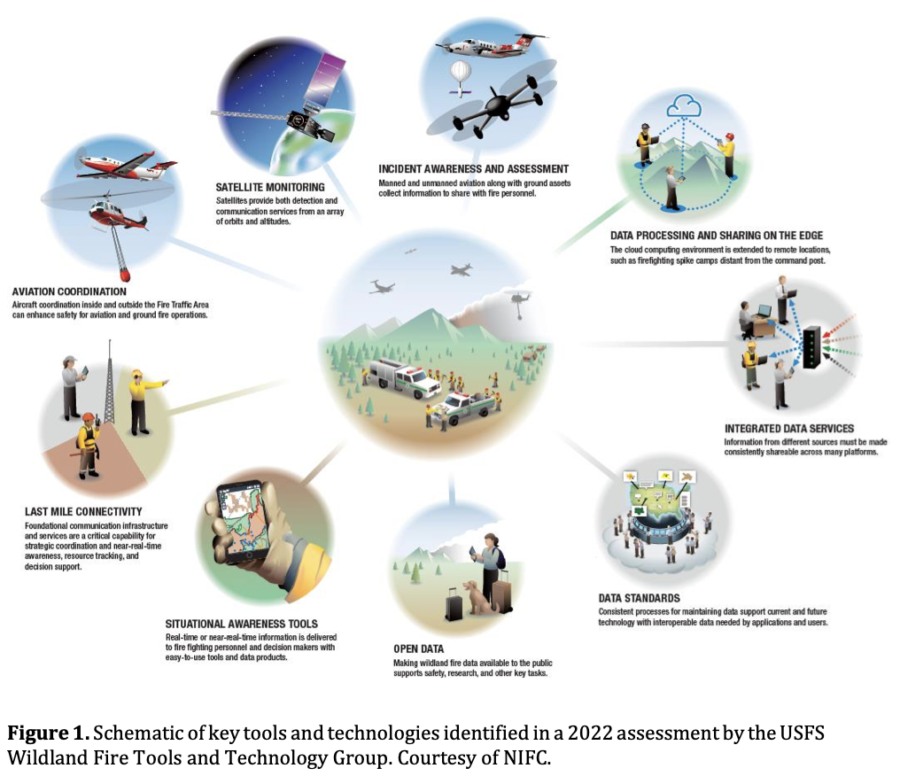
While the goals are straightforward the implementation is complex, as indicated in this graphic from the report.

Figure 1. Schematic of key tools and technologies identified in a 2022 assessment by the USFS Wildland Fire Tools and Technology Group. Courtesy of NIFC.

At the NIFC website, a search for the word “safety” produced 641 results. Hits for “technology” totaled 206, “intelligence” 121. “Location-based” yielded 24 results, though most were variations of “allocation.” The most concrete reference is to the 2023 Red Book, where there’s a reference to “Location Systems,” on page 42 of the BLM section:

“The LBS [Location-Based System] Program combines current Global Positioning System (GPS) technologies with BLM fire and aviation preparedness to provide a situational awareness tool by tracking equipment. LBS is incorporated into dispatch and other operating procedures to enhance situational awareness and accountability of WCF 600-class fire equipment. This program meets the intent of S.47 – John D. Dingell, Jr. Conservation, Management, and Recreation Act, SEC. 1114. (d) 12 Location Systems for Wildland Firefighters.”

With wholehearted respect for the BLM’s LBS program and the efforts to date, the federal location systems in their entirety seem a far (and hard to track) distance from meeting the intent of the 2019 Dingell act.

This week’s PCAST recommendations seeks to correct the “vulnerabilities and pitfalls” of our current processes and accelerate the urgency toward this decade-long search for the “Holy Grail” of location systems. It’s a race we need to win.


Lockheed looks ahead to advancing capability in wildland firefighting

James Taiclet, CEO of Lockheed Martin, says “21st Century Security” means that large defense contractors can quickly deliver mission-focused defense capabilities to complex problems outside the traditional defense sphere. Taiclet is focusing on wildland fire, addressing the tough challenges recently highlighted by the President’s Council of Advisors on Science and Technology.

Lockheed Martin has considerable expertise as an integrator of complex technologies, but the company is oriented toward selling big things to a small number of big federal customers. Lockheed’s now shifting to focus on developing systems for big markets like F-35 Lightning II fighter jets or naval combat systems, while firefighting represents the civil component of the 21st Century Security initiative. But as Forbes recently reported, the wildfire marketplace offers no simple route to a big sale.

“Wildfire is one of the toughest national challenges in America,” wrote Craig Hooper, senior contributor at Forbes. “Chronically underfunded, subjected to brutal operating conditions and operating under the constant specter of death, wildfire fighters have little time for gimmicks, ineffective gear, and wasted funds. It is a no-nonsense business, with buyers scattered throughout local, state, and federal governments. If something doesn’t work or is too costly, America’s wildland firefighters won’t buy it.”

On February 13 wildfiretoday.com detailed the federal Wildland Fire Commission’s first report to Congress, which focused on the aviation sector after the federal legislation creating the commission prioritized aerial firefighting as key.

HAI HELI-EXPO 2020 Anaheim helicopter Firehawk
San Diego Fire Rescue’s Firehawk at HAI 2020, January 2020 photo by Bill Gabbert.

“We’re sitting at a point now where we can actually predict where fires might start, and start moving assets there,” said Taiclet. In a joint project with NVIDIA, Lockheed is working with the USFS and the Colorado Division of Fire to use artificial intelligence (AI) to predict and simulate fire behavior. Lockheed’s Cognitive Mission Manager system will integrate a range of sensor- and AI-informed inputs to recommend courses of action. Ultimately, says Taiclet, these would feed into “things that we make that actually do fight fires today.” Those things include the Sikorsky FIREHAWK® helicopter and C-130 airtankers.

“The Department of Defense is only beginning to engage America’s wildfire fighting community,” wrote Hooper for Forbes. “Lockheed has sufficient access to Pentagon decision-makers that the company could, essentially, write up the Defense Department’s strategy for supporting civil authorities during wildfire season, setting the foundation for a national-level NORAD-like early wildfire detection and response capability.”

Flying smarter to manage wildfires

2023 begins as a year of fire aviation innovations.

Wildfire-focused aviation innovations for the first few weeks of 2023 hold promise for a year of improved aviation tools and techniques. Some of the more recent examples range from financial innovation to foam delivery.

FINANCING: The special purpose acquisition company (SPAC) of Jack Creek Investment Corp. collaborated with the long-time aerial firefighting delivery company, Bridger Aerospace Group Holdings, LLC (BAER/BAERW), moving onto Wall Street via the Nasdaq Global Market. Shares began trading on January 25 and dropped by a third on day three, with the company’s market capitalization at a robust $760.64 million. More on process and goals of this business combination at https://ir.bridgeraerospace.com/news-events/press-releases/detail/16/bridger-aerospace-and-jack-creek-announce-closing-of.

Eight scooping air tankers at Santa Fe airport
Eight scooping air tankers at Santa Fe airport, May 6, 2022, operated by Bridger Aerospace and Aero-Flite. The Calf Canyon and Hermit Peak Fires were nearby. Photo by Jerry Messinger.

Bridger provides a “fleet of firefighting aircraft, which includes ‘Super Scoopers’ (CL-415EAF), air attack and logistical support aircraft .. and UAVs (Unmanned Aerial Vehicles). Bridger also offers FireTRAC (https://firetrac.com), an innovative, proprietary data gathering, aerial surveillance and reporting platform that complements its fleet of firefighting assets.”

AERIAL FOAM: Aerial X Equipment continues to develop and deploy a range of aerial foam engines. As described on their website, “Aerial X Equipment’s Striker Airborne Fire Engine™ is the first airborne platform that produces homogeneous high expansion class A foam. This enables it to become the first aerial wildland fire suppression force multiplier with unique capabilities and a range of capacities.” This foam engine floating in the sky beneath a range of helicopter platforms is claimed to have longer-residency foam due to the use of compressed air (CAFS) – with Aerial X stating residency of 30-90 minutes compared to 1-10 minutes for traditional low-expansion foam. More at https://aerialxequipment.com.

TELEOPERATED FLIGHT: Our prior coverage of Rotor Technologies will continue to be updated, and Fire Aviation articles on other innovations are in progress.

But not all the updates hold such promise or good news.

CRASH SETTLEMENT. A family of a helicopter pilot, Heath Coleman, who died while fighting wildfires in Alberta, Canada, in 2021 due to a faulty rotor pin, has received a $10 million settlement, per a report in AviationPros. At the time, the fatality inspection report led to temporary grounding and rotor-pin inspections of more than 500 Bell 212 helicopters.

K-MAX, GOODBYE. The venerable twin-rotored K-Max will cease production. Over 60 rolled off Kaman’s production lines over 30 years, but limited demand and low profitability led to Kaman’s decision.

K-MAX Comet Fire
A K-MAX helicopter (N314) drops water on the Comet Fire north of Salmon, Idaho July 28, 2016.

The company has committed to support those helicopters already in service. https://www.ainonline.com/aviation-news/business-aviation/2023-01-19/kaman-ending-production-k-max-heavy-lift-helicopter.

PRODUCTION NOTE: Lest we take the pace and utility of tech innovation for granted — the research, writing and posting of today’s article was thanks to satellite connectivity on a cross-country flight which also featured some monitoring of prescribed burns in Louisiana and surveying the snowpack in New Mexico, Arizona and southern California.

Surveying the snowpack en route to LAX. Photo: Ron Steffens.


Drones are playing an increasingly important role in fighting wildfires

drone wildland fire firefighter
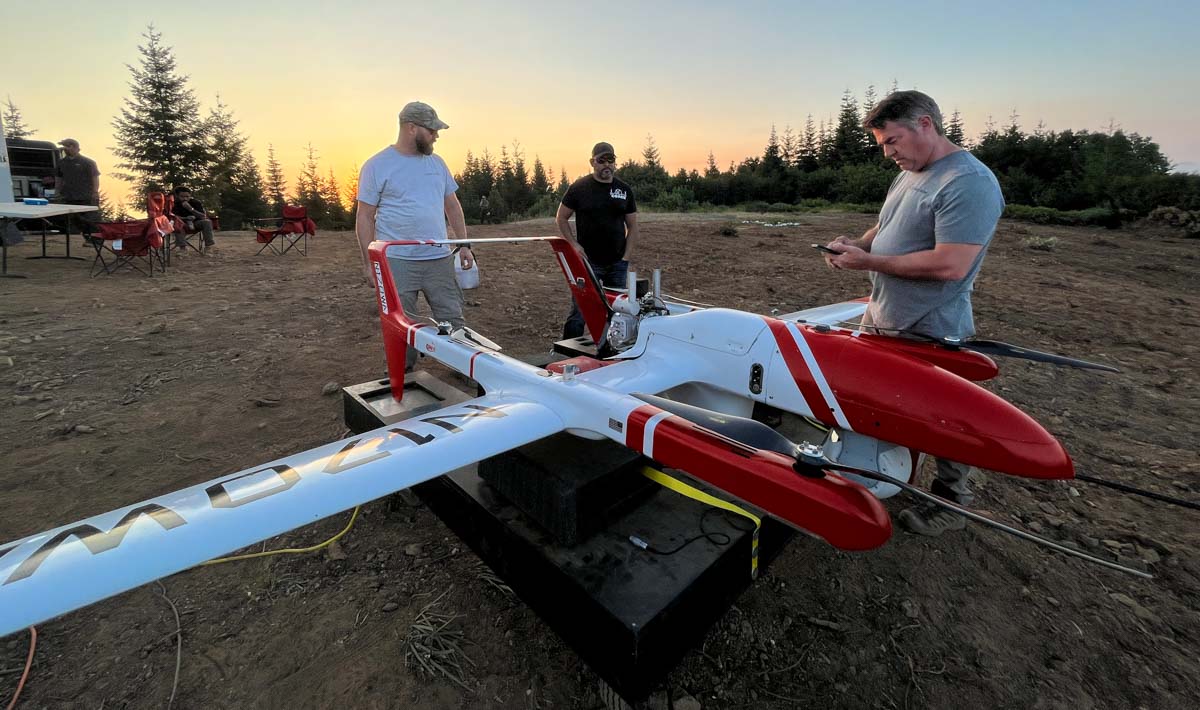
A contracted UAS crew with Precision Integrated Programs / Overwatch Aero — Tyler Kock, Daniel Rodriguez, and Cliff Savage — on the Lighting Complex of fires. US Forest Service photo by Andrew Avitt. FVR-90, N170WA.

By Andrew Avitt, US Forest Service, Pacific Southwest Region

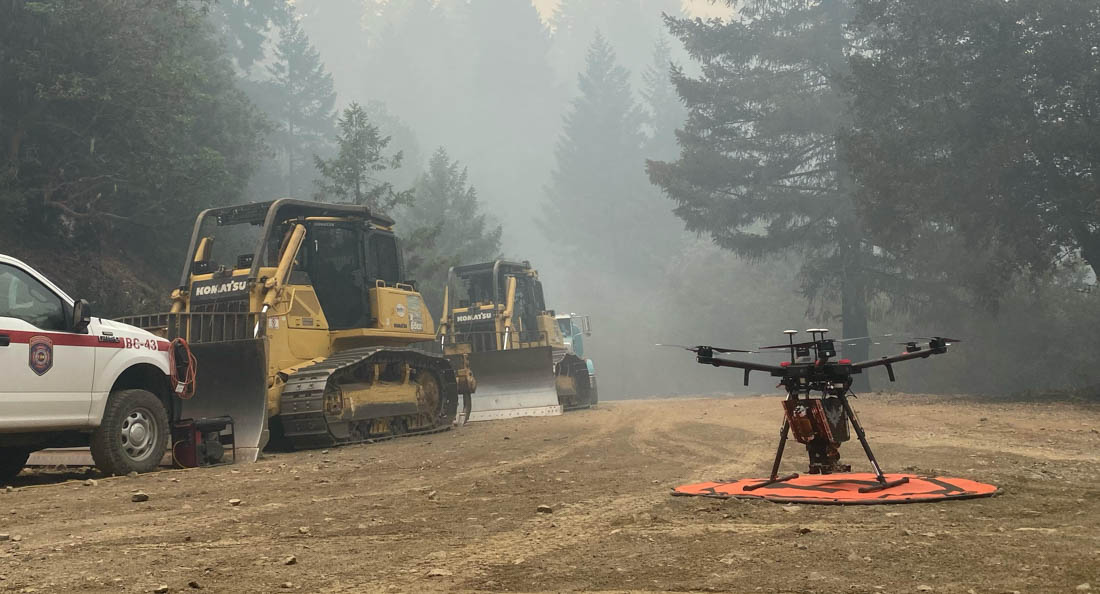
Drones – also called UAS or unmanned aerial systems – are playing an increasingly important role in fighting wildfires by supporting operations with aerial ignition and gathering intelligence for firefighters. The greatest benefit drones provide is they can take to the sky when manned aircraft are grounded for pilot safety.

Take, for example the FVR-90, a fixed-wing drone with a 14-foot wingspan capable of traveling at speeds up to 46 mph with a flight time of 8 hours. They are sent airborne just at dusk when other manned flights are grounded. The sky is theirs, and the overhead view they have of the fire is detailed and in real time.

“The way we use UAS now is very much a supplement,” said Justin Baxter, the Forest Service National UAS Operations Specialist. “There are certain times that it’s just not safe for us to utilize manned helicopters or fixed-wing aircraft, like nighttime operations or in thick smoke or high winds.”

drone wildland fire firefighter
USFS photo by Andrew Avitt.

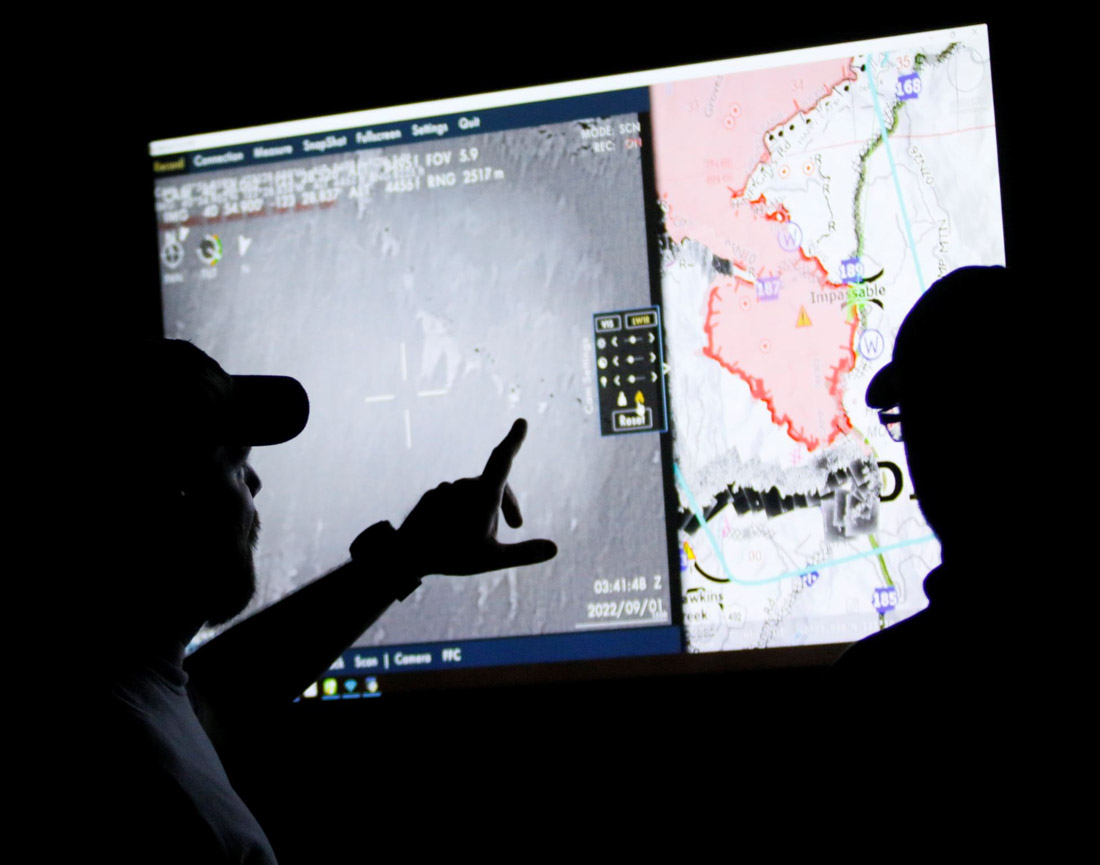
The drones that Baxter and his team fly are equipped with cameras that are not your normal cameras. They have multiple types of sensors, including infrared, that allow the team to see through smoke and, at night, see heat signatures, or thermal-based imaging. This allows the identification of areas where fire is still active and new areas where flames have advanced, such as spot fires.

Spot fires occur when embers from the main fire are thrown into the air and pushed by wind until they fall to the ground, starting a new fire. They are notoriously hard to identify because they are small at first and visibility is diminished by smoke. They may occur in hard-to-reach places difficult for firefighters to patrol, like on steep slopes or down in drainages.

“Drones are changing that labor-intensive process to identify these spot fires, especially when an operational area can span hundreds of thousands of acres,” Baxter said. With drones, fire managers and incident management teams can scan large areas quickly and easily identify spot fires that may be a mile from the main fire. That enables firefighters to get in and suppress those new starts before they grow.

“To give you an idea, this drone can detect a 2-inch by 2-inch spot fire from a half-mile away,” said Baxter as he gestured to the imposing drone just to his left minutes before takeoff to fly around the perimeter of the Six Rivers Lightning Complex Fire near Willow Creek, California.

Baxter said that much has changed since 2015 when the agency began the UAS program.  With each passing year, incident management teams have increasingly incorporated the capability into their strategies.

The communication between the UAS crew and firefighters on the ground flows in both directions. The drone may be flying over and see heat in an area and transmit the information to a hotshot crew. Conversely, the hotshot crew can ask the UAS crew for assistance in exploring an area that they suspect might be active, and then view a feed from the drone of the area in question.

John Crotty served as the air operations branch director with California Interagency Incident Management Team 15 that responded to the Lightning Complex Fire on the Six Rivers National Forest.

drone wildland fire firefighter
A drone equipped for aerial ignition. USFS photo by Mike Yearwood.

Aerial intelligence isn’t new in wildland firefighting, said Crotty referring to the recently retired Cobra helicopter and its Firewatch capabilities. But the implications of unmanned flight— that opens up new possibilities.

“With the Cobra aircraft, we needed a pilot and an interpreter up there to run the camera and talk to the folks on the ground. So, we expose two individuals plus a flight [to risk],” said Crotty, “But what we really needed was the visibility to fly.”

Thick smoke on the fires like the Lightning Complex can ground manned aircraft. That’s where drones come into play and the images it captures can inform firefighters working across a large area.

“The other day I heard from one of the hotshot crews out there. They were in heavy smoke conditions, at night. With the low visibility they couldn’t see if they had a spot fire across the line,” Crotty said. “This tool being up in the air, looking down at that exact area, the UAS crew was able to pinpoint the spot and provide precise coordinates to the firefighters who were able to check it out and put it out. That kind of information we would never have without these unmanned aircraft and that capability. Drones are the future of aviation for not only fire but for aviation in general. It’s a win-win for the agencies to operate under an umbrella of this type of aircraft that can provide precise and timely info to firefighters and incident management teams. And most importantly, we can do it safely.”

Winners announced for student air tanker design competition

air tanker design competition
First place: Fireflighter

The American Institute of Aeronautics and Astronautics (AIAA) Foundation has announced the winners of a Team Aircraft Design Competition open to undergraduate AIAA branches or at-large Student Members.  The task was to design from the ground up a purpose-built large air tanker.

Specifications for the aircraft included 4,000 to 8,000 gallon retardant capacity, 2,000 to 3,000 nm ferry range, it would use existing available engines, and have a dash speed of 300 to 400 knots. Other criteria included a drop speed of 125 to 150 knots and takeoff from a Balanced Field Length of 5,000 to 8,000 ft. with an assumption of +35°F standard atmosphere at an altitude of 5,000 ft. above mean sea-level.

The design teams awarded first, second, and third places all chose 8,000-gallon gravity-powered retardant tanks. The estimated prices of the aircraft are based on a manufacturing run of dozens of each aircraft. The teams’ complete proposals are at the links below.

First Place

The “Fireflighter” designed by a team from Nanyang Technological University in Singapore took first place. (See image above). It is powered by four turboprop engines and has a dash speed of 410 knots. The students estimate it would cost $75 million.

air tanker design competition retardant tank
Fireflighter retardant tank

Second Place

air tanker design competition
Second place, Valkyrie, by team Njord.

Team Njord, from the University of Illinois at Urbana-Champaign designed the “Valkyrie,” powered by two jet engines. Its dash speed is 300 knots and would use two removable RADS-XXL retardant tanks, enabling it to carry 20,000 pounds of cargo at the aircraft’s ferry range of 3,000 nm. It would sell for approximately $186 million.

air tanker design competition retardant tank
Falkyrie retardant tank

Third Place

air tanker design competition
Third place, Firehawk, by team Albatross.

The Albatross team, also from the University of Illinois at Urbana-Champaign, designed the “Firehawk” powered by two jet engines. It would have a dash speed of 380 knots and sell for about $91 million.

air tanker design competition retardant tank
Firehawk retardant tank

DHS tests next generation Wildland Urban Interface alerting technology

Evacuation at the Fort McMurray Fire in Alberta, Canada May, 2016
Evacuation at the Fort McMurray Fire in Alberta, Canada May, 2016.

The Department of Homeland Security hosted a proof-of-concept demonstration of the Wildland Urban Interface (WUI) integration model Monday, August 15, in Fairfax, VA.  The model integrates next generation technologies with the Federal Emergency Management Agency Integrated Public Alert Warning System (IPAWS), enabling alerting authorities to disseminate Wireless Emergency Alerts with new capabilities such as displaying hazard and evacuation alert information on the “infotainment” screens in vehicles.

The DHS is working with partners to develop a new method for putting life safety alerts, such as evacuation alerts, into navigation applications during emergencies. Doing so will not only provide alerts to an increasingly mobile public, but also help the public make informed navigation decisions in all-hazard situations.

“Effective communication of emergency fire information and evacuation routes to people in an endangered area is a necessity for first responders striving to manage emergency operations and guide safe public response actions,” said Norman Speicher, Department of Homeland Security Science and Technology Directorate program manager. “Connecting emergency management tools to situations in the WUI will help emergency management officials achieve better routes and procedures by utilizing cutting-edge technologies that help define, share, and manage the status, and communicate evacuation routes and safety zones in real-time.”

300-gallon firefighting attachment developed for skid steer loader

FYREBX
FYREBX photo

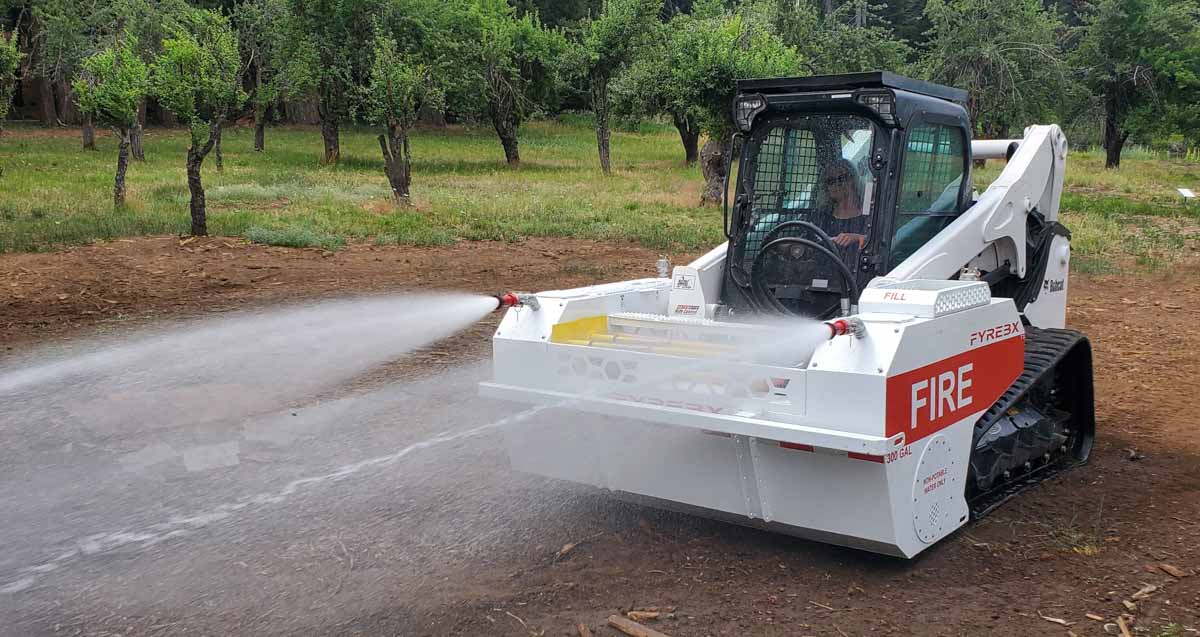
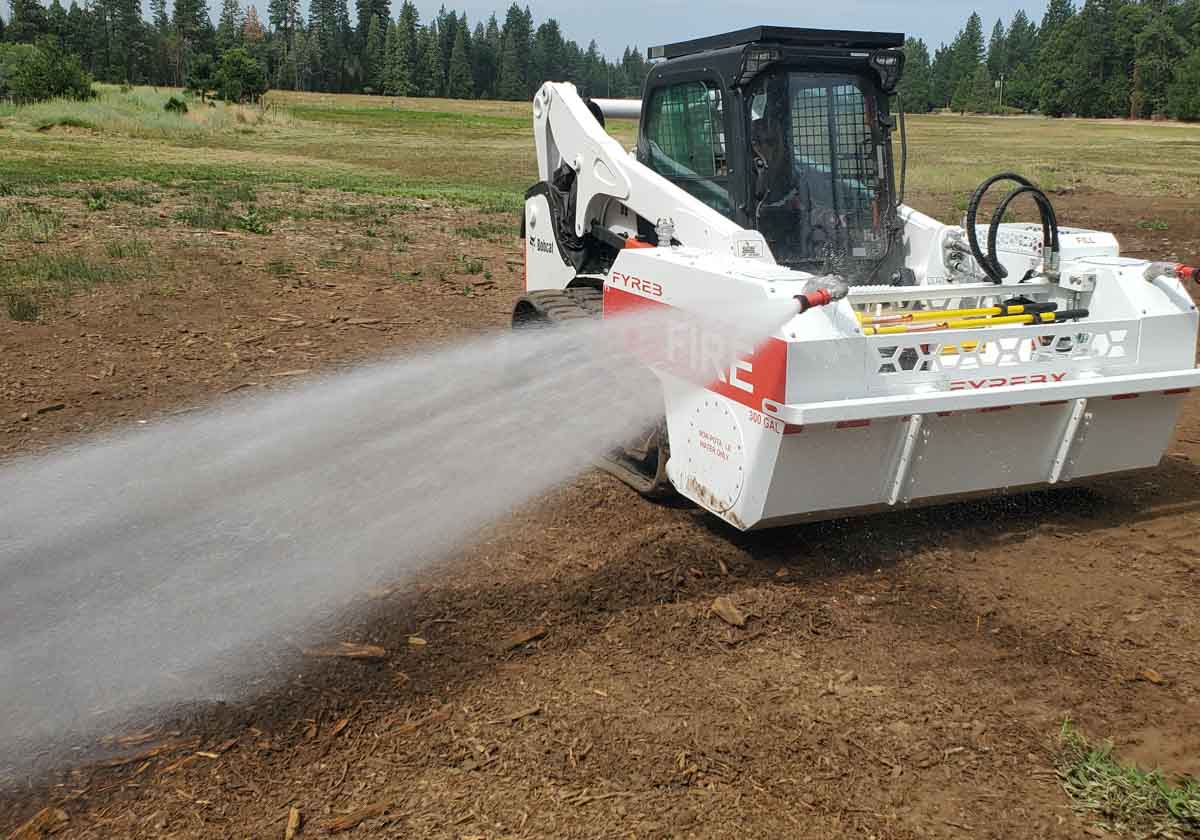
A company in Redding, California  has developed an attachment for a skid steer loader, such as a Bobcat, that enables them to be converted to a firefighting apparatus.

The FYREBX has a 300-gallon water tank with a pump powered by the skid steer’s hydraulic system. It can flow water at 5 gallons per minute up to 250 gallons per minute. One person can apply water from the cab using the two nozzles on the device, or a hose can be connected operated by a firefighter on the ground.

The operator inside the cab can turn the hydraulic power to the pump on or off, but the controls for varying the pressure and volume of water are on the outside of the FYREBX.

FYREBX
FYREBX photo

There are various ways the tank can be refilled, including driving the skid steer into a body of water and lowering the unit so that the submersible pump can fill the tank.

Matthew Wilson, the company’s Vice President for Sales and Service, told Wildfire Today that they have sold units to forestry companies and are in talks with the US Air Force about a sale of multiple units to be used at Air Force bases on the West Coast. He said the California Department of Forestry and Fire Protection is also evaluating the FYREBX.

For the purchase price of $18,950, it comes with the equipment the US Forest Service requires for timber companies in a “fire box”,  3 shovels, 2 axes, 1 pulaski, mcleods, 1 fire extinguisher, 100 ft of 1.5″ wildland hose, and 200 feet of 3/4″ wildland hose, said Sean Henry, President of the company. An optional accessory is a compressed air foam system.

Airbus demonstrates dropping water from a removable tank in an A400M

Airbus A400M tests removable firefighting kit

Airbus recently tested a roll-on/roll-off system to enable an Airbus A400M to drop water on a wildland fire; they say it can hold up to “20 tonnes of water.” A video shot at the test site in Spain showed the water exiting the aircraft out the rear cargo ramp.

AIRBUS Firefighter drop water fires
Still image from the AIRBUS video, looking down, showing water flowing out of the rear cargo ramp on an Airbus A400M

Airbus provided some information about the system being tested:

The Airbus firefighting solution created for the A400M is a roll-on/roll-off (RORO) kit that requires no modification to the aircraft and therefore is interchangeable to any aircraft in the A400M fleet. The water is stored in a fixed tank in the cargo hold, and retained by two independent doors. These doors are connected to two flood pipes, so when the discharge is triggered, the water is expelled through two sections at the end of the ramp. The introduction of this RORO solution allows a rapid reaction to unforeseen fires and reconfiguration of the aircraft to any of its other roles.

It was tested at a minimum operating height of 150ft, flight speeds as low as 125 knots, and drops involving up to 20 tonnes of water in less than 10 seconds. Airbus also plans to test the system while flying at night.

Airbus’ video below describes the system.

The system is reminiscent of the Modular Airborne FireFighting System, MAFFS Generation 1 developed in the United States. After being rolled into a C-130, it dispensed retardant out the open cargo ramp. Due to retardant coming back into the C-130 during a drop and coating many parts of the aircraft, the next version, Generation 2, pumps the retardant out a port on the sealed left side troop door.

We have contacted Airbus for more details, asking how the water is forced out of the tank, if it is by compressed air, a pump, or simply gravity.

Below are more still images from the Airbus video.

AIRBUS Firefighter drop water fires
Still image from the AIRBUS video
AIRBUS Firefighter drop water fires
Still image from the AIRBUS video
AIRBUS Firefighter drop water fires
Still image from the AIRBUS video
AIRBUS Firefighter drop water fires
Still image from the AIRBUS video

In November, 2021 we wrote about a company in France that is designing a retardant delivery system for an Airbus A330. With variants of the original aircraft capable of transporting 247 to 400 passengers, Kepplair Evolution’s plans call for the A330 air tanker to be able to carry up to 9,000 gallons, just shy of the 9,400-gallon capacity of a DC-10 very large air tanker.

Diagram of an Airbus A330 with a Kepplair KIOS retardant delivery system. Kepplair image.

In collaboration with Pr Dominique Legendre of the Toulouse institute of fluid mechanics (IMFT), Kepplair has built a 1/3 scale prototype of their KIOS system which they say validated the concept of the patent by specifying the control to be implemented to guarantee a constant flow. As part of the maturation program managed by IMFT and Toulouse Tech Transfer, further tests are being carried out to confirm the scaling up.