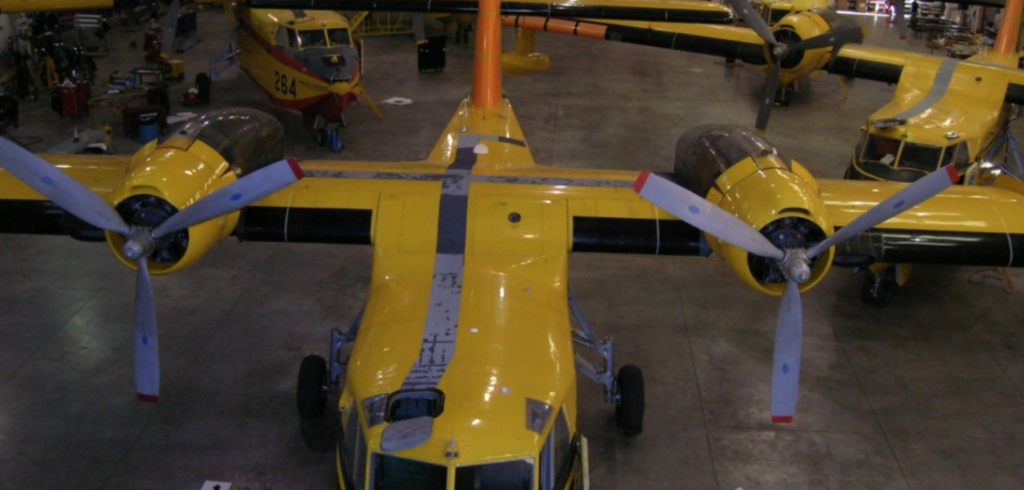
Aero-Flite Inc. is expanding operations at Spokane International Airport, where the company is planning a 30,000-square-foot maintenance hangar to handle its growing fleet, says general manager Chris Niemann.
The Spokane Journal reported that the company has filed a pre-development conference application with the city of Spokane to review plans for the structure, valued at over $8 million. The company bases its operations in 33,000 square feet of hangar space, which includes a 6,000-square-foot attached tent; Niemann says the new hangar will be built next to the existing facility and it will improve winter maintenance capacity.
Aero-Flite ducks in a row
He says the fleet will grow from 12 to 14 aircraft. The company added one plane in 2023 and will add two more next year. The FAA issued a Supplemental Type Certificate (STC) on the Dash 8-400AT airtanker last spring; Aero-Flite has pursued the U.S. certification of the airtanker version of the Dash-8 airliner.
Also operating AVRO RJ-85 and Canadair CL-415 airtankers, Aero-Flite plans to expand their fleet; with the new STC, Aero-Flite will add two Dash 8-400ATs and the FAA approval will allow U.S.-registered Dash 8-400ATs to fly aerial firefighting missions across all states.
The Aero-Flite airtankers will operate under a long-term, multiyear contract with the State of Washington.
Expanding its hangar space will reduce employee time spent moving aircraft around during maintenance time in the off season. Aero-Flite photo
The maintenance hangar will be a pre-engineered metal building with insulated panels for siding. Spokane-based Garco Construction will be the contractor. Since Niemann joined the company in May 2021, Aero-Flite has added 40 employees, bringing the workforce to about 180 people. That includes 125 Spokane-area employees.
For four years running, Aero-Flite’s been named by the Spokane Journal of Business as one of the best places to work in the Inland Northwest.
AirMed&Rescue reported back in the spring that Aero-Flite is a business with 60 years of experience in the aerial firefighting sector. It employs over 170 aviation experts, including 51 pilots and 74 mechanics, and operates a mixed fleet of fixed-wing aircraft, including seven Avro RJ85 airtankers and four De Havilland CL-415 waterbombers; the Dash 8-400AT is one of the world’s most modern airtankers.
Aero-Flite announced earlier this month that the Federal Aviation Administration (FAA) has issued a Supplemental Type Certificate (STC) on the Dash 8-400AT airtanker. Based in Spokane, Aero-Flite has shown an ongoing interest in the U.S. certification of the airtanker version of the Dash-8 airliner.
Currently operating AVRO RJ-85 and Canadair CL-415 airtankers, Aero-Flite plans to expand their fleet. scramble.nl reported that with the new STC, Aero-Flite hopes to add two Dash 8-400ATs to its fleet before the end of the year. This FAA approval will allow U.S.-registered Dash 8-400ATs to fly aerial firefighting missions across all states.
The Aero-Flite airtankers will be operating under a long-term, multiyear contract with the State of Washington.
Aero-Flite photo
“Two of Aero-Flite’s Dash 8-Q400AT airtankers are currently on an exclusive use contract with Washington State,” said Brock Hindman, chief pilot of the Dash 8-400AT program at Aero-Flite. He said they’re operating with a cooperator agreement with the USFS and offering the airtanker to the Forest Service and to other states as the fleet grows.
Hindman said Canadian firefighting company Conair and the French Securité Civile have for years used firefighting versions of the Dash-8. “Conair has been converting the Dash 8-400 into an airtanker since 2005,” he said, “and has been operating them in Australia since 2020 — and in Canada and Alaska since 2022. With this recent FAA approval, Aero-Flite can now register our own airtankers in the U.S. and operate them under contract with government agencies.” He said Aero-Flite provides crews, maintenance, and insurance for the Dash 8 operations, working out of its Spokane hangars.
“Each Q400AT has a captain and a first officer operating the aircraft, supported by two aircraft mechanics on the ground, plus partner fuelers and loaders at each tanker base.” Hindman said the crews travel between tanker bases as needed. In 2022 the Q400AT operated in Washington and assisted in Oregon and Idaho.
Aero-Flite photo
Chris Niemann, general manager at Aero-Flite, told AirMed&Rescue, “The Dash offers greater flexibility and responsiveness than larger airtankers, while still providing a comparable payload capacity. It can operate from shorter runways at higher elevations, positioned in smaller airtanker bases located closer to where wildfires occur — meaning a fast response to the fire and back. Plus, they burn significantly less fuel than a Type 1larger airtanker, resulting in much lower operational costs while delivering a similar punch to the fire.”
Two of Aero-Flite’s CL-415 scoopers, Tankers 260 and 263, began the Mandatory Availability Period on their exclusive use contracts on Monday. The company is hoping their other CL-415’s, Tankers 261 and 262, will be awarded call when needed contracts on the scooper solicitation that closed in March.
Four CL-415 water-scooping air tankers at Cody, Wyoming during the week of August 1, 2016. Photo by Becky Lester Hawkins.
Aero-Flite also has two RJ85’s actively working on contracts and two others begin in the third week of May. They have one or two others available as call when needed depending on maintenance status.
Aero-Flite’s Tanker 161, an RJ85, at McClellan, March 23, 2016. Photo by Bill Gabbert.
Four CL-415 water-scooping air tankers at Cody, Wyoming during the week of August 1, 2016. Some of them had been working the nearby Whit Fire and scooping out of Buffalo Bill Reservoir six miles from the fire. Photo by Becky Lester Hawkins.
Ten additional air tankers brought on temporarily
In the last few weeks the U.S. Forest Service has brought on ten additional air tankers on a temporary basis. This includes CL-415 water-scoopers, CV-580’s, and Modular Airborne FireFighting System (MAFFS) C-130’s. Two of the aircraft were acquired through Call When Needed (CWN) agreements; four via agreements with Alaska and Canada; two MAFFS through an agreement with the Department of Defense; and two water scoopers through other contracts.
HC-130H’s
The U.S. Forest Service expects to have two HC-130H aircraft at McClellan Air Field in September. These are part of the seven aircraft fleet of HC-130H’s that the agency is receiving from the Coast Guard.
Tanker 118, an HC-130H, at McClellan Airport. Photo by Jon Wright, July 25, 2015.
Last year one of the HC-130H’s worked out of McClellan using a MAFFS, a slip-in 3,000-gallon pressurized retardant system that pumps the liquid out the left side troop door. That was aircraft #1721 designated as Tanker 118, still painted in military colors. T-118 is now undergoing scheduled depot-level maintenance and should be replaced in September of this year by #1708 designated as Tanker 116. It will also use a slip-in MAFFS unit, one of the eight owned by the USFS, but should be sporting a new USFS air tanker paint job. After T-118 left, another former Coast Guard aircraft took its place, #1706. It is being used for training the contracted pilots and will not serve as an air tanker.
Early in 2015 the plan was to have two HC-130H’s at McClellan. One would be used as an air tanker, and the second would be used as a training platform. Below is a portion of that early 2015 plan which we covered February 9, 2015.
The USFS plans in early 2015 for incorporating the seven HC-130H aircraft into a Government-Owned/Contractor-Operated fleet of air tankers. Click to enlarge.
Eventually the USFS hopes to have all seven converted to air tankers with removable retardant tanks. A contract for the installation of the retardant delivery systems was awarded to the Coulson Group in May. There is also much other work that has to be completed on the aircraft including programmed depot maintenance, painting, and wing box replacement on most of them. The work is being done or coordinated by the U.S. Air Force. They were directed by Congressional legislation to use their own funds, up to $130 million, so it is no surprise that the schedule keeps slipping as delays continue to occur in awarding contracts and scheduling the maintenance.
The USFS has two water-scooping CL-415 air tankers on exclusive use contract. As noted above they recently temporarily brought on two more on a call when needed basis. All four are operated by AeroFlite and as seen in the photo above were together at Cody last week.
Air Spray
There was some discussion in the comment section of another article on Fire Aviation about the status of the BAe-146 aircraft being converted to air tankers by Air Spray. The company has five of the 146’s; two are out of the country and the other three are at the company’s Chico, California facility. Ravi Saip, their Director of Maintenance/General Manager, told Fire Aviation that they expect to begin flight testing one of them in air tanker mode around the first of the year. After they receive a supplemental type certificate from the FAA, work on the second one would shift into high gear. Then conversion of the other three would begin.
Air Spray’s T-241 finishing its amphibious conversion at the Wipaire facility in Minnesota. Air Spray photo.
Air Spray also has eight Air Tractor 802 single engine air tankers that they have purchased since 2014. Five of them have received the amphibious conversion by adding floats, and the other three are stock, restricted to wheels.
Air Spray’s Tanker 498, an L-188 Electra, is currently in Sacramento being inspected and carded by CAL FIRE so that it can be used in a Call When Needed capacity.
747 SuperTanker
Jim Wheeler, President and CEO of Global SuperTanker Services, told us that the FAA has awarded a supplemental type certificate for their reborn 747 SuperTanker — a major and sometimes very difficult barrier to overcome. Within the next two weeks they expect to receive the airworthiness certificate.
T-944 at Colorado Springs May 4, 2016. Photo by Bill Gabbert.
Beginning next week representatives from the USFS will observe some additional static tests and then there will be an airborne descent test, a new test added in 2013, releasing retardant in a downhill drop. That test was not required when Version 1.0 of the 747 was certified. It may have been added after it was discovered that the first BAe-146’s that were converted and issued contracts still retained hundreds of gallons of retardant after downhill runs.
These steps should take less than two weeks, Mr. Wheeler said, after which they will submit the results to the Interagency AirTanker Board.
Jennifer Jones, a spokesperson for the USFS, told Fire Aviation that the company was offered an opportunity to submit a proposal for a call when needed contract solicitation in 2015, along with numerous other companies, but declined to do so. Their next opportunity to obtain a contract will be when another general solicitation is issued in 2017, or perhaps sooner, Ms. Jones said. The agency issued a Request for Information a few weeks ago, which is usually followed some months later with an actual solicitation.
Judging from the list of CWN air tankers with contracts, apparently it is possible to submit a proposal and receive a USFS CWN contract even if the aircraft exists mostly on paper and could be years away from being FAA and Interagency AirTanker Board certified.
In the meantime Mr. Wheeler realizes that the USFS is not the only organization that hires air tankers and has been talking with a number of other agencies in various states and countries as well as companies involved in marine firefighting.
Global SuperTanker is in the process of finishing repairs on the 747 in Arizona after some of the composite flight control surfaces (flaps, spoilers, elevators) and engine cowlings were damaged by golf ball sized hail at Colorado Springs several weeks ago. There was no windscreen or fuselage damage.
Mr. Wheeler said that was the first severe hailstorm within the last seven years at the Colorado Springs airport. But, after the aircraft left to be repaired in Arizona a second hailstorm struck the airport that some have said was a 100-year event and did much more damage than the first one.
Permanent base for the HC-130H air tankers
On September 2, 2015 the USFS formally requested information from facilities that could support the seven-aircraft HC-130H fleet (Solicitation Number SN-2015-16), with responses due September 16. The agency was only asking for information from interested parties, and will not award a contract based on the Request for Information. A few politicians fell all over themselves arguing that the aircraft should be based in their state.
Since then no decisions have been made. Ms. Jones told Fire Aviation:
The U.S. Forest Service continues to cooperate with the Department of Defense to identify potential federal facilities, which must be considered first.
It is unlikely that more than one or two of the seven HC-130H’s would be at the new base at at any one time, except during the winter when they would not have to be dispersed around the country to be available for firefighting. While the base might not be a huge expansion of the aerial firefighting capabilities in an area, the stationing of the flight crews, maintenance, and administrative personnel would be a boost to the economy of a small or medium-sized city.
Above: Air Tanker 262, a CL-415, in Oklahoma, April 7, 2016. Photo by John Wilson.
John Wilson sent us photos of the two CL-415 water-scooping air tankers that are on U.S. Forest Service exclusive use contract. We were not sure which two AeroFlite aircraft were on the contract until we saw his photos. Now we know it is T-261 and T-262. We updated the 2016 contract list first published March 2, 2016.
John said the air tankers were seen near Bethel Acres, Oklahoma. They were most likely scooping water from Shawnee Twin Lakes in Pottawatomie County and then dropping the water on a fire a few miles to the south.
John said:
It was early evening and I was losing light but the Nikon handled it pretty well. I didn’t realize there was more than one aircraft until I started processing the images and noticed the tanker numbers.
Air Tanker 261, a CL-415, in Oklahoma, April 7, 2016. Photo by John Wilson.