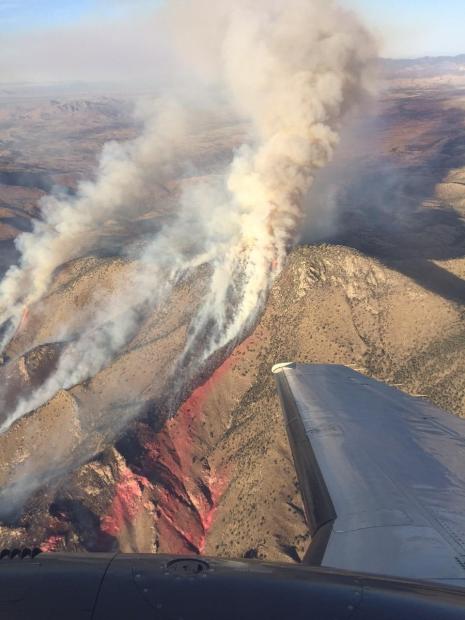
These are photos of an air tanker that you don’t see every day. The C-130Q that Coulson recently acquired, was being moved from Tucson to another facility in Mesa, Arizona where it will be transformed into Coulson’s fourth C-130 air tanker, Tanker #134. Obviously it needs a little work.
It is the second C-130Q that they have acquired. The first was Tanker 131 that entered service about four years ago. The company also has two L-382G’s, which is the civilian version of the C-130.
Britt Coulson, who sent us these pictures, said they expect to have the conversion complete by the end of this summer.
The photo below shows the aircraft before it was dismantled.
Coulson’s C-130Q which will become Tanker 134 later this year.
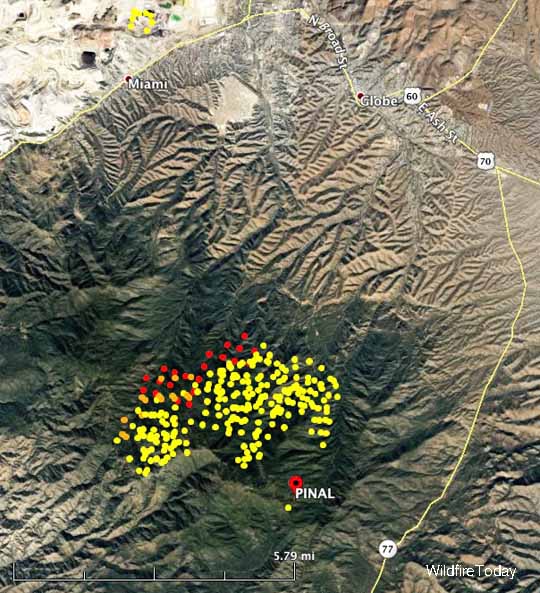
Four separate incidents involving hobbyists flying drones are hindering operations on the 4,991-acre Pinal Fire since the fire was detected May 8 in the Tonto National Forest five miles south of Globe, Arizona.
The latest drone sighting occurred May 24, 2017. An air tanker flying over the fire was forced to release its retardant at a higher altitude for safety reasons. The higher drop reduced the retardant’s effectiveness on the fire. Subsequently, aviation operations were suspended until the drone issue was resolved.
On May 20, 2017, a law enforcement officer cited a hobbyist for flying a drone near the Pinal Fire.
Map showing heat detected by a satellite over the Pinal Fire. The red dots are the most recent, from 3:15 a.m. MDT May 26, 2017.
Forest Service officials continue to emphasize that flying drones over or in close proximity to wildfires is illegal, endangers aviators as well as crews on the ground, and slows operations which potentially could result in the fire increasing in size.
Deputy Forest Supervisor Tom Torres, Tonto National Forest, explained that flying a drone near a wildfire is, in fact, breaking the law.
“The U.S. Code of Federal Regulations 43 CFR 9212.1(f) – indicates that it is illegal to resist or interfere with the efforts of firefighter(s) to extinguish a fire,” Torres said. “Doing so can result in a significant fine and/or a mandatory court appearance.
Drone operators determined to have endangered manned aircraft or people on the ground and/or interfered with wildfire suppression may be subject to civil penalties, including fines of up to $25,000, and potentially criminal prosecution.
Management of the fire
The Pinal Fire is being managed, not aggressively suppressed. One of the objectives is to create a continuous fuel break between the Pinal Mountains and the town of Globe five miles to the north.
Firefighters are involved in preparation and defense of structures and infrastructure along the indirect control lines from which firing operations could be conducted where necessary to maintain low intensity fire conditions and prevent unwanted impacts to the values at risk.
Thanks and a tip of the hat go out to Tom. Typos or errors, report them HERE.
Above: The parking lot at the Granite Mountain Hotshots Memorial State Park trailhead southwest of Yarnell, Arizona was about half full at 3 p.m. on May 19, 2017.
The new Granite Mountain Hotshots Memorial State Park that opened November 30, 2016 is receiving so much use that often visitors are turned away when the small parking lot is full. Arizona State Parks reports that approximately 10,500 people have visited the site, more than the small parking lot can handle at times.
The park honors the 19 wildland firefighters that were killed on June 30, 2013 when they were overrun by the suddenly very active Yarnell Hill Fire near Yarnell, Arizona, 90 miles northwest of Phoenix.
Interpretive panels and stairway leading to the trail at the Granite Mountain Hotshots Memorial State Park.
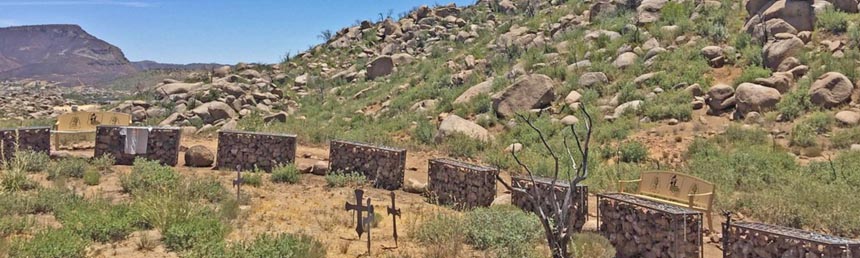
The park consists of a trailhead on U.S. Highway 89 approximately two miles west of Yarnell and a 3.6-mile trail leading to the fatality site. Along the trail are 19 stone plaques honoring each of the fallen Hotshots and six interpretive signs that tell their story.
The trail is fairly steep with quite a bit of elevation change, up and down, and can take four to six hours round-trip for the casual hiker.
The trailhead is located on an east-west section of the highway where the road contours across a very steep mountain. The highway is divided at that point with the eastbound lane several hundred feet below the westbound lane.
If you are driving east toward Yarnell you will not pass directly by the trailhead — you will see it only if you are heading west. However the state built a new road connecting the two opposing lanes about a quarter of a mile to the east. Signs direct eastbound travelers to turn left to get on the connecting road. Upon reaching the westbound lane, you turn left again and drive down to the parking lot and trailhead.
When I was there on May 19 about half of the 17 parking places were taken. According to an article in the Daily Courier the parking lot often being full has motivated park managers and locals to find a way to keep folks from being turned away. One idea being tossed around is to offer a shuttle.
Below is an excerpt from the article:
The group’s idea is to create a shuttle system that would take visitors from an overflow lot in Yarnell to the state park south of town. The group is looking into grant opportunities to help fund the shuttle, Lechner said.
Along with relieving the traffic frustrations for visitors, Lechner said the shuttle also could help the Yarnell businesses by bringing more the visitors into town.
“The best way to honor the sacrifice made by the Hotshots is to make Yarnell the most wonderful, thriving community as possible,” she said.
The fatality site at Granite Mountain Hotshots Memorial State Park. Photo by Arizona State Parks.
Rangers have started using drones to scout fires from above, the Grand Canyon News reported. From the article published Tuesday:
Justin Jager, interagency aviation officer for Grand Canyon National Park, Kaibab and Coconino National Forests and Flagstaff and Verde Valley Area National Monuments, said the drones are utilized in conjunction with traditional methods. Operators use the devices to scout fire lines, or communicate information to other personnel in the area.
The unmanned systems aren’t replacing fixed-wing scouting planes. Rather, they’re being used to search a fire’s outer edges and providing intelligence that can help establish stronger fire lines.
“We’re taking what we’re learning and creating a guide for other agencies, like BLM (Bureau of Land Management) or other national parks to create their own programs,” Jager said. “I think they can all benefit from adding this tool.”
Grand Canyon National Park is the only park with its own fleet of unmanned aircraft that can be used for locating people who have gotten lost, stranded, injured or killed. Under a program that began last fall, it has five drones and four certified operators, the Associated Press reported.
The drones are about 18 inches across and 10 inches high, with a battery life of about 20 minutes. Drone operators watch the video in real time and then analyze it again at the end of the day.
As fire season revs up, so will conversations about the crossroads of the devices and wildfire. While crews have successfully used drones for recon and to aid in igniting prescribed burns, it’s only a matter of time until a curious hobbyist — once again — flies too close to firefighting operations.
The U.S. Department of Transportation’s Federal Aviation Administration (FAA) has come out in the past supporting the U.S. Department of the Interior and U.S. Forest Service in their simple message to drone operators: If you fly; we can’t.
“Flying a drone near aerial firefighting aircraft doesn’t just pose a hazard to the pilots,” said U.S. Transportation Secretary Anthony Foxx. “When aircraft are grounded because an unmanned aircraft is in the vicinity, lives are put at greater risk.”
That didn’t matter. After a string of incidents last year, the FAA warned in a mass email to recreational drone operators that those “who interfere with wildfire suppression efforts are subject to civil penalties of up to $27,500 and possible criminal prosecution.”
Looking for more about the intersection of drones and wildfire? This dated, yet relevant, Smithsonian video below documents the use of the General Atomics MQ-1 Predator Drone in the August, 2013, Rim Fire in California.
Above: Map of the Sawmill Fire east of Green Valley, Arizona as of April 26, 2017.
Firefighters battling the 46,954-acre Sawmill Fire 23 miles southeast of Tucson have been able to slow the spread over the last two days in spite of strong winds. Satellite imagery from early Friday morning did not show any large concentrations of heat over the previous 24 hours. This does not mean the fire is out, and there is no doubt a lot of line building and mopup work still has to be accomplished.
For the last two days the Sawmill Fire has been most active on the northeast side where aircraft have been assisting firefighters on the ground to slow the spread.
A Red Flag Warning for strong winds is still in place for the fire area as well as most of southern Arizona and southwest New Mexico.
On Thursday the Arizona Department of Transportation reopened Arizona Highway 83 south of Interstate 10.
The Pima County Office of Emergency Management has lifted the pre-evacuation order for residents on the west side of Arizona Highway 83. Residents in the Hilton Ranch area remain under pre-evacuation notice. An evacuation order remains in place for Rain Valley.
Above: A satellite photographed the darkened outline of the Sawmill Fire east of Green Valley, Arizona on April 26, 2017. The red dots represent heat.
(UPDATED at 9:10 a.m. MDT April 27, 2017)
The growth of the Sawmill Fire east of Green Valley, Arizona slowed Wednesday as decreasing winds allowed air tankers and helicopters to drop water and retardant to assist the firefighters on the ground. The only significant spread that we found on satellite images was an additional 400 acres on the northeast corner of the fire.
As of Wednesday night fire managers were still calling it 40,356 acres.
An evacuation order remains in place for Rain Valley. Since evacuation orders were lifted for Greaterville and Singing Valley, residents of those areas are being allowed through the Arizona Highway 83 closure to access their homes. Arizona Highway 83 remains closed to public traffic.
The area is under a Red Flag Warning on Thursday and Friday for relative humidities in the teens and strong winds. One of the priorities on Thursday is to use aircraft to help secure the firelines before the winds increase.
Today, April 27, a Type 1 Incident Management Team will assume command of the 606 personnel on the Sawmill Fire.
****
(UPDATED at 7:47 p.m. MDT April 26, 2017)
At about 2 p.m. MDT the Incident Management Team said the Sawmill Fire had grown to 40,350 acres. At that time there were seven helicopters and three fixed wing aircraft assisting the firefighters on the ground.
On Wednesday morning the incident management team called it 20,000 acres.
At 2:03 p.m. MDT on Wednesday a heat detecting satellite mapped growth of the fire on the south and northeast sides.
The red area shows the approximate location of the Sawmill Fire at 2:03 p.m. MDT on April 26, 2017. The white line was the approximate perimeter about 12 hours earlier.
The weather station near the fire at Empire recorded on Wednesday a high temperature of 75, a minimum relative humidity of 12 percent, and wind in the afternoon out of the northwest at 8-12 mph gusting at 20-24.
Undated and uncredited photo of the Sawmill fire. Inciweb photo.
****
(UPDATED at 11:16 a.m. MDT April 26, 2017)
A fire that started Sunday morning, April 23 eight miles east of Green Valley, Arizona, has burned (we estimate) about 28,000 acres as of 2:38 a.m. MDT on Wednesday, April 26, 2017, and required evacuations for the communities of Greaterville, Singing Valley, and Rain Valley. It has spread to the east 21 miles, has a perimeter of approximately 63 miles, and crossed Arizona Highway 83 in multiple places.
Sawmill fire map, approximate perimeter 2:38 a.m. MDT April 26, 2017.
The fire is burning on lands protected by the Coronado National Forest, Bureau of Land Management and the Arizona Department of Forestry and Fire Management.
Sawmill Fire, April 23, 2017. Inciweb photo.
On Tuesday the temperature in the fire area was in the low 70’s, the relative humidity was in the 30’s, and the wind was 12-18 gusting at 25-33 mph out of the west. The forecast for the fire area on Wednesday calls for conditions that could lead to significant additional fire spread toward the east and southeast, with temperatures in the mid-70’s, humidity dipping into the single digits, and winds out of the northwest at 10-20 mph gusting to 29.
Tuesday evening Jeff Andrews’ Type 2 Incident Management Team assumed command. Due to the increasing complexity, management will transition to a Type 1 Team on Thursday, April 27.
Sawmill Fire. Photo by Arizona Dept. of Corrections’ Florence Inmate Crew.
A full suppression strategy is being employed to protect nearby values at risk including homes, ranches and outbuildings, communications facilities, power lines, and the Arizona National Scenic Trail.
Sawmill Fire, early in the morning on April 24, 2017. Photo by Arizona Department of Forestry and Fire Management.
Above: The power pole hazard mitigation crew’s sawyer flush cuts a palo verde stump.
By Tom Story
“As Arizona’s largest utility, there are fire risks we have to manage,” said Wade Ward, Fire Mitigation Specialist for Arizona Public Service (APS). “The primary goal of fire mitigation is to prevent fire from ever happening. The second is to provide safe and reliable electricity to the communities APS serves. Just as important is the ability to provide for firefighter safety around our system in the event of a fire”, Mr. Ward continued. “With five thousand miles of transmission and twenty-eight thousand miles of distribution it is hard not to have our system affected by wildland fire. When this happens, APS’s priority is providing a safe environment for crews to work in”.
In Cave Creek, AZ; Wade Ward, Fire Mitigation Specialist for Arizona Public Service, sizes up a palo verde tree slated for removal as part of the APS Defensible Space Around Poles program.
Mr. Ward knows fire (he joined APS after his fire career at the Prescott Fire Department) and he has seen factors like drought, climate change and forest management set the stage for larger and more powerful wildland fires. “It is becoming more evident that due to extended drought over the past decade forest and vegetation ecosystems have been stressed from the lack of regular moisture compounded by shorter drier winters and longer warmer summers,” Mr. Ward said.
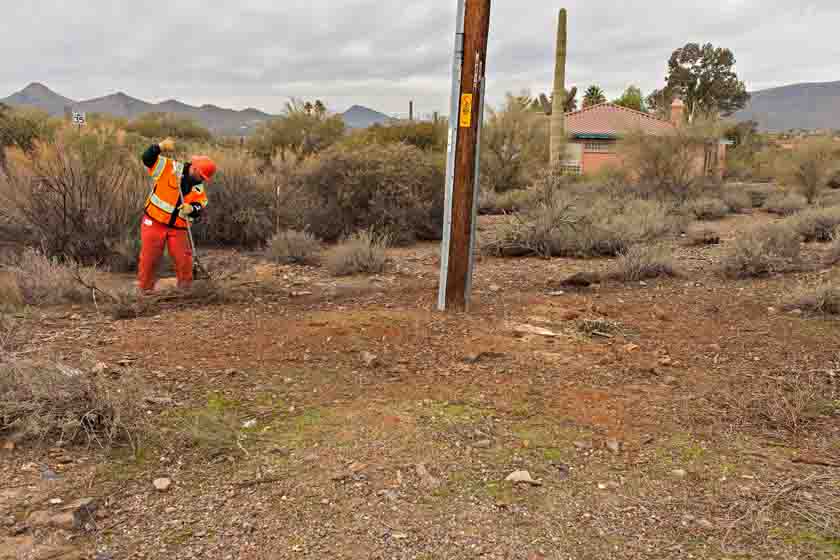
APS sends out inspectors to identify hazardous vegetation in violation of its safety and reliability clearance standards as well as violations of the National Fire Code and the Urban Wildland Interface Code (which state that a utility with equipment attached to the pole must clear all vegetation 10 feet in all directions including 10 feet from the ground). The area around the pole is cleared by work crews to create defensible space. “There are approximately 70 thousand poles within our system that we will have on a three year return cycle to maintain Defensible Space Around Poles (DSAP)” said Mr. Ward.
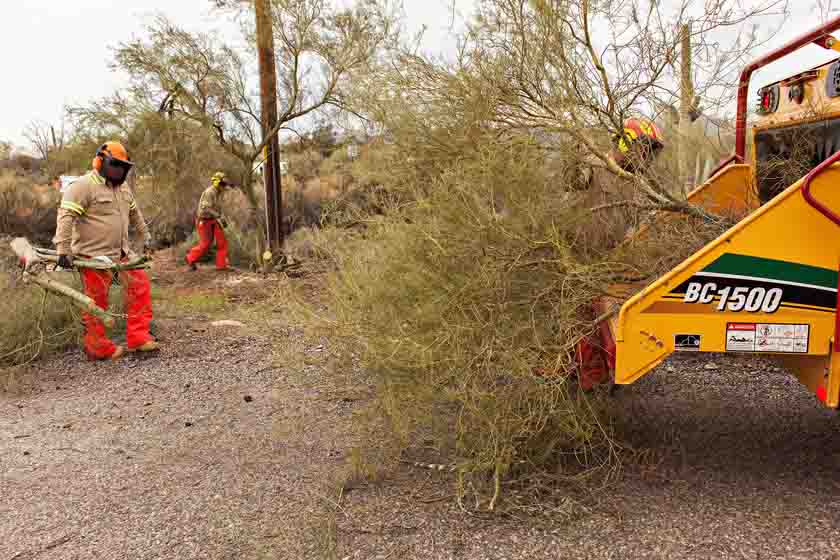
Other crew members cut up and feed the branches into a chipper.
The clearing is being done using manual methods (including chain saws, string trimmers and other hand tools) and where approved is followed by the application of herbicide in compliance with Environmental Protection Agency’s Integrated Vegetation Management practices. APS has prioritized the treatment of subject poles by utilizing data derived from a risk assessment done across the state. Mr. Ward continued; “It is a part of our core values at APS Forestry to manage vegetation and the environment by balancing benefits to create healthy forests and safe reliable energy”.
Mr. Ward finished his remarks noting, “In 2016 we created 110 acres of defensible space around the state of Arizona. One pole at a time”.
Putting the finishing touches on the cleanup around one of the Arizona Public Service power poles in Cave Creek, AZ.
Yarnell Hill Fire at 7:30 p.m. MST, June 29, 2013, approximately 21 hours before the 19 fatalities. Photo by ATGS Rory Collins, Oregon Department of Forestry.
A former hotshot superintendent is suing the Department of Agriculture to get information the U.S. Forest Service so far has not released about the Yarnell Hill Fire. On June 30, 2013, 19 members of the Granite Mountain Hotshot Crew were entrapped and killed on the fire near Yarnell, Arizona.
Fred Schoeffler is seeking recordings or transcripts of radio transmissions with aircraft that were working on the fire.
Below is an excerpt from an article in the Republic:
Schoeffler, a former hotshot supervisor in Payson for 26 years, alleges that the Forest Service answered his Freedom of Information Act request by claiming they “did not find any responsive records.” Wildfire officials previously have acknowledged the study was underway, and Schoeffler’s complaint notes that air-to-ground voices of those taking part are audible in Forest Service videos released after the fire.
Thanks and a tip of the hat go out to Jeff and Dick.
A squadron of air tankers conducted a flyover in a missing man formation as the Granite Mountain Hotshots Memorial State Park opened earlier this week. “The Chopper Guy” got some aerial footage as the four single engine air tankers flew toward the memorial site. As they approached, one of the SEATs trailed smoke as it climbed and turned to the right.
On June 30, 2013 19 members of the Granite Mountain Hotshots were killed as they fought the Yarnell Hill Fire near Yarnell, Arizona, 90 miles northwest of Phoenix.