Report released on entrapment of six firefighters on the Cedar Fire in Arizona

cedar fire entrapment

Above: Fire whirl on the Cedar Fire, June 28, 2016, around the time of the entrapment. Screen grab from the video.

A report has been released on the entrapment of six firefighters that occurred on the Cedar Fire south of Show Low, Arizona June 28, 2016.

The firefighters were part of the Navajo Interagency Hotshot Crew (NIHC) that remained along with two Type 6 engines and possibly one other crew after the Type 1 Incident Management Team was released the previous day. The assignment of half the crew, nine firefighters, was to “monitor” a part of the southwest side of the fire that had six miles of uncontained fire edge. The other half was working on the southeast side.

Three of the nine personnel on the southwest side served as lookouts while the remaining six were monitoring and checking the fire edge. When a very large fire whirl developed near the six, they realized their escape route was cut off, and took refuge in a previously burned area. The ground fuels had burned, but the canopy was still intact. As the fire approached they deployed their fire shelters, remaining in them for about 30 minutes.
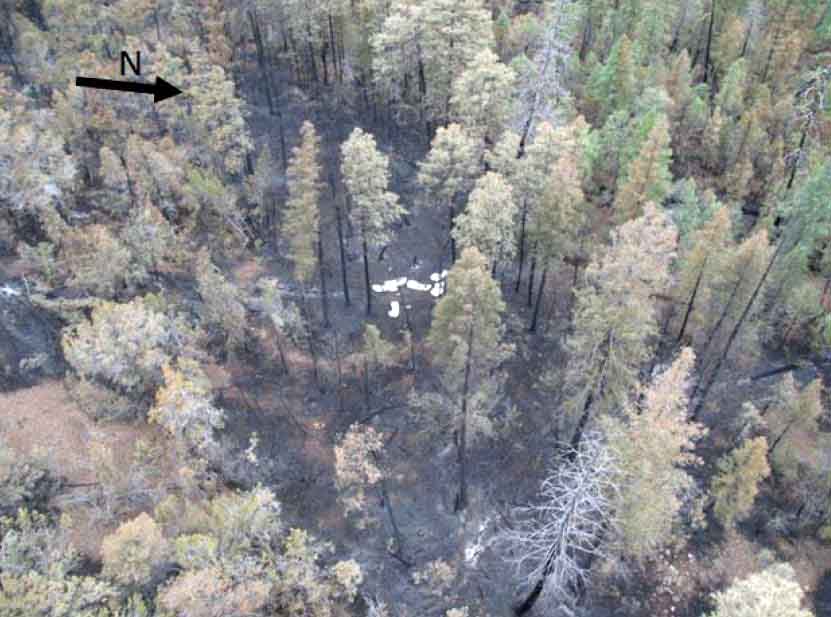
cedar fire entrapment site
The entrapment site at the Cedar Fire.

After the fire whirl subsided, the squad members were able to hike out to staged vehicles. They were transported in three ambulances, medically evaluated, and transported to Summit Hospital in Show Low, Arizona where they were evaluated. Two firefighters were treated for smoke inhalation and all were released by 10 p.m. that evening.

The report says the personnel deployed and entered the shelters just as they had practiced several times in training, and the devices worked as designed. There were no difficulties, as reported at other entrapments, with the PVC bags becoming soft and difficult to open.

Thankfully there were no serious injuries and the training the firefighters had received paid off.

But there are a number of interesting facts about what occurred before the entrapment

Resources on the fire

On June 27, the day before the entrapment, the Type 1 Incident Management Team issued their final update on the 45,977-acre fire just before they were released later that day. Below is a portion of the document.

cedar fire update

The report claims the Type 1 Team recommended that the number of personnel assigned be reduced on Tuesday June 28 to about 400. But on Monday, June 27 all firefighters except for two Type 6 engines were released. With a 70 percent chance of rain in the weather forecast, on Tuesday the local agency decided to replace the Type 1 Team with a Type 4 Incident Commander, two Type 6 engines, and one or two hand crews. The crew(s) had to be re-mobilized on Tuesday after being released. Some aircraft were also assigned on Tuesday.

Video of the large fire whirl

Weather on Tuesday, the day of entrapment

About 20 minutes before the 2:45 p.m. entrapment the weather at the fire was 95 degrees, 21 percent relative humidity, with a 7 to 10 mph wind out of the south. Although “numerous” people observed dust devils and fire whirls before the large fire whirl formed, there was no discussion about modifying fire suppression tactics. Dust devils can be an indicator of the potential for extreme fire behavior.
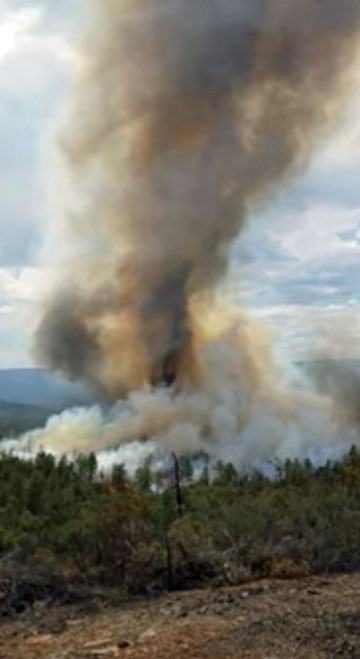
cedar fire entrapment
Fire whirl on the Cedar Fire, June 28, 2016. Screen grab from the video.

Yarnell Hill Fire homeowners ask appellate court to allow them to sue the state

Court of Appeals

Above: Hearing in the Court of Appeals, September 21, 2016. Screen grab from video.

From the Insurance Journal:

Attorneys for Yarnell residents who lost their homes in the deadly 2013 Arizona wildfire are asking the Court of Appeals to allow their clients to sue the state.

KJZZ-FM reported that previously homeowners sued the state Forestry Division, but a trial judge dismissed the case concluding the state had no duty to protect the residents’ property.

At a hearing [September 21, 2016] an attorney for the state said Arizona is not responsible for protecting everyone who chooses to live adjacent to wilderness.

Plaintiffs’ attorney David Abney says that since the state fought the fire, it voluntarily agreed to try to protect Yarnell. Abney wants the appellate court to give his clients a chance to make their case to a jury.

The 2013 Yarnell wildfire killed 19 firefighters and burned more than 120 homes.

To our knowledge, the Court of Appeals has not yet handed down their decision.

Video from the hearing is available on YouTube.

Weather forecast for the prescribed fire in Arizona that led to accidents on Interstate 40

prescribed fire smoke accidents arizona
Map, produced at 11:41 a.m. MDT Oct. 20, 2016, showing heat detected on the Green Base prescribed fire. The dots nearest the Interstate represent heat that was detected during the afternoon of October 18, 2016. The northernmost dots are from October 17, 2016. Click to enlarge.

We looked further into what led to the smoky conditions that resulted in numerous vehicle crashes on Interstate 40 west of Flagstaff, Arizona early Wednesday morning, October 19. The smoke on the highway from a prescribed fire was referred to as “pea soup”, and was clearly the cause of some of the accidents, but investigators are not yet ready to say the smoke caused the one fatality when a vehicle was sandwiched between two semi trucks.

During the very early morning hours of Wednesday, October 19, smoke settled into the areas around Interstate 40 between Parks and Williams. An electronic sign warned motorists about smoke, but the severely reduced visibility was not anticipated by the U.S. Forest Service. After the accidents started occurring the Interstate was closed for five hours.

ADEQ smoke permit green base prescribed fire
Data from the smoke permit issued by the Arizona Department of Environmental Quality for the Green Base prescribed fire. Click to enlarge.

The Kaibab National Forest ignited the Green Base Prescribed Fire on Tuesday, October 18, 2016 immediately north of Interstate 40. The smoke permit issued by the Arizona Department of Environmental Quality anticipated moderate “impacts on sensitive areas”:

Smoke impacts to the following communities of Flagstaff, Parks, Spring Valley, Pittman Valley, Sherwood Forest Estates and some smoke may impact Williams. I-40 may experience moderate smoke impacts in low-lying areas.

The Flagstaff office of the National Weather Service issued a Spot Weather Forecast for the Green Base Prescribed Fire at 5:28 a.m. MST on Tuesday October 18, 2016. It anticipated a “good” maximum ventilation rate for Tuesday, did not specify one for Tuesday night, and for Wednesday it was described as “fair”.

spot weather green base prescribed fire
Spot Weather forecast for the Green Base Prescribed Fire, October 18, 2016. Click to enlarge.

The ventilation rate provides an estimate of how high and how far smoke will disperse. A high ventilation rate suggests that smoke will spread out quickly and through a deep layer of the atmosphere, so that surface concentrations downwind will be lower than they would be with a lower ventilation rate.

The transport winds (from the ground to the mixing height) for Tuesday night were predicted to be “west 5 to 10 knots shifting to the north after midnight, then shifting to the northeast early in the morning.” The wind speed after the shift was not specified. Perhaps this was interpreted by fire managers to mean it would continue at 5 to 10 knots.

The prescribed fire was just north of the east-west Interstate, so a wind out of the northeast would likely push the smoke toward the highway. And if an area is prone to nighttime inversions, visibility can be compromised.

Fox News reported that Cory Mottice, a National Weather Service meteorologist in Flagstaff, said, “[Smoke] always gets trapped after dark,” he said. “It’s just a question of where the wind blows it.”

However that analysis was not described in detail in the spot weather forecast issued by Mr. Mottice’s office. As in many spot weather forecasts, much of the information appears to be generated by a computer, with little interpretation or discussion about how the information will affect the fire. Meteorologists are not expected to be Fire Behavior Analysts, but sometimes a little human-created discussion and interpretation can add value to a computer product.

Below are excerpts from an article at the Arizona Daily Sun:

… A Highway Patrol captain at the scene said smoke in the area reduced visibility down to about 20 feet, Department of Public Safety spokesman Bart Graves said. Sherwood Forest Estates Fire Chief Wayne Marx said even his crews had to stick their heads out the window to watch the yellow stripe on the road as they escorted commuters away from the interstate.

“You couldn’t see past the end of the hood,” Marx said.

[…]

One retired meteorologist who lives in the area believes more precautions should have been taken. Parks resident Byron Peterson, who retired from National Weather Service station in Bellemont, said the smoke was already bad on Old Route 66 Tuesday afternoon. Firefighters waved him on, he said, even though there were times when he could not see 10 feet in front of him.

“It was very frightening to say the least,” Peterson said.

He said strong southwest winds coming up over Bill Williams Mountain near Williams formed an eddy of swirling air that then dove down over the prescribed burn, keeping the smoke from dissipating.

“I tried to explain that to people at the Forest Service and it was just like talking to a wall,” he said.


Rainfall in western states slows wildfire season in many areas

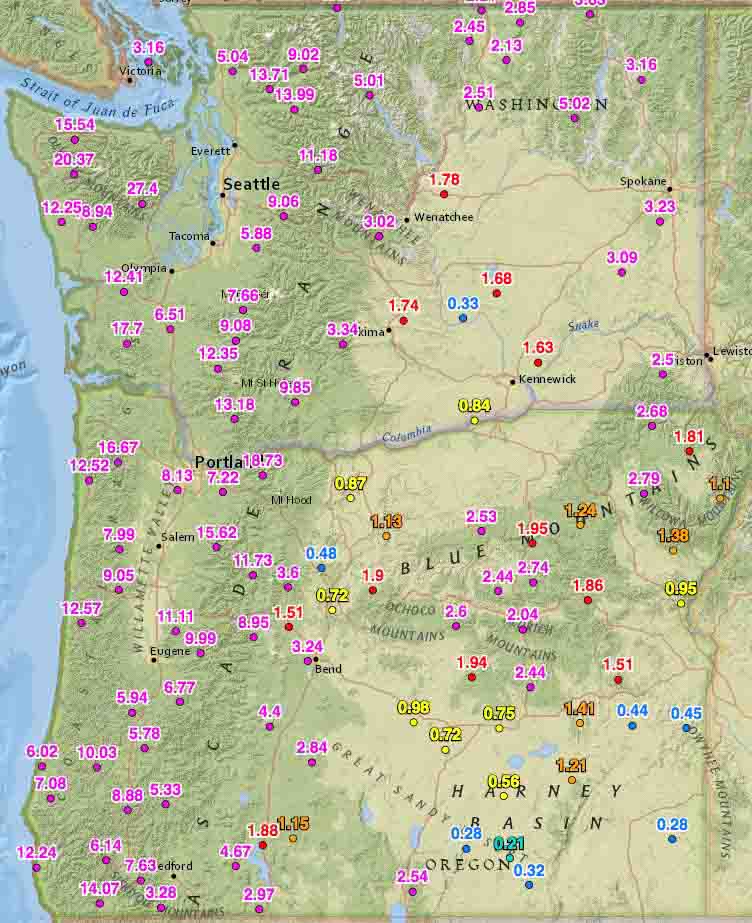
Rainfall last 2 weeks washington oregon
Rainfall last 2 weeks, Washington and Oregon

Rainfall over the last two weeks has slowed or in some cases, ended the wildfire season in some areas.

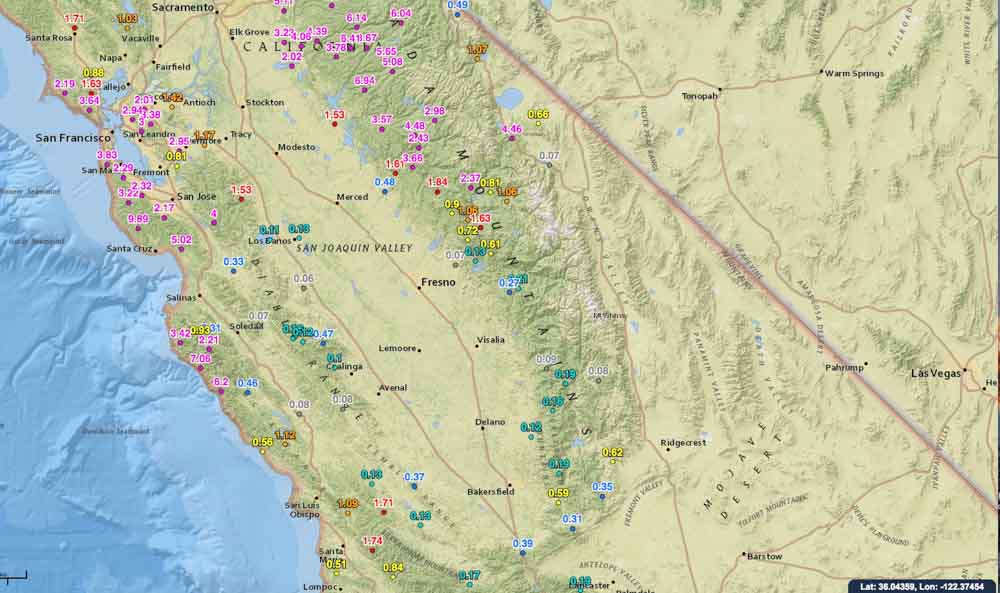
On October 19 we ran the numbers for the accumulated precipitation for the last 14 days in the western states. These maps show amounts that exceeded 0.05 inches at some of the Interagency Remote Automatic Weather Stations (RAWS).

Washington, Oregon, and northern California have received a good soaking and I would imagine that local fire officials may be declaring an end to the fire season. Of course this is not unusual for these areas this time of the year, and some locations had already seen their season end. But what IS unusual, is the high amount of moisture that occurred in just two weeks.

You can click on the images to see larger versions.

Rainfall last 2 weeks, northern California
Rainfall last 2 weeks central California
Rainfall last 2 weeks, central California

Continue to see maps for the other western states.
Continue reading

A few more details released about fire shelter deployment on the Cedar Fire

On Sunday the Bureau of Indian Affairs released a “72-hour report” that contains a few more details about the entrapment of six firefighters and deployment of their fire shelters on the Cedar Fire south of Show Low, Arizona.

The new information includes mentions of a large fire whirl and three lookouts that were posted.

Below is the press release version of the 72-hour report. The formal memo-style document is HERE. They contain approximately the same information.

****

“On June 28, a large fire whirl formed near six members of the Navajo Interagency Hotshot Crew (IHC), entrapping them. In response to the intense heat, flying ash and woody debris, the firefighters deployed their fire shelters.

Throughout the 15 minute event, the crew maintained radio communication with each other and agency personnel. Aviation and safety resources were immediately dispatched to assist the crew.

After the fire whirl passed, the IHC walked out of the fire area and were transported to Summit Healthcare in Show Low, Arizona. Two firefighters were treated for smoke inhalation and all six firefighters were released from the hospital that evening. After the crew was released, a Critical Incident Stress Management Team was made available to the crew.

The Bureau of Indian Affairs initiated an Interageny Serious Accident Investigation (SAI) that evening. On June 30, the SAI Team members, led by Clark Richins, Team Leader, Bureau of Indian Affairs, reported to Western Region, Fort Apache Agency. Members of the SAI Team include: Chief Investigator, Safety Officer, Personal Protective Equipment Specialist, Long Term Fire Analyst, Hotshot Crew Representative, Public Information Officer, Writer/ Editor, and Regional and National Agency Liaisons.

The investigation will collect evidence, which includes conducting personnel interviews, inspecting equipment and analyzing photographs, weather and voice data. On June 30, the SAI Team completed their interviews of the IHC, which allowed the crew to return home.

According to the National Wildfire Coordinating Group Terminology Glossary, a fire whirl is a spinning vortex column of ascending hot air and gases rising from a fire and carrying aloft smoke, debris, and flame. Fire whirls may range in size from less than one foot to over 500 feet in diameter and have the intensity of a small tornado.

Prior to the event, the crew was working along the western flank of the uncontained fireline where they had previously been assigned for several days. At 12:00p.m three nearby lookouts observed low intensity surface fire, but by 2:00p.m., as the day got warmer, the fire behavior increased. These lookouts and an additional firefighter scouting the fireline witnessed the large fire whirl.

While managing wildland fires is inherently dangerous, all firefighters are trained to minimize the risk they take on every assignment. In the rare circumstance firefighters are faced with an impending entrapment, they are trained to consider all options to insure the safety of all crew members. This includes deploying fire shelters for protection from smoke, heat, and embers. The Navajo Interageny Hotshot Crew executed their training, which resulted in a successful outcome to a hazardous wildfire anomaly.

As a highly reliable organization, the wildland fire community strives to learn and transfer lessons learned on a continual basis. In the spirit of this culture, the BIA Western Region will provide the Factual Report to the Lessons Learned Center when the Report is finalized.”

****

Thanks and a tip of the hat goes out to Jonah.

Update on the condition of the firefighters who deployed fire shelters on the Cedar Fire

(UPDATED at 12:52 p.m. MDT June 30, 2016)

Today the BIA released a “24 Hour Report” about the fire shelter deployment on the Cedar Fire. It provided a few facts that were not previously disclosed by the agency.

The six firefighters deployed their shelters in an area that had already burned, and they were evaluated in the hospital for “smoke inhalation”.

The Serious Accident Investigation Team will be led by Jon Rollins, Chief Investigator for the National Park Service.

****

(Originally published at 9:52 p.m. MDT, June 29, 2016)

The Bureau of Indian Affairs provided more information today about the six firefighters on the Cedar Fire south of Show Low, Arizona who on June 28 found themselves in a situation where they had to deploy fire shelters. The firefighters, all from the Navajo Interagency Hotshot Crew, walked away from the site and were transported to Summit Healthcare in Show Low where they were treated and released that evening.

A Serious Accident Investigation Team has been formed and will investigate the circumstances surrounding the deployment.

We don’t know why or how the incident occurred, but if recent history holds true, we may never know, thanks to the unintended consequences of Senator Maria Cantwell’s and Representative Doc Hastings’ hastily conceived Public Law 107-203 signed into law in 2002.

But putting aside the unknown details of fire behavior, decisions made on the fireline, and the strategy and tactics being used on the Cedar Fire yesterday, there a few things that we do know.

  • The Type 1 Incident Management Team issued an update titled “Final Cedar Fire Update” on Monday, June 27. It said in part, “While 554 firefighters are working on the fire [Monday] morning, only the Team itself will remain by Tuesday afternoon. The Bureau of Indian Affairs (BIA) will assume command of the fire at 6 A.M. Tuesday.” That Monday update said the fire received rainfall on Sunday and more rain was expected on Monday.
  • The Type 1 Team turned the fire over to the Fort Apache Agency at 6 a.m. on Tuesday, June 28. There was no mention of a Type 2 or Type 3 Incident Management Team.
  • The Fort Apache Agency posted a fire update on Facebook at 1:05 p.m. on Tuesday, June 28 saying the resources on the fire that day were, “Navajo Hotshots, 3 Type 6 Engines, Fort Apache Fuels Type 2 IA Crew.” And, “Fire Personnel will continue to hold and mop up the fire.” These two crews and three engines probably amounted to a maximum of 50 people, plus miscellaneous overhead. This was down from 554 the previous day, a 91 percent reduction in personnel overnight.
  • Candy Lupe, a Public Information Officer with the Bureau of Indian Affairs’ Fort Apache Agency, told Wildfire Today that she was not sure exactly when the incident occurred but estimated it happened around 3 p.m. Arizona time on Tuesday, June 28.
  • The infrared scan of the fire conducted very early Monday morning, June 27, showed “scattered” and “isolated” heat over much of the fire. There was no record of an infrared scan prior to the day shift on Tuesday June 28, but they had been completed every day from June 17 through June 27.

We’re not pointing fingers or attempting to lay blame on anyone. Hopefully the investigation will bring to light some lessons that can be learned.

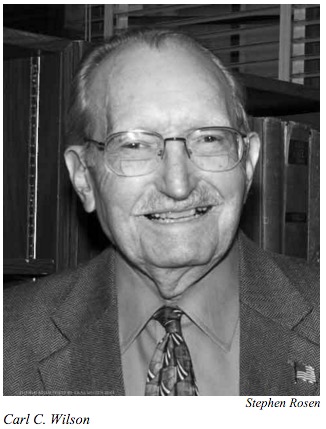
Carl WilsonThe incident brings to mind the Common Denominators of Fatal and Near-Fatal Fires, developed by Carl Wilson in 1976. Mr. Wilson put two lists together, a four-item list based on his studies of 61 fatal fires, and a five-item list that included an additional 31 near-fatal fires. More information about these lists is in our February 1, 2016 article, Are there 4 or 5 common denominators of fire behavior on fatal fires? Almost all recent wildland fire publications, if they publish the list, only have the four-item list.

These lists are not intended as a quick and easy checklist for investigators, nor are they rules or guidelines that must be followed. They are simply interesting commonalities seen on many fatal and near-fatal fires. Things to think about, not rules that must be adhered to.

Here is the five-item list that includes data from fatal and near-fatal fires:

  1. Most of the incidents occurred on relatively small fires or isolated sectors of larger fires.
  2. Most of the fires were innocent in appearance prior to the “flare-ups” or “blow-ups”. In some cases, the fatalities occurred in the mop-up stage.
  3. Flare-ups occurred in deceptively light fuels.
  4. Fires ran uphill in chimneys, gullies, or on steep slopes.
  5. Suppression tools, such as helicopters or air tankers, can adversely modify fire behavior. (Helicopter and air tanker vortices have been known to cause flare-ups.)”

Fire shelters deployed on the Cedar Fire — firefighters injured

(Originally published at 8:58 MDT June 28, 2016)

Today six firefighters deployed fire shelters on the Cedar Fire south of Show Low, Arizona.

Candy Lupe, a Public Information Officer with the Bureau of Indian Affairs’ Fort Apache Agency, said all six were transported to area hospitals with non-life-threatening injuries. Other than that she was not able to answer questions about the nature or extent of the injuries. After the fire in the area cooled, the firefighters were able to walk away from the accident site. Medical, air, and ground resources were deployed to the area to provide assistance. The six firefighters were described as “a portion of the crew” that was working near a flare up on the remaining uncontrolled fire line of the Cedar Fire. 

Ms. Lupe was not sure exactly when the incident occurred but estimated it happened around 3 p.m. Arizona time today, June 28.

Tuesday morning at 6 a.m. the Type 1 Incident Management Team demobilized and transitioned command to the Fort Apache Agency.

The “Final Cedar Fire Update” from Southwest Incident Management Team #2 was posted on InciWeb on June 27. At that time the fire was listed as being 45,977 acres, 75 percent contained, with 546 personnel assigned. The fire received rainfall on Sunday and more rain was expected on Monday. The report stated:

While 554 firefighters are working on the fire [Monday] morning, only the Team itself will remain by Tuesday afternoon. The Bureau of Indian Affairs (BIA) will assume command of the fire at 6 A.M. Tuesday.

An update on the fire that was posted on the Fort Apache Agency’s Facebook page around noon on Tuesday said:

The Southwest portion of the fire will continue to produce smoke as well as the interior of the fire.

Much of the rest of the update was devoted to fire rehabilitation activites.

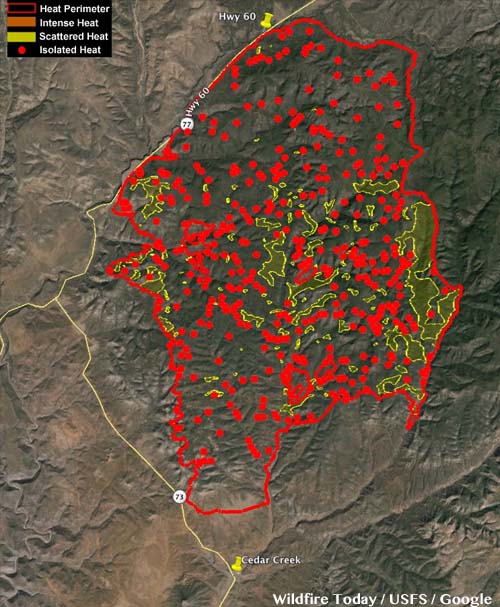
Map Cedar Fire
This map shows the locations of heat detected on the Cedar Fire by a fixed wing aircraft at 2:43 a.m. June 27, 2016.

At 3 p.m. on June 28 the RAWS weather station “IRAWS 5 (Hwy 60 flat)(MST)” on the west side of the Cedar Fire recorded 90 degrees, 19 percent RH, and winds at 3 to 5 mph. Between 9 a.m. and and 5 p.m. the wind direction was very inconsistent, from the south, southwest, and northwest with variable gusts from 9 to 15 mph.

Our earlier primary article about the suppression of the Cedar Fire.

Thanks and a tip of the hat go out to Tom.

Helicopter operations at the Cedar Fire

Above: Helitanker 718 is on final at Show Low Airport and will land at the heavy helicopter area next to a Columbia Boeing Vertol, while JR Helicopter’s AStar is checked over by it’s mechanic. Members of the BLM’s Twin Falls Helitack chat near their medium Bell’s parking spot.

Helicopter Expresses Bell 205 departs the helibase area at the Show Low, AZ airport to the Cedar Fire, burning south of town on the White Mountain Apache Reservation.
Helicopter Express’ Bell 205 departs the helibase area at the Show Low, AZ airport to the Cedar Fire, burning south of town on the White Mountain Apache Reservation.

Tom Story sent us these captioned photos of operations at the helibase for the Cedar Fire south of Show Low, Arizona. More information about the 9,600-acre fire is at Wildfire Today.

Challenged by a pretty good breeze and lack of decent writing surface Angie Tom of Twin Falls Helitack runs the deck operations from the passenger seat of Durango Helitack's vehicle.
Challenged by a pretty good breeze and lack of decent writing surface Angie Tom of Twin Falls Helitack runs the deck operations from the passenger seat of Durango Helitack’s vehicle.
JR Helicopters AStar was staffed by Sandia Helitack while Idaho Helicopters Bell 205A was Twin Falls Helitack's ship.
JR Helicopters’ AStar was staffed by Sandia Helitack while Idaho Helicopters Bell 205A was Twin Falls Helitack’s ship.
The passenger side window of Durango Helitack's vehicle was pressed into service as a writing surface, showing a diagram of the helibase deck at Show Low, AZ airport for helicopters staged for IA and in support of the Cedar Fire on the White Mountain Apache Reservation.
The passenger side window of Durango Helitack’s vehicle was pressed into service as a writing surface, showing a diagram of the helibase deck at Show Low, AZ airport for helicopters staged for IA and in support of the Cedar Fire on the White Mountain Apache Reservation.