Wildfire briefing, March 30, 2014

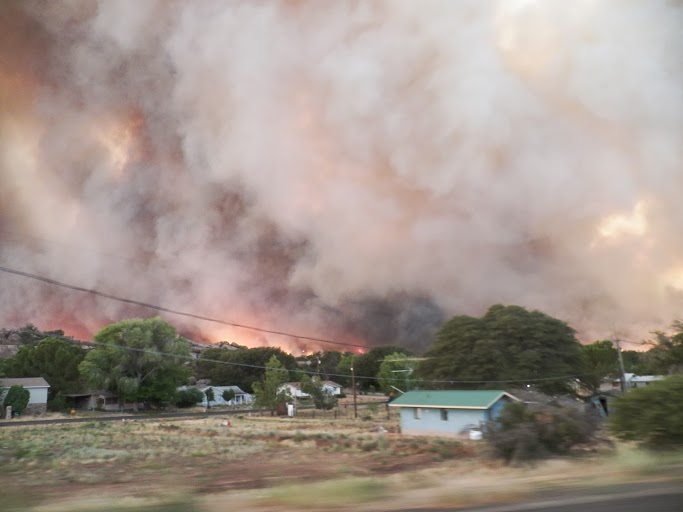
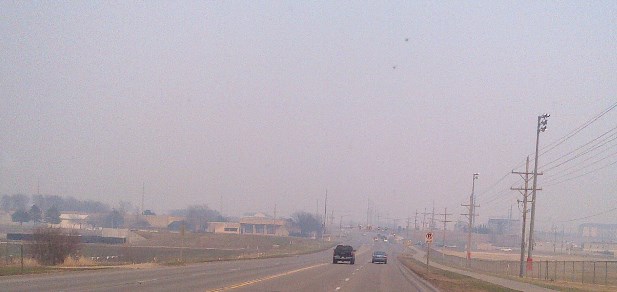
Prescribed fire smoke in Manhattan, Kansas
Prescribed fire smoke in Manhattan, Kansas, March 29, 2014. Photo by Eric Ward.

Prescribed fire smoke in the Flint Hills

In light of the discussion on Wildfire Today about prescribed fire as a tourist attraction in the Flint Hills of Kansas, Eric Ward sent us the above photo that he took Saturday afternoon in smoky Manhattan, Kansas. He explained that many of the ranchers in the area conduct extensive burning projects this time of the year in order to enhance weight gains of cattle if they plan to stock pastures in May. On days when the relative humidity and wind speed are within an acceptable range, the evidence of the burning is very visible in the atmosphere, especially if weather for the previous week or so has been bouncing between snow and red flag weather conditions, as it has this year.

Colorado report recommends contracting for air tankers and helicopters
Colorado Firefighting Air CorpsA long-awaited report about aerial firefighting by state agencies in Colorado was released Friday by the Colorado Firefighting Air Corps (CFAC). Some of the more significant recommendations include:

  • Increase the number of Single Engine Air Tankers (SEAT) on exclusive use contracts from two to four.
  • Contract for the exclusive use of four Type 3 or larger rotor-wing aircraft. (Type 3 helicopters can carry 100 to 300 gallons.)
  • Contract for the exclusive use of two Type 2 or larger air tankers. (Type 2 air tankers can carry 1,800 to 3,000 gallons). The contingency, if the State is unable to contract for two air tankers, is to contract for two helitankers, or a combination of one fixed-wing air tanker and one helitanker.

More details are at Fire Aviation.

Arizona seeks to immunize the state from liability from wildfires

A bill that was approved unanimously Tuesday by the Arizona Senate Appropriations Committee, House Bill 2343, would exempt the state and state employees from prosecution for harm resulting from the action, or inaction by state employees on state lands. Hundreds of millions of dollars in claims have been filed by the families of the 19 firefighters killed on the Yarnell Hill Fire and by property owners whose homes burned. The fire was managed by the state of Arizona in June, 2013.

Firefighters assisting with Oso landslide

Personnel that usually can be found at wildfires are helping to manage the response to the tragic landslide at Oso, Washington. We have reports that some of the resources assisting include Washington Incident Management Team #4 (a Type 2 team), miscellaneous overhead, and some Washington Department of Natural Resources chain saw teams. The IMTeam was dispatched on March 27.

New topic from “Safety Matters”

The “Safety Matters” group has released their “Topic #5”, and they are seeking input from wildland firefighters. Below is an excerpt:

…2014 marks the 20th Anniversary of South Canyon and the 38th Anniversary of Battlement Creek. Both fires fit the model of firefighters dying in a brush fuel type, on a slope, during hot and dry conditions.

The loss of the Granite Mountain Hotshots indicates that a significant accident occurs every 18 to 20 years. Is there a reoccurring cycle, and if so why? Could it be related to a cyclic turnover of firefighter culture, training and attitude? What are the thoughts of Safety Matters readers?

Bushfire season ends in New South Wales

The bushfire season has reached its official end in New South Wales.

Tribute to author Norman Maclean

The Daily Beast has reprinted an excellent essay that Pete Dexter wrote for Esquire in 1981 about Norman Maclean. It explores a side of of the author that is not revealed in his book about firefighters, Young Men and Fire. Mr. Dexter spent quite a bit of time with Mr. Maclean, who at that time was writing the final chapter. Mr. Maclean also wrote A River Runs Through It, which was made into a movie starring Robert Redford and Brad Pitt. The Esperanza Fire, a book written by his son John N. Maclean, is working its way towards becoming a movie.

U.S. National Guard assists with fire in Puerto Rico

From the AP:

Puerto Rico has enlisted the U.S. National Guard to help extinguish a fire that has ravaged a forest in the island’s central region. Firefighting Chief Angel Crespo says that about 40 percent of the Modelo Forest in the town of Adjuntas has been destroyed. Authorities say they believe the fire was intentionally set and that it has consumed up to 290 acres (117 hectares). A U.S. National Guard helicopter helped dump water over the area on Friday.

Fantastic photo

Northwest Fire District hoped the Ironwood Hotshots would be a moneymaker

On Tuesday the Northwest Fire District which serves the northwest metropolitan area of Tucson, Arizona announced they were disbanding their Ironwood Hotshot crew at the end of the 2014 wildland fire season. Various reasons for the decision were reported in the media, with representatives of the District quoted as saying it was mostly for financial considerations. John Hoellerich a firefighter on the Ironwood Hotshots who started a petition to retain the crew, said it was related to lawsuits filed against the Prescott Fire Department over the fatal Yarnell Hill Fire that killed 19 members of the Department’s Granite Mountain Hotshot crew.

Ironwood Hotshots
Ironwood Hotshots. Photo by Ironwood Hotshots.

When the concept of having a hotshot crew was sold to the Tucson community, one of the justifications was that the 20-person firefighting crew would make money for the district, or at least break even.

David Gephart, the District’s Finance Director, told Wildfire Today the crew is being disbanded for “financial and operational” reasons. He said one of the operational considerations is that the District has some vacant structural firefighting positions it needs to fill, and the seven permanent members of the crew will be offered those positions. Four of those seven have already been through the structural fire academy, while three have not but will be scheduled to receive the training.

When a firefighting resource, such as a hotshot crew or fire engine, from one agency helps to suppress a fire in another jurisdiction for an extended period of time, formal agreements usually stipulate that the lending agency is financially reimbursed for their expenses. The reimbursement amount is based on the crewperson hours worked. That rate is almost three times the actual hourly rate the District pays the firefighters, in order to cover other expenses related to the fire assignment. For example, the Prescott Fire Department was reimbursed for 95.5 percent of the total expenses of operating the Granite Mountain Hotshots in the 2012 fiscal year, according to an article in The Daily Courier.

Mr. Gephart provided figures for the fiscal years 2011 through 2013 showing that the operational expenses for the Ironwood Hotshots for that three year period were $7.3 million. They were reimbursed for $7.2 million, or, 98.6 percent of their costs.

Right now there is a positive balance in the Hotshots’ account of $1.2 million when considering payments the District expects to receive for fire assignments last year, Mr. Gephart said.

Ironwood Hotshots costs

We asked if the 200 other firefighters that the District employs were expected to generate their own funding, and Mr. Gephart said they were not.

He pointed out that there are other costs for maintaining the Hotshot crew that are not included above and are more difficult to put on a spread sheet, including overhead, indirect, capital needs, and IT expenses.

Since the crew came within one percent of being self-supporting, we asked why the Hotshots were created in the first place. Mr. Gephart said they expected the crew to make money for the District, or in a worst case, break even. He went on to say future costs will have a negative effect on the crew’s financial situation, such as a new requirement that the 13 seasonal firefighters have health insurance, and increases in the cost of pensions.

Ironwood Hotshots to be disbanded

Ironwood Hotshots
Ironwood Hotshots

UPDATE at 5:13 p.m. MST, March 5, 2014: today we reported more details in a new article about why the Fire District decided to disband the Ironwood Hotshots.

****

(Originally published at 4:53 p.m. MST, March 4, 2014)

The Northwest Fire District announced today that they will disband their Hotshot Crew, the Ironwood Hotshots, at the end of the 2014 wildfire season. The District serves the northwest metropolitan area of Tucson, Arizona, and is one of the very few organizations employing a hotshot crew that is not a federal or state land management agency. Another was the city of Prescott, Arizona, whose Granite Mountain Hotshot crew was virtually wiped out when 19 members of the crew were entrapped and killed on the Yarnell Hill Fire June 30, 2013.

The Fire District said the reason for eliminating the Ironwood Hotshots, according to Tucson News Now, was financial.

Financial and operational reasons were given for the decision to disband. Financially, the fire district said the hotshots cost money, including indirect costs that are not reimbursed by the federal government. Operationally, the crews are sent all over the country and by disbanding the crew, Northwest Fire can improve service locally and lower the tax rate.

A petition at Change.org that encourages the retention of the crew, cites fear of lawsuits, such as those filed against the City of Prescott following their disaster last year.

…In the wake of this terrible tragedy a series of lawsuits were filed against Prescott Fire Department, and State and Federal agencies. It was in direct result of these pending suits that the leadership of Northwest Fire District has hastily decided to abolish the Ironwood Hotshots, who provide a core function in the protection of the cities of Tucson, Marana and surrounding communities against the threat of Wildland fires…

When a firefighting resource, such as a hotshot crew or fire engine, from one agency travels and helps to suppress a fire in another jurisdiction for an extended period of time, formal agreements usually stipulate that the lending agency is financially reimbursed for their expenses. For example, the Prescott Fire Department paid the personnel on the Granite Mountain Hotshots around $12 an hour according to The Daily Courier, but the department was reimbursed by the federal government at the rate of $39.50 an hour.

In fiscal year 2012, the city estimated that the crew brought in $1,375,191, and had $1,437,444 in operating expenses – for a difference of $62,253.

In 2012, payments for fighting fire paid for 95.5 percent of the cost of the Granite Mountain Hotshots. While they were not assigned to a fire, they sometimes spent time on projects for the city, including hazard fuel mitigation — removing vegetation to reduce the chance that fires approaching residential areas would destroy the homes of city residents. And of course, much of the year they were available for fighting wildland fires in and near the city of Prescott.

We have a report that the Ironwood Hotshots have been doing even better financially and the crew is not a monetary burden on the Fire District. They are reimbursed at about $40 per crewperson hour, which covers not only salary but some other routine expenses while firefighting the fire. The starting pay for a new crewperson is about $13 an hour. Even though the crew recently purchased and paid for $500,000 worth of new crew carriers, they still have a positive balance in their hotshot crew account of several hundred thousand dollars.

Last September another hotshot crew, El Cariso, established 60 years before, was disbanded. The Ironwood Hotshots first attained Type 1 Interagency Hotshot Crew certification in 2009.

Leader of Yarnell Hill Fire investigation says one firefighter should be able to attack a fire — alone

Yarnell Hill Fire, June 30, 2013
Yarnell Hill Fire, June 30, 2013. Photo by Joy Collura.

The leader of the 54-person team that conducted the Serious Accident Investigation Team’s investigation into the Yarnell Hill Fire in Arizona that killed 19 firefighters was quoted as saying that individual firefighters should be able to attack wildfires alone. Florida State Forester Jim Karels’ reasoning seems to be that it is too expensive to send two firefighters to a fire.

Below is an excerpt from an article at WFSU explaining that the Florida state legislature is considering a recommendation from the Florida State Fire Service Association that firefighters should not be sent alone to a fire:

…Florida Forest Service Director Jim Karels says the increased staffing mandate is not necessary because the lowest-risk fires only require one firefighter—and if he sends two to one fire, it’s possible nobody will be available when the next one breaks out.

“Safety-wise, purely, if I can send two firefighters to every fire every time with no other decisions, I’m good with that. But we’ve got to look at it on effectiveness and efficiency too,” he says.

But Rep. Mike Clelland (D-Lake Mary) says his experience as a firefighter makes him question the department’s refusal.

“I just can’t imagine one person responding to a forest fire or a brush fire,” he says. “I spent my whole adult life in the fire service.”

The article also has a 50-second audio recording in which you can hear Mr. Karels actually speaking those words.

This helps to explain how Mr. Karels’ 54-person investigative team came up with their analysis of the fatal Yarnell Hill Fire:

The judgments and decisions of the incident management organizations managing this fire were reasonable. Firefighters performed within their scope of duty, as defined by their respective organizations. The Team found no indication of negligence, reckless actions, or violations of policy or protocol.

Many people, including this writer, disagree with the conclusion reached by Mr. Karels and his team. The article we wrote on February 15 is an example of some, but not all, of the negligence, reckless actions, and violations of policy or protocol that have been documented about the fire, in spite of Mr. Karels’ analysis. Other examples surfaced after the release of the second official report on the fire which was issued by the Arizona Division of Occupational Safety and Health.

Many people, after studying for weeks how 19 firefighters were killed on a fire, would be hyper-aware and sensitive to firefighter safety issues, but not in this case. Florida State Forest Service Director Jim Karels is a danger to firefighters and should get out of the business. We don’t use term idiot often at Wildfire Today, but it is well deserved in this case.

Arizona releases statements from Blue Ridge Hotshots about Yarnell Hill Fire

Granite Mountain Hotshots hike to the fire, June 30, 2013
Granite Mountain Hotshots hike to the Yarnell Hill Fire, the morning of June 30, 2013. Photo by Joy Collura.

Written statements that members of the Blue Ridge Hotshots provided about the Yarnell Hill Fire have been released by the Industrial Commission of Arizona. The documents, even though they are heavily redacted, provide more information about what happened on June 30, 2013 before and after 19 members of the Granite Mountain Hotshots were overrun by flames and killed on the fire.

The statements from approximately 12 members of the crew provide more insight about what the Blue Ridge Hotshots were doing that day on the fire, including some of their communications with the Granite Mountain Hotshots.

The general atmosphere on the fire that day, according to how we interpreted some of the statements, was chaos and disorganization.

  • Neither of the two hotshot crews received a briefing that morning.
  • Blue Ridge never really had a significant assignment during their one shift on the fire, other than prepping a dozer line for 30 to 65 minutes, and one person from the crew who worked with a dozer that originally did not have a radio.
  • When Blue Ridge had to disengage and move to a safety zone, there were “still people milling about in town” (Yarnell). At about 1600 some of the residents, who had no information about the fire, asked crewmembers why they were leaving.
  • There was a “debate” on the radio about the border between two geographical divisions. (Other reports confirm this, and the fact that one of the Division Supervisors left the field and did not return.)
  • Firefighters working on the north side of the fire, far away from where the fatal entrapment occurred, were:

…burning around structures and having to use alternate escape route since some have been compromised.

As Blue Ridge was forced to leave the fire and was heading toward a safety zone they:

…find engine crews hiking out and we urge them to move as fast as they can.

The first of the statements mentions what appear to be communications with the Granite Mountain Hotshots at some time before 1615, telling them they are moving Granite Mountain’s crew carriers for them so that they would not be consumed by the fire, and informing them of the current fire behavior:

…I explain that we will keep their rigs with us too because things are very dynamic now, and [redacted] mentions that they are trying to come down off the hill, he mentions traveling through the black.

And later at 1655:

Radio traffic is overheard on A/G or TAC about Granite Mountain IHC needing to deploy shelters and they were in the process of cutting deployment site and trying to burn out around it. No other radio traffic is heard from Granite Mountain over TAC or A/G, we arrive at the Ranch House Restaurant staging area and I jump in Granite Mountain’s chase rig and try to listen on their crew channel and all I hear is a keyed mic, I try to raise them but with no success. I tell [redacted] to sit in the truck and monitor their crew channel for any traffic.

Comments that our readers leave about these statements will be allowed as long as our rules about commenting are respected. If there is a problem, we will close this article to comments.

The entire document can be downloaded, but be aware that it is a huge 18MB file.

Wildfire briefing, February 6, 2014

Arizona: specialty license plate for honoring wildland firefighters

Arizona firefighter license plate proposal

An effort is underway to create a specialty license plate in Arizona to honor fallen wildland firefighters. The cost of the plates will be $25 with $17 of that going to the Wildland Firefighter Foundation to help support injured firefighters and families of those firefighters we have lost.

There is only one thing holding this effort back — $32,000 has to be raised to get the program started. The group working on this said:

Our nonprofit is set up, Our account is set up, now we need donations to make this possible! We need your help to reach our goal..and our goal is to start a long lasting/revolving fundraiser that will support injured firefighters and families of those that have lost a firefighter! These plates will be to honor the memory of those who have paid the ultimate sacrifice. Soon you will be able to buy these plates and show your support on your vehicles! But first, we need to raise the money to start them!…every amount helps folks!

You can make a donation at youcaring.com, and more information is on Facebook.

Safety Matters, Topic #1

The Safety Matters group has established their first forum topic:

****

“HOW CAN 19 FIREFIGHTERS DIE WITHOUT SOMETHING GOING VERY WRONG?

The idea exists that the Granite Mountain Hotshots died because they were in the wrong place at the wrong time, and sometimes bad things happen. We strongly disagree with this assessment of the situation.

In order to get a clearer view of firefighter fatalities due to entrapment and burnover, we examined wildland fires from 1990 through 2013 where journeyman firefighters have died.

We started with an analysis of all firefighter fatalities that were attributed to entrapment and burnover based on statistics from the NIFC website Historical Wildland Firefighter Fatality Reports. We expanded our analysis to determine the common factors on fires that took the lives of experienced firefighters on eight fires with a total of 44 fatalities.

  • Fire Escaped Initial Attack – 100%
  • Type III Incident – 75%
  • Mountainous w/steep drainages – 100%
  • Fire Danger Rating (Extreme or Very High) – 88%
  • Brush a Major Component of Fuel – 100%
  • Experienced an Exceptional Weather Event – 88%

Question for discussion:  If firefighter safety is truly our Number One Priority, then how and why did 44 highly trained and experienced firefighters perish in this manner? (Especially in light of the fact that their actions did not directly result in saving lives or structures).

We will be exploring some of the more specific contributing reasons in the near future. We would now like to hear your thoughts on the question for discussion. Thank you for your participation in Safety Matters!

Safety.Matters@aol.com
Facebook: Safety Matters: A Wildland Firefighter Forum for Change
Twitter: @FFSafetyMatters  ”

The Telegraph writes about the Yarnell Hill Fire

Mick Brown has written a long article for The Telegraph about the tragic fire that killed 19 members of the Granite Mountain Hotshots on June 30, 2013 in Arizona. I have not had a chance to read it yet, but Mr. Brown did quite a bit of research, talking to quite a few people including yours truly.


Thanks and a hat tip go out to Hermione, Holly and David

Wildland firefighter statue finds permanent home in Prescott

Wildland firefighter statue in Prescott
Wildland firefighter statue outside the memorial service for the Granite Mountain Hotshots in Prescott, July 9, 2013, Photo by Bill Gabbert.

After the 14 wildland firefighters were killed on the South Canyon Fire in Colorado in 1994 the Wildland Firefighter Foundation commissioned a stature to be built in their honor. For years it sat outside the airport in Boise, but last year just before the memorial service for the 19 firefighters that were killed on the Yarnell Hill Fire the statue appeared in Prescott at the entrance to the arena where the service was being held. The Prescott Daily Courier published an editorial today about its travels since that day on June 30, 2013.

Here is how the article begins:

The world showed its heart to the Prescott community this past June 30, when 19 of our Granite Mountain Hotshots perished in the Yarnell Hill fire they were struggling to contain.

One of the grandest memorials arrived in Prescott within a few days of the tragedy: a statue that had greeted and bid farewell to wildland firefighters passing through the Boise, Idaho, airport, either to help fight a fire or board a plane to fly home.

This extraordinary gesture of sympathy, the Spirit of the Wildland Community statue, honoring all firefighters – past, present and future – arrived in Prescott quietly, without a lot of fanfare.

The statue – all 1,300 pounds of it – was flown from Boise in Ross Perot’s personal Boeing 737, and when the plane landed in Phoenix in hot July summer heat, Jackson Hotshots unloaded the statue by hand and helped get it to Prescott Valley, where it first stood for the memorial services for the Hotshots on July 9 at Tim’s Toyota Center, a very fitting greeting for people who attended the public farewell to the firefighters…

Posing by the Wildland Firefighter statue
A firefighter being photographed with the Wildland Firefighter statue at the memorial service for the Granite Mountain Hotshots in Prescott. Photo by Bill Gabbert.
Inside the auditorium during the memorial service, July 9, 2013
Inside the auditorium during the memorial service, July 9, 2013 in Prescott. Photo by Bill Gabbert.


Wildfire briefing, January 3, 2014

Drought Monitor 12-31-2013

Drought Monitor

The Drought Monitor shows that most of California, Nevada, and southern Idaho are in either a severe or extreme drought. This could be an interesting winter fire season if it continues.

Drought Monitor 12-31-2013

Arizona State Forestry Division wants to almost double budget

The state organization responsible for managing the Yarnell Hill Fire is requesting a budget for the Arizona State Forestry Division that is nearly double what they received in the fiscal year that ends June 30. According to an article at Azcentral, State Forester Scott Hunt wants to add $6.2 million to this year’s budget of $7.3 million. The additional funds would be used to hire 15 additional staffers, replace firefighting and communications equipment, and allocate $2 million to remove hazardous vegetation on state and private lands. The budget request was filed in October, after 19 firefighters died on the Yarnell Hill Fire but before the state Division of Occupational Safety and Health issued their report on the fire and recommended a $550,000 fine be imposed on the Arizona State Forestry Division as a result of the fatalities on the fire.

Retired smokejumper interviewed on Montana Public Radio

Retired smokejumper Wayne Williams is featured in an interview on Montana Public Radio. In the 11-minute recording Mr. Williams speaks eloquently from his decades of experience. It is refreshing to hear someone interviewed about wildland fire in the media who knows the subject matter. The audio is HERE, and a short article with his photo is HERE.

Army attempts to prevent wildfires at Schofield Barracks

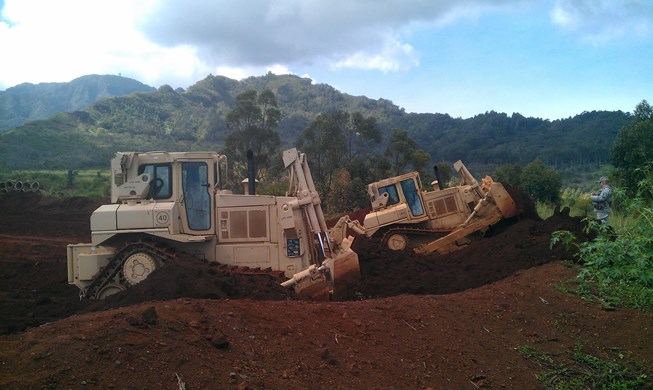
Raising the berm at Schofield Barracks
A soldier with 2nd Platoon, 523rd Engineer Company, 84th Engineer Battalion, 130th Engineer Brigade, 8th Theater Sustainment Command, uses a D7 bulldozer to increase the size of the berm so it is a 20 feet by 20 feet dimension. (U.S. Army photo by: 1st Lt. Lucian Myers, 2nd Platoon, 523rd Engineer Company, 84th Engineer Battalion, 130th Engineer Brigade, 8th Theater Sustainment Command)

In October and November two wildfires started at a range used for controlled detonations to dispose of unexploded ordnance at Schofield Barracks west of Honolulu, Hawaii. The fire that started October 15 burned more than 250 acres. It was fought for five days, then two days later rekindled and was finally extinguished October 28. Another fire in November burned about 30 acres.

In order to reduce the chances of vegetation fires igniting from the explosions, soldiers are using dozers to increase the height of the dirt berm surrounding the range from 7 feet to 22 feet. During the project, which was conducted 24 hours a day between December 9 and 13, they moved 5,800 cubic yards of dirt.

Wildfire Tweets

Below are a couple of messages on Twitter that had photos of fires — at Valparaiso, Chile and Lake Tahoe, California (which may be a prescribed fire).


Thanks and a hat tip go out to Dick and Chris

City of Prescott and Arizona State Forestry reject Yarnell Fire claims and fines

Yarnell Hill Fire
Yarnell Hill Fire. Photo by Joy Collura, June 30, 2013.

The City of Prescott has rejected the claims filed by the mother of one of the 19 firefighters that were killed, as well as those filed by 21 residents whose homes burned during the Yarnell Hill Fire on June 30 in Arizona. According to the Prescott Daily Courier, the claims, which cited negligence in management of the fire, amounted to $48 million for the death of firefighter Grant McKee and nearly $100 million for the property damage.

The newspaper also reported that the Arizona State Forestry Division is contesting citations and $559,000 worth of fines issued to them by another state agency, the Arizona Division of Occupational Safety and Health. The Forestry Division said in their letter to the state OSHA agency that the citations and fines “are not supported by substantial evidence, are contrary to law, arbitrary, capricious and constitute an abuse of discretion by the Industrial Commission of Arizona.” The next step may be a review by the Industrial Commission’s Hearing Division, which originally approved the fines and citations recommended by the state OSHA. The fines included $25,000 allotted for the survivors of each firefighter, a total of $475,000.

In a related story by the Daily Courier, more claims have been filed:

PRESCOTT – The families of 12 of the fallen Granite Mountain Hotshots filed wrongful death claims today, seeking a total of more than $200 million from four public entities.

The notices of claim are going to the State of Arizona (including the Arizona State Forestry Division), Yavapai County, the City of Prescott, and the Central Yavapai Fire District (CYFD), and are claiming “intentional, reckless, careless and grossly negligent conduct” during firefighting efforts on the June 30 Yarnell Hill wildfire.

Arizona releases Yarnell Hill Fire documents


Superintendent Eric Marsh
Superintendent Eric Marsh hikes ahead of his crew on the morning of June 30, 2013. Photo by Joy Collura.

The Arizona Republic obtained a large number of documents about the Yarnell Hill Fire from the Arizona State Forestry Division which provide more insight into the management of the fire. On June 30, 19 members of the Granite Mountain Hotshots were entrapped by the fire and killed.

Notes from interviews with firefighters further confirm and flesh out some of the issues that we knew from previous reports.

The two investigations completed so far about the fire revealed little if any interaction on June 30 between the Granite Mountain Hotshots and their day to day supervisor from the Prescott Fire Department, Darrell Willis, who was not in charge of the crew on that fatal day, but was a Structure Protection Group Supervisor attempting to prevent homes from burning in Yarnell. The Arizona Republic article said there was communication between Mr. Willis and the crew that day.

Darrell Willis of the Prescott Fire Department, who helped found the Granite Mountain Hotshots, told investigators he had pressed Marsh to complete a protective fire break around Yarnell before the accident, saying, “This thing is not anchored — we got to get an anchor on this thing.” The notes say Willis “seemed to have some ‘minor guilt’” in retrospect.

“This was the last conversation he had with Eric,” investigators wrote.

From that text, it is not clear WHEN Mr. Willis “pressed” Mr. Marsh, who is normally the Superintendent of the crew but was serving as Division Supervisor in charge of the area of the fire which included the Hotshots. If Mr. Willis’ conversation with Mr. Marsh resulted in a decision to move the crew from a safe, black, previously burned area, and walk through unburned brush into a box canyon where they were overrun by the fire, this is significant news, previously unreported.

This information, interpreted by a reporter from interview notes we have not seen, makes it sound like Mr. Willis wanted the Hotshots to construct a fireline around the town of Yarnell, but under the conditions that day, it is unlikely that would have been feasible, and was certainly too big a task for one crew.

We went back and reviewed the video recordings made by John Dougherty of Mr. Willis’ press conference at the scene of the tragedy. They were uploaded to YouTube on July 23 and 24 and are in two parts, Part 1 and Part 2. Below are transcripts of portions of Part 1:

3:12: Most of this information that I’m giving you is information that I gathered based on some of the information, maps, and stuff like that. I happened to be on the fire on the north end of the fire that day doing structure protection. So I wasn’t really involved with what they were doing but we are able to monitor the radio frequencies they were on and we heard that they were gonna move out and start coming in a southerly direction based on the fire behavior.

[…]

4:32: I believe that they were, felt that they weren’t doing good where they were at, they had to abandon their tactic of trying to anchor and flank the fire and go into what we call point protection, and that’s to move fire around the houses and protect structures. I believe that that’s what their intent was and when they moved down off of there you know they’re carrying 40 or 50 pounds of tools, equipment, and a pack, upwards of 70 pounds when you put a saw, fuel and stuff on their back and they were moving down to protect this house. That’s my theory on it. Like Jim Paxton said, we’ll never know, because we don’t know what 19 of the Granite Mountain Hotshots were thinking at that time and there’s no confirmation radio traffic that we’re aware of.

At first he said he heard on the radio “that they were gonna move out and start coming in a southerly direction based on the fire behavior”. And later said, when talking about why they moved from the black to where they became entrapped, “there’s no confirmation radio traffic that we’re aware of.”

The article also reported that members of the Blue Ridge Hotshots described the aerial firefighting personnel as sounding “overwhelmed”.

Visibility over the fire area during the entrapment and the effectiveness of air tankers due to smoke has been discussed before on Wildfire Today. According to the article, an air attack person said about the entrapment:

We have a crew in trouble. We are going to go look. … It was just a sea of black. … There was too much smoke.

In discussing the predictions of the weather moving into the fire area which caused the fire to change directions and increase in intensity, a meteorologist wondered at what point, during a chaotic incident like that, does weather information need to be translated into direct decision-support actions.

Below are some excerpts from the article.

****

“A group interview with four Blue Ridge Hotshot crew members provides the first detailed account of the day they spent working near the Granite Mountain team. The U.S. Forest Service, which employs them, refused to allow them to be interviewed for the workplace-safety investigation.

In one set of notes, members of the Air Attack crew — responsible for surveillance and assistance to air tankers — told investigators they did not realize they were in charge until minutes before the fatal burn-over, when another aircraft abruptly left the fire.

The air-crew members said they weren’t sure where to make fire-retardant drops as the blaze reversed directions and bore down on Yarnell with a 2-mile- long wall of flame.

At that moment, according to the interview notes, they heard a distress call over the radio — apparently from the Granite Mountain Hotshots — and called a ground supervisor to ask, “Do we stop and go look for the crew?” The answer came back: “No, they’re safe.”

Eric Marsh, a division supervisor with the Granite Mountain squad, calmly reported that they were OK, but moments later, the crew began calling for help, and Marsh followed with an announcement that the crew was trapped and would be deploying its fire shelters. [Note from Bill: according to previous investigation reports, the “calling for help” did not come “moments later”. It was much later.]

“I looked at (another crew member), and he did this (slash across the throat),” the Air Attack flier said in the interview. “We have a crew in trouble. We are going to go look. … It was just a sea of black. … There was too much smoke.”

[…]

Throughout the interviews, key figures in the fire-suppression effort criticized almost every aspect of planning, oversight and execution.

Members of the Blue Ridge crew said they dealt with a leadership dispute among supervisors and got no instructions, records show. They characterized the overall operation as “total non-stop chaos” and “Swiss cheese” because it was so full of holes.

[…]

The Blue Ridge members said that they witnessed “a near miss” with aircraft, who they described as sounding “overwhelmed” adding that “the air show seemed troublesome.”

[…]

Keeping track of the treacherous weather conditions also proved problematic before the tragedy. Some personnel said they hadn’t received updates; others had. Chuck Maxwell, a predictive meteorologist at the Southwest Coordination Center, told investigators that as storms moved toward the fire in the early afternoon, he warned about shifting winds. Maxwell believed there was “a generally high degree of situational awareness” about the approaching thunderstorm and its impacts.

In a separate synopsis recounting June 30, however, Maxwell wrote, “Things were in relative chaos” on the Yarnell and another blaze near Kingman that was competing for resources. Maxwell said he warned that conditions in Yarnell were similar to those that led to multiple fatalities in the Dude Fire.

He questioned whether he should have personally warned firefighters to get to safety, noting that his job was to support commanders and not get in the way.

“At what point within the chaos of an incident like this,” he wrote, “does the weather information need to be translated into direct decision-support actions?” “