
The firefighter was operating a UTV when it became disabled
Continue readingEngine burned over on Country Fire east of Auburn, California
Injuries to two firefighters were described as minor
Continue readingMajor damage to an engine on a prescribed fire in California
An engine that was working on a prescribed fire near Covelo, California was burned over and appears to be destroyed.
Below is the summary from a “Green Sheet” report released by the California Department of Forestry and Fire Protection.
On October 22, 2018, a CAL FIRE fire engine staffed with one Fire Apparatus Engineer and two firefighters were participating in a Vegetation Management Program (VMP) hazardous fuel reduction burn near Covelo, CA. While the crew was away from the engine assisting with containment of several spot fires, the parked, unattended engine was impacted by spot fires burning outside of containment lines, and sustained major damage. No personnel were injured during the incident.

Report released on burnover of two fire engines
The incident occurred on the North Eden Fire which burned in Utah, Idaho, and Wyoming. No firefighters were injured.
Continue reading911 call from entrapped dozer operator: “Don’t risk anybody’s life for mine”
(Published at 8:30 a.m. PDT October 22, 2018)
During the Carr Fire earlier this year at Redding, California a dozer operator entrapped by the rapidly spreading fire told a 911 operator, “Don’t risk anybody’s life for mine”.
The Redding Searchlight obtained the recording of the July 26 call in which the dozer operator said there were two other dozers with him and, “There’s a CAL FIRE pickup just exploded right in front of me. I think the guy didn’t get out.”
“I don’t know if the two guys behind me are alive,” the man told a dispatcher, possibly referring to the other two dozers working with him.
There were two deaths that day on the Carr Fire, but the 911 caller who identified himself as “Don”, was not one of them. Redding Fire Department Inspector Jeremy Stoke was burned over in his truck on Buenaventura Boulevard, not far from the location of the caller. On the other side of the Sacramento River, the west side, Don Ray Smith was entrapped and killed in another dozer.
The caller said the windows in his dozer had been blown out and he had lowered his curtains, referring to the drop-down curtains made of fire shelter material that can reduce the amount of radiant heat entering the cab.
Below are excerpts from an article at the Redding Searchlight:
“Don’t risk anybody’s life for mine, but as soon as it lays down…” he trails off in a 911 call obtained by the Record Searchlight on Friday in response to a California Public Records Act request. “As soon as it lays down, send somebody for me, please?”
“I’m in a dozer. All the windows got blown out. I got my curtains down,” he starts off telling the dispatcher.
“OK, sir, I need you to get out of there,” she tells him with urgency.
He’s still calm as he tells her the horrifying truth.
“I can’t.”
‘I don’t know how long I can last’
According to a Green Sheet report by CAL FIRE, the conditions that resulted in the entrapment of the three dozers and the Redding Fire Department Fire Inspector that day were due to a fire tornado — a large rotating fire plume that was roughly 1,000 feet in diameter. The winds at the base were 136-165 mph (EF-3 tornado strength), as indicated by wind damage to large oak trees, scouring of the ground surface, damage to roofs of houses, and lofting of large steel power line support towers, vehicles, and a steel marine shipping container. Multiple fire vehicles had their windows blown out and their bodies damaged by flying debris.
The strong winds caused the fire to burn all live vegetation less than 1 inch in diameter. Peak temperatures likely exceeded 2,700 °F.
The conditions described by the 911 caller, including his location and the fact that he was with two other dozers, are consistent with the section of the Green Sheet report describing the entrapment of three pieces of equipment identified in the document as Dozer 2, Dozer 3 and Dozer 4. Wildfire Today covered this report on August 20. Below is an excerpt from the section about the three dozers:
(From pages 13-14)
At approximately 8:02 p.m., Dozer 2, Dozer 3, and Dozer 4 continued northbound on Buenaventura Boulevard toward Keswick Dam Road. Approximately one-half of a mile from Land Park, all three dozers were violently impacted by flying debris, rocks, embers, smoke, and intense heat. The flying material shattered windows on all three dozers. As hot air entered the cab of Dozer 2, the operator repositioned the dozer and parked next to Dozer 3. When Dozer 3’s windows shattered, airborne glass entered the operator’s eyes. Dozer 3 stopped on Buenaventura Boulevard and deployed his fire curtains.
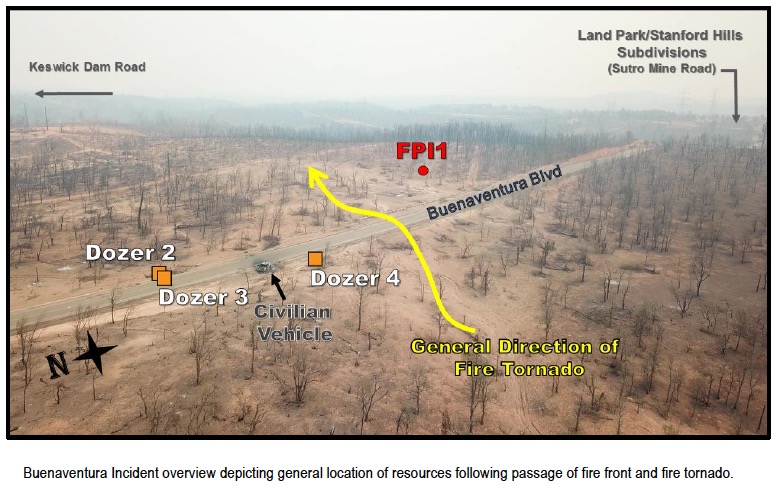
Dozer 4 became disoriented when impacted by the flying debris. As a result, the dozer hit a civilian vehicle that was stopped along Buenaventura Boulevard. The impact caused the dozer operator to land on the floor of his cab. The dozer continued to travel until it came to rest against a tree. Once stopped, the operator tried to drop the fire curtains. Due to burn injuries on his hands, he was unable to manipulate the straps, and had to cut the straps with a razor knife to deploy the curtains. He successfully dropped three out of the four curtains. The operator then deployed a fire shelter. In order to escape the intense heat, he exited the cab and sought refuge under the dozer, but saw a tree blocking his route. When the dozer operator reentered the cab, he saw emergency vehicle lights on Buenaventura Boulevard. He ran up to the vehicle where PREV1 directed him into the backseat. Once in the pickup truck, the dozer operator noticed there was also a civilian in the vehicle.
Prior to the rescue of the Dozer 4 operator, at approximately 8:01 p.m., PREV1 and SUP1 exited north on Buenaventura Boulevard from Land Park and Stanford Hills. SUP1 was now travelling back out of the subdivision with the evacuated family members.
Both PREV1 and SUP1 drove slowly, due to the heavy smoke conditions. Both vehicles were in close proximity to each other. As they approached the general area where the three dozers were stopped, PREV1 saw a civilian vehicle on fire. SUP1 passed PREV1 as he slowed to a stop. SUP1 continued north approximately 150 feet when both of their pickup trucks were suddenly impacted by flying debris, rocks and embers.
SUP1’s vehicle began to shake violently, and the passenger windows shattered. SUP1 ducked down to avoid being hit by flying debris and he momentarily drove off the road. SUP1 regained control of his vehicle, drove back onto the road, and exited the area to the north.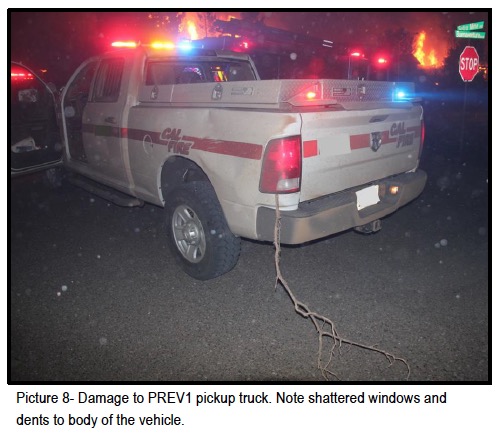
As PREV1 slowly approached the burning vehicle, he felt his pickup truck get “pushed” from the west. All the windows in his pickup truck except the windshield shattered. PREV1 took refuge in his vehicle. Approximately 30 seconds later PREV1 observed a male civilian attempting to get in his pickup truck. PREV1 directed the civilian to get in the back seat. Moments later, PREV1 saw a second individual (Dozer 4 operator) running toward him wrapped in a fire shelter. PREV1 directed the dozer operator into the back seat. PREV1 asked if they were injured. The dozer operator indicated that his hands were burned. PREV1 notified Redding ECC that he had a burn victim.
Helicopter crash, with injuries, starts fire, and rescuers are burned over
In addition to the personnel injured in the helicopter crash, two rescuers became victims
Continue readingTwo fire engines burned on the North Eden Fire in Utah
Two fire vehicles fighting the North Eden Wildfire were destroyed August 17 by wind-driven flames. A heavy engine from Woodruff Fire Department and a light engine from the State Division of Forestry Fire & State Lands responded to the fire’s west flank.
One engine experienced a mechanical problem and as both crews tried to make the vehicle mobile again flames quickly moved toward the scene cutting off their escape route. The group of three firefighters was forced to leave the vehicles and escape into the black. No injuries were reported.
Here’s a look at the trucks that have been burned by the #NorthEdenFire. https://t.co/251jH3rtM8 pic.twitter.com/irLsukDAj3
— KSL (@KSLcom) August 16, 2018
The 13,753-acre fire is burning in Utah, Idaho, and Wyoming.– a rare three-state fire.
Thanks and a tip of the hat go out to Tom.
Typos or errors, report them HERE.
Report released on dozer burnover in Florida
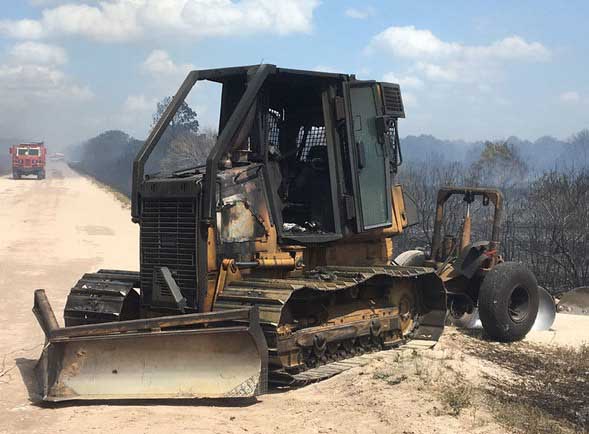
The Florida Forest Service has released a report on the burnover of a dozer that occurred April 16, 2017 in Okeechobee County. As you may remember from our April 17 article, the operator, who was not injured, became entrapped while constructing fire line with the tractor plow and was overrun by the fast-moving fire.
You can read the entire report HERE, but below are some excerpts:
****
Contributing Factors:
- Initial tactics deployed by the first arriving units were based on limited knowledge and experience.
- Incident Commander having minimal initial attack experience.
- Operating equipment beyond its capabilities
- Leaders intent, was not made clear.
- Ineffective transfer of command to experienced leadership positions.
- Loss of situational awareness with crews.
- Lack of effective communication.
- Minimal staffing in Communications Center during high fire danger.
Lessons to Share:
- It is imperative to speak up when you are feeling uneasy, uncomfortable, or unsure.
- Experienced firefighters should be mixed with those who are less experienced. This will necessitate a thorough briefing, ensure instructions are clear and understood and to keep firefighters from working alone when additional units are on scene.
- Personnel accountability is extremely important, especially in complex initial attack circumstances that often require unique tactics and strategies. This helps ensure safety of all crews.
- Operate equipment in appropriate speed settings (1.7-1.9). This will reduce equipment fatigue and failure.
- Turn off air-condition unit if caught in flame front or heavy embers. This will help reduce the likelihood of the filters and cab catching fire.
- Establish properly qualified and experienced leadership.
- Incident Commander should limit his/her hands-on fire suppression activities to maintain effective situational awareness.
- Limit radio traffic to the extent possible. This will improve the possibility that emergency traffic can be transmitted and received successfully.
- Increase staffing in Communications Center on high fire days to help with the additional call volume and radio traffic.
- Know and follow established policy and procedures for emergency radio traffic.
Thanks and a tip of the hat go out to Rob.
Typos or errors, report them HERE.
Dozer burns in Florida wildfire, operator unhurt
The Florida Forest Service reported that on Sunday a tractor plow was overrun by a fast-moving fire and was destroyed in Okeechobee County, near NW 144 Ave. and NW 286 Street, 13 miles southwest of Yeehaw Junction. The operator escaped and was not injured.
The fire eventually burned about 450 acres.

Report released on burnover of CAL FIRE engine
The California Department of Forestry and Fire Protection has released what they call a “Green Sheet”, a summary of the burnover of an engine that occurred as it was making a mobile attack on the Pacheco Fire, which eventually burned 341 acres in Calaveras County south of Valley Springs.
****
“SUMMARY
On July 12, 2016, a CAL FIRE Type 3 Model 34 engine (E1) attempted to start a mobile attack toward the head of a vegetation fire. Firefighters deployed two lines, but before they could anchor and start the mobile attack, the main fire and several spot fires converged on the fire engine. One firefighter took refuge in the engine, and one firefighter ran into the green. The engine sustained damage from the fire. Neither firefighter was injured.
CONDITIONS
- Weather: 89°, 21% relative humidity, winds 9 mph from the west and shifting, taken from the Campo Seco RAWS at 1400 hours.
- Fuel Type: Approximately two feet tall grass.
- Topography: Southeast aspect, rolling topography with multiple draws
- Fire Behavior: Sheeting, fire whirls, spotting
SEQUENCE OF EVENTS
On July 12, 2016, at approximately 1314 hours, CAL FIRE and local government resources were dispatched to a vegetation fire in the vicinity of Langford Pacheco Road and Milton Road in Calaveras County. The initial report on conditions given by the Air Attack at 1329 hours was 15 acres of grass woodland and spotting out in front of the main fire. At 1356 hours, the fire was reported to be 100 acres in size and spotting under the column.
A CAL FIRE engine (E1) arrived at scene at 1345 hours and was assigned Division R, the right flank of the fire. The crew met with a Battalion Chief (BC1) and came up with a plan to create an anchor point and start a mobile attack toward the head of the fire. A second CAL FIRE Engine (E2) and Dozer (D1) were just behind E1.
As E1 crossed through a gate to make access to the fire. E1 stopped in the green and deployed a one inch THY-600 Angus line manufactured by Rawhide Fire, with a 3/8 inch tip for the mobile attack and a reel line to pick up any spot fires. The Captain (FC1) on E1 saw the engine was between the main fire and multiple spot fires. Winds were shifting and the fire behavior was erratic so FC1 from E1 gave the order to pick up the lines so they could move to a better location. As the two firefighters (FF1 and FF2) began to roll up the hose, the main fire and spot fires converged and burned up to the engine. FF1 jumped into the engine while FF2 ran away from the engine into the green, losing his helmet. FC1 lost sight of FF2, and seeing only flames, announced on the tactical frequency that a fire fighter had been burned over. Engine E2 radioed to E1 that they were heading toward them. A large fire whirl was between E2 and E1.
Uninjured, FF2 looked back toward E1 from the green and saw the under carriage of the engine was on fire. FF2 contacted E1 on the radio and told them the engine was on fire. FF1 exited the cab and used the reel line to extinguish the fire under the engine.
Flame impingement caused the airlines above the frame rails to burst. When the air pressure dropped below 60 psi, FC1 was unable to release the spring brake. FF2 ran back to E1. A helicopter dropped water around E1 while D1 constructed line around a portion of E1 to protect the crew. FC1 notified the Incident Commander that all personnel were accounted for and in a good location.
There were no injuries. E1 sustained heat damage to the tires, fenders, lens covers, air brake lines and pump panel.

SAFETY ISSUES FOR REVIEW AND LESSONS LEARNED
STANDARD FIRE ORDERS
- Base all actions on current and expected fire behavior.
WATCH OUT SITUATIONS
- Wind increases and/or changes direction.
- Getting frequent spot fires across line.
LESSONS LEARNED
- Consider topographical features and fuels, no matter how minor, in relation to you and/or your vehicle’s location to anticipate fire behavior.
- Base actions on current fire situation and activity potential.
- Properly wear your PPE”