Video of 3,000-gallon drop from CH-47 Chinook

CH-47 Chinook 3,000-gallon water drop
CH-47 Chinook 3,000-gallon water drop November 17, 2020. Image from OCFA video.

A CH-47 Chinook Very Large Helitanker (VLHT) with night-flying capability operated by Coulson Aviation is working under an 83-day contract in collaboration with Southern California Edison (SCE) and the Orange County Fire Authority (OCFA).

Registered as N42CU, the Chinook is crewed 24/7 and available for responses day and night within the 15 counties served by SCE. The daily availability costs of $2.1 million for the contract period are being paid by SCE, while the hourly costs will be covered by the agencies responsible for the fire protection where the fires occur.

The Chinook is based at the Los Alamitos Joint Forces Training Base in Orange County. It can fill it’s 3,000-gallon internal tank while on the ground, or while hovering over a water or retardant source using its retractable snorkel hose.

To the best of our knowledge, here are the maximum capacities of firefighting helicopters, in gallons:

CH-47 Chinook   3,000
S-64 Air-Crane   2,650
S-70i Firehawk    1,000
CH-107   1,000
S-61    1,000
UH 60    900 or 1,000?
K-Max    700 or less
214-B    660
212    359
412EP    375

Chinook with water bucket fought a structure fire during Vietnam War

Chinook Vietnam 1970 fire water bucket
Chinook helicopter dropping water while fighting a structure fire in Vietnam in 1970. 213th Assault Support Helicopter Company.

Mike Brown, the Unit Historian for the 213th Assault Support Helicopter Company sent us some historical photos of Chinooks with water buckets fighting a massive structure fire in Vietnam. Taken January 20, 1971, the photos were in a 213th ASHC Alumni Association Photo Album maintained by Don Skipper. The file names for a few of the photos mention Saigon.

This ties in with information from Bambi Bucket about how a version of a helicopter water bucket was fabricated by the 213th ASHC in Vietnam in 1968 by then 33-year old Lieutenant Colonel Glenn Carr and others in the 213th in Phu Loi, about 15 miles north of Saigon.

Chinook Vietnam 1970 fire water bucket
Chinook helicopter dropping water while fighting a structure fire in Vietnam in 1970. 213th Assault Support Helicopter Company.
Chinook Vietnam 1970 fire water bucket
Chinook helicopter dipping water bucket while fighting a structure fire in Vietnam in 1970. 213th Assault Support Helicopter Company.
Chinook Vietnam 1970 fire water bucket
Chinook helicopter dipping water bucket while fighting a structure fire in Vietnam in 1970. 213th Assault Support Helicopter Company.
Chinook Vietnam 1970 fire water bucket
Chinook helicopter fighting a structure fire in Vietnam in 1970. 213th Assault Support Helicopter Company.
Chinook Vietnam 1970 fire water bucket
Chinook helicopter dropping water while fighting a structure fire in Vietnam in 1970. 213th Assault Support Helicopter Company.
Chinook Vietnam 1970 fire water bucket
Chinook helicopter dipping water bucket while fighting a structure fire in Vietnam in 1970. 213th Assault Support Helicopter Company.

Interview with Britt Coulson about their firefighting Chinooks and Blackhawks

Britt Coulson blackhawk helicopter
Britt Coulson with one of their recently acquired Blackhawks.

The Vice President of Coulson Aviation describes the new Chinook and Blackhawk program they are undertaking with Unical. He also updates us on the firefighting aircraft they have working in Australia during the 2018-2019 bushfire season. It was filmed at the HAI Heli-Expo in Atlanta, March 5, 2019.

If you are having trouble viewing the video, you can see it on YouTube.

National Guard helicopters assist with firefighting in California

2,000-gallon Bambi Bucket

Above: screenshot from the first video below.

California Air National Guard helicopters are assisting with the suppression of wildfires in the state.

The Bambi Bucket shown in this first video holds 2,000 gallons. I’m thinking it is used under a Chinook

In the video below you’ll see a 650-gallon Bambi Bucket, probably used with a Blackhawk.

Helicopter mechanic on top of Chinook struck by rotor

Chinook at RDD
File photo of a California National Guard Chinook at RDD in 2014.

The Wildland Fire Lessons Learned Center has published a report written by individuals in the Rocky Mountain Geographic Area about an incident that happened July 8, 2018 after a Chinook helicopter that had been dropping water on a fire landed to refuel. As the pilot was shutting down the engines an error code for engine #2 indicated a failure. This code pointed to a cannon plug issue, which was pulled, inspected, reinserted, and the error code cleared.

Here is an excerpt of what happened after the Pilot in Command shut down the engines:

…Two of the crew’s mechanics climbed on top of the aircraft to complete their tasks. These tasks include, but are not limited to, visually checking certain fluid levels within a five minute window for the most accurate readings. As the crew members were busy at work and focused on their assigned tasks, the PIC began going through the engine start-up process to see if the error code issue was completely resolved.

Upon hearing the engine spool up, the crew chief immediately wanted eyes on top of the aircraft, knowing that there might be crew personnel engaged on top. Two crew mechanics were indeed on top of the aircraft, aft of the front rotor. Hearing the engines spool up, several support personnel noticed these two mechanics and began yelling: “Get down! Get down!” As the engine was spooling up and the rotors began to turn, one of the mechanic crew members was struck in the head, impacting the side of this individual’s face/head and their safety helmet. The crewmember immediately went limp and slumped down.

The second crewmember was able to grab the struck mechanic in a bear hug to prevent them both from falling off the aircraft. Crewmember 2 stated that he “fundamentally supported and slid partway down the aircraft and then pushed off the fuel tank near the bottom.” He explained that this response was based on his military training. Crewmember 2, still supporting the injured mechanic, fell onto the pavement—both landing safely. At this point, the injured mechanic sat up, stunned. Simultaneously, the PIC heard the noise outside the aircraft and immediately initiated complete engine shut-down…

After being checked by a paramedic at the helibase, the injured crewmember was driven to a hospital by a company driver to be examined. The individual was treated and released from the hospital the same afternoon.

Following the accident and before any other flight operations continued, the crew had a “safety stand-down”. This provided the crew with an opportunity to establish a clear understanding of what happened, how operations will continue moving forward, and closure for anyone who may have been traumatically affected by the incident.

Discussions within the company after the incident centered on safety meetings, communications, and continuing the use of helmets.

Retardant from a helicopter’s internal tank

American Elk prescribed fire, Wind Cave National Park, photo by Bill Gabbert

These days it is not uncommon on a large fire to see a helicopter dropping retardant or a Chinook with an internal tank, or… both at the same time.

This photo of a Columbia Helicopters ship supporting a very large firing operation on the Thomas Fire was in a tweet by the Los Padres National Forest.

In July we posted the KEYT video below which originally was streamed live on YouTube, showing and explaining the activities at a facility set up at the Whittier Fire northwest of Goleta, California for mixing retardant for helicopters that could draft to refill their tanks. The 11-minute video did not show any ships with buckets — just Type 1 helicopters with internal or external tanks.

The video below shows several helicopters including the same Columbia Helicopters aircraft and the 747, supporting the Thomas Fire on December 13, 2017.

Helicopter mobilized from the showroom floor of convention

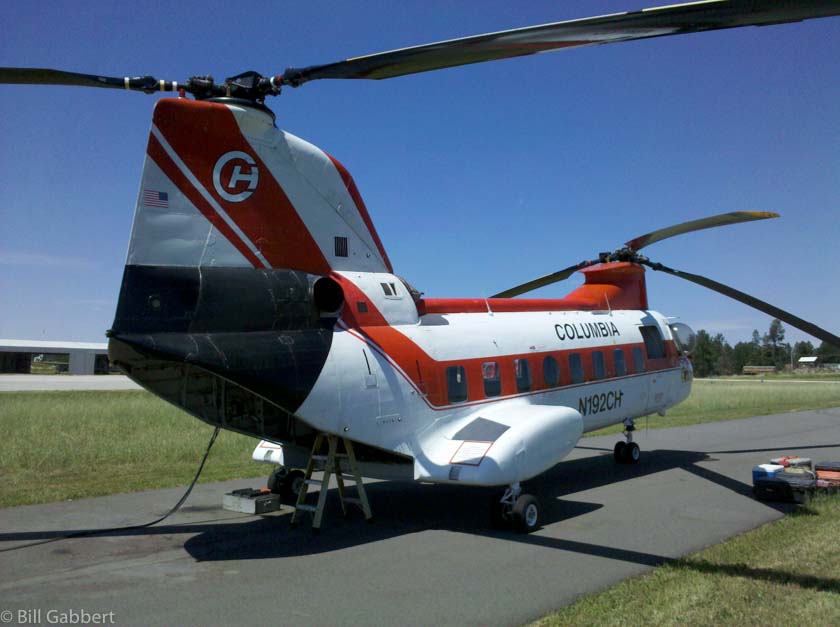
Columbia BV-107
File photo of a Columbia BV-107 at Custer, SD July 31, 2011. Photo by Bill Gabbert.
While some have said the National Interagency Fire Center responded slowly to the very busy wildfire activity that started March 6 in the central plains where about a million acres burned in a few days, eventually they did take action.

In an effort to mobilize a Type 1 helicopter they contacted Columbia Helicopters who had one on display at a helicopter convention.

 “This is the first time we have received a resource order for firefighting duty, while displaying our helicopter at a convention,” said Keith Saylor, Director, Commercial Operations, for the Portland, Oregon-based company.  Reached by phone at the Helicopter Association International (HAI) convention in Dallas, Saylor explained that transitioning the helicopter, from a static display to a mission-ready firefighting aircraft, involved removing the rotor blades, exiting the convention center, then reinstalling the rotor blades.  This was followed by a flight to a nearby airport for refueling and overnighting.  Called up on March 9, the helicopter was deployed the following day to Ardmore, Oklahoma, under an optional use clause of a US Forest Service (USFS) exclusive use contract.  The helicopter was dispatched with two pilots, five mechanics and ground support equipment drivers.

A former US Army-operated CH47D Chinook, the helicopter was modified by Columbia Helicopters with a 2,800 gallon capacity internal tank for water, jells, foam, or retardant dropping, and had been flown to the convention following firefighting duty on East Coast fires.

Also responding to the fires, Neptune Aviation Services dispatched three of its BAe-146 air tankers to multiple locations, according to Dan Snyder, Chief Operating Officer for the Missoula, Montana-headquartered company.  Three of the tankers were dispatched from Missoula between March 9 and 11, and flown to USFS tanker bases in Ardmore, Oklahoma, Abilene, Texas, and the Rocky Mountain Regional Airport, near Denver, Colorado.  A fourth BAe 146 tanker will continue to fly out of a base at Lake City, Florida, where it has been on duty since February 20.

On March 16 Neptune mobilized T-05, the first of their P2V piston engine tankers to start an assignment this year, which will probably be the model’s last season as the company completes their transition to the jet-powered BAe-146 airframe.