Forest Service confirms firefighters swam to extract pilots from helicopter that crashed into river

N388RZ Boeing CH-47D crash
N388RA Boeing CH-47D preparing to take off at Penticton Airport in British Columbia July 16, 2022. Image from VMC Aviation Videos. The helicopter crashed into the Salmon River July 21, 2022.

Today the US Forest Service confirmed reports that when the Boeing CH-47D helicopter crashed into the Salmon River July 21, 2022 while working on the Moose Fire in Idaho, firefighters swam across the river to extract and care for the two pilots. Unfortunately, both of the pilots died from their injuries.

Four teams from the FS are investigating the incident. In addition, the agency is providing Critical Incident Stress Management (CISM), clinician, and peer support to affected individuals. The National Transportation Safety Board is conducting an investigation to determine the cause of the crash.

The official “72-Hour Report” is below.

[pdf-embedder url=”https://fireaviation.com/wp-content/uploads/2022/07/USFS-72-Hour-Report_Moose_2022_Final_072822-copy.pdf” title=”USFS 72 Hour Report Moose fire helicopter crash”]

Brief initial report released about the Chinook crash into Salmon River

N388RZ Boeing CH-47D crash
N388RA Boeing CH-47D at Penticton Airport in British Columbia July 16, 2022. Image from VMC Aviation Videos. It had stopped for fuel on the way from Alaska to Idaho.

The US Forest Service has released a brief initial report about the July 21 crash of the Boeing CH-47D helicopter in the Salmon River while working on the Moose Fire 20 air miles northwest of Salmon, Idaho. The two pilots were killed.

Below is the complete text of the narrative section of the document which was dated July 22, 2022, but was not posted on the Wildland Fire Lessons Learned site until today around noon.

On Thursday, July 21, a call when needed CH-47D Series Chinook Helicopter crashed into the Salmon River, adjacent to the Indianola Work Center approximately 11 miles west of North Fork, Idaho on the Moose Fire. The aircraft sustained severe damage, the pilots were extracted and transported to hospitals but both sustained fatal injuries. The NTSB has been notified and will be conducting an accident investigation. The USDA Forest Service has assigned a learning review team.

The pilots, the only personnel on board, were Thomas Hayes, 41, of Post Falls, Idaho, and Jared Bird, 36, of Anchorage, Alaska.

The helicopter was operated by Anchorage-based ROTAK Helicopter Services.

The FAA confirms that the registration number of the helicopter is N388RA, which is one of two CH-47D ships ROTAK recently purchased from Columbia Helicopters.

where the CH-47 crashed July 21, 2022
The general area where the CH-47D crashed July 21, 2022. Google Earth. The red shading represents the approximate area Moose Fire, but the portion of the fire at the bottom of the image is cut off.

There are unconfirmed reports that a hotshot crew was nearby when it crashed and they went into the Salmon River and extricated the pilots in an attempt to save them.

The last time Flight Aware tracked N388FA was at 3:02 p.m. MDT July 21. Because of the rugged terrain, it first showed it north of the Salmon Airport. Then it went northwest generally toward the Moose Fire and lost tracking at 3:12 p.m. before it reached the river.

As an example of the terrain here is a photo of the Comet Fire I took a few years ago from Highway 93 just east of the current Moose Fire, 13 air miles north of Salmon, ID. The Salmon River is in the foreground.

Comet Fire, July 28, 2016
Comet Fire, July 28, 2016. Photo by Bill Gabbert.

The video below was shot at Penticton Airport in British Columbia July 16, 2022 when it stopped for fuel en route from Alaska to Idaho.

The GoFundMe fundraisers for the two pilots can be found through the following links:
https://www.gofundme.com/f/support-jared-birds-family-moose-fire-crash

https://www.gofundme.com/f/thomas-tommy-hayes-moose-fire-crash

Chinook helicopter working on Moose Fire crashes into river in Idaho

ROTAK Helicopter Services

Updated 3:54 p.m. MDT July 22, 2022

Both pilots of a firefighting helicopter that crashed in Idaho have died, the U.S. Forest Service said on Friday.

Mary Cernicek with the Salmon-Challis National Forest said Thomas Hayes, 41, of Post Falls, Idaho, and Jared Bird, 36, of Anchorage, Alaska, died from injuries they sustained when their CH-47D Series Chinook crashed in the Salmon River about 3:30 p.m. Thursday.

The pilots were employees of the Anchorage-based ROTAK Helicopter Services and were working on the Moose Fire northwest of Salmon, Idaho.

We send out our sincere condolences to the families, friends, and co-workers of the two men.


12:05 a.m. MDT July 22, 2022

A CH-47D Chinook helicopter operated by ROTAK Helicopter Services crashed into the Salmon River Thursday July 21 while working on the Moose Fire northwest of Salmon, Idaho.

The company released a brief statement Thursday.

It is with heavy hearts that we confirm that on July 21, 2022, at approximately 3:30 p.m. a CH-47D series “Chinook” helicopter operated by ROTAK Helicopter Service with two pilots on board was involved in an accident near Salmon, Idaho. Emergency medical teams are responding to the scene. ROTAK is working closely with all appropriate agencies and will issue a full statement as information is confirmed.

A spokeswoman with the U.S. Forest Service said an incident management team is handling the crash but further details were not released, including the condition of the pilots.

A few weeks ago ROTAK purchased two former US Army CH-47D Chinooks from Oregon’s Columbia Helicopters for use in firefighting and line maintenance. ROTAK also operates K-MAX helicopters

The Moose Fire has burned more than 20,000 acres in the Salmon-Challis National Forest 12 air miles northwest of Salmon, Idaho. It is burning in steep terrain on both sides of the Salmon River west of North Fork and Highway 93.

Moose Fire map
Moose Fire map, 3-D, looking east at 9:56 p.m. July 20, 2022.

Thanks and a tip of the hat go out to Tom and Gerald.

Video of 3,000-gallon drop from CH-47 Chinook

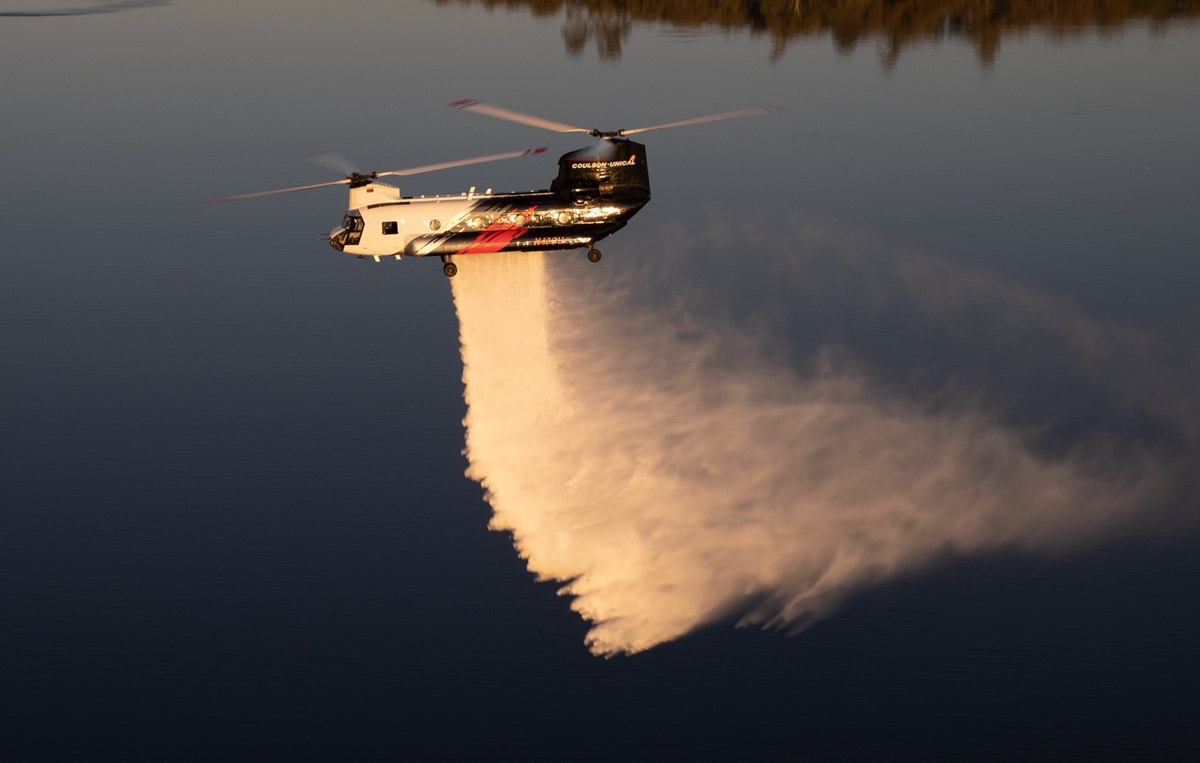
CH-47 Chinook 3,000-gallon water drop
CH-47 Chinook 3,000-gallon water drop November 17, 2020. Image from OCFA video.

A CH-47 Chinook Very Large Helitanker (VLHT) with night-flying capability operated by Coulson Aviation is working under an 83-day contract in collaboration with Southern California Edison (SCE) and the Orange County Fire Authority (OCFA).

Registered as N42CU, the Chinook is crewed 24/7 and available for responses day and night within the 15 counties served by SCE. The daily availability costs of $2.1 million for the contract period are being paid by SCE, while the hourly costs will be covered by the agencies responsible for the fire protection where the fires occur.

The Chinook is based at the Los Alamitos Joint Forces Training Base in Orange County. It can fill it’s 3,000-gallon internal tank while on the ground, or while hovering over a water or retardant source using its retractable snorkel hose.

To the best of our knowledge, here are the maximum capacities of firefighting helicopters, in gallons:

CH-47 Chinook   3,000
S-64 Air-Crane   2,650
S-70i Firehawk    1,000
CH-107   1,000
S-61    1,000
UH 60    900 or 1,000?
K-Max    700 or less
214-B    660
212    359
412EP    375

Night-flying Chinook begins fire contract in Orange County, California

October 2, 2020 | 3:12 p.m. PDT

N42CU Coulson CH-47 Chinook helicopter
Coulson’s CH-47 Chinook N42CU. Coulson photo.

A 3,000-gallon night-flying firefighting helicopter is available starting today October 1 in Southern California.

The CH-47 Chinook Very Large Helitanker (VLHT) operated by Coulson Aviation is working under an 83-day contract in collaboration with Southern California Edison (SCE) and the Orange County Fire Authority (OCFA).

Registered as N42CU, the night-flying Chinook will be crewed 24/7 and available for responses day and night within the 15 counties served by SCE. The daily availability costs of $2.1 million for the contract period are being paid by SCE, while the hourly costs will be covered by the agencies responsible for the fire protection where the fires occur.

The Chinook will be based at the Los Alamitos Joint Forces Training Base in Orange County. It can fill it’s 3,000-gallon internal tank while on the ground, or while hovering over a water or retardant source using its retractable snorkel hose.

As a comparison, the two Orange County Fire Authority Bell 412EP helicopters are capable of dropping up to 375-gallons. Water capacities of other helicopters: Bell 214B, 660 gallons;  K-MAX, 700 gallons; FireHawk S-70i, 1,000 gallons; and S-64 Skycrane, 2,650 gallons.

RADS tank N42CU Coulson CH-47 Chinook helicopter
The RADS internal 3,000-gallon tank in Coulson’s CH-47 Chinook, N42CU. Coulson photo.

In 2019 the OCFA also had an arrangement with SCE for a 24/7 night flying helicopter. In that case Coulson supplied an S-61 capable of 1,000 gallons and, a Sikorsky S-76 to provide intelligence, evaluate effectiveness, and identify targets with a laser designator. This year the contract is just for one helicopter, the CH-47 Chinook.

N42CU Coulson CH-47 Chinook helicopter
Coulson’s CH-47 Chinook N42CU. Coulson photo.

Coulson’s ground-based fleet

Coulson Ground Fleet vehicles helicopters CH-47 fire
Coulson Aviation’s maintenance support vehicles and fuel trucks for their CH-47 helicopters. Coulson photo.

Coulson Aviation posted these photos and text on their Facebook page:

Prior to dispatching out the second half of our Rotary Wing fleet this year we took one afternoon to do a photoshoot with N49CU and the rolling stock. Each CH-47 module consists of a brand-new fuel truck that was custom built to our specifications along with a 53’ ex-Nascar truck/trailer combination as a maintenance support vehicle. Great job to the fleet ops team for getting all this built up in time to go on contract!

Coulson Aviation’s maintenance support vehicles for their CH-47 helicopters. Coulson photo.
Coulson Aviation’s fuel trucks for their CH-47 helicopters. Coulson photo.