Canadian fire pilot loves his work

After 21 years as a fire pilot, Williams Lake’s Guy Ridler still enjoys his job flying an airtanker. Besides the obvious benefit supporting firefighters on the ground, he says he enjoys the constant variety that aerial firefighting entails.

“No fire is the same,” he recently told Ruth Lloyd with the Williams Lake Tribune. With changing geography, winds, fuel types, and fire activity, he says it is always a challenge to put retardant where the client wants it — and do it safely.

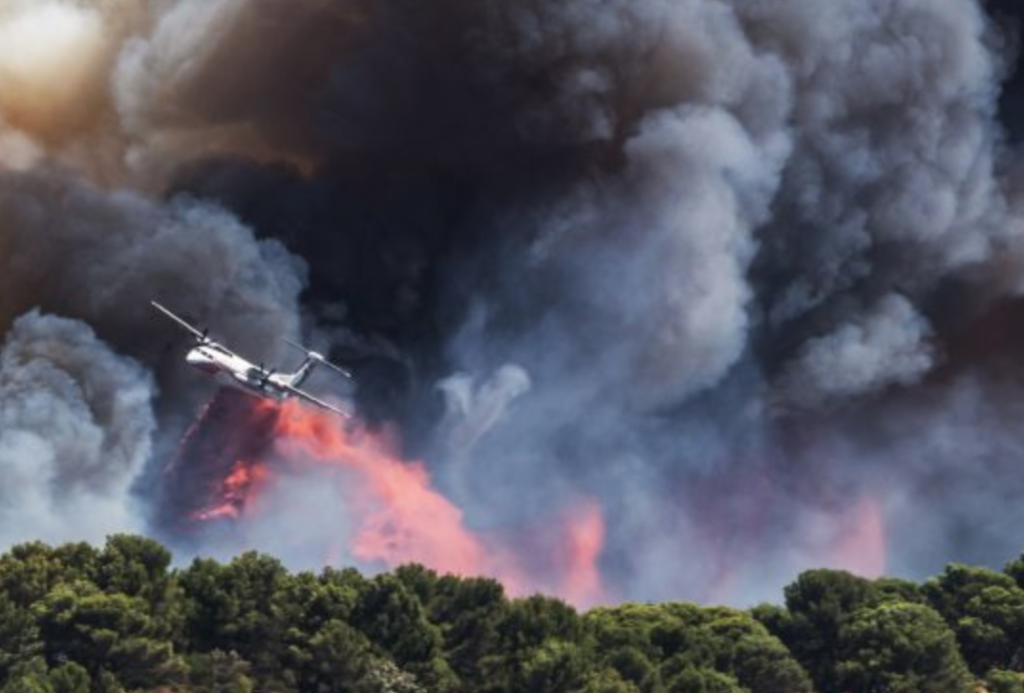
2020 photo by BC Wildfire Service
2020 photo by B.C. Wildfire Service

How did he end up where he is, an aerial firefighter who spends his time off in the Cariboo region of British Columbia?

When Guy Ridler was just a young boy, he flew with his parents to Ontario from Newfoundland to visit family. It was his first flight — and he loved it. When he spotted a uniformed pilot in the airport, he approached the “grizzled” pilot and asked him,  “How do I get your job?”

The pilot replied with a question of his own. “Well kid, do your parents have a lot of money?”

When Guy said no, the pilot told him, “Then join the Air Force.”

Years later when he was applying to universities, with grades good enough to go anywhere he chose, a teenage Guy applied and was accepted to the Canadian Armed Forces and a spot at Royal Roads Military College near Victoria, B.C.

But he also had his heart set on competing in the Canada Summer Games that year as a cyclist on Team Newfoundland, and the military would not grant him leave to attend. Against the advice of his advisor, Guy turned down his spot at Royal Roads to compete in the Summer Games and instead attend Memorial University of Newfoundland (MUN) for one year, planning to reapply for the military the following year.

He was accepted at MUN, and all these years later, he says his military college experience was very different from what he’d experienced at MUN, and despite the challenges, he considered it  a job he had to do to get the education and training he wanted.

After completing military pilot’s training — and obtaining a degree in physics — Ridler graduated and landed a job at the Comox Air Force Base, where he flew a Buffalo for the Search and Rescue team. He flew to airshows all over the continent to drop parachutists and also flew them on SAR missions on Canada’s coast.

After his 11 years of required military service, he left for commercial flying. Ridler was hired on as a copilot on a Conair DC-6, and his captain told him, “You are no longer a pilot, you are now a museum curator,” given that the now-retired DC-6 tankers were first built in the 1940s.

Conair DC-6
The Convair replaced the DC-6 and Grumman S-2 Tracker airtankers and now the modern Dash 8-400 airtanker replaces the Convair, bringing with it speed, advanced avionics, fuel efficiency, and tactical flexibility.

He says the job is 100 percent operational — it’s all about safety and a focus on hazards, to be as effective and as safe as possible — for the airtanker, the crew, and those on the ground. And it’s all VFR. “People think it’s some big high-tech operation,” he says. “But in the end, it’s a lot of experience, on-the-job experience.”

Over the years, Ridler has worked alongside forestry agencies in Alaska, Alberta, British Columbia, Washington state, and even Australia. He’s flown not only airtankers but also birddogs — referred to as lead planes in the U.S.

In 2004 he moved to Williams Lake for his first year as a copilot flying a Convair. He later become a captain, which sent him to Alaska for a number of seasons, but returned to Williams Lake seven years later as the captain of the birddog aircraft.

Conair RJ85
Conair RJ85

He thinks the smaller and more maneuverable birddog, which carries the air attack officer, is the best way to learn the job. He completed training as a pilot on the 4-engine RJ85 jet airtanker, and began spending his summers based in Kamloops, then moved back to Williams Lake in 2020.


Williams Lake is a city in the Central Interior of British Columbia, in the central part of a region known as the Cariboo. The feature on Guy Ridler was written by Ruth Lloyd with the Williams Lake Tribune and is highly recommended.  There’s also a PDF file posted [HERE] that details the Convair’s celebrated history of aerial firefighting with Conair in Canadian Aviator Magazine.
British Columbia’s world-class fleet

The British Columbia Wildfire Service and its six regional fire centers coordinate the province’s wildfire suppression efforts in Canada’s southwestern province using strategies the service has developed over its 121-year history. One of its key strategies is an aviation fleet and program that makes the U.S. look like amateurs by comparison.

Western Canada forests are dense and often inaccessible from the ground, so the province relies heavily on its aerial firefighting program to keep fires from burning into huge mega-fires. The job of conducting aerial attacks has become more challenging in recent years due to hotter weather, lower humidity, longer and smokier fire seasons, and an ever-present load of fuels to feed fires. A recent report by the Prince George Citizen helps explain what Michael Benson knows from experience.


Before he joined Conair Aerial Firefighting this spring as the company’s director of business development, Michael Benson spent 17 years flying with the B.C. Wildfire Service as an air attack officer. For seven of those years he led the provincial airtanker program.

“From my perspective, British Columbia has the most advanced airtanker program in the world,” Benson declares, “and the power of the fleet is immense.”

From his base in Abbotsford, he explains that B.C. has a lot of planes and a lot of speed. “It’s quite an amazing fleet. Most people in B.C. just don’t know how fortunate we are to have such a mighty fleet and a competent wildfire agency managing the fleet.”

Conair Aerial Firefighting has 70 firefighting aircraft, 29 of which are based in B.C. alone. It is the world’s largest privately owned fixed-wing aerial firefighting fleet, operating in Canada, the U.S., Australia, and France.

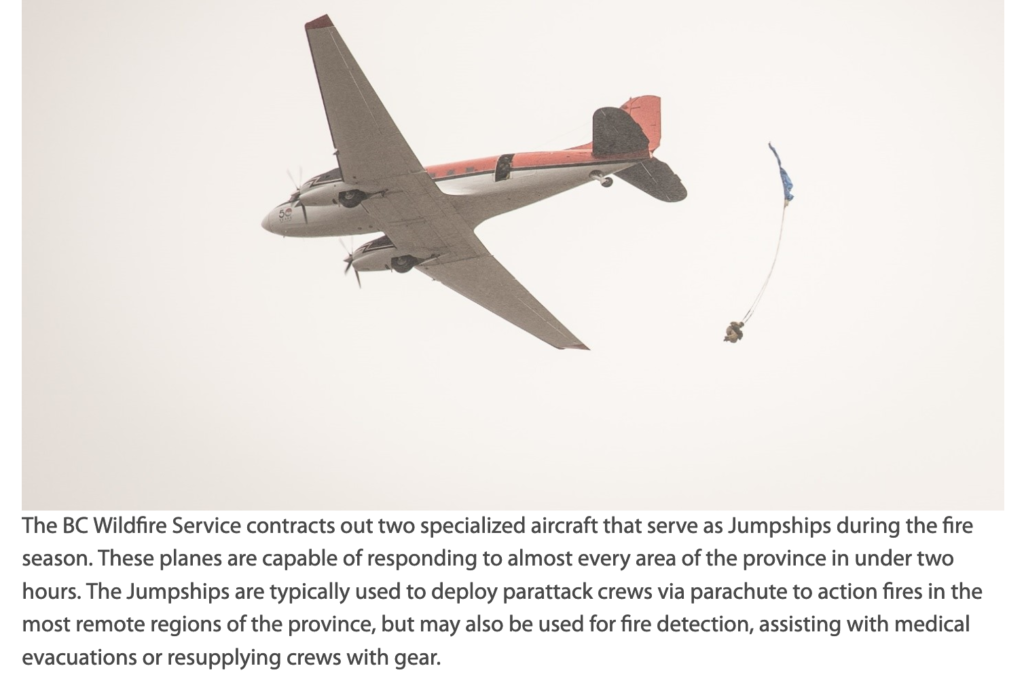
Parattack jump ship

Benson says other provinces are having to catch up to B.C.’s firefighting equipment and labor force capacity. Fire season started earlier this year in Alberta, Saskatchewan, Ontario, Quebec, and Nova Scotia — and more countries are facing similar wildfire battles brought on by climate change.

“One of the characteristics of this year is it wasn’t just B.C. that was busy; much of Canada was busy at the same time, and that creates some real challenges in that resources are shared across Canada,” said Benson. “Because the demand was so high nationally, it was difficult for any agency to free up their resources and help another agency. We have been lucky that in the USA it’s been an unusually slow season for them, so there has been some added capacity for them to come up to Canada.”

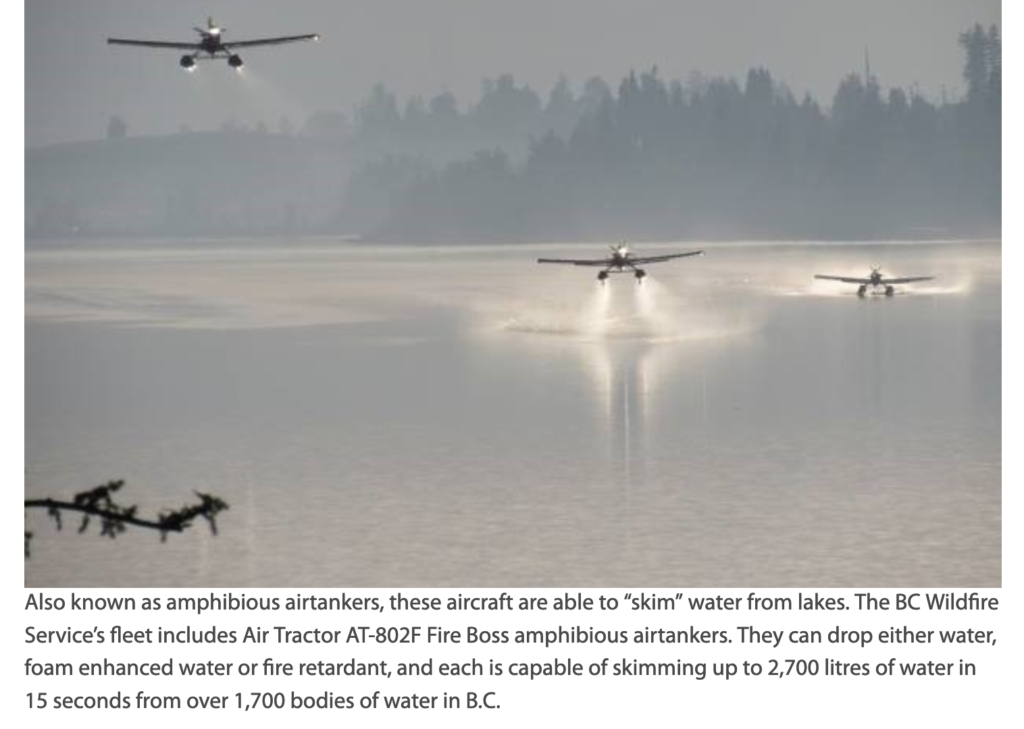
Five of the most destructive fire seasons ever in B.C. occurred during the past 10 years. Amphibious waterbombers that scoop from lakes or rivers are now often used alongside land-based tankers loaded with retardant — one of several adaptations B.C. has made in its fire aviation program. The scoopers fly over the fire to dump water and foam directly while the airtankers skirt the perimeter with retardant. Once those firelines are complete, the land-based tanker is free to go to another fire, while the waterbombers continue to dump water to cool the fire for ground crews.

Prince George is the base for five Conair aircraft for part of the season — a Cessna 208 Grand Caravan birddog that’s used to coordinate aerial attacks and provide air traffic control, plus four Air Tractor AT-802AF Fire Boss waterbombers. Benson says they work well together and it’s not uncommon to get 10 or 12 aircraft on one fire.

Fire Boss trio

“For me, I think it’s the coolest job out there,” he says. “Working for an airtanker program you can effect change in a short period of time because the power of the fleet is incredible. The capability to have 15 or 20 airplanes on your fire in a short period of time gives you the chance to contain the fire and buy time for the hard-working ground firefighters to arrive and actually extinguish the fire.”

Conair Dash 8
Conair Dash 8

At its base in Abbotsford, Conair takes De Havilland Dash 8-400 twin-engine turboprops — commonly used for passenger flights — and in 75 days converts them into airtankers that can deliver 10,000-litre payloads — about 2650 gallons.

They offer more than double the fuel efficiency of other more traditional large tankers, and the loaded cruising speed for a Dash 8 is 360 knots (well over 400 mph), faster than most jets over short distances. First introduced as an airtanker in 2020 in Australia, there are now 19 Dash 8-400s flying firefighting missions around the world. Eight are owned and operated by France — built in Canada by Conair — with the rest operating in Conair’s fleet, four of which are on contract in B.C. this fire season.

Check out these videos on Vimeo:
Conair’s Tactics and Training Centre
Conair’s Changing Tactics
Conair’s Dash 8-400 Airtanker

Firefighters stop the Elmore Fire in Anchorage, Alaska

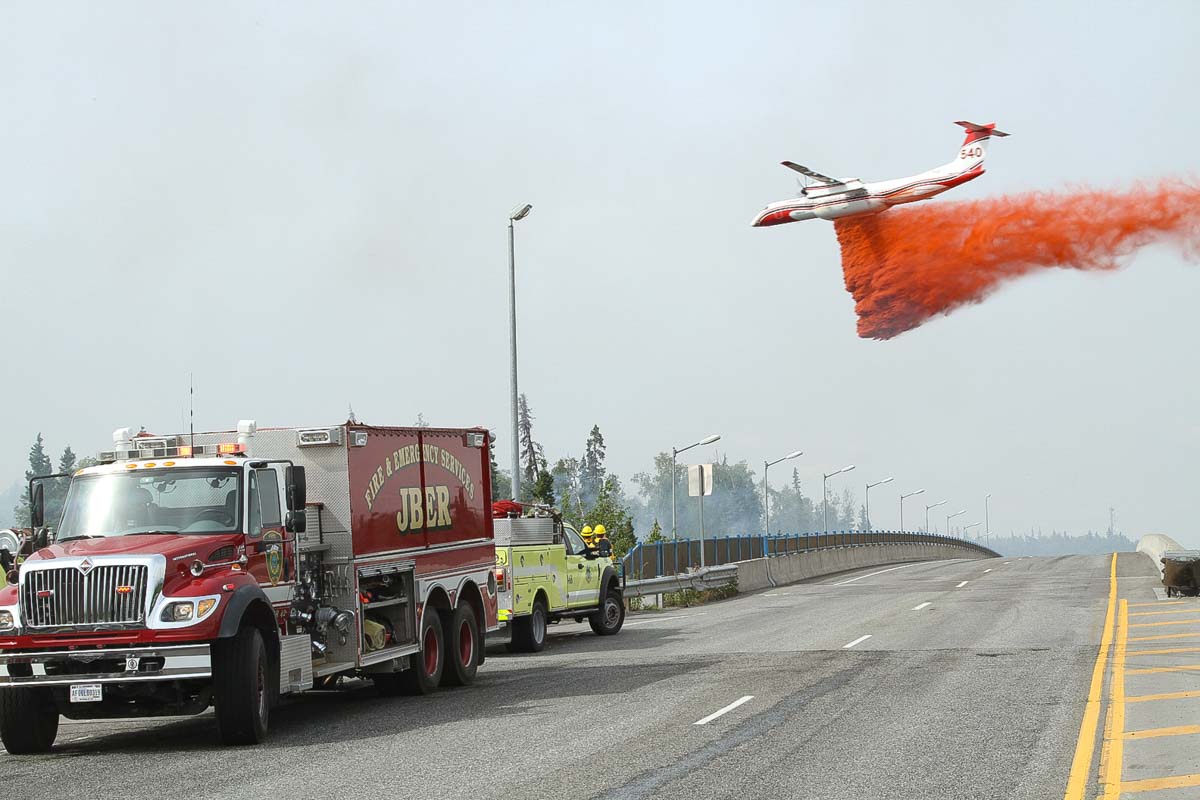
 Q400 air tanker drops Elmore Fire Anchorage, Alaska
A Q400 air tanker, Tanker 540, drops on the Elmore Fire near Anchorage, Alaska June 23, 2022. Mike McMillan/ AK DOF.

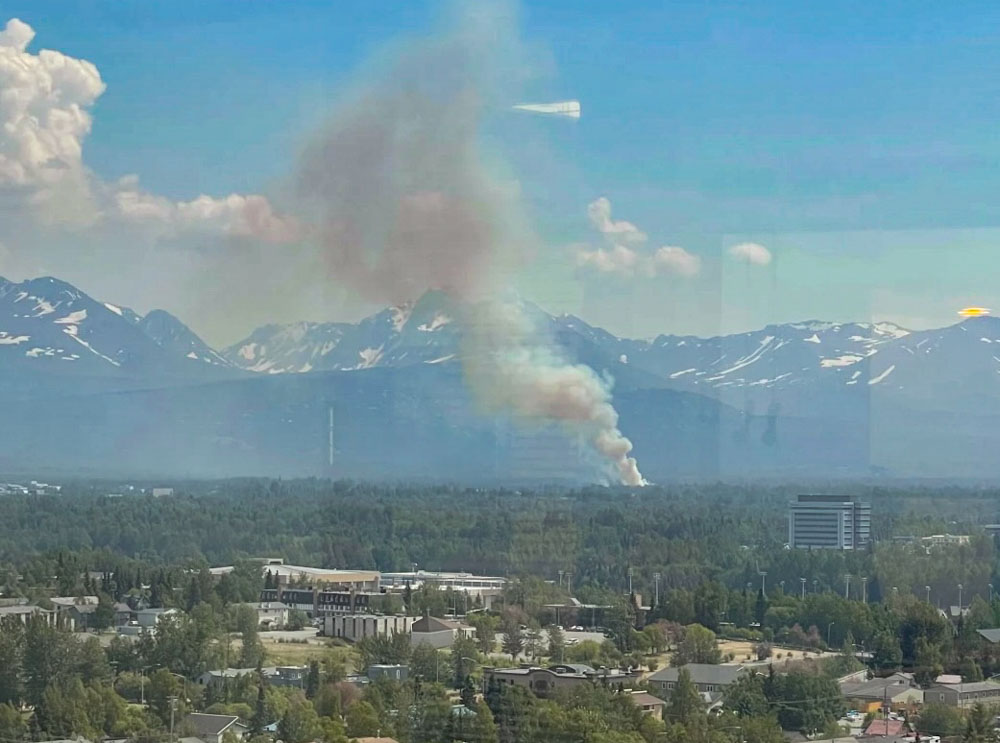
Firefighters in Alaska were able to stop the spread of the Elmore Fire on the east side of Anchorage Thursday at 13 acres before it spread into structures. It was reported at 5 p.m. in the Campbell Track area near the intersection of Dowling and Elmore Roads.

Elmore Fire, Anchorage, AK June 23, 2022
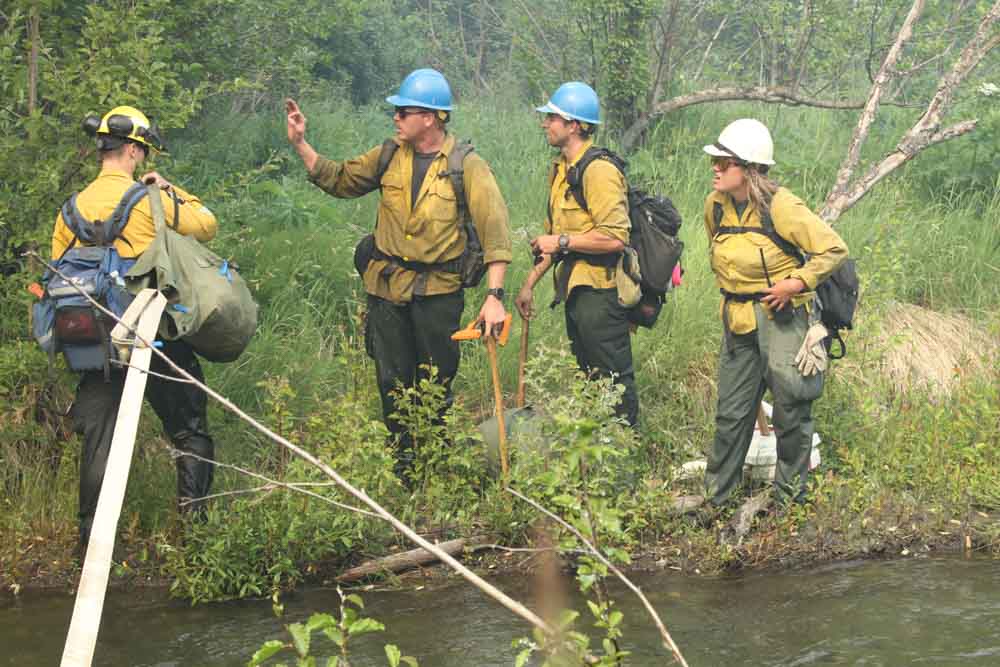
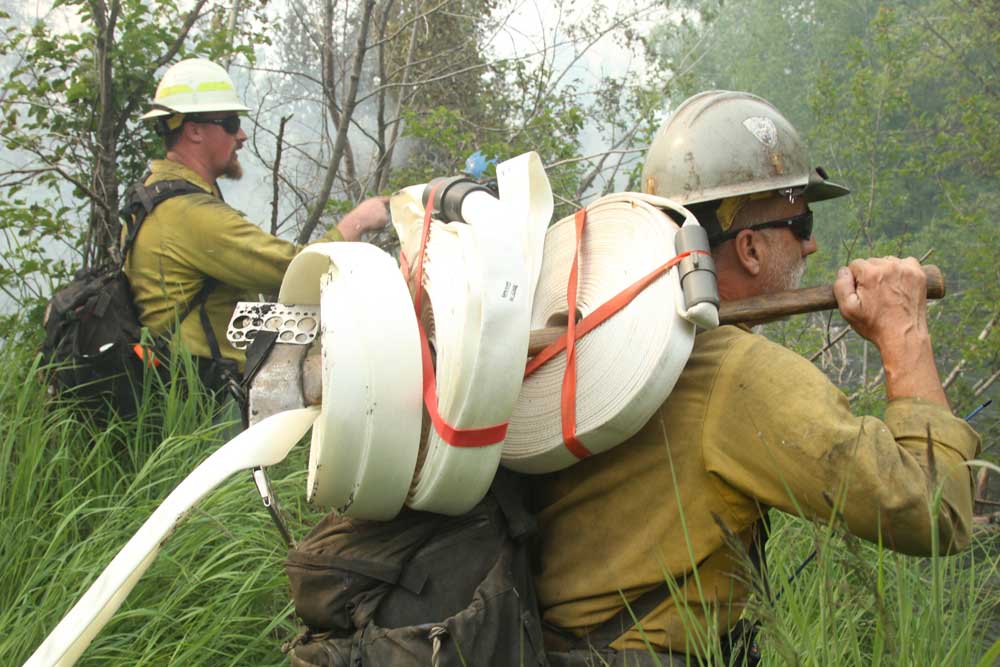
Alaska Dept. of Forestry firefighters on the Elmore Fire, Anchorage, AK June 23, 2022. Mike McMillan-Alaska DOF.

Personnel responded from the Pioneer Interagency Hotshot Crew, Palmer forestry, Joint Base Elmendorf-Richardson, Anchorage Fire Department, and Alaska Division of Forestry (DOF). A group of Canadian firefighters staged in the area with the DOF through the use of the Northwest Compact were also on scene.

Elmore Fire, Anchorage, AK June 23, 2022
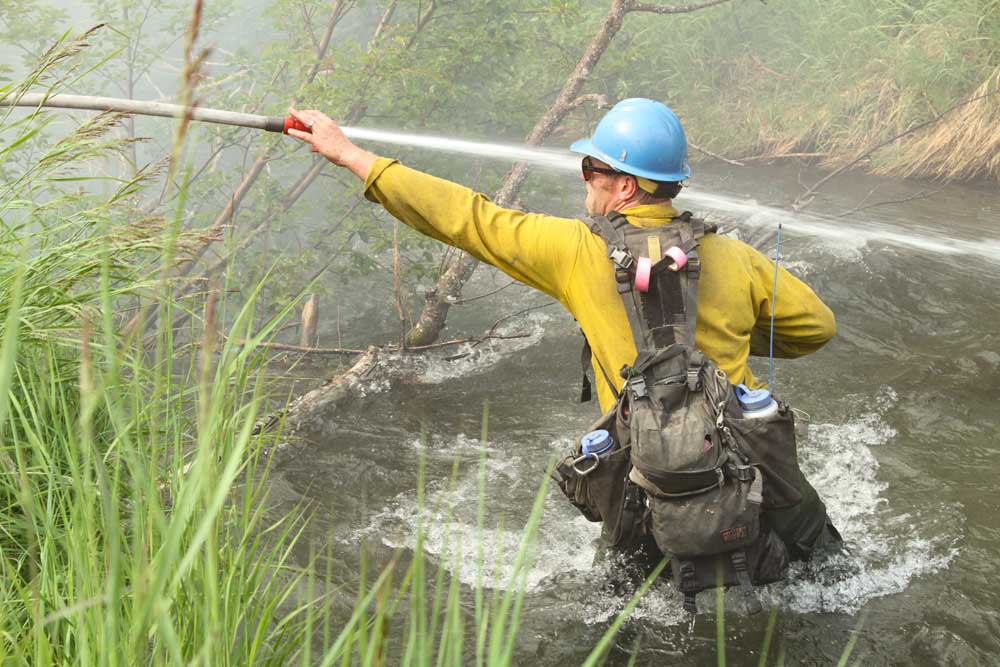
Alaska Dept. of Forestry firefighter on the Elmore Fire, Anchorage, AK June 23, 2022. Mike McMillan-Alaska DOF.

The firefighters were assisted by one DOF helicopter and two fixed wing air tankers operated by Conair, a Q400 and a Convair 580. The Q400, Tanker 540, is seen above.

Elmore Fire, Anchorage, AK June 23, 2022
Elmore Fire, Anchorage, AK June 23, 2022. Brent Goodrum-Alaska Div. or Forestry

The DOF has a contract with Conair to supply two Convair 580 air tankers, but the company has the option to substitute one of their Q400 tankers for a 580 at the same price. One of the tankers is usually based at Palmer and the other at Fairbanks.

Elmore Fire, Anchorage, AK June 23, 2022
Alaska Dept. of Forestry firefighters on the Elmore Fire, Anchorage, AK June 23, 2022. Mike McMillan-Alaska DOF.

In 2021 Conair purchased 11 Q400 aircraft from Flybe Airlines. The first one was delivered at Conair facilities in Abbotsford, British Columbia, February 21, 2021. After being converted to air tankers, called A400ATs (Air Tanker), they will eventually replace the L-188’s and CV-580’s currently operated by Conair. Showcasing a Q400 in Alaska can increase the familiarity of the tanker among Conair’s potential clients.

The repurposed Q400s are capable of holding up to 2,640 gallons of retardant. The CV-580s were produced between 1947 and 1954 and can carry up to 2,100 gallons. The Q400 cruises about 50 mph faster than a CV-580.

Before purchasing the 11 Q400’s from Flybe, Conair had two A400ATs operational within their fleet that were used in 2021 for the first time in the North American fire season, including Alaska. They also had one under contract in Australia during the 2020-2021 bushfire season.

In 2017 the Conair Group secured a deal to sell six Q400MR (Multi-Role) air tankers to France’s Securite Civile (Department of Civil Defense and Emergency Preparedness). These were new aircraft that Conair purchased from Bombardier which can be reconfigured in a few hours to carry passengers, hence the Multi-Role designation. The new aircraft are replacing France’s old S-2 air tankers.

Maintenance of Q400AT and RJ85 air tankers

RJ85
Conair RJ85, Bomber 391

These photos show Conair Q400AT and RJ85 air tankers undergoing maintenance.

The aircraft undergo meticulous inspections to locate and repair the wear and tear that inevitably results from aerial firefighting. A pro-active, thorough evaluation of each aircraft, along with expert maintenance and professional cleaning, can take several weeks depending on the size and complexity of the aircraft type.

RJ85
Conair RJ85

Q400AT air tanker
Conair Q400AT

The photos are used with permission from the “RJ85 and Q400 Airtankers” Facebook page.